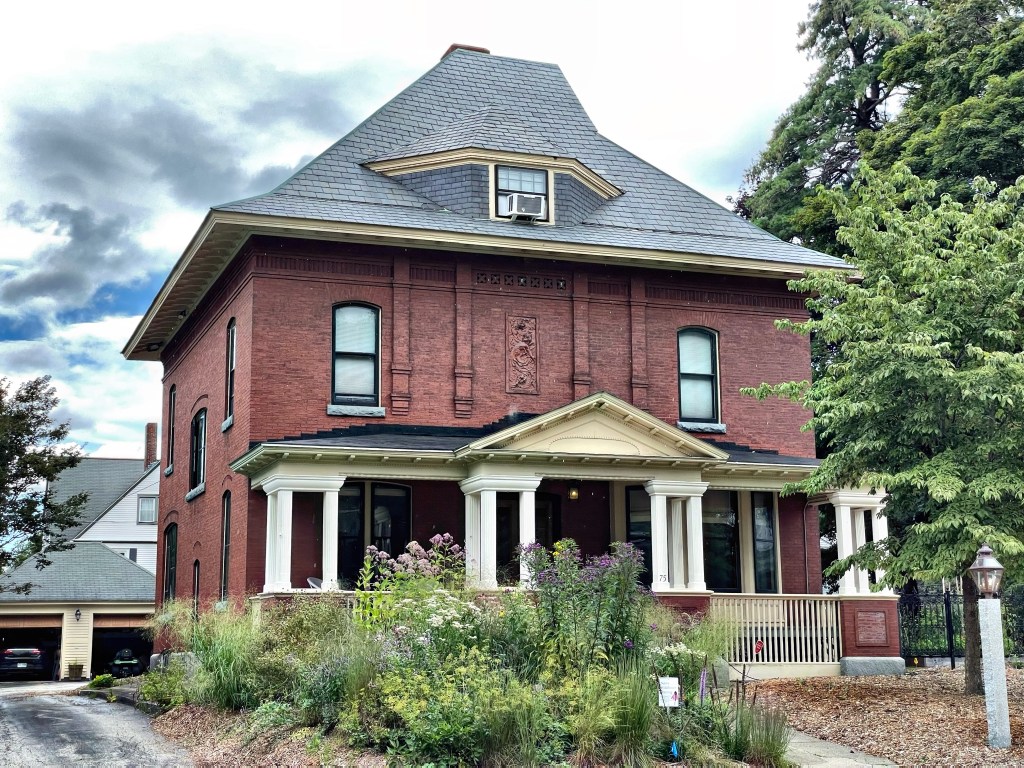
Yet another of Nashua’s fine estates on Concord Street is the George French House, a more academic example of the Queen Anne style of architecture. The French House was built in 1890 for George Barstow French (1846-1933), an attorney in town. I really wish I could find more on the architect, as this seems to be a more academic example of the style with bold material choice of brick construction with brownstone and terracotta trim and detailing. The hipped roof with flared eaves and brick pilaster detailing on the second floor add a lot to the design and are not common! Does anyone know more?
The John Reed House at 37 Orange Street in Nashua, New Hampshire is a testament that houses can be updated over time with thoughtful renovations, and still be pretty darn amazing! The house was originally constructed in 1840 in the then-popular Greek Revival architecture style. Within a decade, to ‘keep up with the Jones”, the house was “modernized” with Italianate style detailing, including the brackets at the eaves and the large, square cupola with round arched windows and shutters. Decades, later, Queen Anne/Colonial Revival changes were made, with the full-length front porch with turned, fluted posts, enlarged windows, and an oversized front door. The house today blends these very different styles very well and adds to the house’s significance.
Thought to be the oldest extant residential building in Nashua, New Hampshire, the Killicut House is an important piece of local history of the early settlement days of the city. The exact date of construction of the Killicut House is not known, with local legend stating that the house was built between 1680 and 1700 with other estimates dating the house slightly later, to 1740. It was known for years as the “1700 House”. Regardless, this is one of only two 18th century houses remaining in Nashua. The first known owner of the house was Thomas Killicut (1723-1784) who resided in present-day Nashua by 1746 when he was chosen to hold the position of field driver for the newly established town of Dunstable, New Hampshire (an extension from Dunstable, Massachusetts). Killicut served as one of “Rogers Rangers” in the French and Indian War. During the early to mid 19th century, the Killicut House apparently passed onto members of the Blodgett family who were apparently related to the Killicuts as up until the 1960s, the house was still reportedly owned by descendants of Thomas Killicut. Later in the 20th century, much of the land was subdivided and single-family homes were built nearby, with the Killicut House now located on the end of an unassuming cul-de-sac. It is a great example of a Georgian-era Cape style house with central chimney.
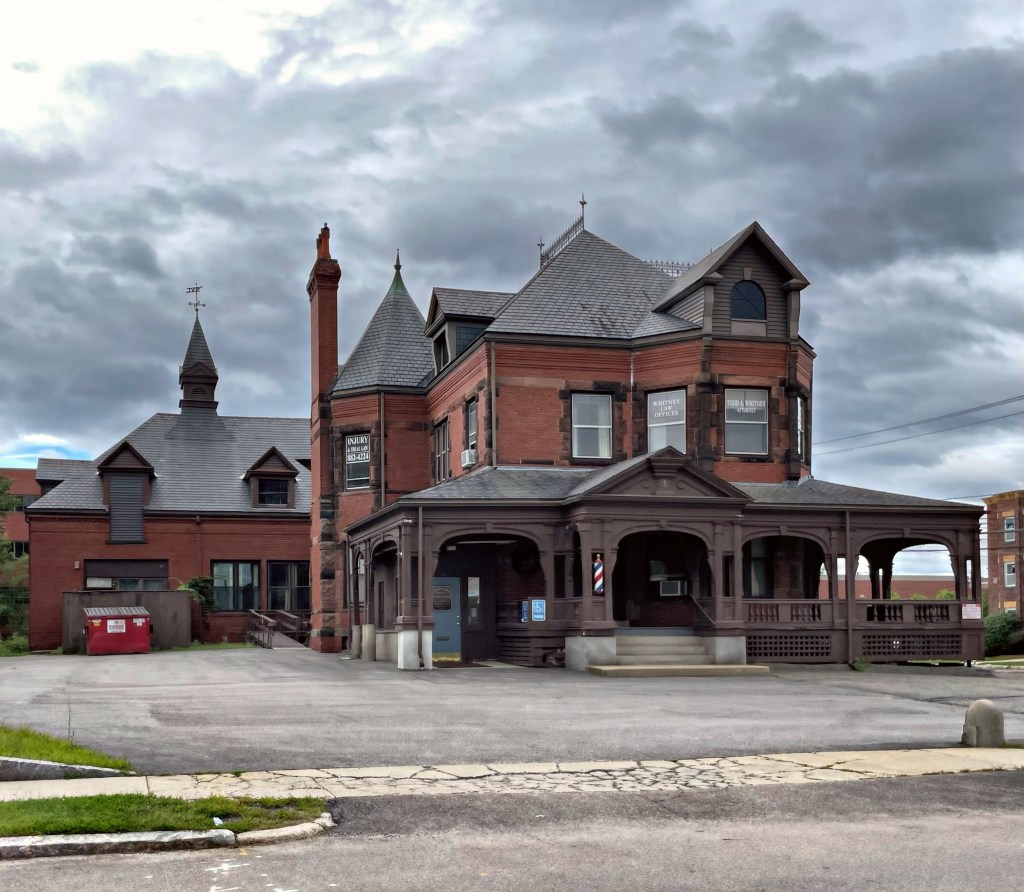
Another stately Victorian-era house on Nashua’s Concord Street is this brick beauty, known as the Dana King House. The property was constructed in 1879 for Dana William King (1832-1912) who had quite a history. He was born in Alstead, New Hampshire where he lived until he was 19, moving to Boston to “make his fortune”. In 1852, he shipped aboard a whale boat in East Boston, and realized that whaling wasn’t for him. He was persuaded by his brother to move in with him in Detroit, where he worked as a grocery clerk before moving back to New Hampshire, settling in Nashua, where he did make his fortune. He began working at a local mill until the outbreak of the American Civil War, where he enlisted in the First Regiment of New Hampshire, eventually rising to the rank of Lt. Colonel. He was captured during the war and held in prison in Shreveport for over seven months, failing at least one prison escape. He was eventually included in a prisoner swap and returned to Nashua in 1865. Upon his return, King used his war stories to gather favor locally, and he was elected Register of the Hillsborough County of Deeds, a position he held for over 30 years. The King House is a great, and rare example of the Victorian Gothic style of architecture in Nashua, notable for its steeply pitched slate gable roof with octagonal corner tower serving as a belvedere or cupola.
One of the finest homes in Nashua, New Hampshire is this stately brick and brownstone mansion at the corner of Main and Prospect streets. It was built for Charles Horace Burke (1850-1912) and his wife, Asenath Burke (1856-1943) in 1889 as one of the most up-to-date residences in the city. As a young man, Charles was known as “the busiest businessmen” in Nashua. He would become the president of the Nashua Iron and Brass foundry as well as the director of the Second National Bank. In 1878, he was the city’s tax collector and he served as Mayor from 1889 to 1890, soon after he had this estate built. As mayor, Mr. Burke was responsible for the building of the Soldiers and Sailors Monument in Abbot Square and the Court Street Police Station. As Mayor, Burke also improved the sewage system, streets, sidewalks, and highways of Nashua. He hired architect Charles J. Bateman to furnish the plans for the house, which would take over a year-and-a-half to build. Bateman would later be named City Architect for the City of Boston, designing schools, firehouses, and more during his time there in 1893-4 and 1898. The house is a high-style Queen Anne Victorian home of brick with brownstone trim. There is an intact former carriage house at the rear. The house was inherited by Charles and Asenath‘s only child, a daughter, Tena, in 1914. She sold it two years later to Dr. Augustus W. Shea and his wife, Lucy. When Lucy passed away in 1948, her daughter sold the property to the Nashua Medical Center. It has seemingly been used as offices ever since. The large corner lot and adjacency to a large medical center across the street have me worried that this property may be threatened in the future for redevelopment, here’s to hoping Nashua can preserve this significant and architecturally grand estate! Thank you to the Nashua Historical Society for assistance researching this post!
WOW! Would you just look at this absolute stunner in Nashua? The town is not necessarily known for its historic architecture, but like most New England towns and cities, there are some amazing buildings to check out. This example, the James Tolles House, was built in 1890 and is one of the finest residences in the city. The stately residence was built for Mr. Tolles who served as Nashua’s 23rd mayor. The Tolles House stands out for the use of sandstone ashlar construction on the first floor with shingle siding above, carved terracotta panels, and a large, rounded corner tower capped with a domed copper roof. This one is pretty close to perfect!
The Stephen and Maria Mansfield House is located at 70 Concord Street in Nashua, New Hampshire, and is one of many stunning old houses along the largely residential street. The dwelling was built in 1888 for Stephen Willard Mansfield, a shoe dealer in Nashua, and his wife, Maria. The Mansfield House is a great example of a more modestly sized Queen Anne style house, which is typified by the asymmetrical plan, varied siding types, and intricate carvings and turned posts. This house is dominated by a two-story rounded bay which is capped by a conical roof. She could definitely use a good paint job but it’s a really sturdy old home built from old-growth lumber. She’s here to stay!




 Buildings of New England