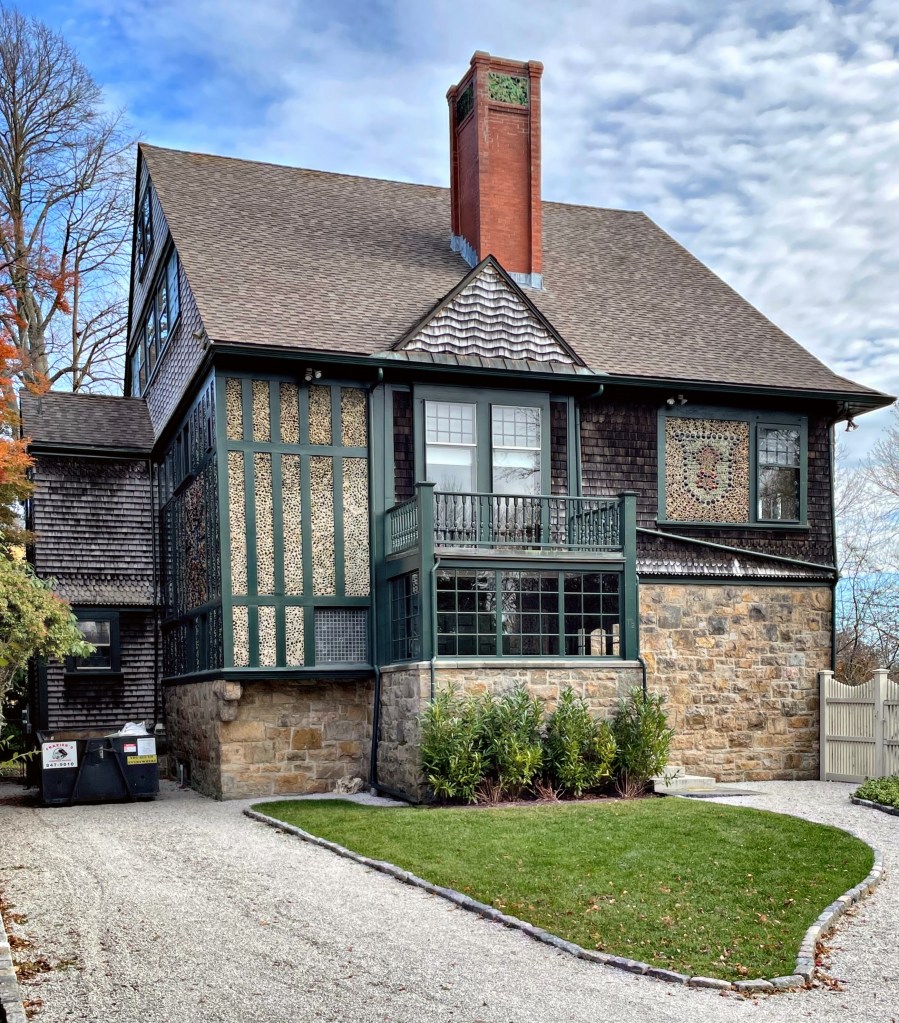
Samuel P. Tilton Cottage // 1880

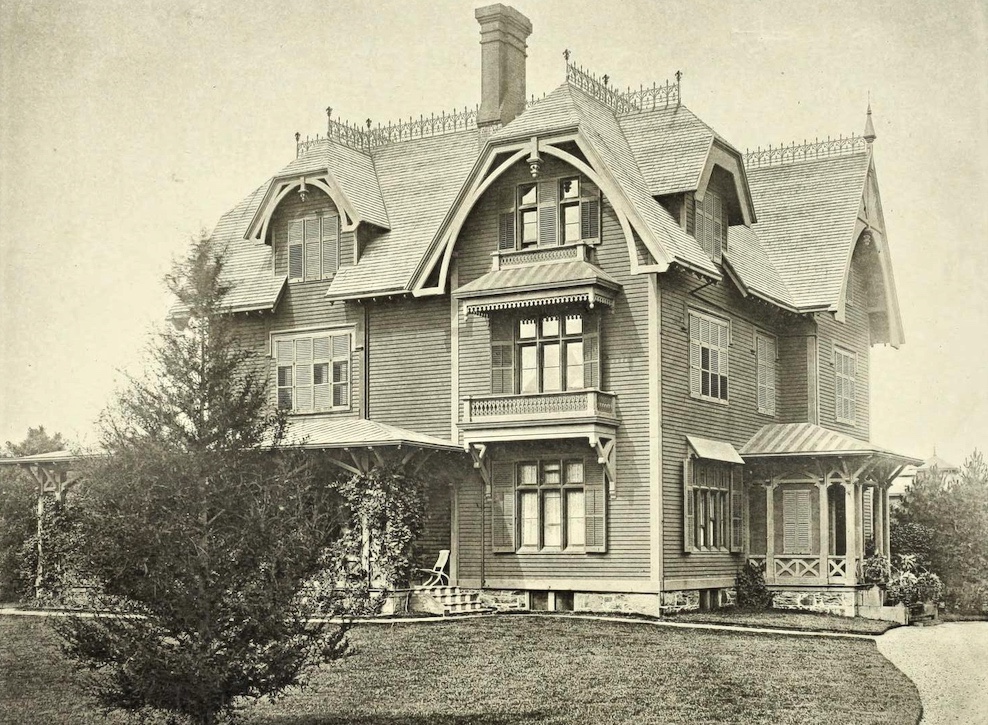
One of the most well-designed and least-pretentious summer cottages in Newport is this charming dwelling on a dead end street. The Samuel P. Tilton Cottage was designed in 1880 by the prestigious firm of McKim, Mead & White as an idiosyncratic blending of Queen Anne and Shingle architectural styles. Mr. Tilton was a milliner (maker and seller of women’s hats) with stores in Boston and Paris, France. He had this cottage built to summer close to the nation’s wealthiest, likely marketing some hats at elaborate Gilded Age events. The facade is assertively Queen Anne with its massing and decorative panels, with shingled side elevation seemingly sprouting from the earth. The architectural terminology for these unique decorative panels is “sgraffito” where here, cement or plaster siding is set and adorned with shells, pebbles, colored glass, and pieces of coal into a cartouche design. The house is one of the finest in Newport, and shows that bigger isn’t always better!
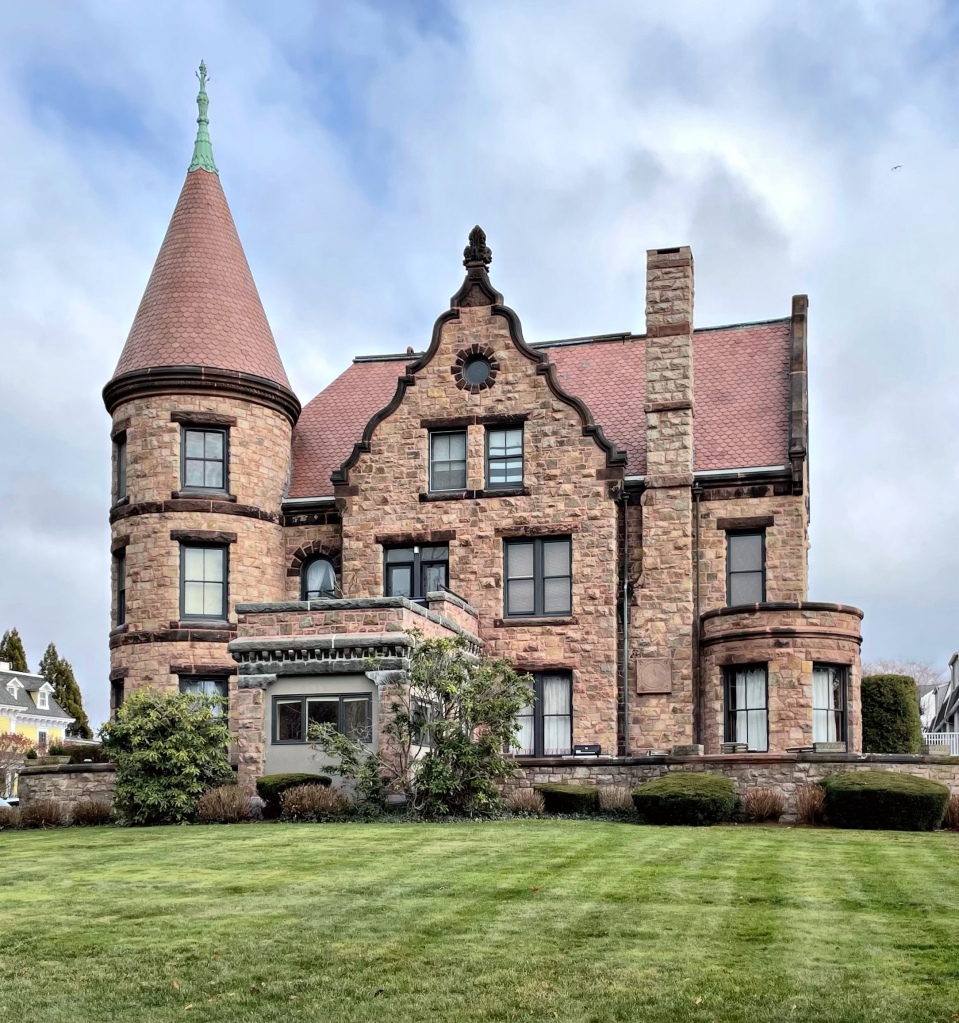
De La Salle // 1884

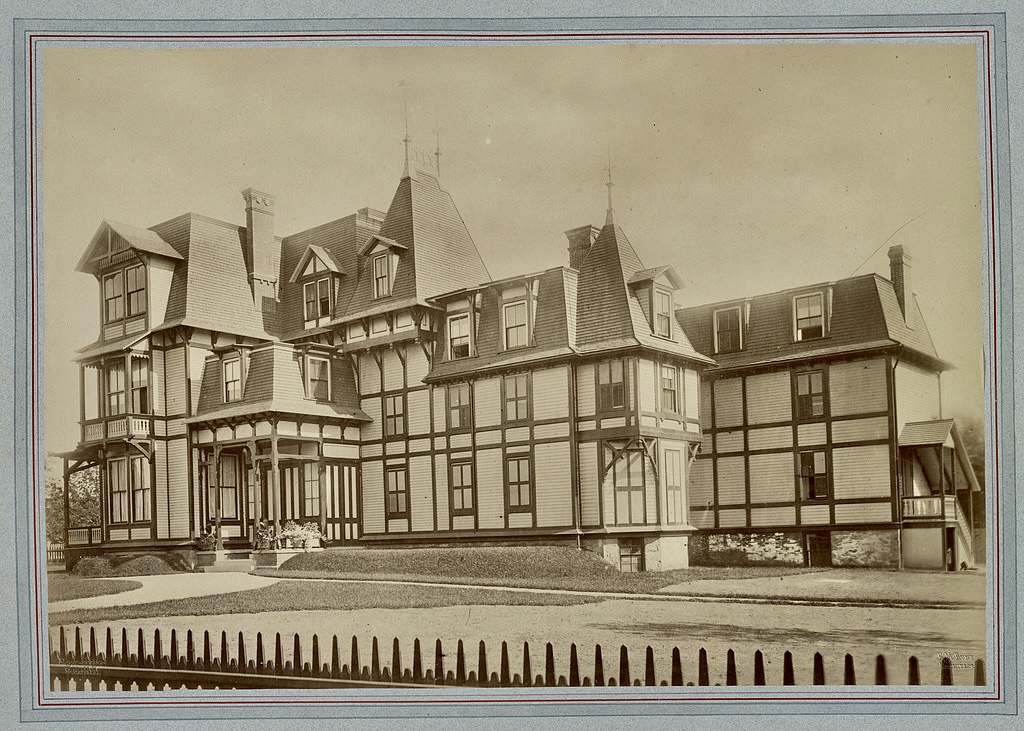
The Weld family has long been a prominent family in Boston, with ancestors dating back to the 17th century in New England. One of these men was William Fletcher Weld, a merchant, later making investments in railroads and real estate. By the time of his death in 1881, he had an estate of approximately $20 million, or more than half a billion in today’s dollars, and he left nearly all of it to his family. His eldest son, William Gordon Weld II, received a large inheritance and he began construction on this summer “residence”cottage” in Newport. The house was designed by local architect Dudley Newton, who had the estate built of locally-quarried granite. Architecturally, the dwelling is eclectic in style with Dutch Renaissance gables with conical roof forms seen typically in Queen Anne and Romanesque buildings. Weld spent his summers here for over a decade until his death in 1896. His widow Caroline, summered in the mansion until her death in 1918. By this point, Newport was beginning to fall out of favor as a wealthy resort community, and the many Gilded Age mansions were increasingly viewed as costly white elephants from a previous era. This property was sold by the Weld family in the early 1920s and became the De La Salle Academy, a Catholic school for boys, and remained in use until it closed in the early 1970s. After the school closed, the mansion was converted to condominiums and some townhomes were built on the expansive property.

“Snug Harbor” – Charles H. Baldwin Cottage // 1877

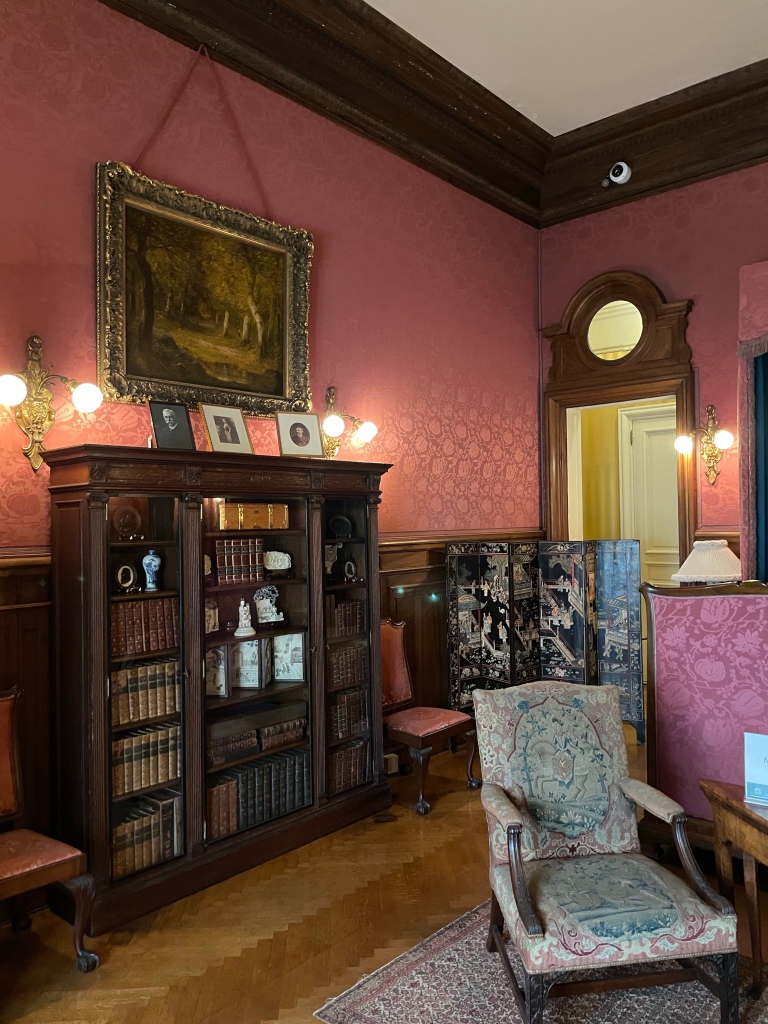
One of the finest Queen Anne style residences New England is this 1877 summer cottage, named “Snug Harbor”. The mansion was designed by architects William Appleton Potter and Robert Henderson Robertson for Charles H. Baldwin, a prominent admiral in the United States Navy. The design utilizes a brick first floor with shingle siding above, a high cross-gabled roof, panels and half-timbering, asymmetrical form, and a porte cochere at the entry. Later owner Arakel Bozyan, painted the entire exterior a deep red color and renamed the house “Gamir Doon”, Armenian for “Red House”. The house was restored back to a traditional color scheme and sold in 2020. The interiors are STUNNING!

Villa Rosa // 1900-1962

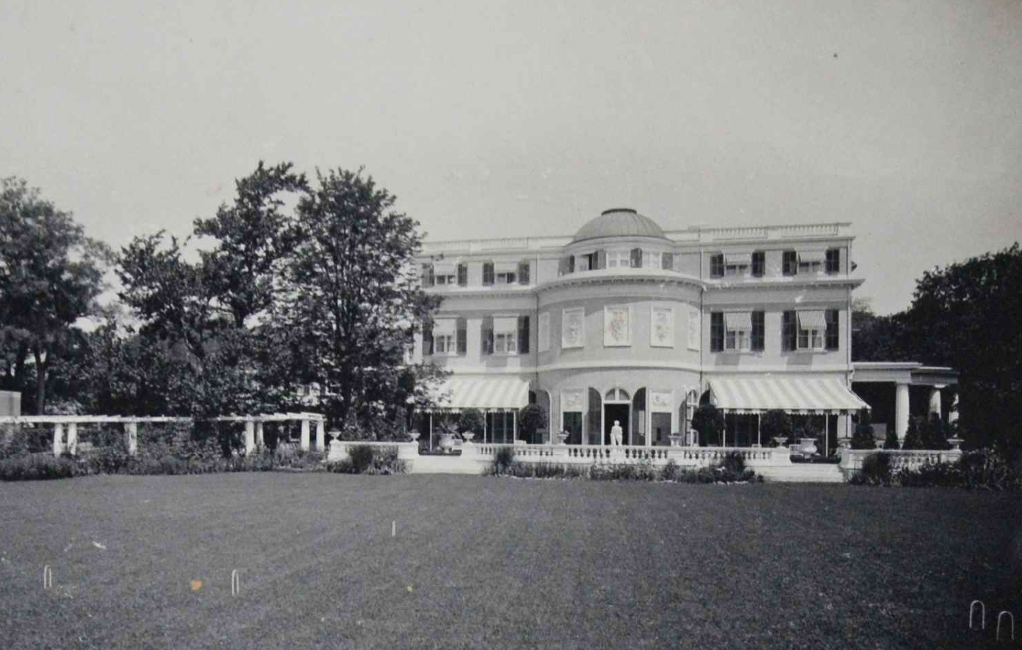
Built as the summer residence of Mr. Eben Rollins Morse and Mrs. Marion Steedman Morse of Boston and New York, Villa Rosa was one of the finest summer cottages in Newport. The property was purchased by Mr. and Mrs. Morse, which originally included three, large estates two of which were featured previously. Mr. Morse was a stockbroker and investment banker, and the couple lived on Commonwealth Avenue in Boston, maintaining a summer home in Beverly, Massachusetts. In 1900, the couple hired Ogden Codman, Jr., a society architect and historian from Boston, to design a townhome in New York (their new permanent home) and Newport, where they could summer with other wealthy New Yorkers. Their cottage, Villa Rosa, was a huge statement, likely to insert themselves into the high-society of Newport summers. Oriented to the south, rather than to Bellevue Avenue, the house took maximum advantage of its long narrow setting. The exterior of the house was covered in pastel pink stucco offset with white bas-relief panels and was crowned by a copper dome. The heart of the house was the green trellised circular Music Room or Ballroom, the first room in the United States to incorporate lattice design as a decorative scheme. The property was eventually sold for $21,500 to E.A. McNulty, a Rhode Island contractor. Ogden Codman’s masterpiece was demolished in December of 1962 and an apartment complex built on the site in 1965. Townhouse condominiums replaced the gardens in the 1970s and the gateposts, a final vestige, were cleared in 2004.

Image courtesy of Newport Historical Society.

Ms. Rebecca Jones Cottage // c.1870-1899

Formerly located adjacent to “The Lodge” (last post) on Newport’s iconic Bellevue Avenue, this mansion once stood and today, would be one of the finest in town, but it suffered a similar fate as its neighbor. The home was built for Rebecca Mason Jones (1803-1879), a widow (who married her first cousin) and daughter of wealthy New York banker and developer, John Mason. Rebecca made money from her late father’s estate, developing some parts of Manhattan. For her summer residence, she hired local society architect, George Champlin Mason to design the cottage. The cottage (originally thought to have been razed) was moved to 28 Narragansett Avenue to make room for Rose Villa, which also necessitated the demolition of the two neighboring mansions (more on that tomorrow).

“The Lodge” // 1870-1899

Believe it or not, but Newport, Rhode Island was once a “tear-down town”. Despite having arguably the largest extant collection of Gilded Age mansions, many older, properties were razed and redeveloped as tastes changed between the mid-19th century and the turn of the 20th century. And then there was the 1960s… But that’s for another time. This stunning mansion formerly on Bellevue Avenue was built in 1870 for Elizabeth Underhill Coles (1813-1891), the widow of William F. Coles of New York City by the high-society architect Richard Morris Hunt. The “cottage” was their summer residence and one of the finest Stick style residences built in the seaside town. The irregular layout, half-timbering and complex roof forms show the influence on the emerging Queen Anne style. The mansion was sold out of the Coles Family after Elizabeth’s death and was razed by 1900 for the second mansion on the site (next post).

The Elms – Stable and Garage // 1911

By 1911, the Berwind’s wooden stable at their summer home, The Elms, was deemed inadequate and the couple’s new automobiles needed an appropriate structure to protect them from the elements. Edward Berwind purchased a large estate from Ms. Ida Powell Johnson, abutting his sprawling property and razed it to have a new stable and garage structure built there. The two structures are modeled after the Louveciennes Pavillon de Goury in France, built originally for Madame du Barry. Above the garage space lived the stable keepers and gardeners. As the space shifted from stable to garage, it is said that the head coachman, in order to keep his job, became the family driver, but he could never learn to back up, so a large turntable had to be installed in the garage. The complex originally held space for ten carriages, stalls for six horses and room for eight automobiles, as well as harness repairs, laundry rooms and living quarters. The Beaux Arts style building employs the best of French architecture, including a mansard roof, corbels, and raised central pavillion.

The Elms – Pantry and Kitchen

We always see the ornate and entertaining spaces of house museums, but it is always amazing to see the “back of the house” which kept everything running. The two-story pantry and basement kitchen in The Elms are a rare look into the life of servants that worked in these mansions. These types of spaces were designed in a way to allow for servants to tend to the owners and guests, but neve The pantry spans floors one and two and would serve the owners and guests for smaller items and meals. The space features floor-to-ceiling oak cabinets to store china and other items. The basement kitchen is lined with white enamel tile for cleaning.

The Elms – Mr. Berwind’s Bedroom and Bathroom

Mr. Berwind drew the short straw and occupied the smaller of the two bedrooms in the Elms mansion as his wife Sarah Torrey Berwind, got the larger corner room. I was shocked to see just how small the bedroom was for one of the richest men in the country, even if it was just a summer residence that they occupied for a couple months of the year! Mr. Berwind did have a small bedroom, but he spared no expense to furnish it well. The fireplace in his bedroom is of ox-blood marble with gilt bronze mounts. The walls are covered in red silk and the carpet is a late 19th-century Khorassan. His private attached bathroom contains a sink of translucent white onyx.

The Elms – Mrs. Berwind’s Bedroom // 1899

On the second floor of The Elms mansion in Newport, you will find two separate bedrooms for the owners Edward and Sarah Berwind, a husband and wife of high society. The larger of the two bedrooms was for Mrs. Berwind as you know what they say, “happy wife, happy life”. Mrs. Berwind’s bedroom has cream-colored woodwork covered with custom-woven celadon green damask with borders of coordinated green, gold, and cream material. She had an adjoining bathroom and her chambers had access to her husband’s chamber along with a shared fireplace.