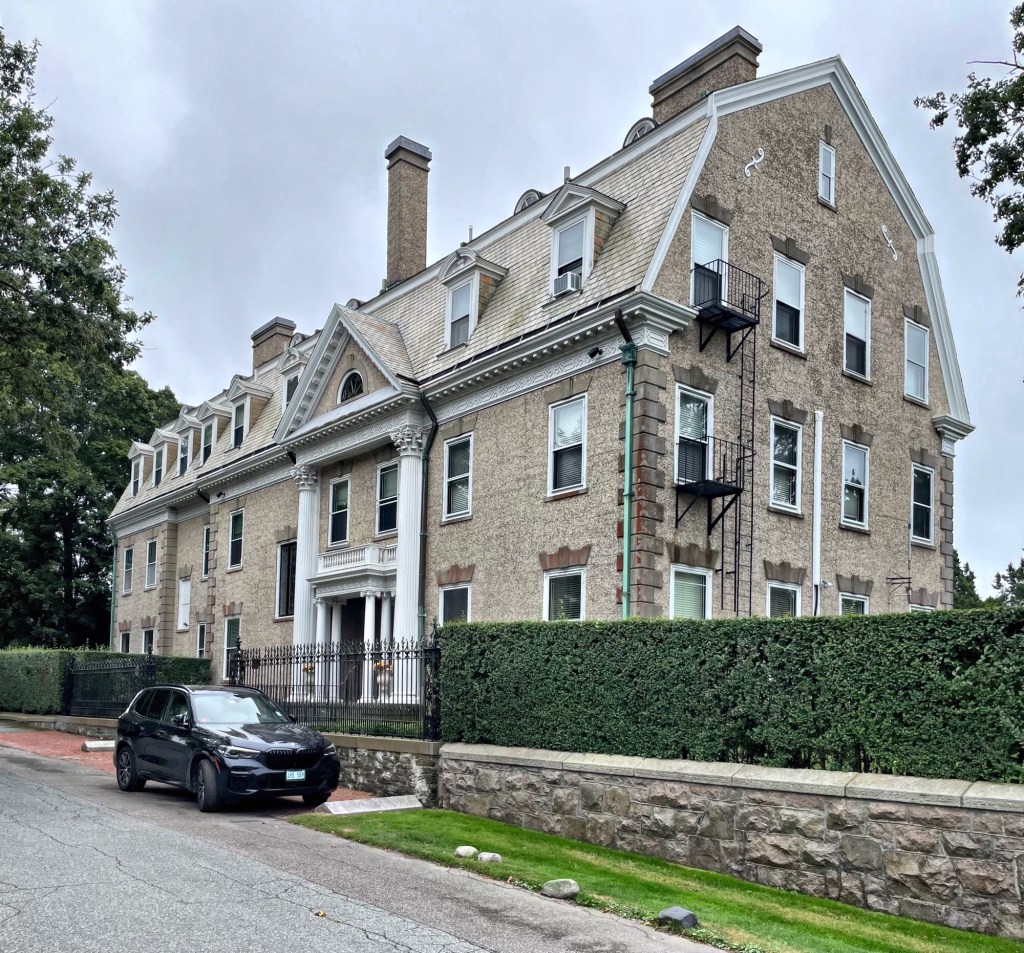
Oakwood, another massive gambrel-roofed “cottage” in Newport, Rhode Island, is another of the McKim, Mead & White designed residences in the Old Beach Road vicinity of town for wealthy summer residents. Built in 1902 for George Gordon King (1859-1922), Oakwood is a large, elongated two-and-one-half-story structure with a gambrel roof with walls in pebbledash finish. Its off-center main entrance with double-height engaged Corinthian columns supporting a pedimented gable and a blind balustrade set on smaller Ionic capitals. The massive home was later converted to condominiums. It sometimes amazes me that families (but with many servants) would live in these houses just for a season…
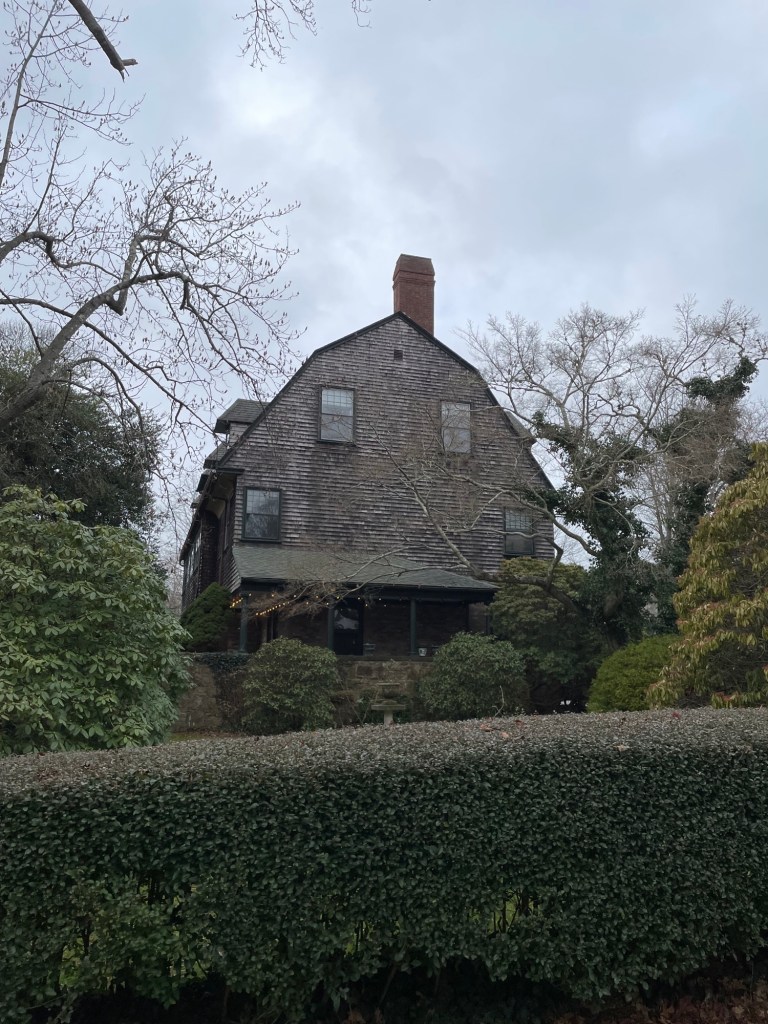
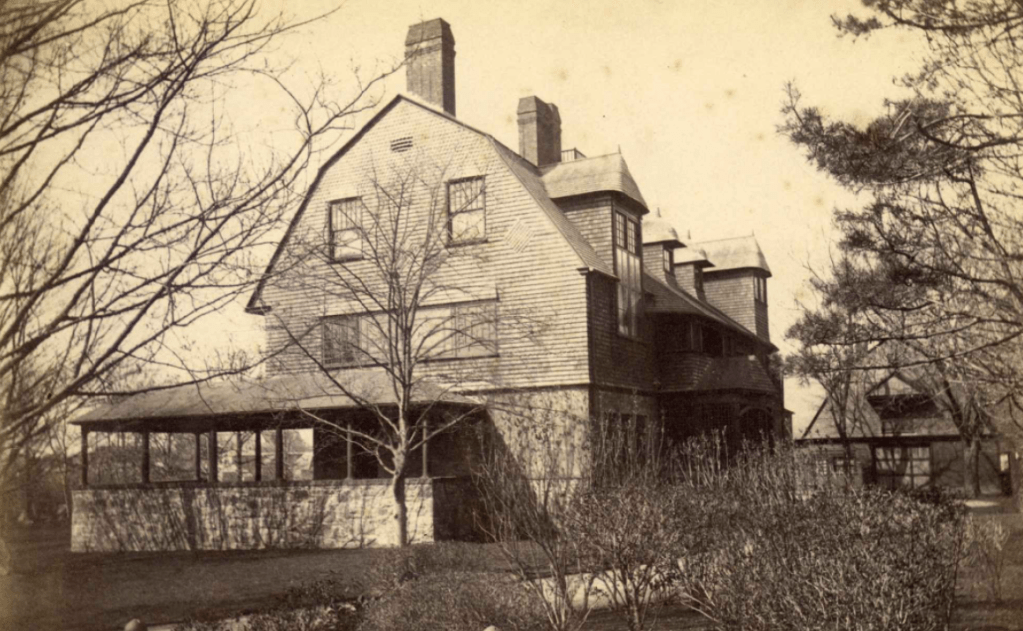
“Boxcroft” (also known as “Whileaway”) is a historic Shingle style summer “cottage” on Red Cross Avenue in Newport, Rhode Island. While it is surrounded by vegetation and tucked away, not facing the road, the house is a landmark example of the architecture style and very significant. The house was completed in 1883 from plans by the architectural firm of McKim, Mead & White a white shoe firm who designed many summer cottages in Newport for social elite. The original owner was Samuel Colman (1832-1920), a well-known landscape artist, the first President of the American Water Color Society, a connoisseur of Oriental art and an interior designer in business with Louis Comfort Tiffany specializing in fabrics and wallpaper. Colman lived here with his first wife, Ann Lawrence Dunham until her death in 1902. The property was later owned by Mary Appleton, an unmarried daughter of publisher William Henry Appleton. She would sell Boxcroft to lawyer and socialite J. Coleman Drayton, years following his bitter (and very public) divorce from Charlotte Augusta Astor, a member of the prominent New York Astor family, following a cheating scandal by Charlotte. Mr. Drayton died in Newport in 1934. Boxcroft remains an architecturally and historically significant piece of Newport’s Gilded Age.
A true Italian Villa can be found in the dense center of Newport, Rhode Island. This is the Butler House, built in 1865 for physician Samuel Butler (1816-1881) and his wife, Emeline. Dr. Butler was born in Maine and was educated at Harvard before moving to Newport to become a member of high-society there. Besides working as a physician, Samuel Butler served on the Newport School Committee and as a director of the Redwood Library. His house was originally built in 1865 (as the right half) in a late-Greek Revival style as a side-hall house with flushboard siding and pilasters between the bays. As Newport continued to grow in wealth as a summer destination, Dr. Butler modernized his home in 1876, adding the oversized corner tower with round arched windows and bracketed cornice. The two aesthetically opposing styles somehow work well together in this eclectic home, which today, is further enhanced by a color palette to accentuate the two sections.
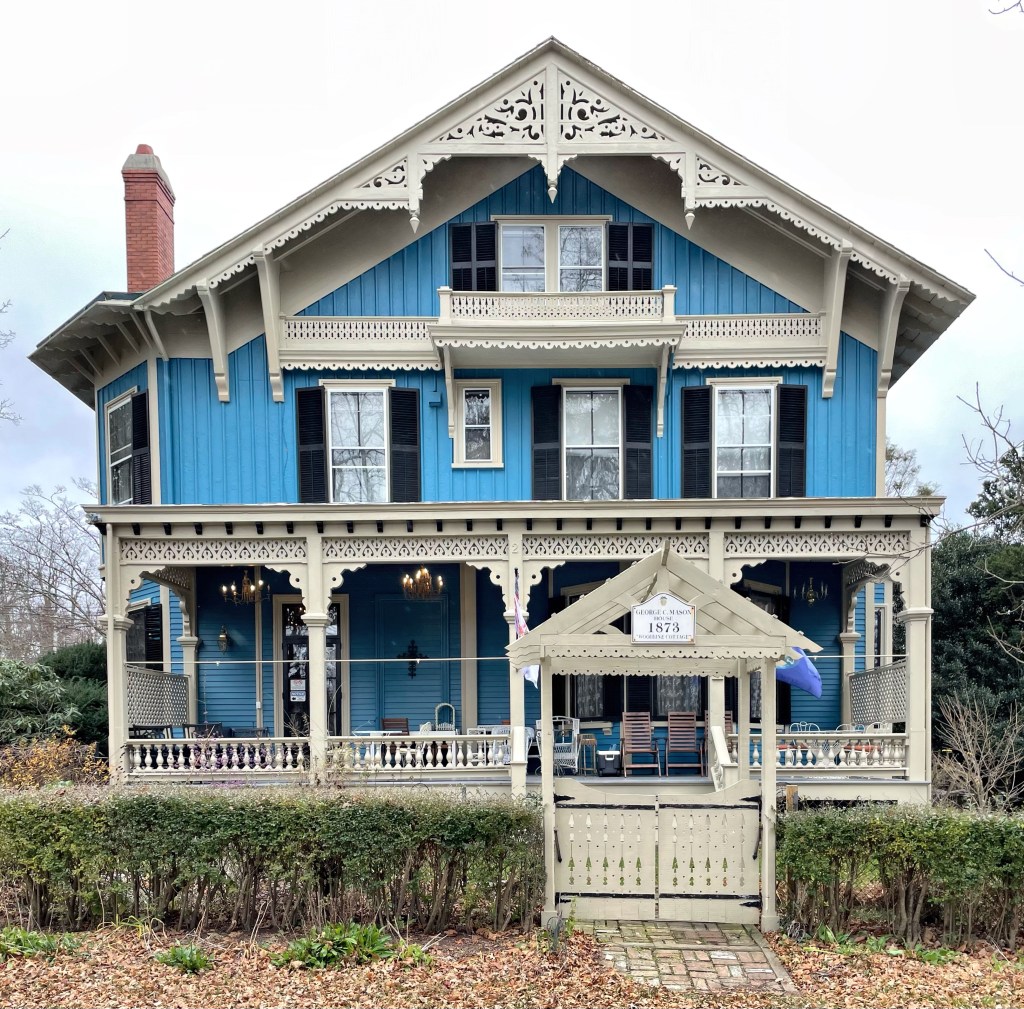
George Champlin Mason (1820-1894) can be credited as one of the most influential people who helped make Newport what it is today. He was born in the old Colonial town in 1820 and after a brief period working in New York City in dry goods, he traveled to Europe in his twenties to study art in Rome, Paris, and Florence, specializing in landscape paintings. Mason spent the 1840s trying unsuccessfully to make a living as landscape painter and published Newport and Its Environs, a collection of 11 engravings of his landscape views of Newport that is one of the earliest books about Newport to showcase its potential as a vacation destination. In 1851, Mason switched professions and became part owner and editor of the Newport Mercury newspaper. He often wrote on architectural subjects. In around 1858, he took his love for art and architecture and became an architect/developer, just as Newport was seeing early stages of development as a summer colony. He was hired by some early summer residents to design their homes, and did not disappoint, gaining notoriety all over the northeast. His son George C. Mason, Jr. (1849-1924), followed in his father’s footsteps and is said to have been the first professional architectural preservationist in the United States. George Sr., built this house as his primary residence in 1873, a stunning and rare example of Swiss Chalet architecture in New England, notable for the use of pierced bargeboards, board-and-batten sheathing, and cut-out railings. The property also included a charming stone English Revival tower in the rear yard, built in the 21st century as a workshop for the previous owners. How cool!
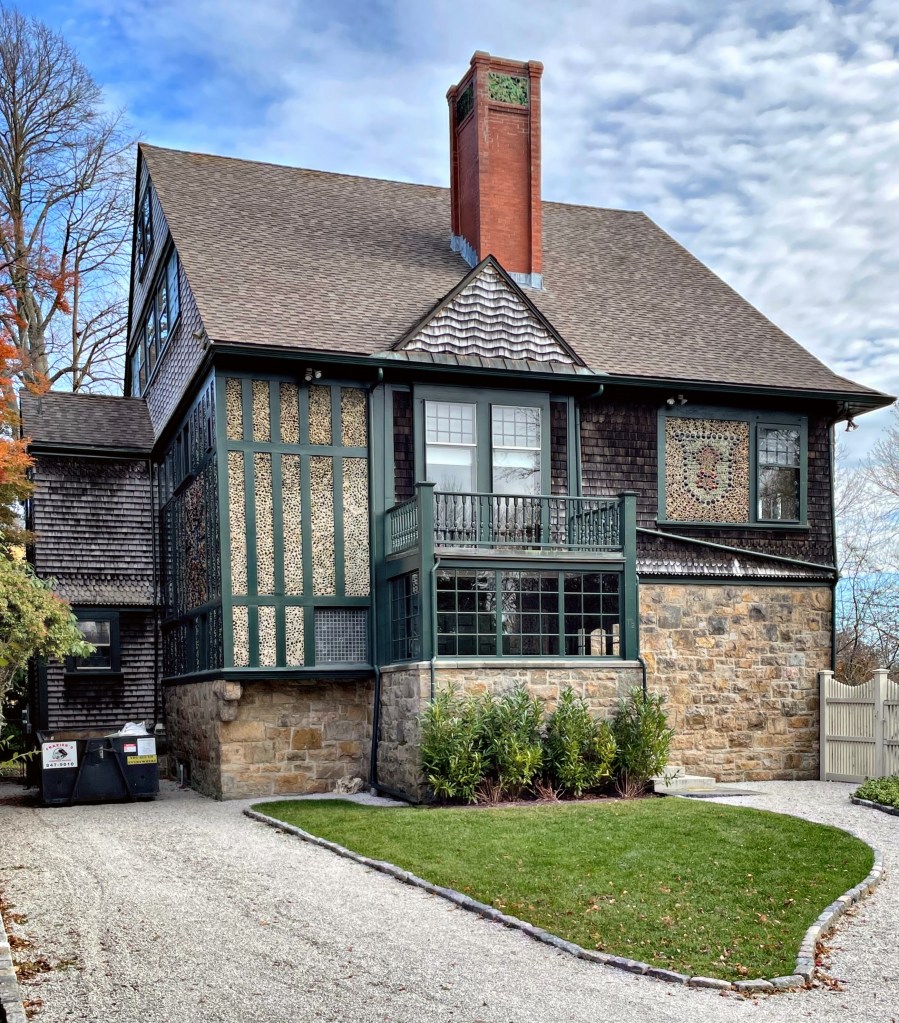
One of the most well-designed and least-pretentious summer cottages in Newport is this charming dwelling on a dead end street. The Samuel P. Tilton Cottage was designed in 1880 by the prestigious firm of McKim, Mead & White as an idiosyncratic blending of Queen Anne and Shingle architectural styles. Mr. Tilton was a milliner (maker and seller of women’s hats) with stores in Boston and Paris, France. He had this cottage built to summer close to the nation’s wealthiest, likely marketing some hats at elaborate Gilded Age events. The facade is assertively Queen Anne with its massing and decorative panels, with shingled side elevation seemingly sprouting from the earth. The architectural terminology for these unique decorative panels is “sgraffito” where here, cement or plaster siding is set and adorned with shells, pebbles, colored glass, and pieces of coal into a cartouche design. The house is one of the finest in Newport, and shows that bigger isn’t always better!
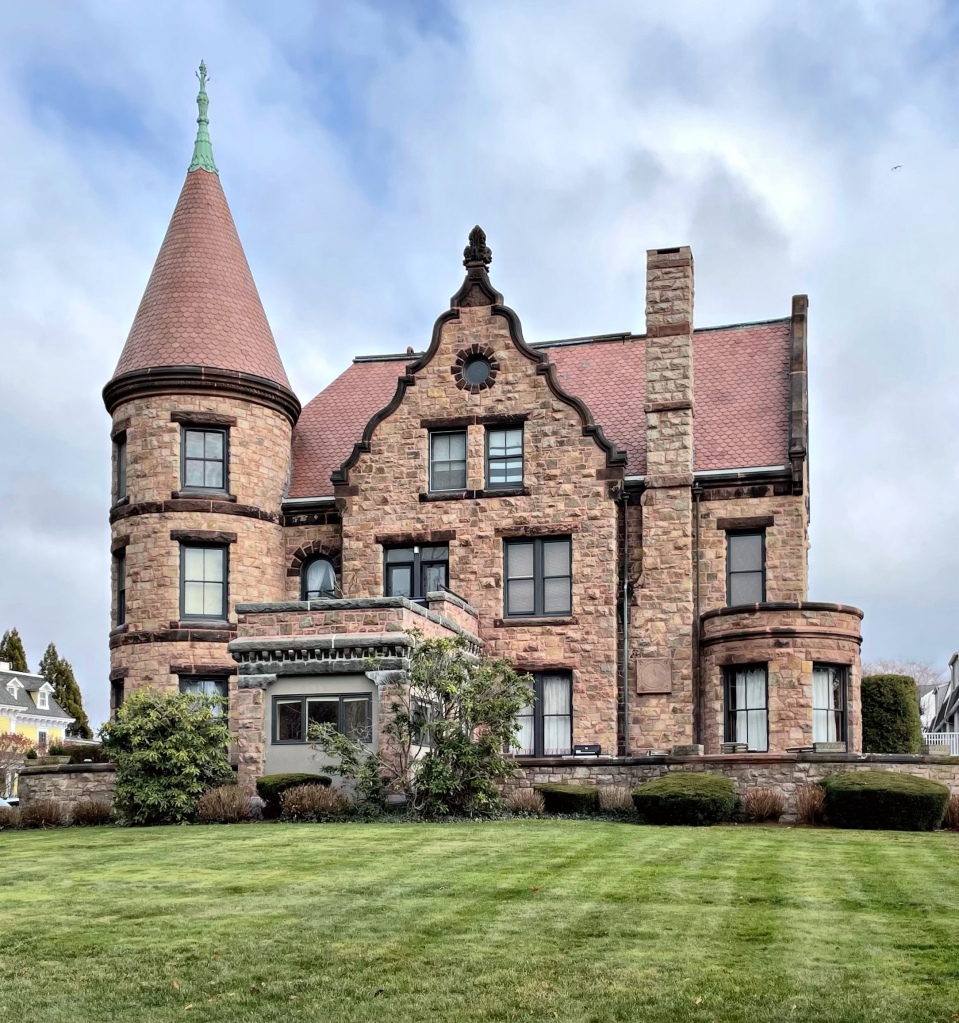
The Weld family has long been a prominent family in Boston, with ancestors dating back to the 17th century in New England. One of these men was William Fletcher Weld, a merchant, later making investments in railroads and real estate. By the time of his death in 1881, he had an estate of approximately $20 million, or more than half a billion in today’s dollars, and he left nearly all of it to his family. His eldest son, William Gordon Weld II, received a large inheritance and he began construction on this summer “residence”cottage” in Newport. The house was designed by local architect Dudley Newton, who had the estate built of locally-quarried granite. Architecturally, the dwelling is eclectic in style with Dutch Renaissance gables with conical roof forms seen typically in Queen Anne and Romanesque buildings. Weld spent his summers here for over a decade until his death in 1896. His widow Caroline, summered in the mansion until her death in 1918. By this point, Newport was beginning to fall out of favor as a wealthy resort community, and the many Gilded Age mansions were increasingly viewed as costly white elephants from a previous era. This property was sold by the Weld family in the early 1920s and became the De La Salle Academy, a Catholic school for boys, and remained in use until it closed in the early 1970s. After the school closed, the mansion was converted to condominiums and some townhomes were built on the expansive property.
One of the finest Queen Anne style residences New England is this 1877 summer cottage, named “Snug Harbor”. The mansion was designed by architects William Appleton Potter and Robert Henderson Robertson for Charles H. Baldwin, a prominent admiral in the United States Navy. The design utilizes a brick first floor with shingle siding above, a high cross-gabled roof, panels and half-timbering, asymmetrical form, and a porte cochere at the entry. Later owner Arakel Bozyan, painted the entire exterior a deep red color and renamed the house “Gamir Doon”, Armenian for “Red House”. The house was restored back to a traditional color scheme and sold in 2020. The interiors are STUNNING!
In 1885, a 28-year-old Leroy King (1857-1895) and his wife Ethel Rhinelander King (1857-1925) hired one of the country’s most prominent architects, Stanford White, to design a Newport home for their family. Leroy was the son of Edward King, a prominent local merchant, and upon his fathers death in 1875, inherited some of the $100+million dollar fortune he had amassed in today’s dollars. The corner lot at Bellevue and Berkeley avenues was purchased and work was underway on the new mansion. The house is a really interesting take on the Shingle style, but instead of cedar shingle siding, employs fireproof construction. A central hall, large gabled masses, picturesque window arrangements, and a spectrum of surface textures (here conveyed largely in natural stone and brick with flourishes of shingle and pebble dash work), align this house with McKim, Mead & White’s earlier efforts in this style. The interior has been meticulously preserved and maintained by the owners.
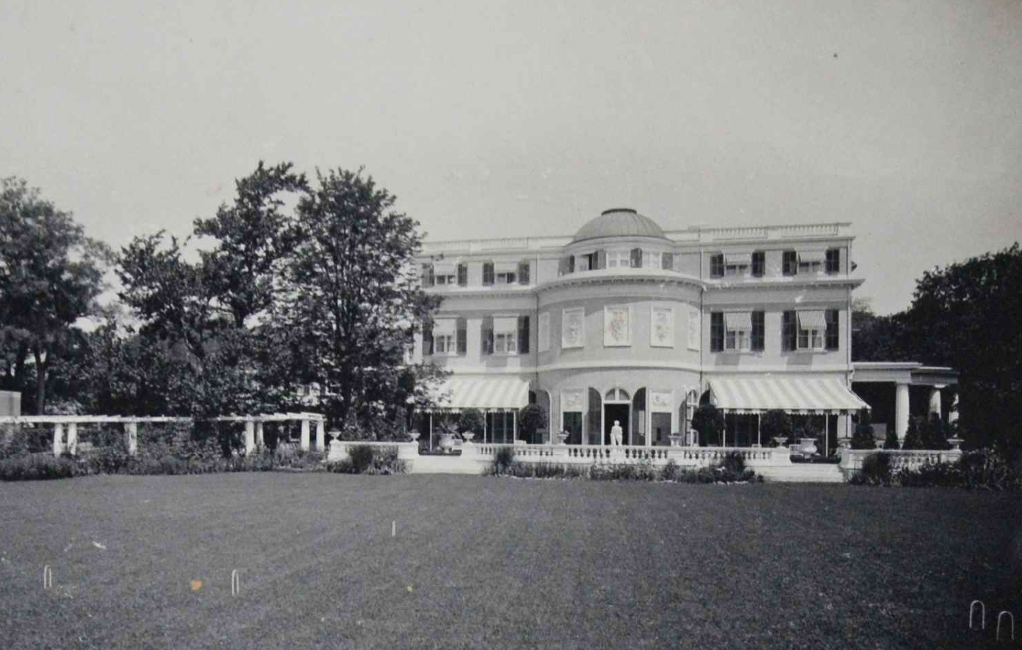
Built as the summer residence of Mr. Eben Rollins Morse and Mrs. Marion Steedman Morse of Boston and New York, Villa Rosa was one of the finest summer cottages in Newport. The property was purchased by Mr. and Mrs. Morse, which originally included three, large estates two of which were featured previously. Mr. Morse was a stockbroker and investment banker, and the couple lived on Commonwealth Avenue in Boston, maintaining a summer home in Beverly, Massachusetts. In 1900, the couple hired Ogden Codman, Jr., a society architect and historian from Boston, to design a townhome in New York (their new permanent home) and Newport, where they could summer with other wealthy New Yorkers. Their cottage, Villa Rosa, was a huge statement, likely to insert themselves into the high-society of Newport summers. Oriented to the south, rather than to Bellevue Avenue, the house took maximum advantage of its long narrow setting. The exterior of the house was covered in pastel pink stucco offset with white bas-relief panels and was crowned by a copper dome. The heart of the house was the green trellised circular Music Room or Ballroom, the first room in the United States to incorporate lattice design as a decorative scheme. The property was eventually sold for $21,500 to E.A. McNulty, a Rhode Island contractor. Ogden Codman’s masterpiece was demolished in December of 1962 and an apartment complex built on the site in 1965. Townhouse condominiums replaced the gardens in the 1970s and the gateposts, a final vestige, were cleared in 2004.
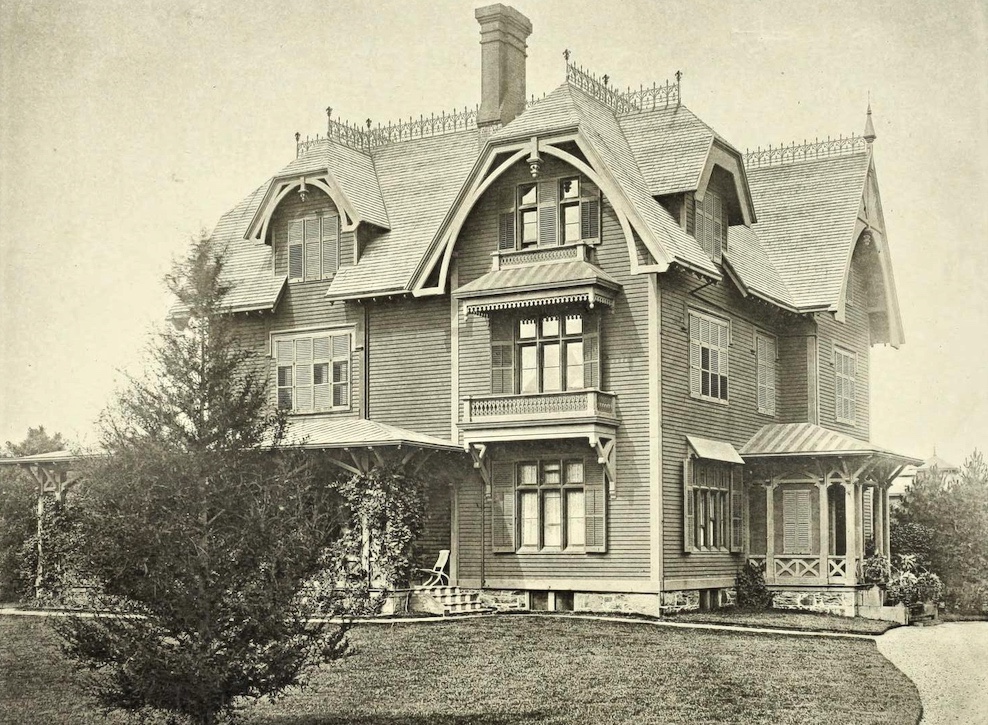
Formerly located adjacent to “The Lodge” (last post) on Newport’s iconic Bellevue Avenue, this mansion once stood and today, would be one of the finest in town, but it suffered a similar fate as its neighbor. The home was built for Rebecca Mason Jones (1803-1879), a widow (who married her first cousin) and daughter of wealthy New York banker and developer, John Mason. Rebecca made money from her late father’s estate, developing some parts of Manhattan. For her summer residence, she hired local society architect, George Champlin Mason to design the cottage. The cottage (originally thought to have been razed) was moved to 28 Narragansett Avenue to make room for Rose Villa, which also necessitated the demolition of the two neighboring mansions (more on that tomorrow).



 Buildings of New England