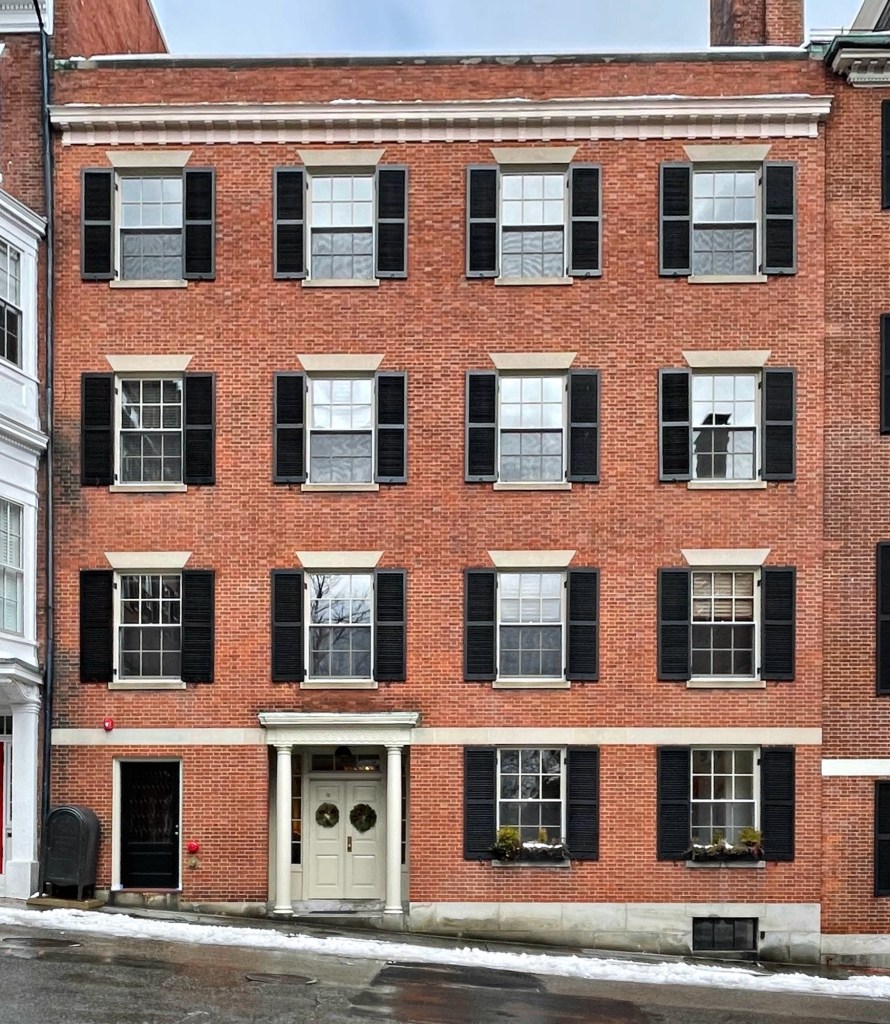
Simmons House – Japanese Relocation Hostel // 1856

Together with its two neighbors to the south, this townhouse at 6 Walnut Street represents the development of the South Slope of Beacon Hill in the second half of the 19th century, when larger estates continued to be carved up for housing, typically in the Italianate/Second Empire styles. Built in 1856, this residence was constructed on one of the last undeveloped lots in the area and was originally owned by George W. Simmons. Simmons was the owner of a well-known clothing emporium at Oak Hall, North Street, where he sold all kinds of ready-made clothing for men, including that needed by sailors, as well as sets of clothing for those headed for the California gold fields. His business was renowned also for its ambitious and creative advertising campaigns. Simmons died in late 1882, leaving this property to his heirs who sold the property. After successive ownership, the residence was converted to a boarding house during the Great Depression and rented out to families who could no longer afford the large single-family dwellings in the city. After WWII, in 1945, the boarding house was converted into the first Relocation Hostel for Japanese Americans in New England. The mission of the Relocation Hostels was to provide temporary lodging and career guidance to Japanese Americans who had been uprooted from their homes because of unfounded accusations of sabotage during World War II. Massachusetts joined New York, Pennsylvania, Illinois, and other states in establishing these hostels. Today, the residence is a four-unit condominium. 
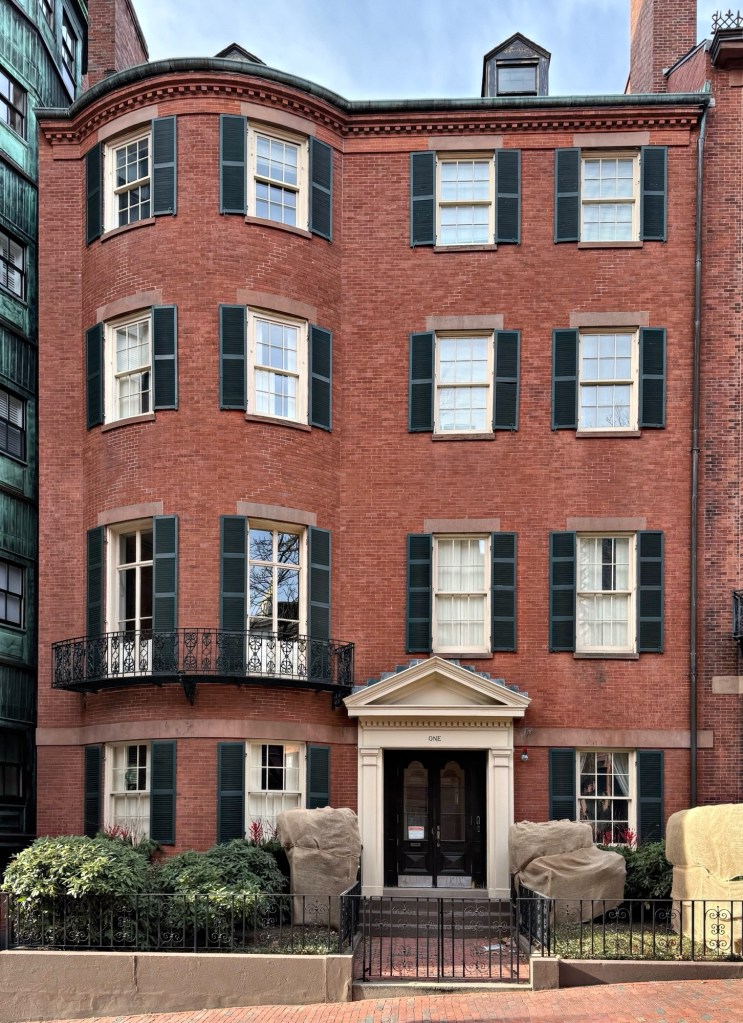
Perkins House – Diocesan House // 1832

Constructed of red brick and trimmed with brownstone, the beautiful townhouse at 1 Joy Street, is one of a few properties in Boston’s Beacon Hill neighborhood to have a front yard. Built in 1832, the four-story residence has its primary facade characterized by a flat entrance with a rounded bay extending upwards to the roof. Designed by architect, Cornelius Coolidge, who designed many other homes in this section of Beacon Hill, the completed house was purchased by Thomas Handasyd Perkins, Jr. (1796-1850), the eldest son of the enormously wealthy and influential Thomas Handasyd Perkins, Sr., who is considered by many to have been the most successful merchant prince of Boston’s Federal period. In 1892, the Episcopal Association purchased 1 Joy Street for use as headquarters of the diocese, and it became known as the Diocesan House. Today, the building is divided up into condominium units, providing residences just steps from the Boston Common.

Motley-Davis Mansion // 1811

This stately Federal style mansion at 10 Walnut Street in Beacon Hill, was built in 1811 for Ebenezer Francis as an investment property on land he had purchased from Uriah Cotting, one of the premier real estate developers of 19th century Boston. By 1823, Thomas Motley, the father of historian John Lothrop Motley, lived here, and hosted impromptu melodramas enacted by a young John Motley and two of his friends,
Wendell Phillips and Thomas Gold Appleton, both of whom lived close by on Beacon Street. After the Civil War, the property was owned by James Davis (1806-1881), a wealthy coppersmith who co-founded The Revere Copper Company with Joseph Warren Revere, grandson of Paul Revere. James Davis remodelled the Federal style house with Second Empire detailing including a brownstone-faced first story and quoins, with an oriel window at the second story, and a slate mansard above a bracketed cornice. During the 1920s, 10 Walnut Street’s Victorian facade was removed and a Federal Revival facade was constructed in its place, closer to original conditions. Today, the Motley-Davis Mansion rises four stories from a low granite basement to a flat roof enclosed by a low parapet. The off-center entrance is marked by columns supporting a cornice-headed entablature. This entablature interrupts the continuous stone belt course separating the first and second stories. What a beauty.