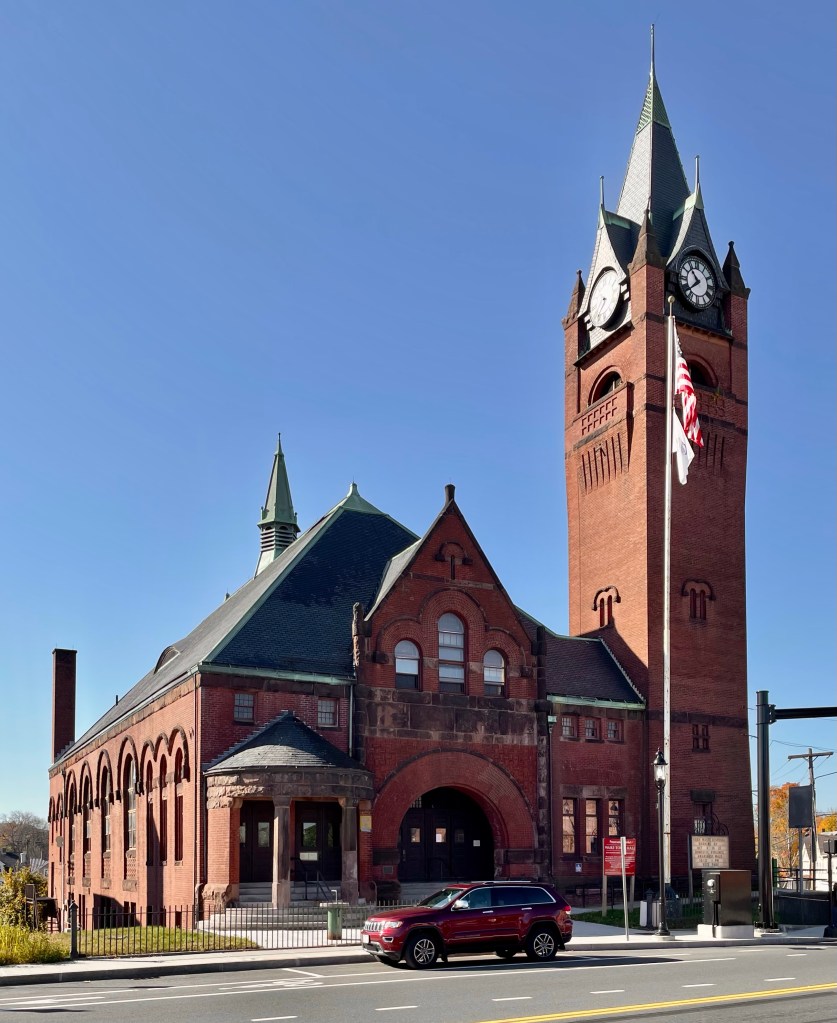
The economic center of the town of Killingly, Connecticut is the village of Danielson, which is located at the confluence of the Quinebaug and Five Mile rivers. The area developed as an industrial village and prospered as the town’s center through the late 19th and early 20th centuries. The present-day town hall building was originally constructed in 1876, not as a civic building, but as a multi-purpose music hall and G.A.R. Hall. The Victorian/Ruskinian Gothic style building was constructed of brick with stone trim. The building was later acquired by the town in 1906 and has served as the town offices ever since. Besides the unfortunate replacement windows, the building is well-preserved by the town.
The area that is now Chaplin, Connecticut was settled in the 18th century. The impetus to separate the community occurred due to the difficulty of area residents in reaching the churches in nearby town centers. Benjamin Chaplin (1719-1795), bequeathed funds for the establishment of a church near his (now no longer standing) home. A village center developed around the church, and the town was incorporated in 1822. The village is unusual in Connecticut for its relatively late development, and because the center is not near usable water power, and was bypassed by railroads, it was not affected by later industrialization. The main street is extremely well-preserved and a visual link to 19th century Connecticut. In 1840, the town erected this one-story Greek Revival building to serve as the town hall. The gable end reads as a pediment with the walls constructed of smooth vertical boards. The town outgrew this building and it became the town’s museum after the present town hall building was constructed in the northern part of the village. The museum closed and the building appears unused today. Hopefully the town can find a way to use the structure and maintain it.
Union, Connecticut is the smallest (by population) town in the state and it was the last Connecticut town east of the Connecticut River to be settled, largely because of its rough terrain and poor soil. The small town of under 800 residents was incorporated in 1734 and named Union, likely named after the fact that the new town was formed of a “union” of different sections of land which were left over when the boundaries of surrounding towns, though it is still speculation. Union erected this Town Hall building in 1847 which was fitting for the town’s small (and then-declining) population at the time. The one-story clapboard building is vernacular and lacks much adornment of other town halls and institutional buildings of the time period in nearby towns. Eventually, the town built a new city offices building and the small town continues to maintain the former building to this day and it houses the Union Historical Society.
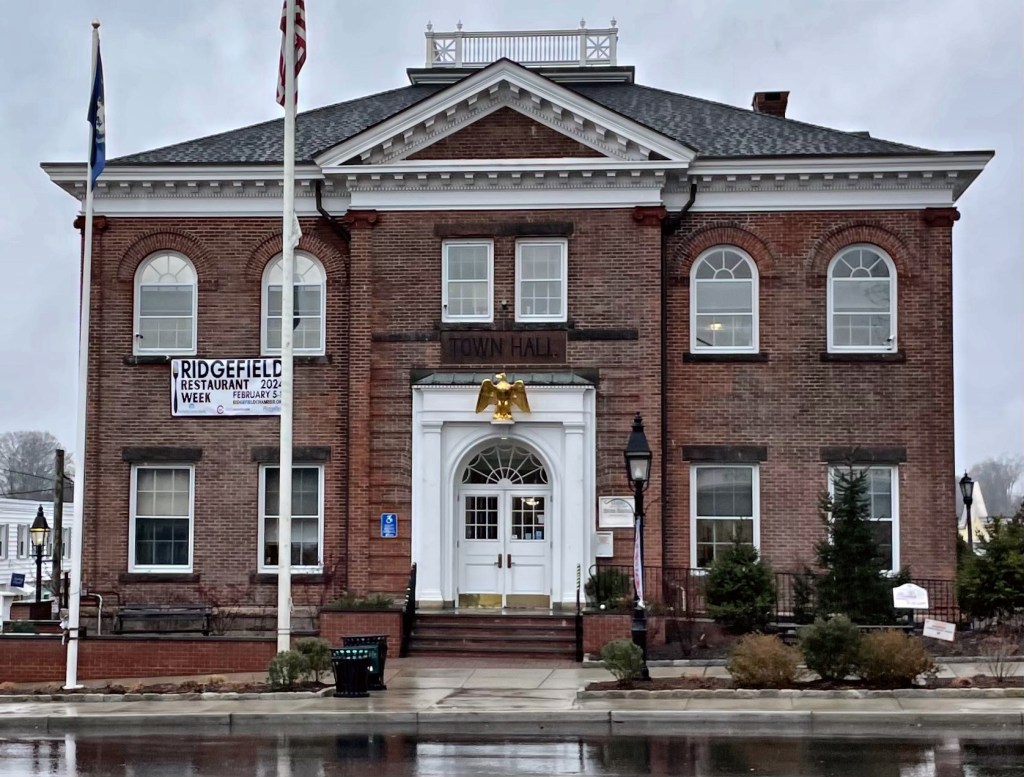
Ridgefield, Connecticut was settled in 1708 when 24 families from Long Island purchased land from Chief Catoonah of the Ramapo tribe. The Fundamental Orders adopted by Connecticut in 1639 directed would-be settlers, able to support a minister, to establish a settlement, build a Congregational church and farm the land. This is exactly what was done in Ridgefield, beginning in 1708. The original 24 proprietors received 7½-acre home lots drawn by lottery, with a 25th reserved for the minister. The lots were located up and down Main Street from a Common where a Meeting House was built. The town grew and for much of its three centuries, was primarily comprised of old farms. By the late 19th century, spurred by the connection of the railroad, Ridgefield was “discovered” by wealthy New York residents, who assembled large estates in town, a trend that has only picked up in the 21st century! Population growth and a large fire on the town’s Main Street in 1895 necessitated a new Town Hall building. The present Town Hall building was constructed in 1896 from plans by architect Philip Sunderland. Colonial Revival and Romanesque in style, the two-story brick building features a pedimented central bay also containing the entrance with fan light transom, round arched windows, brownstone trim, and narrow pilasters of brick. The building houses town offices today.
The first white settlers arrived in what is now the Town of Middlebury, Connecticut in the early 1700s, displacing Algonquin people who lived there long before. By the late 1700s, there was sufficient population to justify a petition to the General Assembly for establishment of a separate Middlebury ecclesiastical society, and such action was taken by the legislature December 29, 1790. They named the new town Middlebury due to its location between the existing towns of Waterbury, Woodbury and Southbury. The first church edifice was completed four years later, on the town green in the center of the new town. Other buildings normally found in a village center followed, including store, tavern, school, blacksmith shop and other churches. The town grew organically as a more agricultural center and saw some suburban development due to the proximity to larger population centers. In 1935, a fire destroyed the existing 1840s church and 1890s town hall, forcing the town to rebuilt. They hired J. Frederick Kelly, who was not only an architect but a historian who restored many significant buildings all over the state, to furnish plans for a new town hall. The present Classical/Colonial Revival building features two columns in antis and recessed pediment that echoes the adjoining Greek Revival church, but the Town Hall is executed in brick instead of wood (to give it more fireproofing than the last building). On the sides, the building has elliptical and round-headed windows and other elaborate details that suggest the Federal style.
The township of Moretown, Vermont was chartered on June 7, 1763 by Governor Benning Wentworth of New Hampshire. The original charter contained approximately 23,040 acres of land to be divided into about 65 shares of proprietors. Active settlement did not occur until after the Revolutionary War with early buildings constructed on the Winooski River (the northern boundary of the town) and subsequent development along the Mad River (which cuts through the middle of town). Saw and grist mills were built and the town developed as a rural farming and industrial community on the rivers. The Moretown Town Hall was erected in 1835 in the Greek Revival style. It has a pedimented portico with Doric columns that support a large pedimented gable peak in imitation of a Greek temple. Like most buildings in the Mad River Valley, the building is unapologetically Vernacular which means it relies on local materials, local builders, and not on architect-designed finishes. This is an aspect of Vermont architecture that makes the state so charming.
The town of Litchfield, New Hampshire is located at the southern section of the state across the Merrimack River from the town that carries its name. Land which is now known as Litchfield, was once populated by the Abenaki people. The New Hampshire Archaeological Society has located over 30 Native American sites along the shore of the Merrimack River in Litchfield, with artifacts several thousands of years old being uncovered. European influences started in the 1650’s with early records showing that Litchfield was then a part of Dunstable, Massachusetts. Both sides of the Merrimack River were granted in 1656, to William Brenton, colonial governor of Rhode Island. The name was changed to “Brenton’s Farm” in 1729. Chief Passaconaway of the Penacook lived in a Litchfield settlement at least part of the year around this era. In 1728, sixteen proprietors divided up the Brenton Farm Land. In 1749, the land was granted to another group of settlers and named “Litchfield” after George Henry Lee, Earl of Lichfield. The town has historically been comprised of farmland without a true town common or center. A small enclave of buildings did center in town, where the town hall was built. This building, the Old Town Hall of Litchfield, was built in 1851 from parts of an older meetinghouse, which was built across the road from where the building now stands. A shift in the course of the Merrimack River during the early 1800s forced the dismantling of the original Meeting House and a new structure to be built. It is a modest Greek Revival structure with corner pilasters, entablature, and gable end facing the street which reads as a pediment. It is very well maintained to this day as the home to the Litchfield Historical Society.
After learning a little about some of the buildings in Dorset, Vermont, which were saved and relocated to the town from land flooded for the Quabbin Reservoir, I wanted to visit one of the surviving towns there to see it for myself. I found myself in Ware, Massachusetts, a town with a history that parallels many in central and northern Massachusetts. The town was first settled by white European colonists by 1717, and incorporated in 1775. The town was named after the English town of Ware in Hertfordshire. The Town of Ware began as a sleepy farming town with inns and taverns dotting the landscape until industrial sites were developed on the banks of the Weir River. The post Civil War era (1860s–1900s) brought a new prosperity to the now established textile mill town. “Ware Factory Village” sprang up overnight and formed the basis for new growth and development, to the east of the former town center. From this, a new Town Hall was needed, and where better to locate it, than the economic and population center of town?! The Ware Town Hall was built in 1885-1886 from plans by the prominent Boston firm of Hartwell & Richardson. Sadly, a fire gutted much of the building in 1935, but the shell remains (though needing much repair). The town, like many former industrial centers, has struggled to re-invent itself, but a growing population is a great indicator of good things to come!
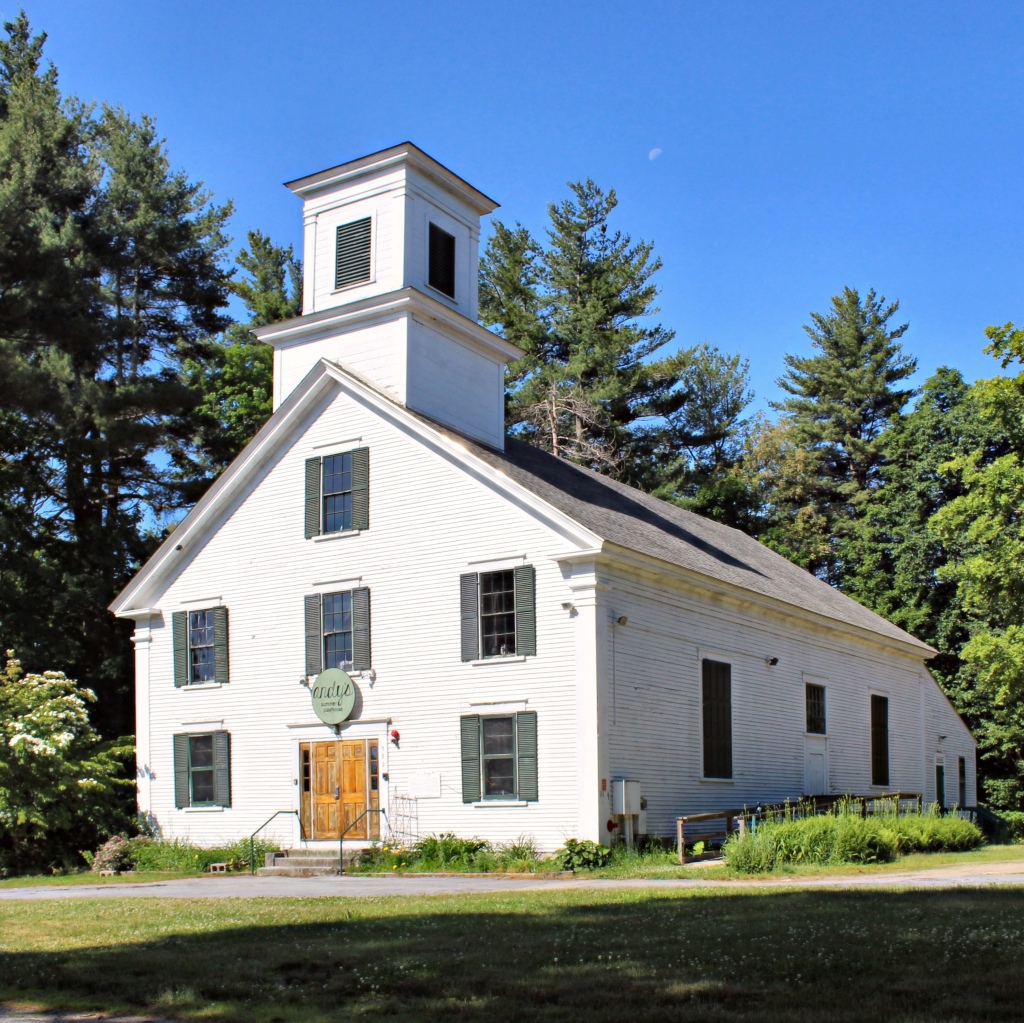
When Wilton, New Hampshire was settled and incorporated, a log structure was built to serve as a town meeting house. The structure in the center of town was deemed insufficient and was torn down and replaced with a larger meeting house in 1775. The second meeting house served the town for 80 years until it burned down in 1859. The town voted to build a third meeting house (this building) on the same spot, at a cost and the building was completed in 1860. The vernacular Greek Revival building was used as the town hall for just a couple decades, until the 1880s when East Wilton became the population and economic center of town, facilitating the move of the town hall there into a new building. The building would later serve various uses from a community hall to a grange hall, and it is now home to Andy’s Summer Playhouse, a youth theater and cultural hub for the region.
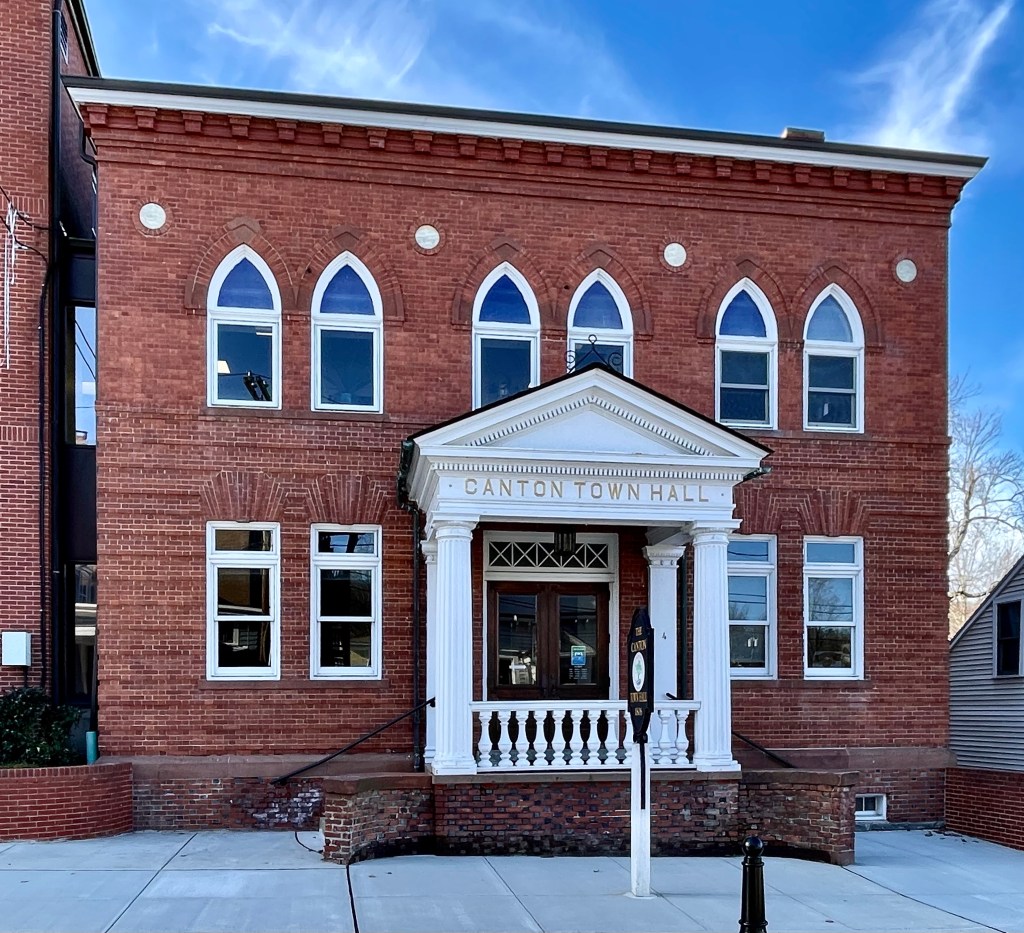
Collinsville, Connecticut grew in importance and population significantly in the 19th century. The traditional, rural town center of Canton remained pastoral with dairy farms on large agricultural lots. With the population centered around Collinsville, it was decided to erect a new town hall building in Collinsville, which is actually at the far edge of town, but the village where most residents lived. In 1902, this two-story, brick building was constructed just off Main Street. The building is unique for the Colonial Revival design, but with Gothic style lancet windows at the second floor. In the second half of the 20th century, the Town of Canton purchased the larger, three-story brick building adjacent to this building and expanded for additional town offices.




 Buildings of New England