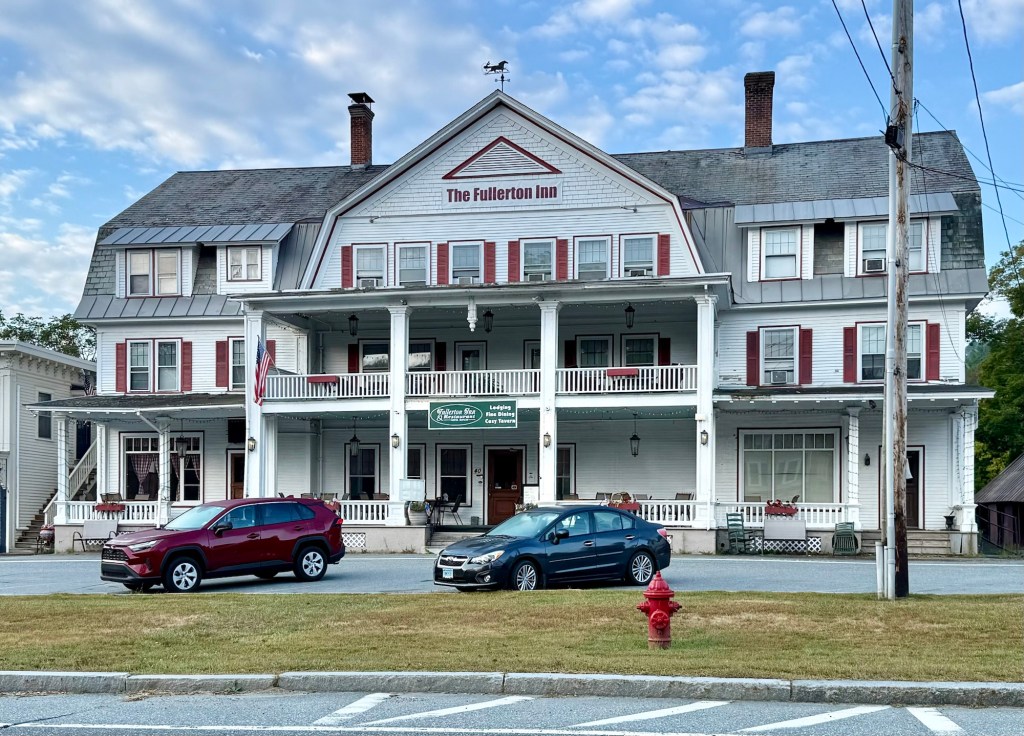
Fullerton Inn // 1921

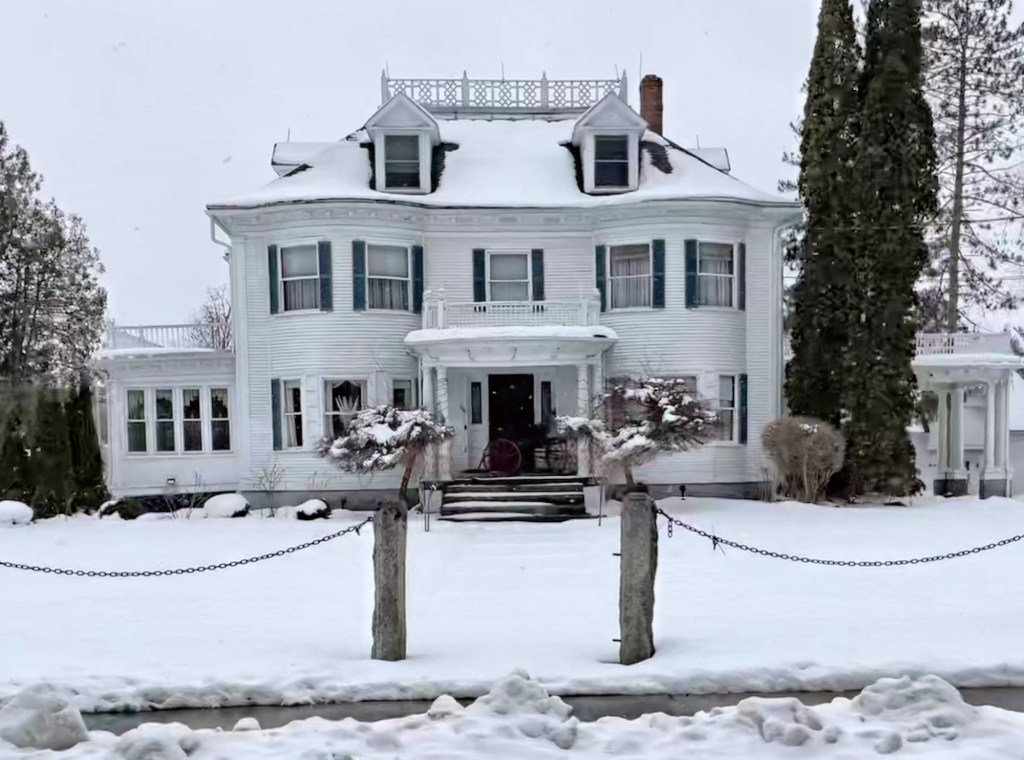
The Fullerton Inn, overlooking the Town Common in Chester, Vermont, is an imposing Colonial Revival style hotel that has been in operation through many iterations, and contributes to the strong commercial character of the Chester Village streetscape. The inn was first developed here following the arrival of the railroad to Chester, which brought new business and travellers to the formerly agrarian and light industrial community. The original 1862 inn building, known as the Ingraham House, was destroyed following a large fire in the village, and its replacement burned as well in January 1920. Within a year, the present building was built from the ashes in a style typical of the early 20th century, Colonial Revival. Dominated by the large slate-shingled gambrel roof and projecting front veranda, the building’s most iconic feature is said to be inside, a fireplace inside the lobby which contains 27 stone varieties from the area.
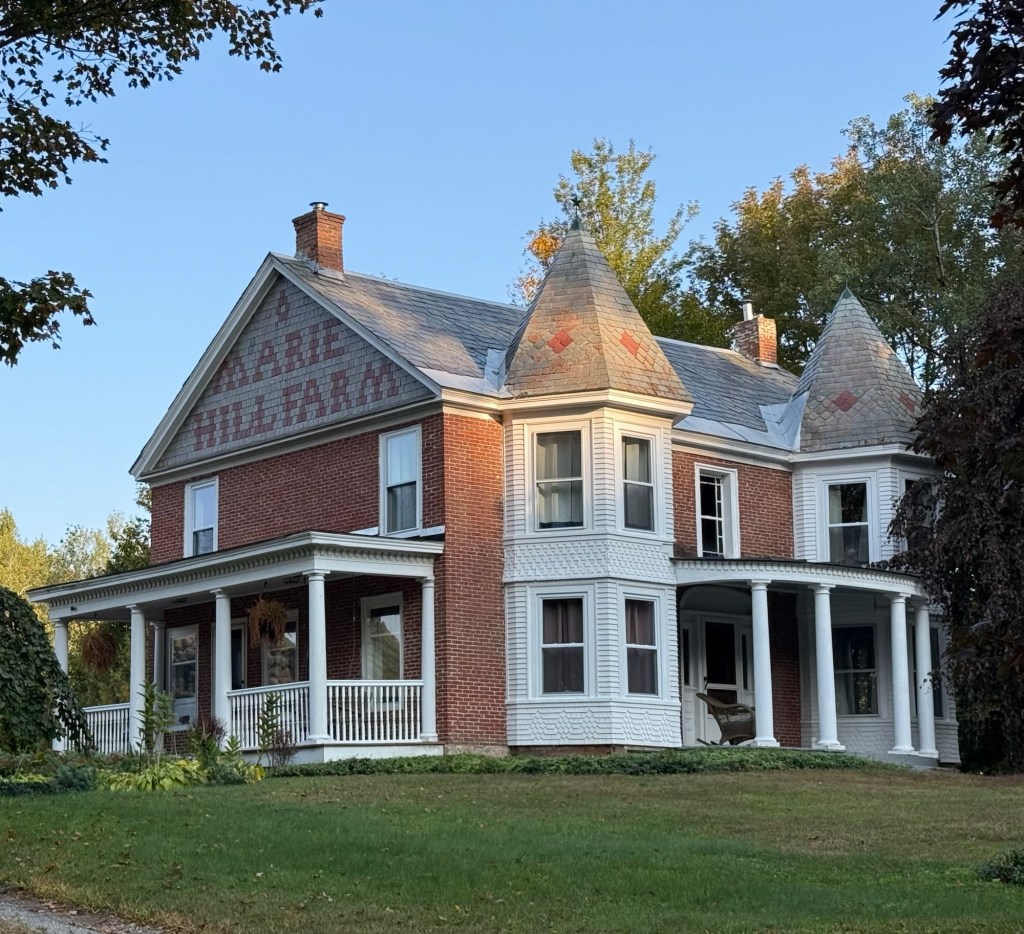
Marie Hill Farmhouse // c.1810

Located in the charming rural town of Andover, Vermont, the Marie Hill Farmhouse is one of the most interesting and charming residences in the area. Built around 1810, the brick farmhouse was designed in the Federal style, with a symmetrical five-bay facade, brick end chimneys, and a fanlight over the front door. The property was purchased by New Yorkers, Laurence Pfluger and his wife Mary “Marie” Pfluger, who operated the farm, raising dairy cows. Laurence would ship eggs, dairy and meat to his market in New York from this farm, which did quite well financially. The farmhouse was “modernized” by the turn of the 20th century with the addition of the two-story octagonal towers on the facade, front and side porches, along with the decorative slate spelling out “Marie Hill Farm” after his Marie Pflueger. The residence was later converted into a guesthouse, a use that remains to this day, still retaining the iconic name and branding in the southern gable.

Butterfield Mansion – Derby Line Village Inn // 1903

Once described in a local history book as: “The largest, most glamorous home ever built in this [Derby Line] village”, the Butterfield Mansion is one of Northern Vermont’s best early 20th century houses. The house was built between 1901-1903 for Gen. Franklin G. Butterfield (1842-1916) who before this, received the country’s highest award for bravery during combat, the Medal of Honor, for his action at Salem Heights, Virginia on May 4, 1863 during the American Civil War. He would eventually move to Derby, Vermont, where he established the Butterfield Company, who specialized manufacturing axle cutters. Butterfield hired architects, James T. Ball and Gilbert H. Smith of Boston, who also designed the Haskell Free Library and Opera House in town that same year, to design his Colonial Revival mansion and intact carriage house. Today, the Butterfield Mansion is known as the Derby Line Village Inn.

The Dorset Inn // 1796

One of the oldest continually operating inns in America, the Dorset Inn remains a visual and historical anchor to the charming little village of Dorset, Vermont. The Federal period building was historically known as the Hodges Hotel before becoming The Washington Hotel in about 1858 (the porch was added at that time to make it resemble George Washington’s Mt. Vernon home). The name became the Dorset Inn in 1904. As constructed in 1796, the main block possessed a five-bay facade arranged symmetrically around a central entrance; an 1858 extension added two bays on the west, when it was modernized. Though the inn has seen changes and modernizations over time, the building has such a historic character that brings in people from all over the country to experience the best of Dorset every year.

Four Columns Inn // 1832

One of the best examples of a temple-front Greek Revival house in the state of Vermont is this stunner, found in Newfane Village. The house was constructed in 1832 for General Pardon T. Kimball (1797-1873), a cattle-broker, general of the state militia and later, a state senator. Kimball made a name for himself locally as he donated much of his money to social causes, from a local almshouse to other charitable organizations. Kimball died in 1873 after falling from his carriage. The house was converted to an inn in 1965-6 and has since been known as the Four Columns Inn, so-named after the four monumental Ionic columns that dominate the house’s facade.

Bailey’s Mills // 1837

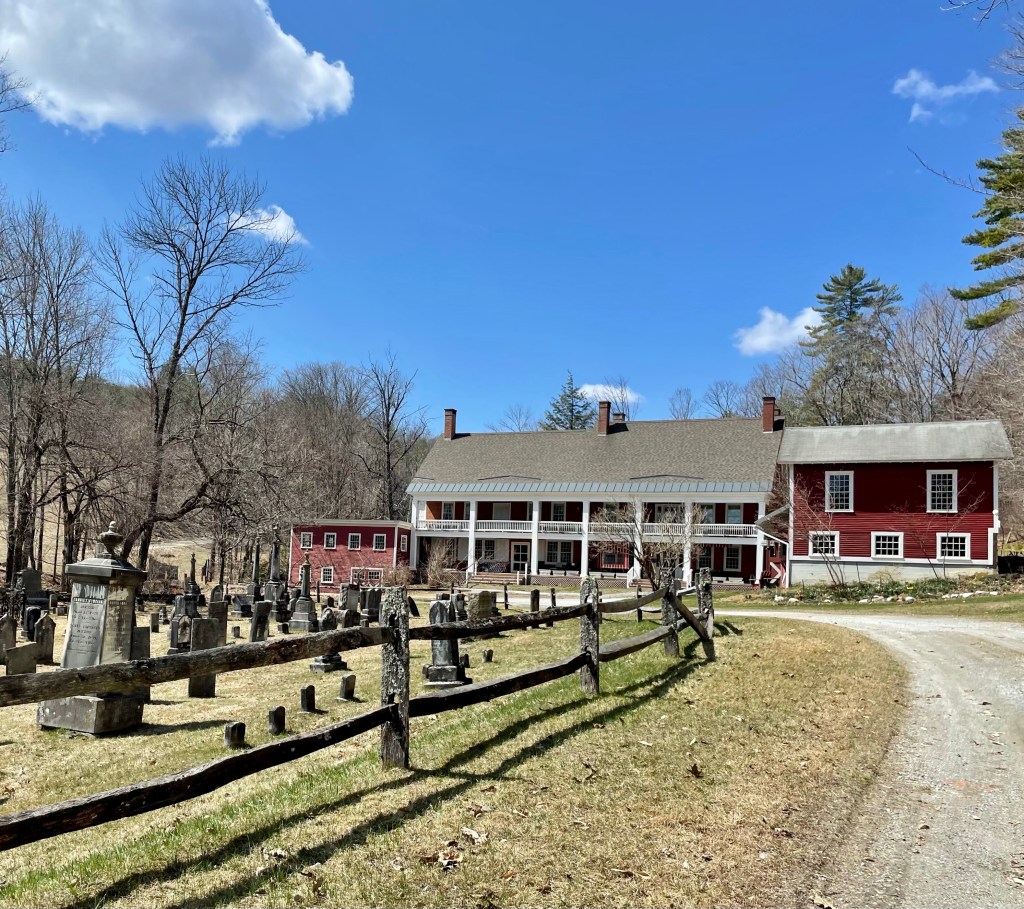
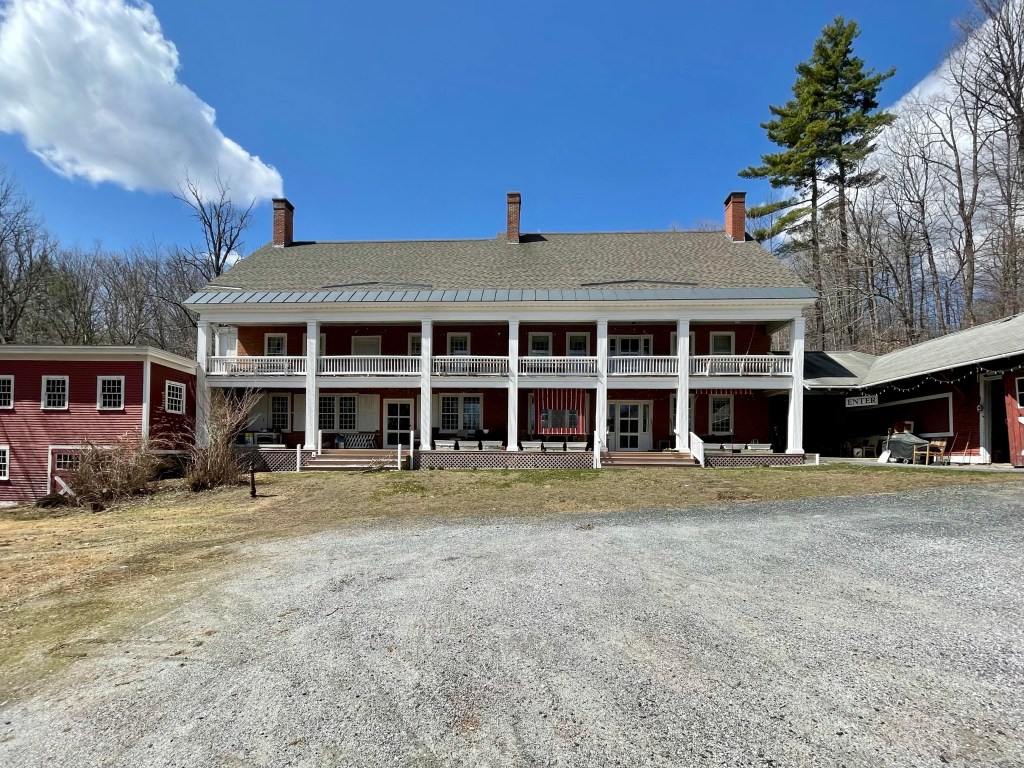
Driving down the dirt roads of rural Vermont with no cell phone service can be a great way to explore, so imagine my delight when i drove past this stunning old building tucked behind a historic cemetery! The building was erected in 1835-1837 by Levi Bailey, a local entrepreneur and mill owner who, in 1794, in partnership with a George Betterley, purchased the mill site and proceeded to build a dam, for later development. Legend says, in 1808, he required the good will of David Hapgood, his next door neighbor, so he could buy more land in front of his proposed mill. But, in fact, Levi had so irritated Hapgood somehow, that he instead donated the coveted acre to the Town of Reading for use as a town cemetery, ensuring that Bailey could never control it. Thus a “spite” cemetery was laid out, the only one I am aware of! Underterred, Bailey erected over the next two decades the series of buildings to manufacture goods, the buildings we see today. Bailey’s Mills in Reading, Vermont, is actually three connected, 2 1/2-story, brick, Greek Revival style buildings with several attached wood frame appendages added over time. He lived in the building and a store was run out of the building for locals. The building is now home to the Bailey Mills Bed & Breakfast.