This Tudor mansion in Waban Village was built around 1905 for George and Amelia Angier. George was the President of the Angier Chemical Company of Brighton. The company sold (among other things) Petroleum Emulsion, which was to be drank, serving as an anti-septic and soothing agent in the throat, stomach and intestines, it doesn’t sound safe to me! After their house was built, Mrs. Amelia Angier spent much of her time with charitable clubs and organizations. In 1916, before America joined WWI, Amelia started a fund and group to provide aid to the French who were wounded in the on-going war.
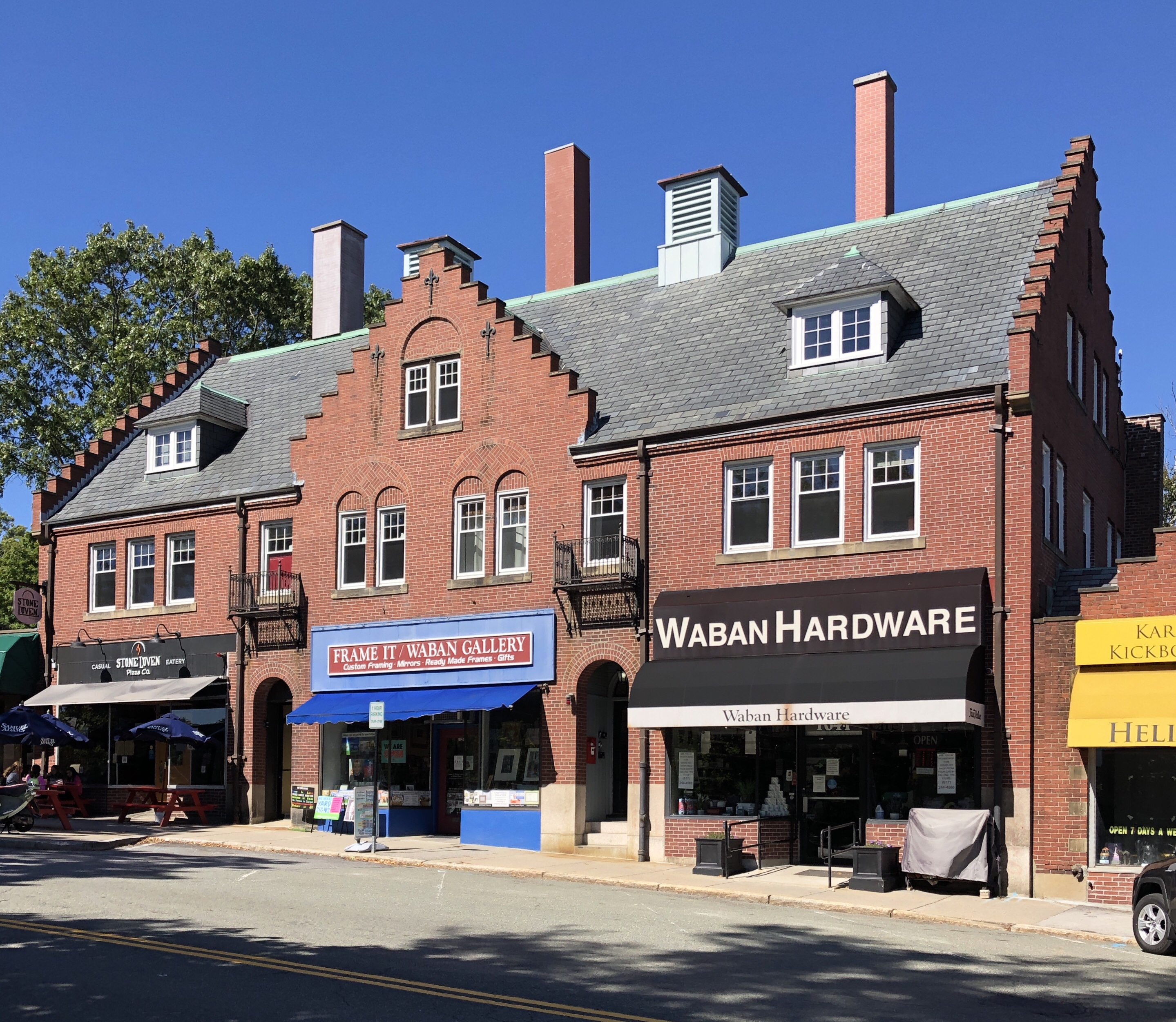
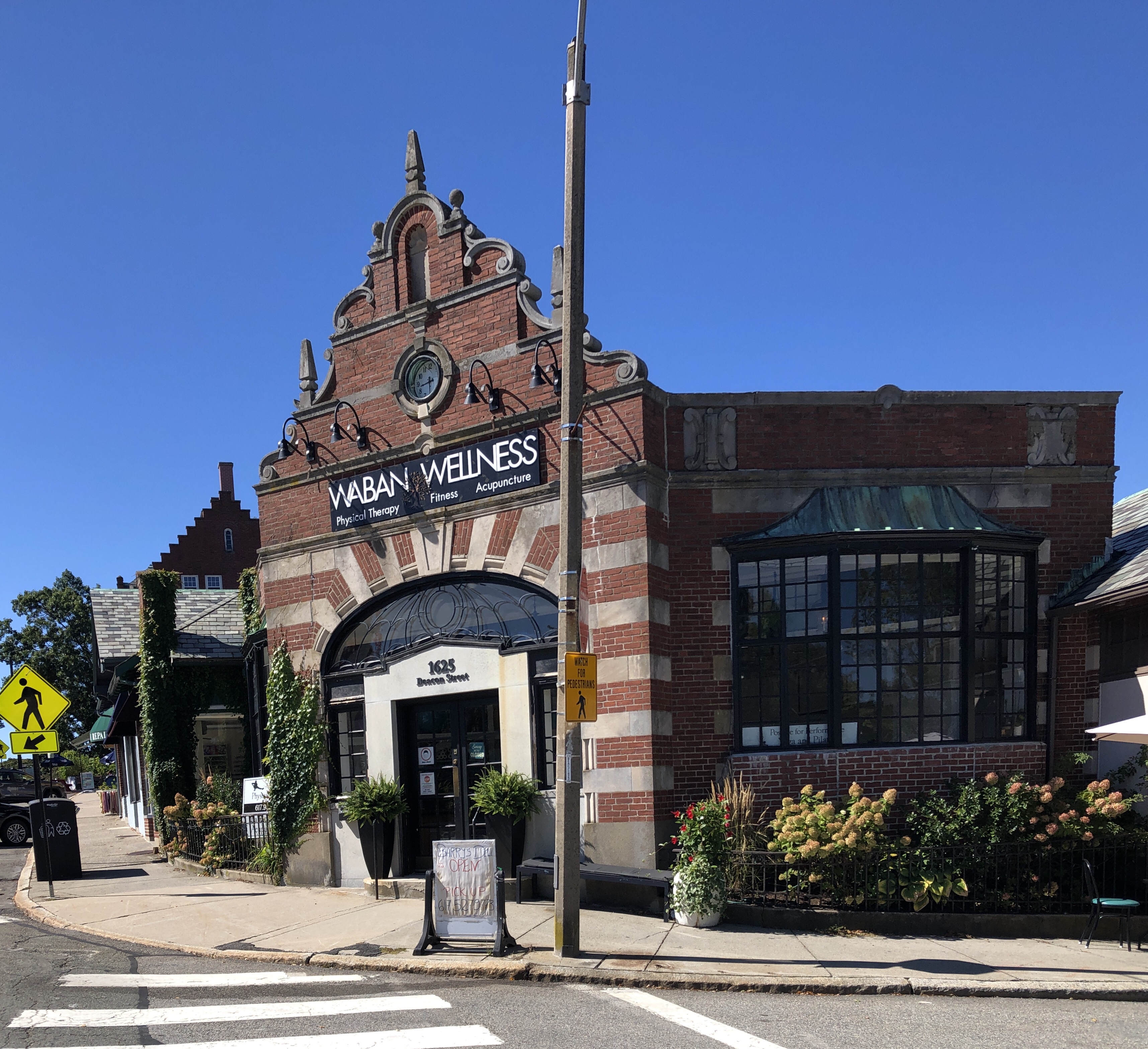
William C. Strong, a prominent local citizen who resided nearby, had this stylish commercial block built to serve the expanding population of the village which eventually became known as Waban. After the completion of the Waban Train Station, the demand for neighborhood retail became apparent and William Strong was an early developer to realize this. He hired Lewis Bacon, an architect who resided nearby, to design the commercial block. The result is a stunning Dutch Revival building with gables showcasing stepped parapets. The upper stories were apparently used as apartments when completed. Notwithstanding Strong’s efforts, the Waban commercial district developed rather slowly. It was not until 1924 that the row of one-story shops was added to its right. The addition was designed by Edward B. Stratton, who followed suit with Tudor and Jacobean motifs, to compliment the Dutch Revival block.
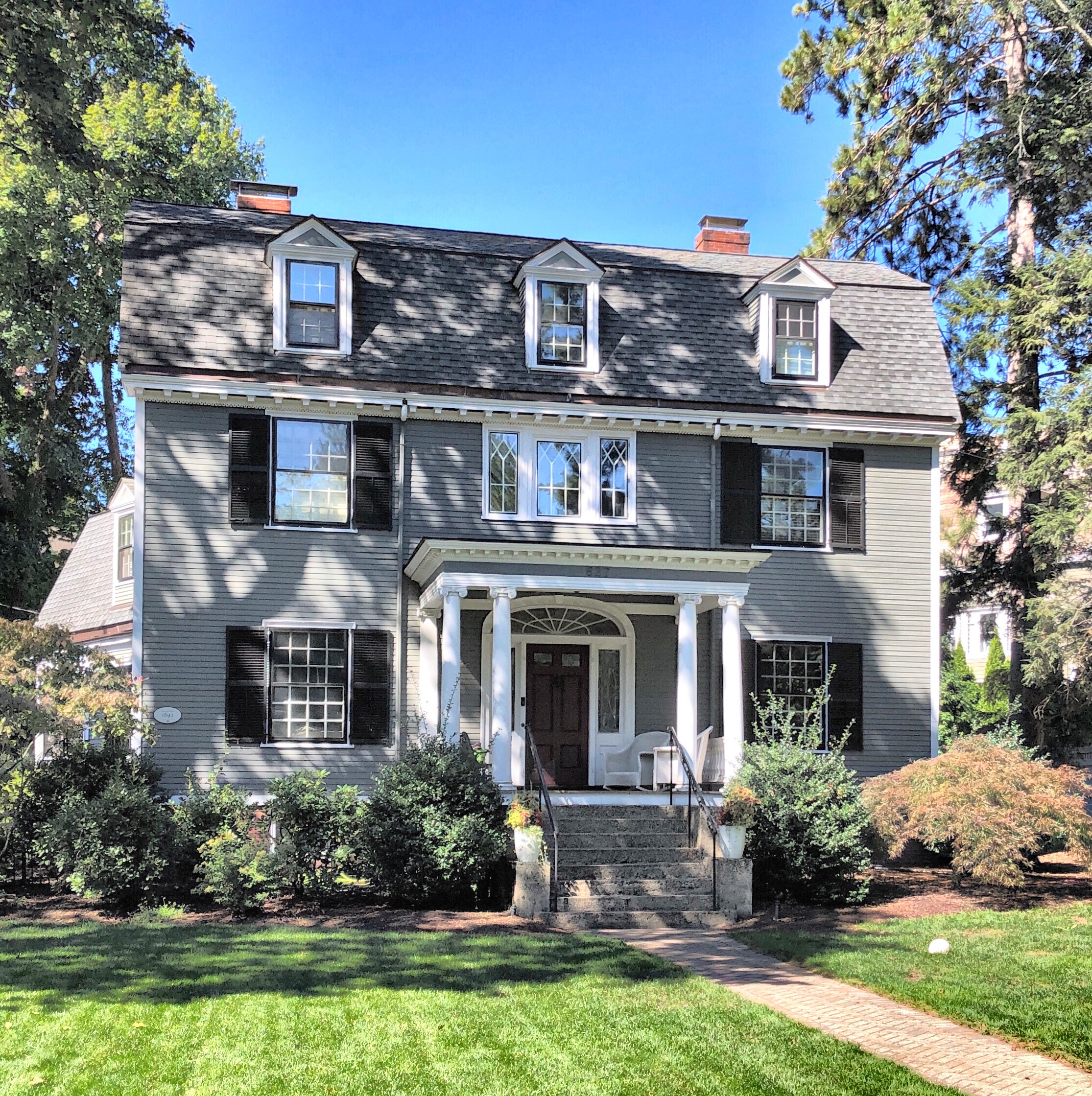
Another architect-designed home for their own use in Waban Village in Newton, is this house on Chestnut Street. Built in 1892, the Colonial Revival home is set far off the street with a commanding presence and symmetrical facade. The home was designed and occupied by Lewis Howard Bacon (1857-1941), a former chairman of the Newton board of appeals and a member of the school committee and the board of aldermen in Newton, also a practicing architect. He studied architecture in the office of Samuel Lane, architect of Cleveland, 1877-80, when he moved to Boston as a draughtsman and supervisor of construction for the firm of Sturgis & Brigham, 1880-1886. For four years he was a member of the firm of Morrison & Bacon (1888-1892), before embarking on his own practice in an office in Downtown Boston. He resided in this home until his health failed and he moved to a nursing home where he died.
After the completion of the Waban Station, providing opportunity for residential and commercial development due to transit to and from Boston, two men sought to develop the area into attractive housing lots. In 1886, Dr. Morrill Wyman, founder of Mount Auburn Hospital in Cambridge, sold the old Wyman Farmhouse (still extant) and 150 acres of farmland to real estate speculators. The speculators, Charles Page and Frederick Henshaw, proceeded to subdivide the land into 87 house lots, creating this suburban neighborhood in Waban we know today. Frederick Henshaw sought to build his own home adjacent to the old farmhouse and hired H. Langford Warren (who then owned the farmhouse next door), esteemed architect and then Dean of the Harvard School of Architecture to complete designs. The Queen Anne mansion with its bold octagonal bay commands the corner lot and is a well-preserved significant home in the neighborhood.
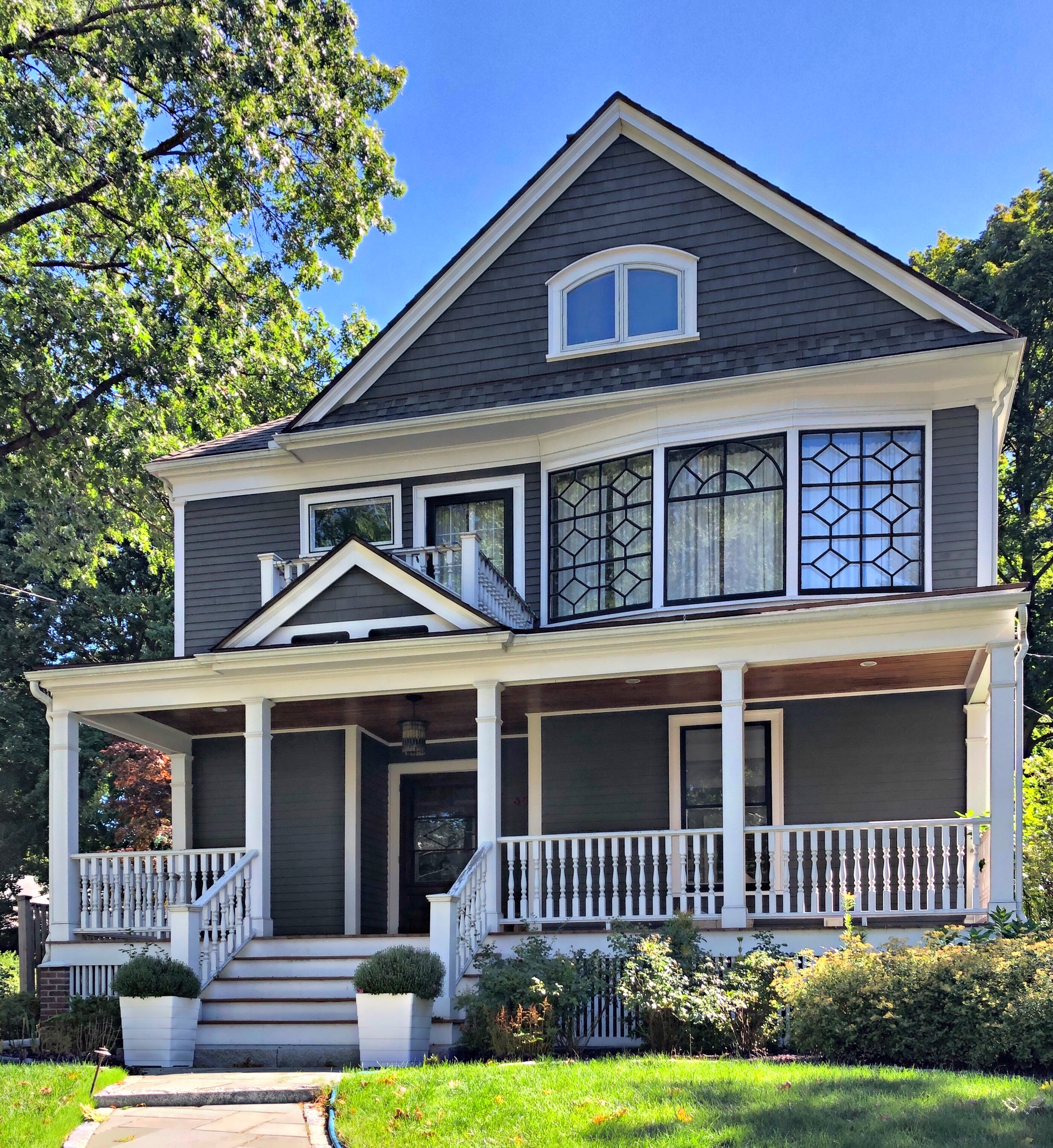
When an architect designs their own home, they typically focus on the minute details which can make such a difference, often because they know what works and what doesn’t! This home was designed and built for William F. Goodwin, an architect with an office in Downtown Boston. After the Waban Station was built in 1886, he sought open space and a large home in suburban Boston, to get away from the hustle-and-bustle of daily life. Years after he moved into his home, he gifted his services to design the neighborhood’s first church, the Church of the Good Shepherd.
For the small population living in the farming village of Waban in Newton, MA, every Sunday, they had to take a horse and carriage or walk to church in a nearby village. The Waban Christian Union was the first religious organization to be established in Waban, 1894-1895 after seeing a suburbanization of the village. The church was to be for services of the Protestant Episcopal Faith, though the group claimed no allegiance to the Diocese, nor was it organized according to the laws of the church. It was independently owned by a corporation that felt the need for a religious association in the community. This church structure was constructed in the summer of 1896 at a cost of $5000 with William F. Goodwin, a charter member of the group (and resident nearby), donating his services as the architect. The organization leased the space to a pastor for $200 a year, later selling it to the congregation, known now as the Church of the Good Shepherd.
The village of Waban in Newton, Massachusetts, was named after a Massachusett Chief who had previously resided atop Nonantum Hill on the Newton-Brighton line. This location is believed to have been a favorite hunting ground for Waban (the Wind) and his people. Throughout much of the 19th century, Waban remained a quiet agricultural region. As late as 1874, fewer than 20 families held title to all of its land. In the mid-1880s, however, interest in suburban developments near the Boston and Albany Railroad became increasingly widespread. Seeing suburbanization in the late 19th century and into the early 20th century.
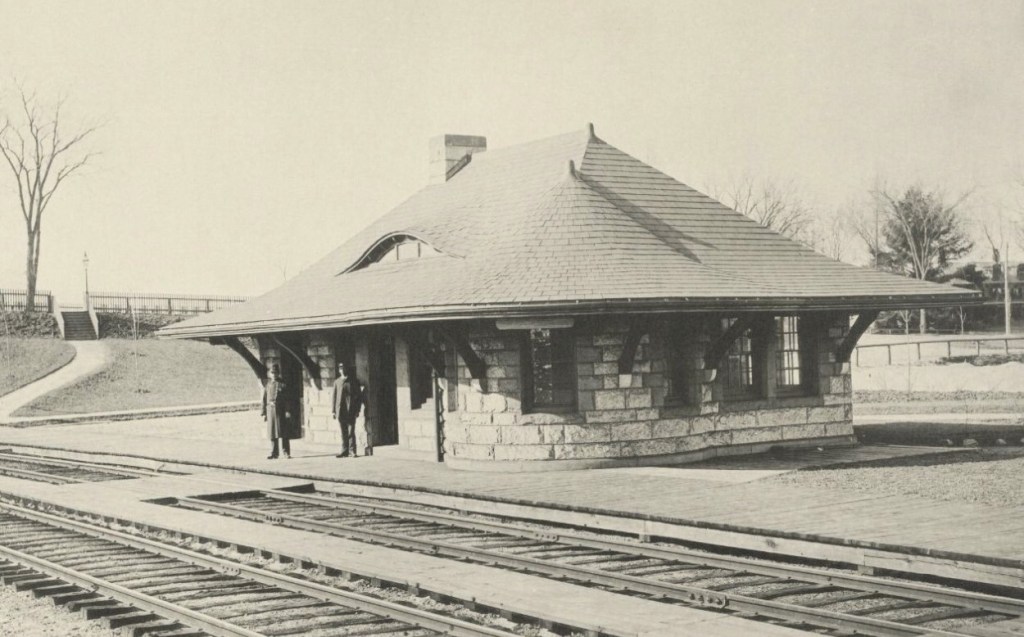
The station that allowed all the development in the early days of Waban was built in 1886. The Boston & Albany Railroad hired renowned architect Henry Hobson Richardson to design the station, and many others on branches of the various lines radiating out from Boston. The Highland Branch (which this station was on) was later acquired by the MBTA in Boston, which operated it as a Commuter line. Waban Station closed along with the rest of the Highland Branch commuter rail line in 1958 and reopened a year later in 1959 as part of the Green Line’s D Branch. The gorgeous H.H. Richardson-designed station was demolished in order to build a 74-space parking lot. They literally paved paradise, and put up a parking lot…



 Buildings of New England
