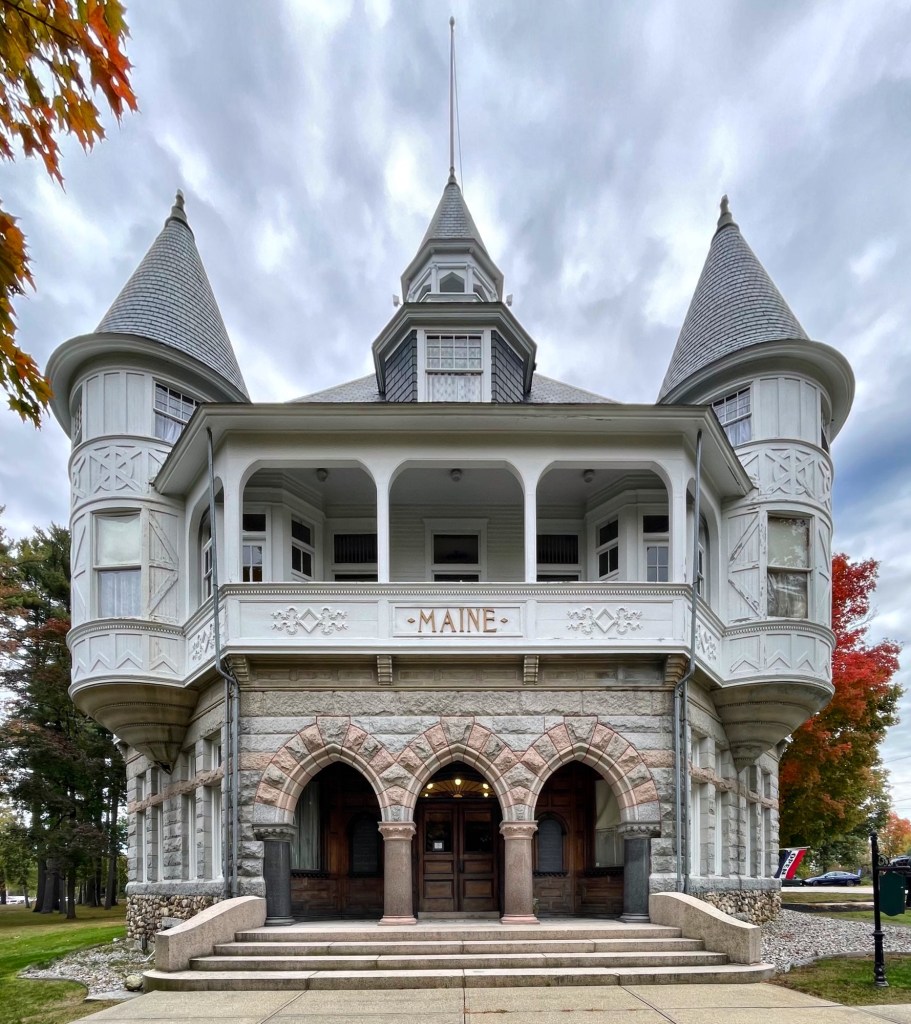
The Maine State Building is a one-of-a-kind landmark located in the Poland Springs Historic District of Poland, Maine, though it was not originally built in this location! The Victorian structure was built in 1893 at the Columbian Exposition in Chicago (aka the Chicago World’s Fair) as one of the State Buildings constructed by each U.S. state to highlight their history. Designed by Chicago architect Charles Sumner Frost, a Lewiston, Maine native and MIT graduate, the building was constructed of granite with a slate roof. After the close of the fair, the Ricker family of Poland Spring, purchased the building from the state. They had it dismantled, moved to Maine, and rebuilt on their resort, which brought even more visitors to their property. In Maine, it reopened in 1895 as a library and art gallery for their hotel guests. Along with the Norway Building in Norway, The Dutch House in Brookline (a personal favorite), the Palace of Fine Arts (now the Museum of Science and Industry) and World Congress Auxiliary Building (now the Art Institute of Chicago) in Chicago, the Maine State Building is one of the few remaining buildings from the 1893 World’s Fair, and the only State Building remaining. It has been lovingly preserved and operated by the Poland Spring Historical Society, who operate the building as a museum.



 Buildings of New England
