Yale University – Phelps Hall and Gate // 1896

After Lawrance and Welch halls (previous two posts) were built on the eastern edge of Yale’s Old Campus, there was a small space between the two that needed to be enclosed to provide a true cloister for students, shielding them from the noise and ever-developing Downtown of New Haven. Architect Charles C. Haight designed the new hall to resemble a medieval gatehouse. The simple, tall rectangular mass has octagonal towers at each corner with copper domes on top and a crenelated parapet resembling an old English castle spanning between them. On the ground floor is the Phelps Gate, the main entrance to the Old Campus from the east. Its namesake was the late William Walter Phelps, an 1860 Yale graduate who served as a Congressman and as ambassador to Germany and Austria-Hungary. The building holds an important role in the annual commencement ceremonies, which begin in the New Haven Green and pass through to the Old Campus through this gateway.

Yale University – Welch Hall // 1891

As Yale University continued to enclose its Old Yard with elongated dormitories in the second half of the 19th century, the proprietors began to experiment with slight deviations to the prototypical Victorian Gothic piles built in the previous decades. Following a financial gift from Pierce N. Welch, an 1862 graduate of Yale College, and his sisters in memory of their late father, Harmanus M. Welch, the college hired architect Bruce Price to furnish plans for the new dormitory. Welch Hall is built of Longmeadow Freestone, the building is more Romanesque in style with arched masonry openings, the rough hewn stone walls, and pointed dormers projecting through the eave lines.

Yale University – Lawrance Hall // 1886

Lawrance Hall was built in 1886 following a financial gift to the college by Frances (Garner) Lawrance, as a memorial to her late son, Thomas Garner Lawrance (1862-1883), who died unexpectedly during his senior year at Yale. The building was designed by New York architect Russell Sturgis, who previously designed Farnam and Durfee halls as well as the Battell Chapel, all enclosing the northeastern edge of the Old Yard. Lawrance Hall is the last Victorian Gothic style building constructed at Yale and also Sturgis’ last commission at the college. Here, Sturgis designed a Gothic building to provide continuity to his earlier dormitories nearby, but added French flair seen at the end towers and rounded turrets at the street facade. The French inspiration may have been a suggestion by Mr. and Mrs. Lawrance as they operated Cercle anglais, an English Club in Pau, France where they occupied Villa Lawrance, when living there. Today, Lawrance Hall is the freshman dormitory for Ezra Stiles College at Yale.

Yale University – Battell Chapel // 1874

As the Old Campus of Yale was being enclosed at its north and east by Farnam and Durfee halls, architect Russell Sturgis was again tasked to design a new building, but for a corner site; though this time, he would design a college chapel. Built between 1874–76, it was funded primarily with gifts from Joseph Battell. Succeeding two previous chapel buildings on Yale’s Old Campus, it provided space for daily chapel services, which were mandatory for Yale students until 1926, which were all-male and mostly Protestant. The large stone chapel is constructed of New Jersey brownstone with decorative elements in sandstone. The design of the Victorian Gothic chapel is great, but how it sits with the entrance unceremoniously dumping out to the end wall of Durfee Hall leaves much to be desired.

Yale University – Bingham Hall // 1928

One of my (many) favorite buildings at Yale University is Bingham Hall, a monumental and landmark example of the Collegiate Gothic architecture style. Built in 1928, replacing the 1888 Osborn Hall (last post), Bingham Hall was constructed as an inward-facing freshman dormitory by architect, Walter B. Chambers, who had just overseen the completion of his first building at Yale, the Colonial Revival style McClellan Hall. Built of Longmeadow brownstone, Bingham Hall largely constructed from funds donated by the children of Charles W. Bingham (Yale, 1868), a Cleveland based businessman. The building stands five stories with a massive nine-story corner tower and helped solidify Yale’s iconic Collegiate Gothic architecture for the future buildings and growth as well.

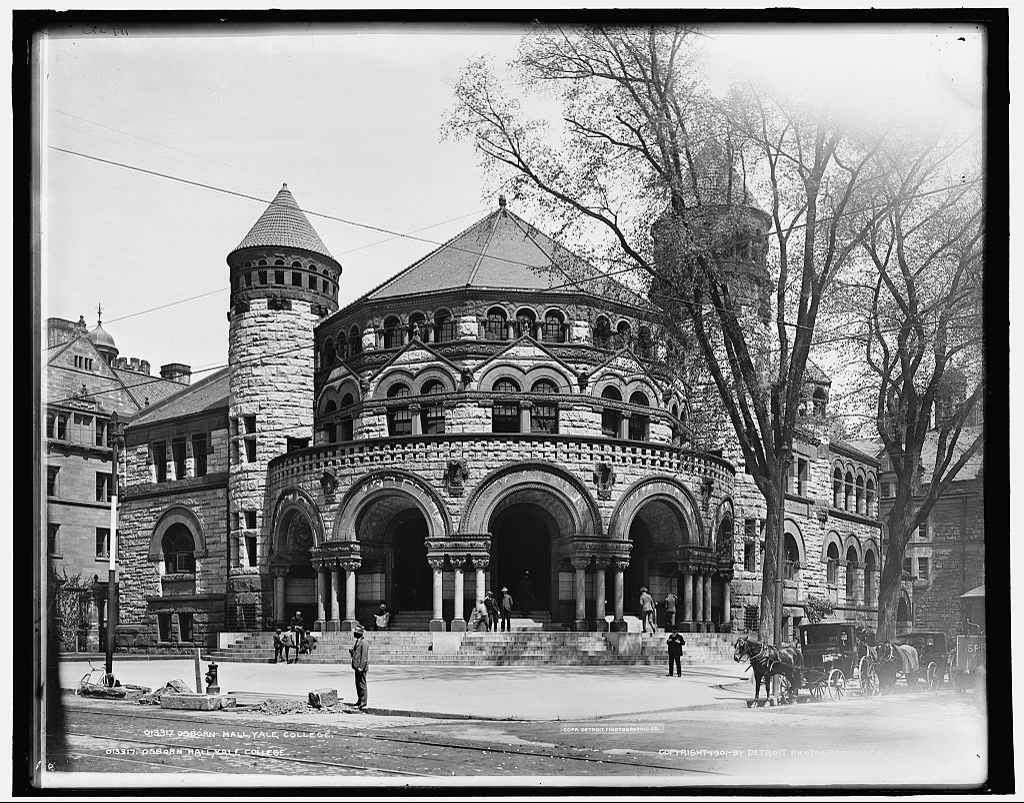
Yale University – Osborn Hall // 1888-1926

One of the biggest architectural losses at Yale was the demolition of the grandiose Osborn Hall in 1926, after standing less than 38 years! The building was constructed in 1888 at the southeast corner of the Old Yard at Yale, at the corner of College and Chapel streets, and was a landmark example of the Richardsonian Romanesque style of architecture. Designed by architect Bruce Price, the building was designed to face outward and was said to resemble a “squating toad with an open lip”. While architecturally stunning, the building was immediately met with criticism. Its construction necessitated the removal of the cherished Yale fence and the outward-facing design made it hard for students to focus on lectures while the sounds of horses and carriages on the cobblestone streets just outside. The short-lived Osborn Hall was razed in 1926 for Bingham Hall (next post), a prominently designed, but inward-facing building.

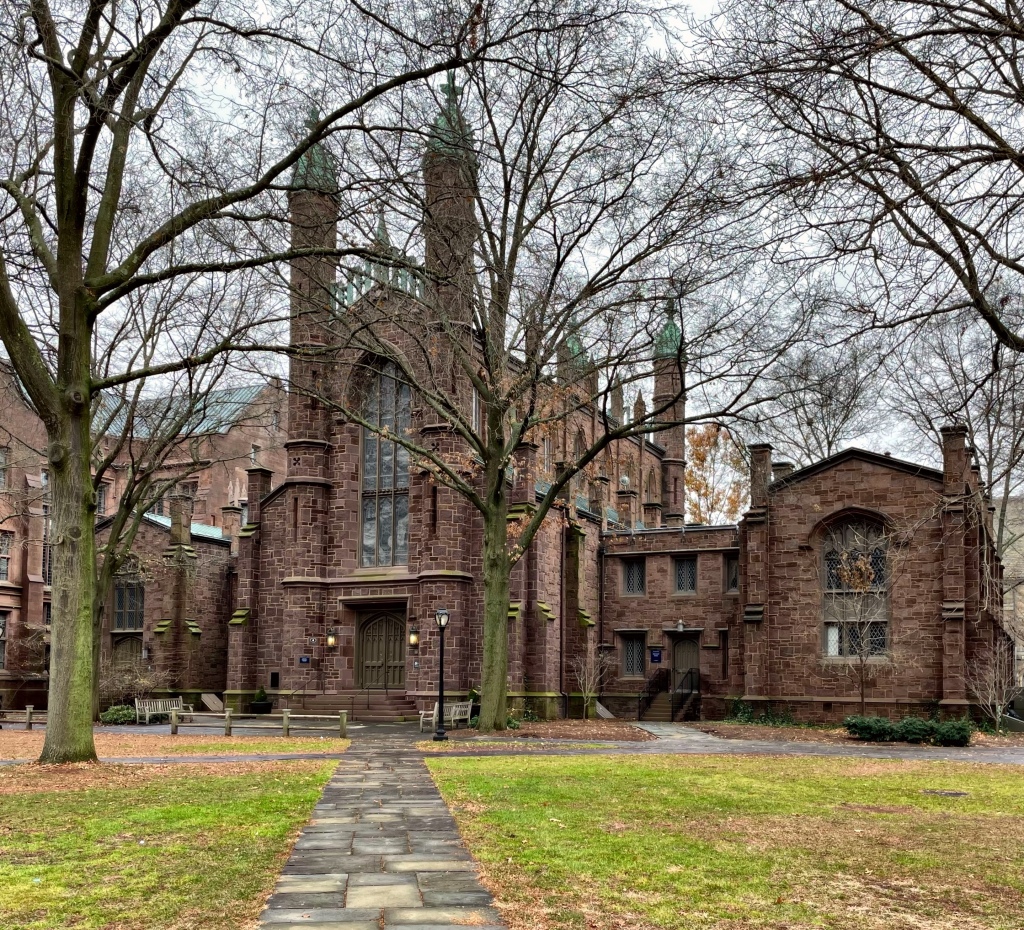
Yale University – Dwight Hall // 1842

One of the most architecturally significant college buildings in the United States, Dwight Hall was designed to house the growing book collection of Yale College as its library. The former Yale College Library, now Dwight Hall, represents a significant shift in Yale’s campus architecture from Georgian and Federal brick buildings to the Gothic mode which the campus is largely known for today. Dwight Hall was designed by local architect Henry Austin with the guidance of esteemed architects Ithiel Town and Alexander Jackson Davis, both experts in early high-style Gothic buildings in America. The design, to me, resembles the 1443 King’s College Chapel in Cambridge, England. The structure is constructed of brownstone from Portland, Connecticut, and it is composed of a central block with two smaller flanking wings on either side connected by smaller linking spaces. At the yard facade, two octagonal towers with domed copper roofs rise, flanking a large, pointed lancet arch window that extends above the doorway. The library was outgrown fairly quickly, necessitating an annex next door and eventually collections were transferred to Sterling Memorial Library in 1930, the Old Library was converted to a chapel and community service building and is known as Dwight Hall.

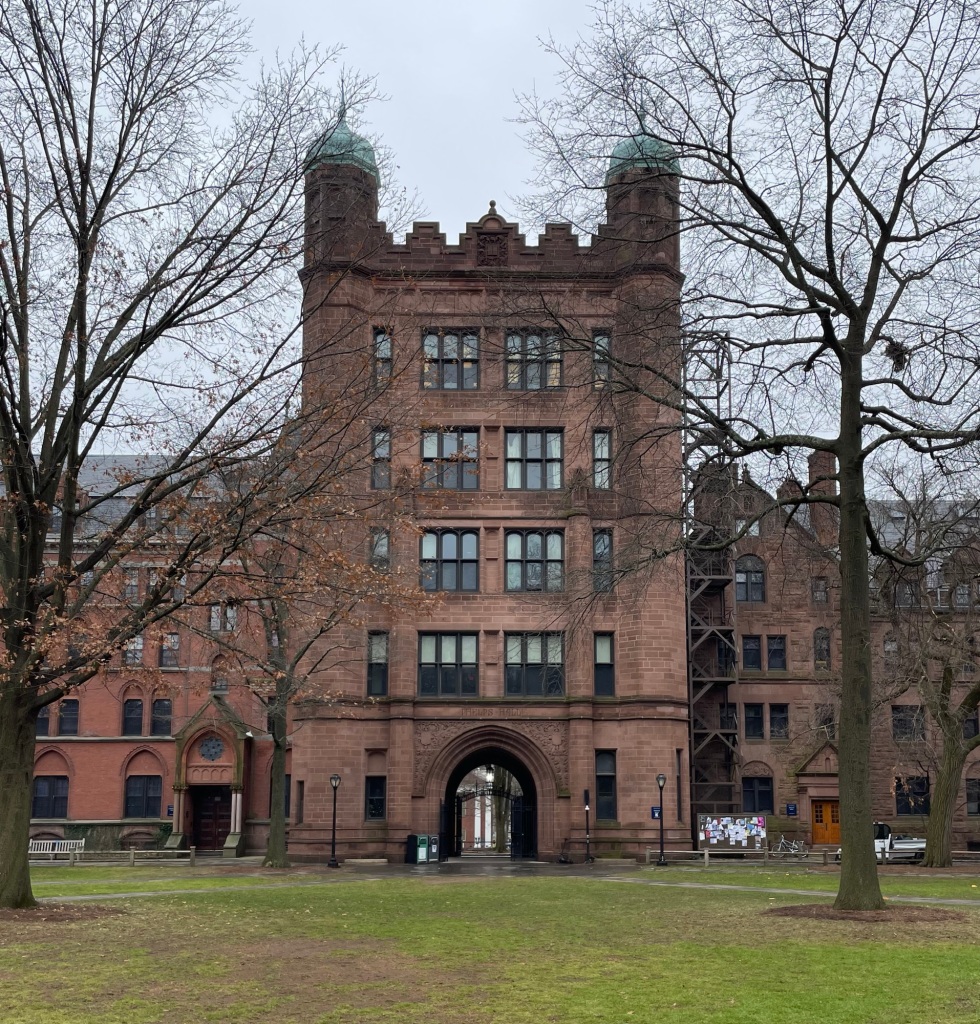
Yale University – Vanderbilt Hall // 1894

Like many other buildings on campus, Vanderbilt Hall is named for its wealthy sponsors, but its foundation is one of family tragedy. One of Yale’s stunning Collegiate Gothic structures, the building is named after William Henry Vanderbilt II (1870-1892), who attended Yale in the early 1890s. William contracted typhoid fever from a water pump while touring the western United States and died during his junior year. His father, railroad tycoon Cornelius Vanderbilt, constructed Vanderbilt Hall in 1894 as a memorial to his son and donated it to the University. The highly prized Vanderbilt room, which is located above the archway, is apparently one of the finest residential spaces on the campus. Architect Charles C. Haight designed the building which enclosed the southern edge of the yard, created a gateway, and is one of the early architectural statement pieces for the campus in the Collegiate Gothic style. Haight would receive later commissions at Yale based on his work on Vanderbilt Hall.

Yale University – McClellan Hall // 1924

Located in the Old Campus Courtyard of Yale University, McClellan Hall stands as an early example of Colonial Revival on the college’s campus. Built in 1924 across from and as a conscious reproduction of the 1752 Connecticut Hall, McClellan Hall adds to the architectural diversity of the Yard, providing some warm red brick to the mix. The building was constructed thanks to a financial gift to Yale by Helen Mynderse McClellan in memory of her late husband Edwin McClellan (1861-1924), Yale ’84. The college hired architect Walter B. Chambers, who would design the building to provide symmetry in the yard against the one Georgian building there, Connecticut Hall. This was following a recommendation by campus architect James Gamble Rogers who advocated for this, stating that the Colonial style was enhanced by symmetrical groupings. The dormitory, which became known as “Hush Hall”, was a secret until workers began digging in the Yard. The decidedly Gothic style campus was disrupted by the Colonial building, which was more Harvard than Yale, and protest began by some students and faculty. President Angell would have to suspend construction for two months to allow the furor to die-down. Today, McClellan Hall is an important visual aspect of the yard, providing a beautiful tapestry of styles within the enclosed space.

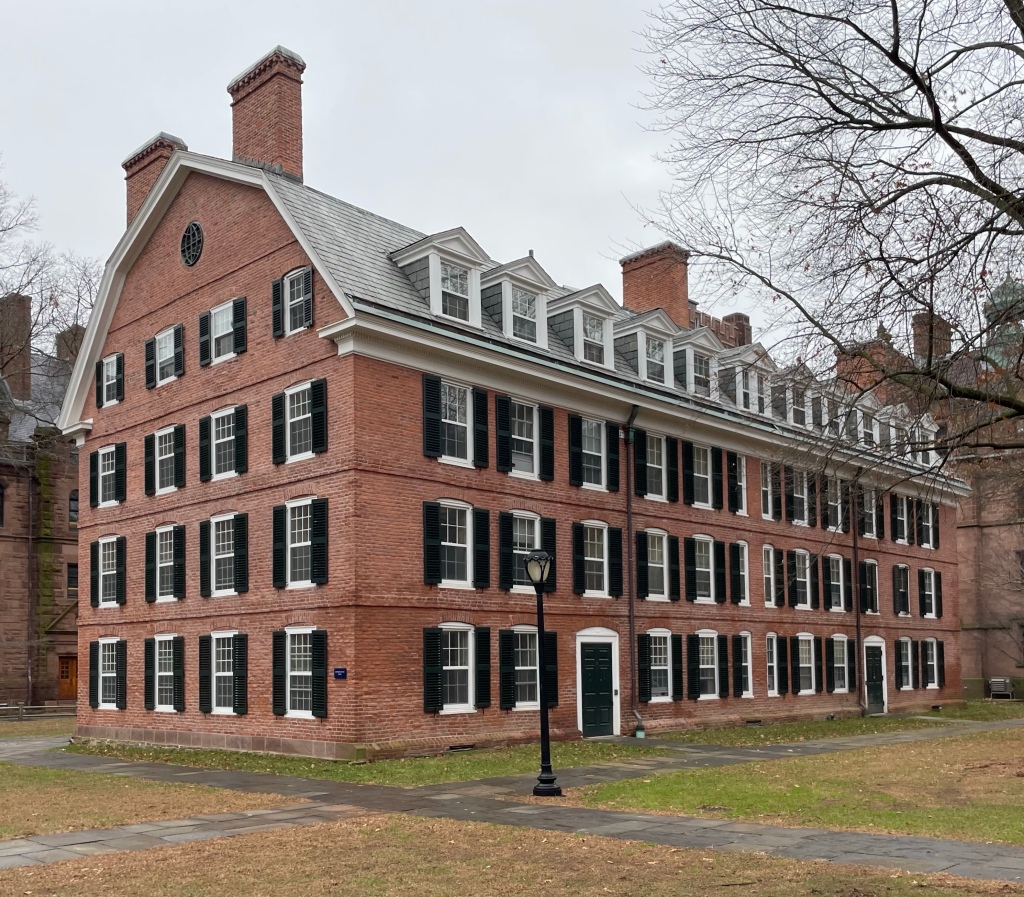
Yale University – Connecticut Hall // 1752

Welcome to Yale! When Yale College, one of the nine Colonial Colleges moved to New Haven in 1718, a wooden building was soon constructed and known as the College House. By 1747, the College House held less than half of the college’s enrolled students, and college president Thomas Clap announced that funds would be raised from the Colony of Connecticut for a “new College House” of three stories. The design followed the traditional Georgian appearance of Harvard College’s Massachusetts Hall, but by the 1790s, it was already outdated. The building was threatened with demolition, but Connecticut Hall was instead given an additional story and a new gambrel roof by 1820, being incorporated into the Brick Row, fronting the Green along College Street. But by the middle of the century the Brick Row was out of style and Connecticut Hall was being described as “dilapidated, scabby and malodorous.” After the Civil War Yale decided to raze all its old Georgian architecture and redevelop the West side of the Green with larger and more modern buildings. Luckily for us, by the 1890’s the Colonial Revival style was booming in popularity and before Connecticut Hall could be demolished, a group of alumni organized to save and restore it. Connecticut Hall stands today as the third-oldest of only seven surviving American colonial-era college buildings, and the second-oldest structure built for Yale College in New Haven (the oldest exant). It was built, in part, by at least five enslaved Africans, including one of whom was owned by Yale president Thomas Clap.