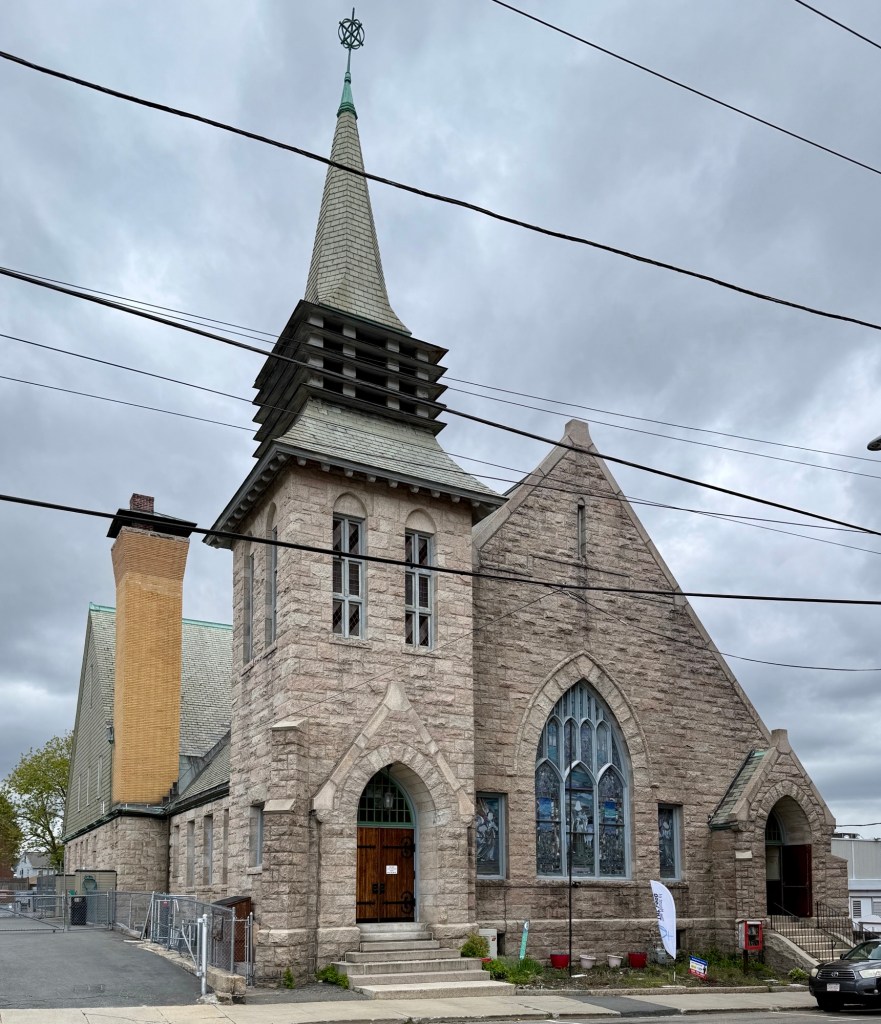
In the summer of 1785, a Universalist congregation was formed in Milford, Massachusetts, making it one of the first in the United States. The Universalists here were led by some illustrious ministers including Thomas Whittemore, an energetic advocate of abolition and an ardent foe of the Fugitive Slave Law; Ebenenzer Fisher who left the Milford congregation to become the first president of what became St. Lawrence University; and Adin Ballou who, after serving the congregation for six years, established a religious commune in the Hopedale section of Milford called “The Hopedale Community” that was to become a model for similar religious organizations. The congregation grew and by the late 19th century, it was decided that a new church in Milford should be built. Local architect, Robert Allen Cook, who was then in his twenties, was hired to furnish plans for this handsome edifice, which was built of locally quarried Milford “pink” granite. Robert A. Cook was a personal favorite architect of the Draper Family of Hopedale and Milford, who likely held sway in his selection. The church was built in 1899 and remains an excellent example of Victorian Gothic architecture with large lancet window and many beautiful stained glass windows in the sanctuary.


My second-great grandfather was Royal T. Sawyer. He was born in Mt. Holly, VT in 1848. He graduated from Tufts College Divinity School in 1870 and was ordained as a Universalist Minister on the anniversary of his birthday, April 25th, 1870, when he was 22 years old. He preached at many churches throughout New England from 1870 to 1897. He was the preacher at Milford from March 1879 to May 1882. He earned a medical degree in addition to his divinity degree. He died in 1898, killed by lightning that came over the wire to his telephone in his home. I realize that he didn’t preach in this building since it wasn’t constructed until 1899. Do you know if any previous Universalist churches still stand in Milford?
LikeLiked by 1 person
I could not locate a photo, but the original church was built in 1851 and sold to the town of Milford when this church was built. It was briefly used as a temporary high school until it caught fire and was razed in 1901. More on the church and a reference to Rev. R. T. Sawyer are found in: Milford, Massachusetts, 1880-1930 : a chronological list of events for fifty years on Archive.org
LikeLike
Thank you for your reply and for forwarding the information. Royal’s collection of sermons has survived and has passed down through the family to me. The sermons are all handwritten by him in little paper booklets bound with string. On the back cover of each sermon, Royal noted the dates and locations where he delivered the sermon. Most were delivered more than once in different locations over the many years that he served. I created a spreadsheet of the sermons with the dates and locations given. I sorted it by chronological order and voila, I have a complete history of his career as a Universalist Reverend that can be used to trace where he was and when! There are no gaps in the record, so I believe we have a complete record of almost 30 years of service. As an architect, lover of history and preservation, and genealogy with ancestors that have been in New England since the 1600’s and who migrated from Newburyport, MA (Sawyer Hill Burying Ground), across New Hampshire (Monson, Sharon, Nelson) and into Vermont (Mt. Holly, Sawyer Rocks), I’ve greatly enjoyed your posts about the Buildings of New England, both for the variety of architectural styles and history that you cover, and especially when the building ties into my genealogical heritage.
LikeLiked by 1 person
Thank you so much for following along and supporting! 🙂
LikeLike