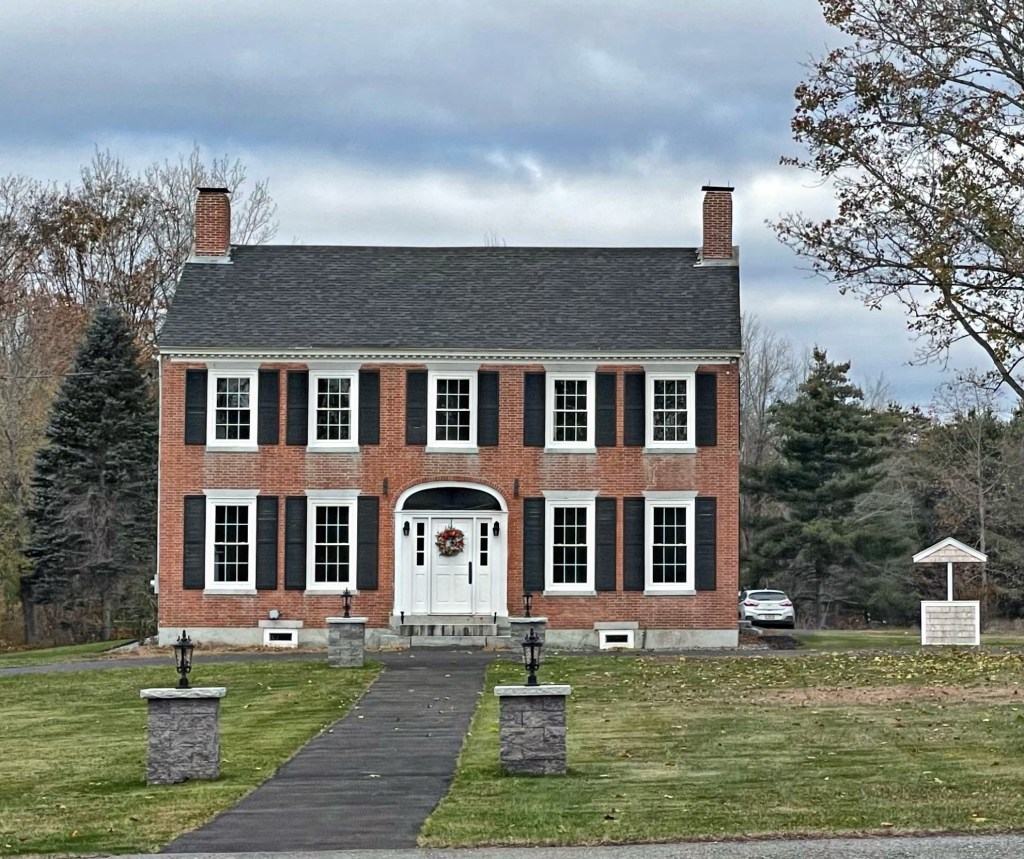
Hezekiah Chase House // c.1820

In 1782, Stephen Chase (1740-1821) settled in present-day Unity, Maine, and built the first frame house there to establish a community. After Stephen’s death, his son, Hezekiah Chase (1774-1848) built this brick, Federal period home for his family, moving his father’s wood-frame house and adding it onto the rear, which remains there to this day. Hezekiah was a judge and was involved in town affairs ever since it was established. The bricks were made locally and were of fine quality. Hezekiah’s son George C. Chase (1844-1919) was raised here. He attended Bates College in its second class, and eventually became a professor of English there. In 1894 he became the second president of Bates College and oversaw a period of significant growth at the college. Chase became known as “The Great Builder” at the college. The old Chase House was listed on the National Register of Historic Places both for its architectural merit and its history and significance to the town and region.

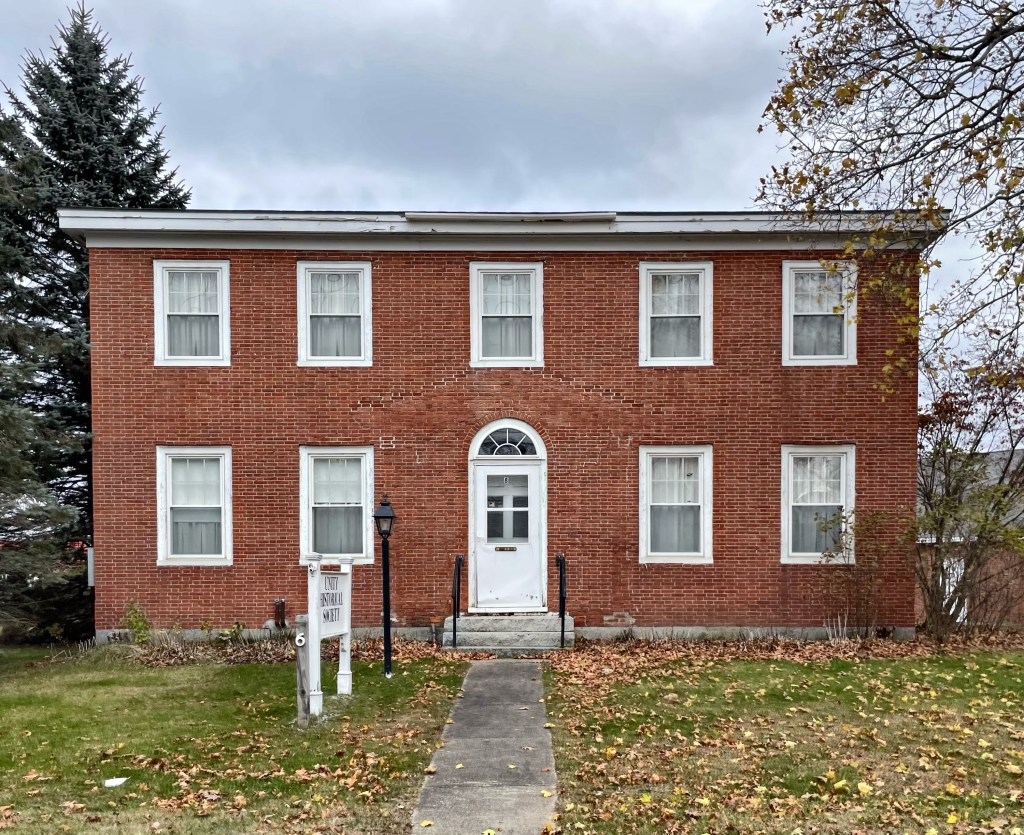
Lemuel Bartlett House // c.1813

When originally settled by Quakers, the town of Unity, Maine, was known as “Twenty-Five Mile Pond Plantation”. The name came from its being located on a pond, twenty-five miles from Fort Halifax in Winslow (creative, right?) The name was changed to Unity upon incorporation as a town in 1804. The town grew steadily through the first few decades of the 19th century and some wealthier residents began building homes. Lemuel Bartlett (1762-1834) built this house around 1813, which is a great, vernacular example of a Federal style residence in rural, central Maine. Lemuel was born in Plymouth, Massachusetts and fought against the British during the Revolution. After the war, he settled in present-day Unity around 1780 and became one of the original proprietors and land-owners here. He worked as a mason and farmer, and likely built this house himself. The property is now occupied by the Unity Historical Society.

South Britain Congregational Church // 1825

The South Britain Congregational Church in Southbury, Connecticut was built in 1825 and was originally known as the Meeting House of the South Britain Ecclesiastical Society. The congregation dates back to 1766 and its first pastor, Jehu Minor, a Yale educated minister from Woodbury, was chosen in 1768. Members met at the Moses Downs House before its first meetinghouse was built in 1770. When the pre-Revolution church building was deemed inadequate, funds were raised to erect a new house of worship. In 1825, boards and other usable parts from the old building were used to construct the present Federal style church that stands in the middle of the village today. History states that pulleys were attached to an ox cart to hoist the bell up the steeple which is by far the tallest structure in the neighborhood. It is an exceptional example of the Federal style, with beautifully balanced proportions, a front pavilion, fine detailing and an elegant three-story steeple. The church made more history when in on September 25, 1937, 178 acres of land in Southbury, Connecticut was purchased for the German-American Bund, intent on building a Nazi camp. Similar camps were popping up around the nation, in an effort to promote an anti-semitic and pro-Nazi agenda. Led by Reverend Lindsay, the pastor of the church, the townspeople quickly established a zoning commission whose first ordinance forbade land usage in the town for “military training or drilling with or without arms except by the legally constituted armed forces of the United States of America.” Stunting the proliferation of nazism in Connecticut before WWII. This is why Southbury is sometimes known as “The town that said no to the Nazis”.

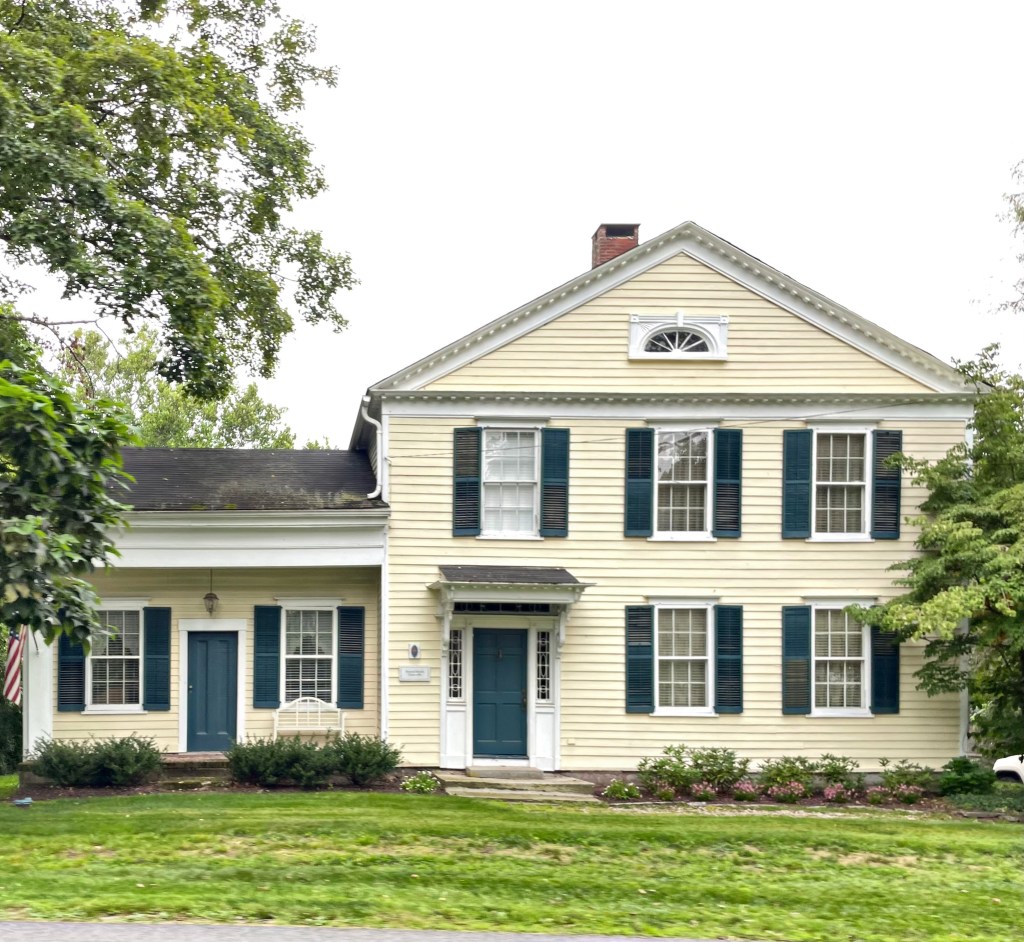
Smith-Pierce House // c.1829

This transitional Federal-Greek Revival style house sits on the main street in South Britain, Southbury, Connecticut. The based on the style, the house was likely built around 1829 for Samuel Smith (1804-1856) who married Caroline Curtiss that year. Federal elements include the entry at the gable end, a pedimented facade embellished with modillions, and a doorway with sidelights and a leaded transom. Some moldings, the six-over-six windows and the simplicity of design are Greek Revival. It is one of the best preserved old houses in this part of Southbury.

Mitchell Double-House // c.1752

This historic double-house in South Britain village of Southbury, Connecticut was reportedly built around 1752 by Zephania Clark with early residents being an M. M. Canfield and C. Muirhill (both possible renters). The house stands out as a rare example of a double-house from this period in a remote/rural section of town. A later owner, Deacon Mitchell deeded the property to two of his sons, who lived side-by-side in mirror residences. The property was likely “modernized” in the Federal period by Mitchell with the paired chimneys, Federal style entry with sidelights, portico, and tripartite window above the central entrance. It is presently covered in aluminum siding – which is likely preserving the clapboard siding and trim underneath – and a metal shingle roof.

Hinman-Peter Parley House // 1777

Sherman Hinman (1752-1793) was born in present-day Southbury, Connecticut as the fourth and youngest child of Colonel Benjamin Hinman and Mary Stiles Hinman. He attended Yale and later married in 1777, his third cousin, Molly, youngest daughter of Captain Timothy and Emma (Preston) Hinman, of Southbury, and settled as a merchant-farmer in his native town of Southbury. He immediately began work on this large, brick mansion to not only impress his new wife, but all the people in town who had not yet seen such a stately mansion in town. He was said to have lived in “dashing splendor” for a few years but was soon reduced to comparative poverty by his extravagance. He died in 1793. The house is most famous for its association with Samuel G. Goodrich, owner from 1857 to 1860, who authored many popular children’s books and textbooks under the name of Peter Parley. By the turn of the 20th century, the expansive property was occupied by the German Lutheran Home for the Aged (now the Lutheran Home of Southbury) with many additions added to the building.

Oldfield – John Moseley House // 1818

Federal style houses are among my favorite styles! From the classical design details to the symmetrical facades, there are so many great examples of Federal style houses in New England. This house in Southbury, Connecticut dates to 1818 and was built by John Moseley (1775-1876), who lived to be 100 years old, and married twice, outliving both of his wives. According to a family history, Moseley personally went to Maine to pick out the wood used to build his house as there were no large trees left in the area when house construction began in 1818. In the early 1900s, the house was updated with a rear addition, built from a structure moved from across the street and attached to Oldfield, and with the addition of the large Colonial Revival style portico at the front entry. The house has been a bed & breakfast since the 1990s, originally called Cornucopia at Oldfield, it is now known as the Evergreen Inn.

Reverend Graham-Howard Richmond House // c.1715

Who doesn’t love a good Colonial house in Connecticut!? This house in Southbury was originally built at the beginning of the 18th century and was later altered and expanded in the fashionable Federal style at the end of the century. The house was built around 1715 by a Nathan Strong, who sold the property to Reverend John Graham who was the town’s pastor for over forty years. The house was later owned by antiques dealers Daniel and Marguerite Croucher. They used the former White Oak Schoolhouse (nextdoor) to store and sell some of their finds! After later owners, the property (which includes the schoolhouse) was purchased by Howard K. Richmond had been a graphic designer and art director in New York. He created the original layout and logo for Life magazine in 1936. He also did advertising and publicity work for Lord & Taylor, Bloomingdale’s, Elizabeth Arden and Saks Fifth Avenue. So many layers of history in over 300 years!

Curtiss-Fabrique House // 1810

Located on Main Street in Southbury, this stately Federal style mansion stands out as one of the most unique and interesting in town! The house here was originally built in the 1760s as a more modest Georgian house by members of the Curtiss Family, one of the earliest families to settle in the area after land here was purchased from the Potatuck Native Americans. In the early 19th century, the house was modernized in the fashionable Federal style, giving the house the present appearance. The facade is dominated by an excellent doorway with a projecting Palladian portico above. The property was later owned by Benjamin Fabrique.

Benjamin Osborn House // c.1808

This charming cottage shows that you do not need a stately or elaborate house to have some serious curb appeal and house envy. This is the Benjamin Osborn House, located in Southbury Connecticut. The house was built in the early 20th century for newlyweds Benjamin B. Osborn and Sarah Stiles, who married in 1808. As a gift to the couple, Sarah’s father Ephraim Stiles, who lived in a house across the street, seemingly deeded a portion of his property for his daughter and son-in-law to build their family. Tragically, Sarah died one year later, possibly during childbirth. Benjamin would marry another of Ephraim’s daughters soon after… messy. The home is a four-bay Cape, with its off-center entrance sheltered by a Colonial Revival hip-roofed portico supported by Tuscan columns.