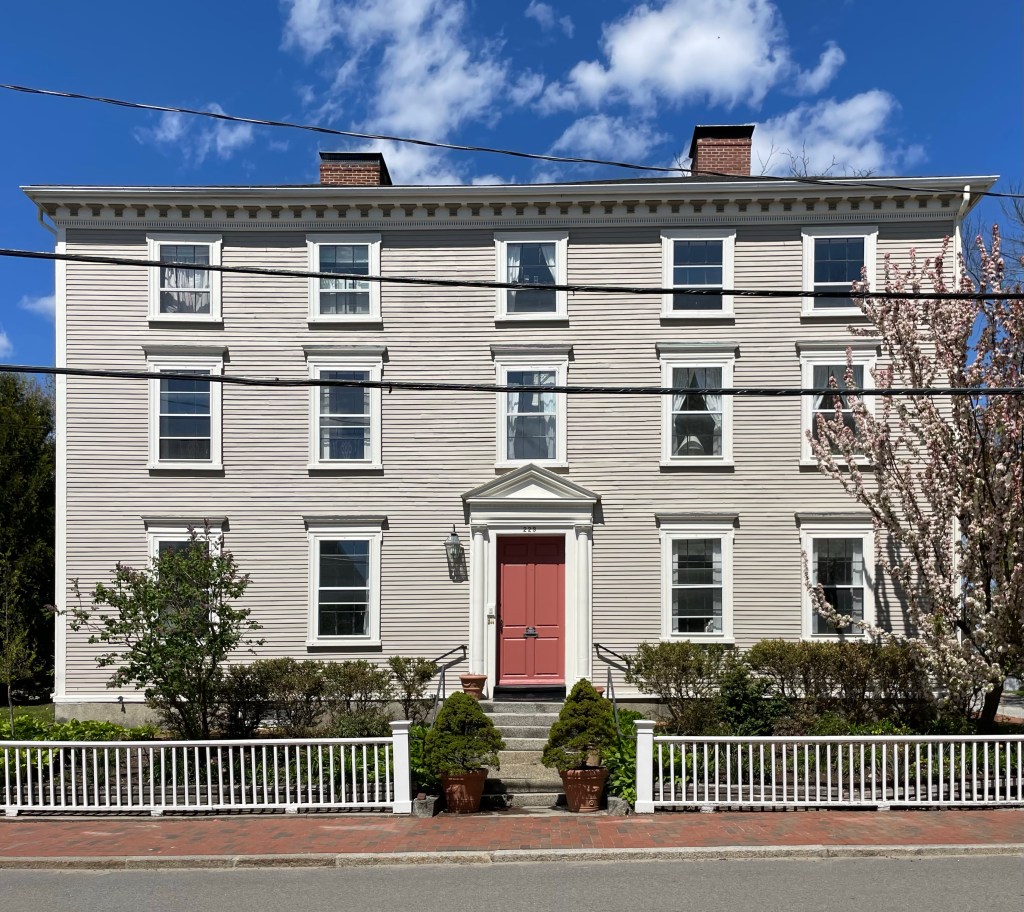
The Captain Drisco House on Meetinghouse Hill Road is a recently restored example of the vernacular Federal period architecture so many flock to Portsmouth to see. The house sits in the middle of a warren of short streets where houses (all built before zoning and setbacks) were built right at the sidewalk creating the most pleasant walking experience. The symmetrical five-bay Federal house was built by Captain Drisco, who purchased the house lot after the Revolutionary War.
Many may not know this fact about Portsmouth, which shaped the city’s development for some of the formative years of the coastal town. The 1814 Brick Act was passed by the New Hampshire legislature after three devastating fires wiped out hundreds of closely-packed wooden buildings in the heart of the state’s only seaport. The act prohibited the erection of wooden buildings of more than twelve feet high in the downtown area which was the densest, it was effectively an early building code. The regulation helped change the look of the city, creating the red brick image Downtown that many identify today as Portsmouth. As a result, nearly all homes and buildings in the downtown area of Portsmouth were constructed of brick, largely in the Federal style, popular at the time. This home was constructed around 1815 as a wedding present for the South Parish’s minister, Reverend Doctor Nathan Parker, upon his marriage to Susan Pickering, the daughter of New Hampshire Chief Justice John Pickering and a descendant of the original John Pickering.
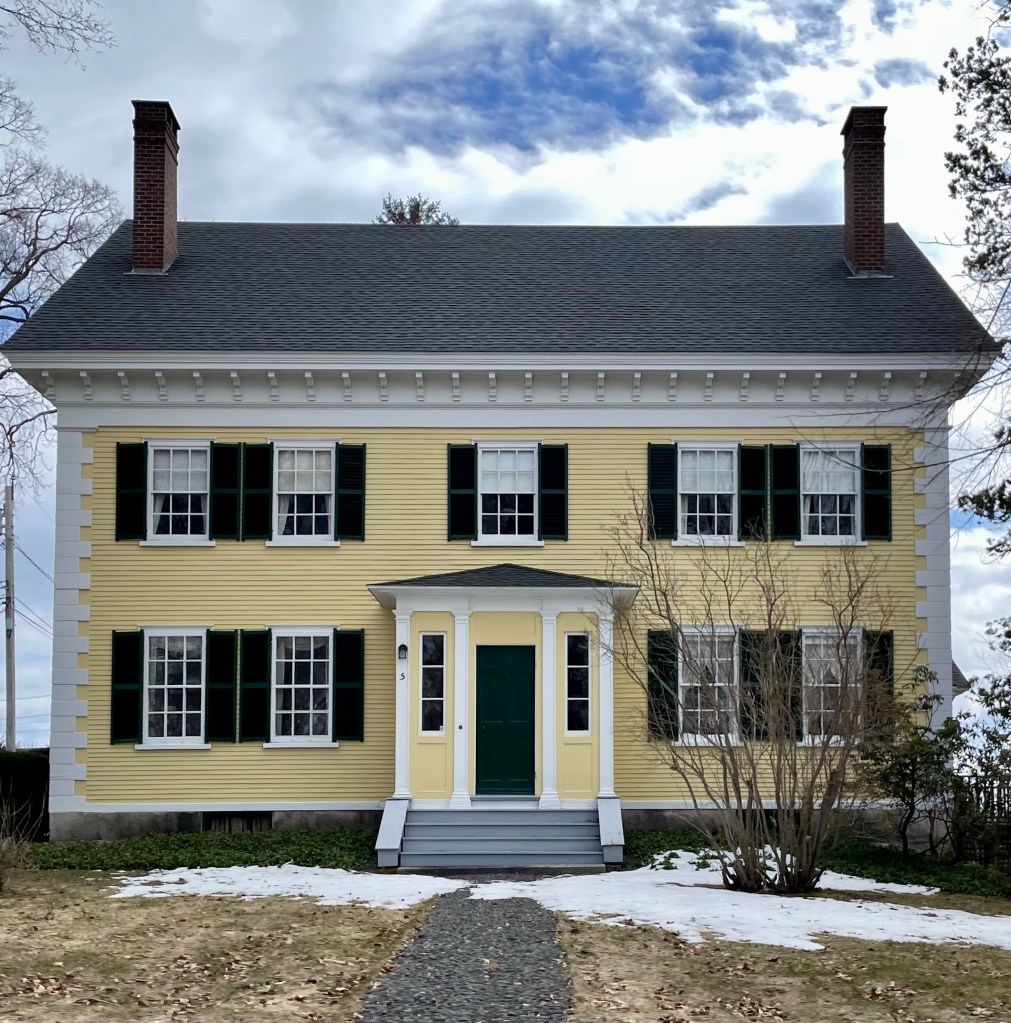
Another three-story Federal period house on Pleasant Street in Portsmouth, NH is this wood-frame example, known as the Haven-White House. The property was developed in 1799-1800 by Joseph Haven, a merchant who built the house across the street from his father’s residence. Joseph Haven occupied this house until his death in 1829. After his wife Sarah’s death in 1838, the house remained in the Haven family, though usually occupied by others, until 1898 when it was sold to Mrs. Ella White. The White family, which included a grocer, a City Councilman in the early 1900s; and a chiropractor, with the family occupying the house until 1981. This history of long ownership by only two families for nearly 200 years perhaps accounts for the survival of this important house with so few changes. As a result, the house was listed on the National Register of Historic Places in 1985, marking it as a nationally significant building.
The Abraham Wendell House on Pleasant Street in Portsmouth, New Hampshire, is a three-story, five-bay, masonry Federal-style residence with symmetrical facade. The building has a slate hip roof with overhanging eaves, a dentilled cornice, and tall brick chimneys. The facade has a wood-paneled entrance door with elliptical entablature, Corinthian pilasters, and a fanlight above. The home was built around 1815 for Abraham Wendell (1785-1865) a ship’s chandler and hardware merchant. Along with his brothers, Jacob and Isaac, established cotton mills in Dover. Although they lost money on the early mill attempts, they became wealthy importer of foreign goods into the ports of Portsmouth. The house remains a highly significant example of early 19th century residential architecture built for wealthy merchants.
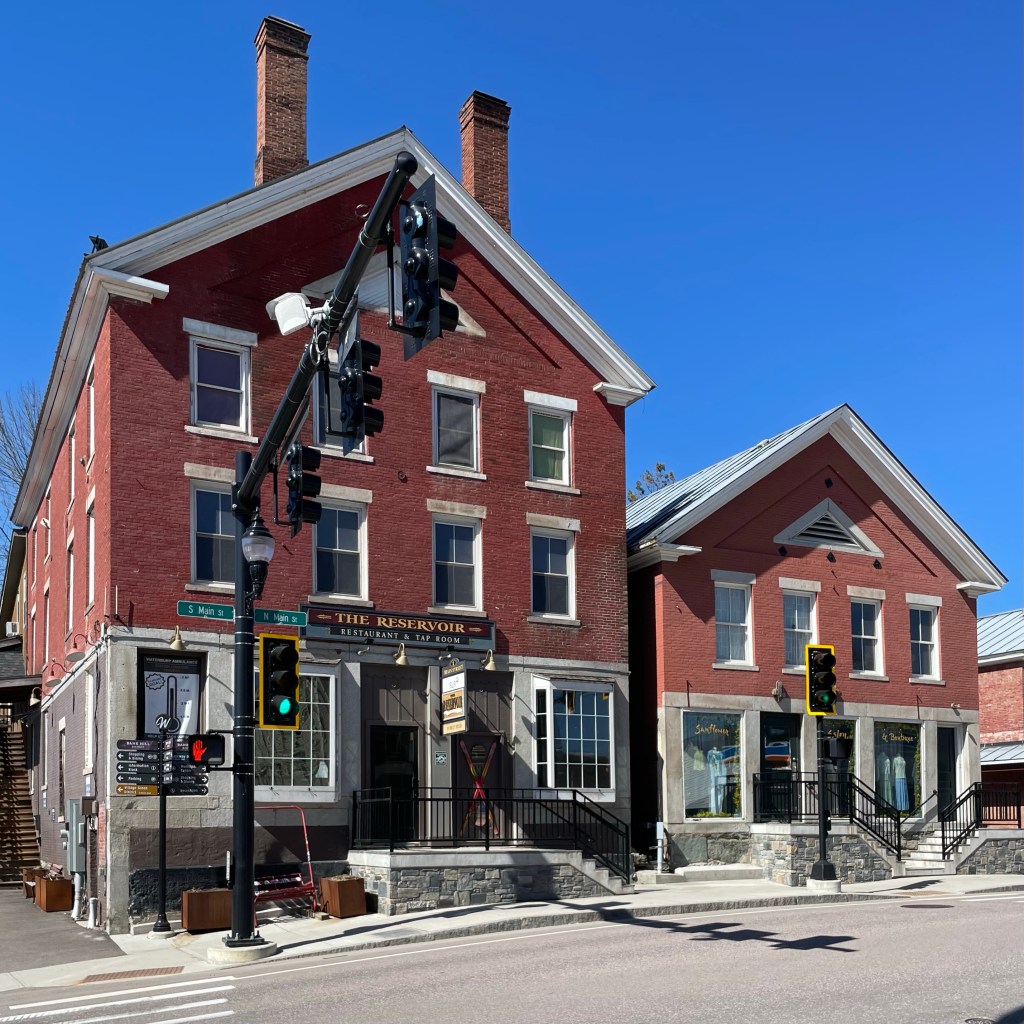
While of different scale, these two brick buildings on Main Street in Waterbury, Vermont compliment each other very well. Vincent’s Pharmacy, the smaller building, was built in 1834 in the Federal and Greek Revival styles by Dan Carpenter, early lawyer and judge, to house a pharmacy business that he ran with his son, William. Next door, dating from approximately the same year as the pharmacy, the larger structure housed Waterbury’s first Masonic hall in 1860’s and in successive years a hardware business. The former Masonic hall is now home to The Reservoir, a great local restaurant that I grabbed lunch in while visiting the town.
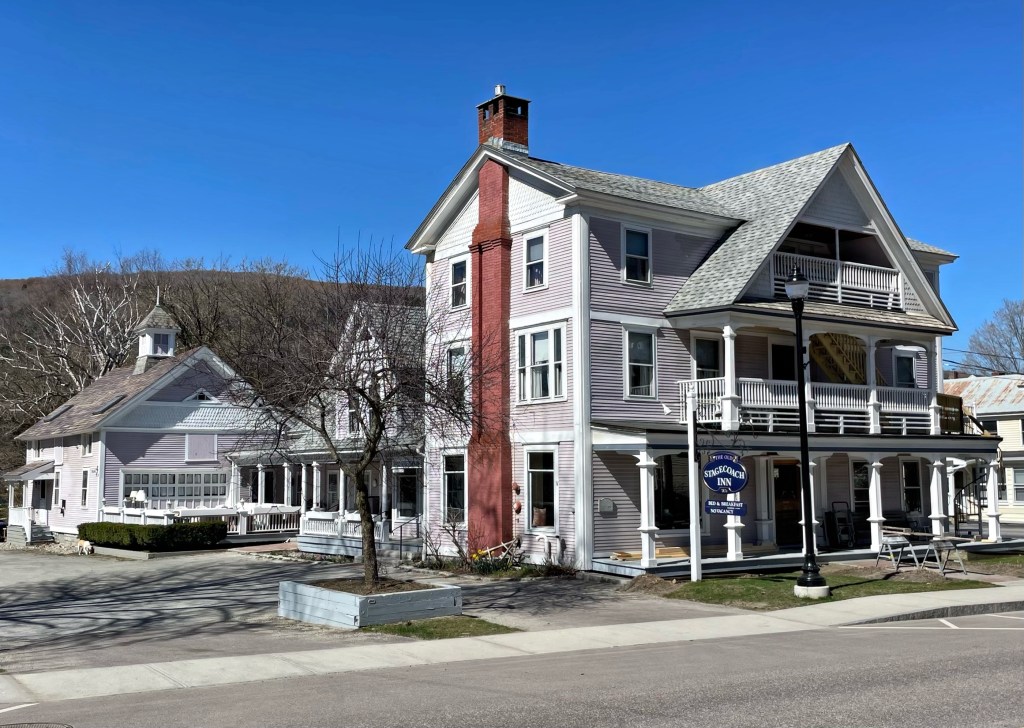
Built by the Carpenter brothers in Waterbury, who also designed and built the neighboring Congregational Church (last post), this large structure was a stagecoach stop on the road to Stowe for much of the nineteenth century. Briefly, the Inn served as a private residence for Albert and Annette “Nettie” Spencer. Nettie grew up in Waterbury and married Albert who owned rubber factories in Ohio and invested in real estate in Burlington. At one time, the Spencers’ residences included their Waterbury house, a suite at the Waldorf Astoria in New York City, a house in Newport, an apartment in Paris, as well as one in London. Albert died in London, and Nettie continued living in Waterbury until her death in 1947, approaching 100 years of age. Within a year, the property was sold and the owners reopened the main house as a sort of boarding house. The property was restored and operates today as the Old Stagecoach Inn.
White settlement in Waterbury Vermont began in about 1770, with the establishment of a small cluster of houses along the Winooski River near what is now Winooski Street. When Main Street, a stagecoach route paralleling the river opened in the 1790s, development moved to that area, including the construction of churches, residences, and businesses. Industry followed, and a town was formed. Many settlers arrived here from Waterbury, Connecticut, and named their new village Waterbury as a result. Many early commercial buildings were constructed with wood frames, but as the town prospered, businessmen developed more substantial brick blocks. This charming Federal/Greek Revival commercial building was erected in 1833 at the most prominent corner on Main Street in Waterbury, by Leander Hutchins (1798-1879). It is apparently the oldest extant commercial structure in the downtown section of Waterbury! The building has been restored in the late 20th century, down to the multi-pane windows and granite lintels. This building is just so perfect.
The Oliver Walker House in Kennebunkport Village is one of the better examples that shows how overlapping architectural styles can work really well on an old house (when done right)! The original house was constructed around 1809 for Oliver Walker (1788-1851), a sea captain who later accepted the call and became a deacon for the South Congregational Church in Kennebunkport. Walker died in 1851 and the Federal style property was inherited by his only surviving child, daughter Susan, who had married Portland native, Captain John Lowell Little. Under their ownership, the traditionally designed Federal house was modernized with fashionable Italianate style modifications of the decorative brackets and an enclosed round arched window in the side gable. A later Colonial Revival projecting vestibule adds to the complex, yet pleasing design. I have a feeling the interiors of this house are just as spectacular as the exterior.
Houses with unique names are always the most fun to research and post! This stately Federal style mansion in Kennebunkport was built in 1810 for Samuel Lewis (1777-1857), a cabinetmaker and carpenter in town. Lewis also worked as an undertaker and made glass-top coffins from 1801, until his death. It is estimated that Mr. Lewis made 2,500 coffins during his career – including his own. Samuel was a quirky character and built his home as a large addition to a 1762 home, which possibly remains today as an ell. The 1810 house with original transom and sidelights at the entrance was two stories as built which contained a spiral staircase that ended on the second floor at a skylight. Thus, the house became known locally as “Samuel’s Stairs.” A later owner added the third floor, but maintained the Federal proportions. SWOON!
Believe it or not, this stunning Federal mansion in Kennebunkport was a marriage present! When Phebe Walker married Nathaniel Lord in 1797, Phebe’s father, Daniel had this home built for the new couple. Phebe and Nathaniel had a total of nine children before Mr. Lord died in 1815 at 38 years old. Before his death, the wealthy couple used part of their property to erect a larger home, which is now known as the Nathaniel Lord Mansion. The couple sold the property, and it was owned for some time by Captain Alden B. Day, who passed it down to his daughter Nellie and her husband, William Gould. The property remained in the Day-Gould family until 2017. The house is very well-preserved and looks much like it would have appeared when built in 1799 besides the later entry added in the mid-19th century.
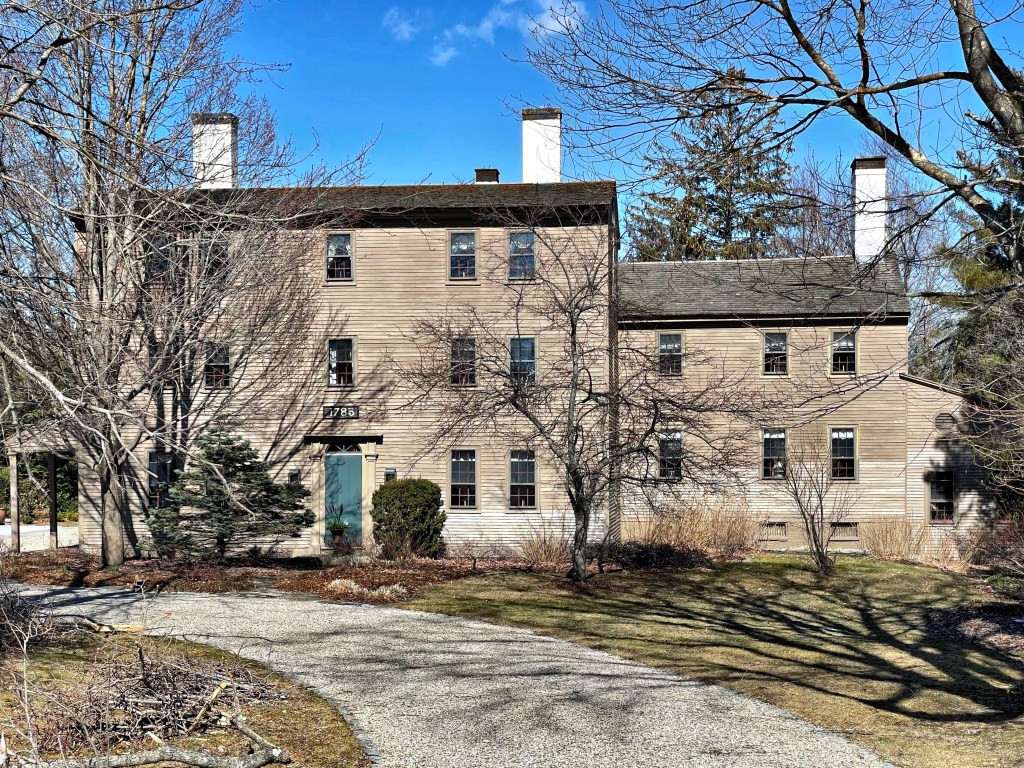
One of the hidden architectural gems of Kennebunkport is this Revolutionary-era house with some serious proportions. The house was built around 1785 by Benjamin Coes, a sailmaker from Marblehead, who settled in the burgeoning Kennebunkport in search of new work and opportunities. He married Sarah Durrell and the couple erected the seventh house in town, which is part of this property. For his work, Mr. Coes used the first two floors as his residence and the third floor was used as a sail loft, with an exterior staircase. A young boy, Joseph Brooks, would work in the loft and he would go on to marry Benjamin’s daughter, Sarah. The couple inherited the family house and retired here. The property was sold out of the Coes-Brooks Family when Maine State Historian, Henry Sweetser Burrage and his wife Ernestine purchased this house in 1917, which would be used as a guest house. The couple and lived in the house across the street. Ernestine Burrage, who was Chairperson of the Kennebunkport Chapter of the Red Cross, allowed the ladies of her chapter to gather there three times a week to roll bandages for the soldiers injured in battles overseas. It became the headquarters for the Kennebunkport Red Cross. It was likely Ernestine who had the chimneys painted white, which resembled the old Tory Chimneys in Revolutionary-era New England; where, when painted white, they served as a quiet signal which indicated that a home’s residents were loyal subjects of the British Crown.
John Bourne (1759-1837) was born in Wells, Maine as the son of Benjamin Bourne. When the American Revolution hit a peak, when he was only sixteen years of age, John enlisted in the service of the country, and marched in company of Capt. Thomas Sawyer, to Lake Champlain. After the war, he learned the trade of shipbuilding and established himself in Kennebunkport, at the height of the village’s manufacturing. John Bourne built ships for a wealthy ship-owner and became successful himself. Bourne was married three times. His first wife, Abigail Hubbard (m.1783) died at just 24 years old after giving him three children. He remarried Sally Kimball a year later, who died in her twenties at just 28, she birthed one son for him in that time. His third wife, Elizabeth, would outlive John, and they had five children together. After his marriage with Elizabeth, John likely had this home built, possibly from his own hands. The Federal style home stands out for the unique entry with blind fan and modified Palladian window framed by engaged pilasters.
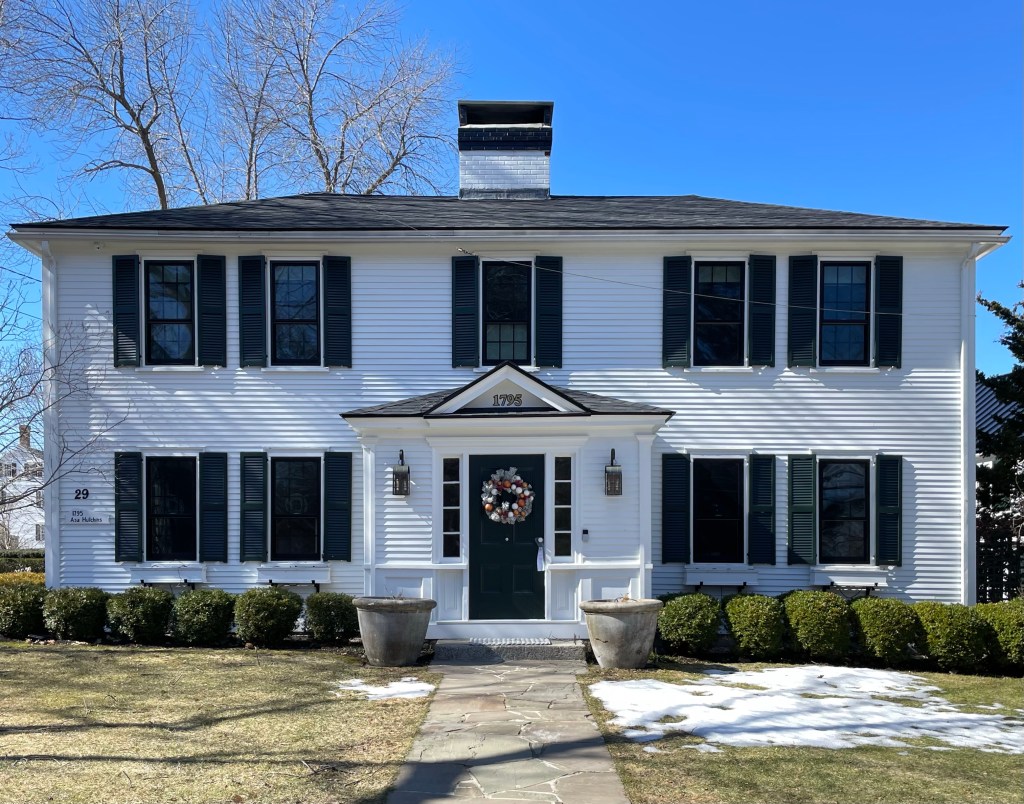
The village of Kennebunkport in Maine is a well-preserved enclave of Federal period houses built at the heyday of shipbuilding and maritime trade in the late 18th and early 19th centuries. Many sea captains and shipbuilders erected stately homes in the village, with high-quality design and woodworking inside and out. This Federal period home was built for Asa Hutchins (1769-1860) a blacksmith who was born in Portsmouth, New Hampshire and settled in Kennebunkport in the late 1700s. The house exhibits a central chimney a feature more common in Colonial-era homes, with a five bay facade and projecting entrance.
In about 1812, Captain Nathaniel Ward Jr. of Kennebunkport purchased this home in the village from housewright and builder Samuel Davis. The Federal style house is five bays with a central entrance with pedimented fan over the door. Two end chimneys would heat the home in the winter months when Nathaniel was out at sea and his wife, Sarah, would be maintaining the home and caring for their six children. The couple’s eldest son Charles Ward, served as the second American Consul to Zanzibar in Africa. In his role, Ward bickered continuously with the Sultan, whose word of law changed with the wind and he eventually left his position and settled in Salem, Massachusetts. This house was later owned by Abbott Fuller Graves (1859–1936), a renowned painter before he built a Prairie Style house in Kennebunkport in 1905.
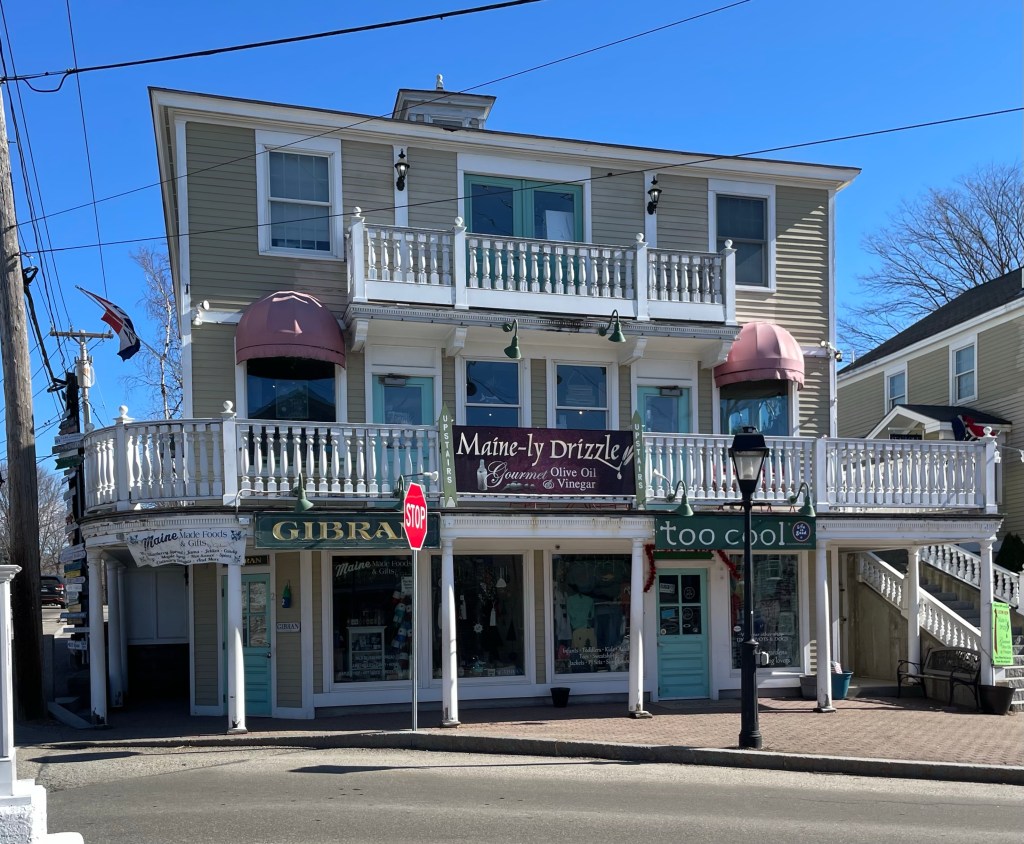
Across from the Luques Store in Dock Square in Kennebunkport, another 19th century commercial building serves as a visual anchor to the vibrant village, this is the Benjamin Mason Store. Built in the 1810s, the Federal style commercial block was originally owned by businessman Benjamin Mason (1777-1855) who built a house in 1812 just nextdoor (which has since been converted to commercial use). The store is three-stories with a cupola at the roof. Later porches were added as the village prospered.