Bullet Hill Schoolhouse // c.1762

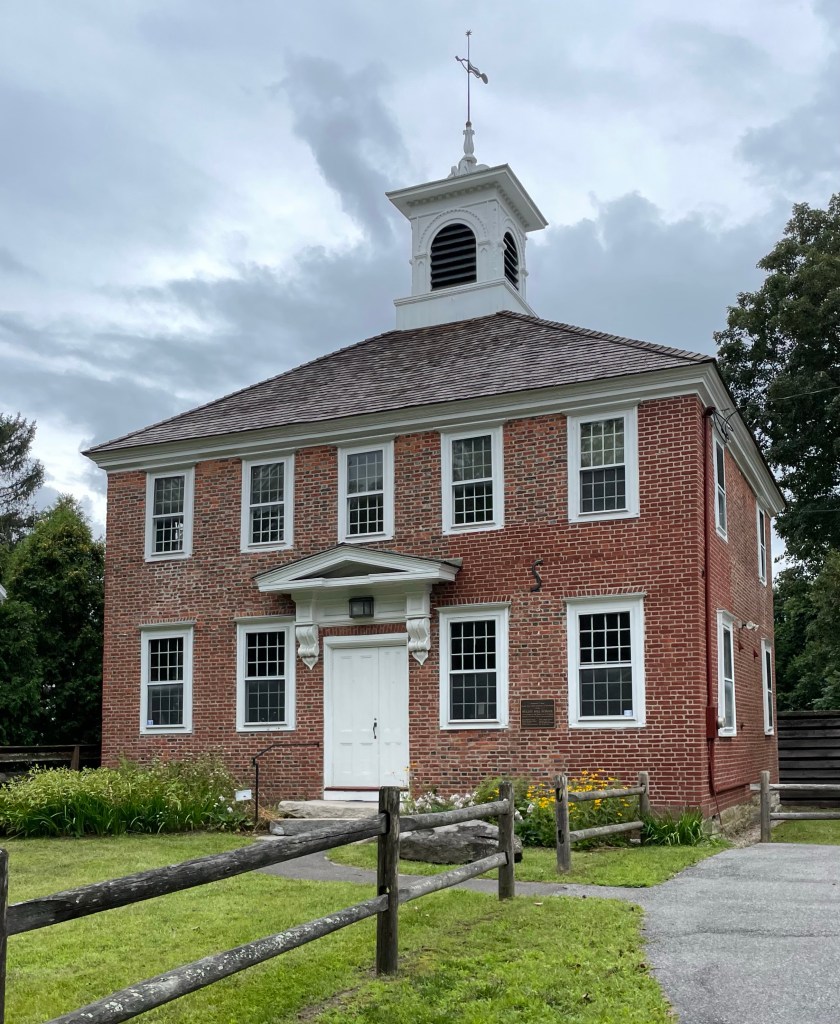
The Bullet Hill School, formerly known as the Brick School, is the oldest public building in Southbury, Connecticut and one of the oldest schoolhouses in America. Originally built in 1762 of locally made bricks, the two-story structure is a well-preserved example of a Colonial-era school building. Some sources date the building to 1790. The building remained in operation as a school for 179 years until December 1941 when the new Southbury Consolidated School, now Gainfield Elementary School, opened in January 1942. The Bullet Hill school is distinguished by its near-square proportions, locally made bricks laid up in Flemish bond, generous window sizes, and a hipped roof. The original cupola, now replaced, served as the model for Southbury’s 1977 Town Hall and other public buildings in town. Today, the former schoolhouse is maintained by the town and operated by the Historical Society as a living museum that is open for class visits and tours.

Reverend Graham-Howard Richmond House // c.1715

Who doesn’t love a good Colonial house in Connecticut!? This house in Southbury was originally built at the beginning of the 18th century and was later altered and expanded in the fashionable Federal style at the end of the century. The house was built around 1715 by a Nathan Strong, who sold the property to Reverend John Graham who was the town’s pastor for over forty years. The house was later owned by antiques dealers Daniel and Marguerite Croucher. They used the former White Oak Schoolhouse (nextdoor) to store and sell some of their finds! After later owners, the property (which includes the schoolhouse) was purchased by Howard K. Richmond had been a graphic designer and art director in New York. He created the original layout and logo for Life magazine in 1936. He also did advertising and publicity work for Lord & Taylor, Bloomingdale’s, Elizabeth Arden and Saks Fifth Avenue. So many layers of history in over 300 years!

Adin Wheeler House // 1790

The Adin Wheeler House is significant as a rare house form found in this part of New England. Located in Southbury, Connecticut, the property includes the main house, a barn, and the wheelwright shop, a barn-like structure. The house is a 1-1/2-story Cape style wood-frame structure, with a front porch across the front that is sheltered by a bell-cast extension of the main roof. This type of porch roof is uncommon in Connecticut, being reminiscent of Dutch rather than English construction methods. The dwelling was built for Adin Wheeler, who owned the millworks on the nearby falls with business partner Enos Candee, a business partner (and brother-in-law) whose house also stands nearby. Theodore Wheeler, Adin’s great-grandson, built the wheelwright shop in the late 19th century, as well as the major addition to the house, which served as a tap room and public meeting space. The property is a well-preserved collection of 18th and 19th century structures.

Pomeroy-Belden House // c.1758

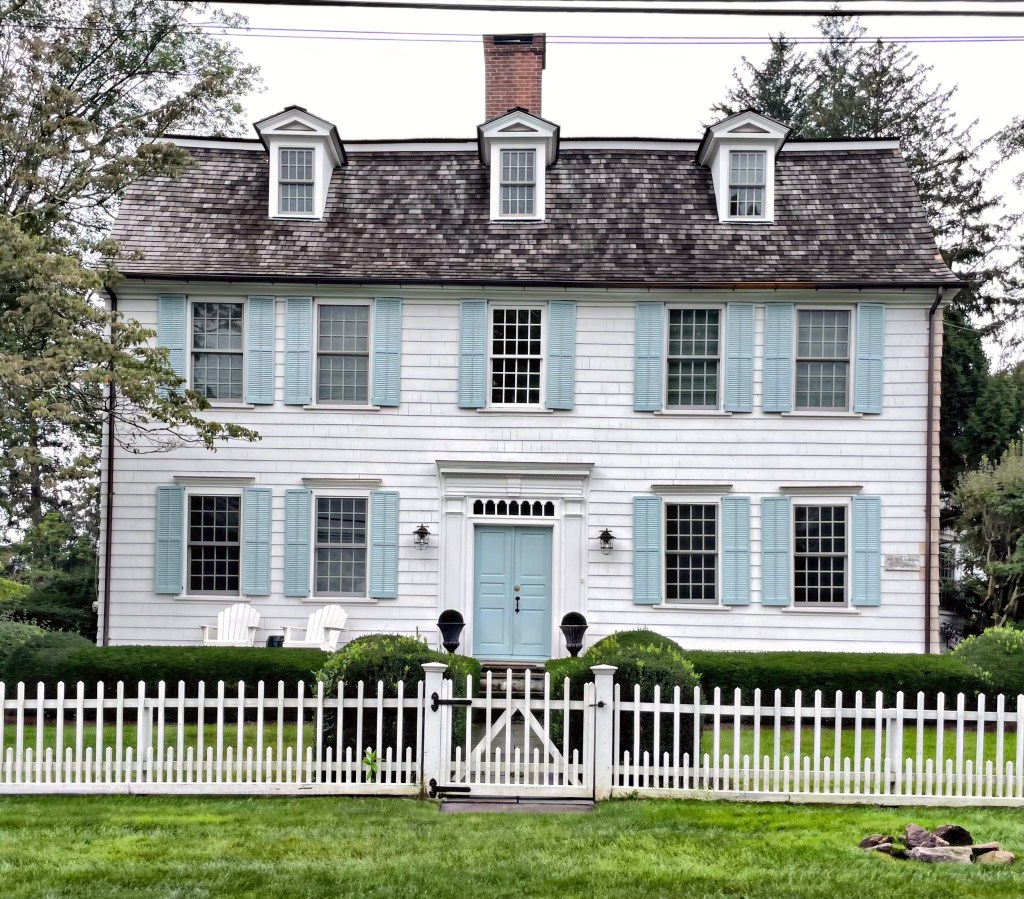
This stunning gambrel-roofed Georgian manse is located on Bronson Road in Fairfield’s Greenfield Hill neighborhood, a well-preserved in the northern part of town with large historic homes on large lots. The Pomeroy-Belden House was built in about 1760 for Seth Pomeroy (1733-1770), the son of Seth Pomeroy Sr. (1706-1777) a gunsmith and soldier from Northampton, Massachusetts, who served in King George’s War, the French and Indian War, and the Revolutionary War (at nearly seventy years old). Seth Jr. graduated from Yale in 1753, and would accept the call as the minister of the Greenfield Hill Congregational Church from 1757 until his death in 1770. He had this stately house built for his family during his time as minister. After his death, the house was purchased by Captain David Hubbell who used it as a store until it was purchased by Reverend William Belden, who served as pastor of the Greenfield Hill Congregational Church from 1812-1821. The Georgian mansion features a central double-door entry with traditional door surround, later shingle siding and a gambrel, wood shingle roof punctuated by three small dormers.

Killicut House // c.1740

Thought to be the oldest extant residential building in Nashua, New Hampshire, the Killicut House is an important piece of local history of the early settlement days of the city. The exact date of construction of the Killicut House is not known, with local legend stating that the house was built between 1680 and 1700 with other estimates dating the house slightly later, to 1740. It was known for years as the “1700 House”. Regardless, this is one of only two 18th century houses remaining in Nashua. The first known owner of the house was Thomas Killicut (1723-1784) who resided in present-day Nashua by 1746 when he was chosen to hold the position of field driver for the newly established town of Dunstable, New Hampshire (an extension from Dunstable, Massachusetts). Killicut served as one of “Rogers Rangers” in the French and Indian War. During the early to mid 19th century, the Killicut House apparently passed onto members of the Blodgett family who were apparently related to the Killicuts as up until the 1960s, the house was still reportedly owned by descendants of Thomas Killicut. Later in the 20th century, much of the land was subdivided and single-family homes were built nearby, with the Killicut House now located on the end of an unassuming cul-de-sac. It is a great example of a Georgian-era Cape style house with central chimney.

Woodward Abrahams House // c.1768

This Georgian-era Colonial home in Marblehead, Massachusetts was built around 1768 by Woodward Abrahams, who was appointed deputy postmaster in Marblehead ten years prior by Benjamin Franklin. Abrahams was one of the seven listed “Tories” mentioned in a town meeting of 1777, which were more loyal to the British crown than the colonies. After the war, he attempted to restore his political favor, which he did over decades, later being renamed a postmaster in 1797. The old Abrahams house was later owned by Thomas Tucker, who ran a dry goods business. In 1881, he converted the first floor to commercial space, giving the house its appearance we see today.

Homan-Devereaux House // 1764

In 1764, Joseph Homan, a wealthy merchant, built this house on a lot that was formerly a “mowing field” in Marblehead, Massachusetts. The Georgian style home is of a more elaborate design, showcasing Mr. Homan’s wealth at the time. His wealth was not all acquired ethically, however. Joseph Homan was engaged in international trade, and enslaved Africans at his Marblehead home. In the Boston Daily Newsletters in September 1770, Homan posted a notice that Jack, one of his enslaved humans escaped. It read: “At Night, a Negro Man, named Jack, about 6 feet high, near 50 years of age, speaks bad English, and Born in Martinico [Martinique]; had on when he went away, a blue Coat with Mohair Buttons, a blue Jacket with black Glass Buttons, blue Breeches with white metal Buttons, and a red worsted Cap, but may have changed his Cloaths [sic], as he had more at Beverly.-Whoever shall take up said Negro, and deliver him to Mr. Brown, Deputy-Sheriff, in Salem, shall have Two Dollars Reward, and all necessary Charges paid them. All Masters of Vessels, and others, are cautioned against carrying said Negro off, as they would avoid the Penalty of the Law.” Homan would later sell the property to Elbridge Gerry, who served as the fifth vice president of the United States under President James Madison, and who Gerrymandering is named after. Gerry gifted the house to his sister Elizabeth, who married Burrell Devereaux a year later. Burrell was a sea captain that later was a privateer.

Reverend Whitwell House // c.1756

Another of the stunning gambrel-roofed Georgian homes in Marblehead is this beauty located on High Street in the village. This house was built around 1756 but is best known for its resident from 1766-1779, as the home of the Reverend William Whitwell (1737-1781), who was the fourth minister of the Old North Church, located just a stone’s throw away. Although this Georgian dwelling looks like a single-family house from the outside, it is actually divided into two houses with separate owners, likely since its construction. Later dormers crowd the roof, but its still a pretty amazing Pre-Revolution home in one of the most charming towns in New England!

Simon Bradstreet House // 1723

Walking the warren of tight streets and hidden alleys of Marblehead, Massachusetts, you are taken back centuries to a simple time, and of a town that has largely maintained its pre-automobile urban fabric. Many pre-Revolution homes still stand in town and have survived cycles of the coastal town’s prosperity and economic hardship, and the increased pressure of gentrification in more recent years! The Simon Bradstreet House sits right in the village and is a well-preserved Georgian-period home. The house was built in 1723 (earlier reports said in 1738) and it was later owned by Rev. Simon Bradstreet (1709-1771), who arrived to Marblehead to serve as the second minister of the Second Congregational Church a year prior. Reverend Bradstreet was the great-grandson of the last Bay Colony Governor of the same name. Chance Bradstreet, an enslaved African that was a subject of the “within these walls” exhibit at the National Museum of American History was born in this home in 1762. He was later sold to Abraham Dodge of Ipswich by Isaac Story, the third minister of the Second Congregational Church. Stories like this are necessary for us to remember that slavery was a huge part of New England’s economy historically.

Wibird-Oracle House // 1702

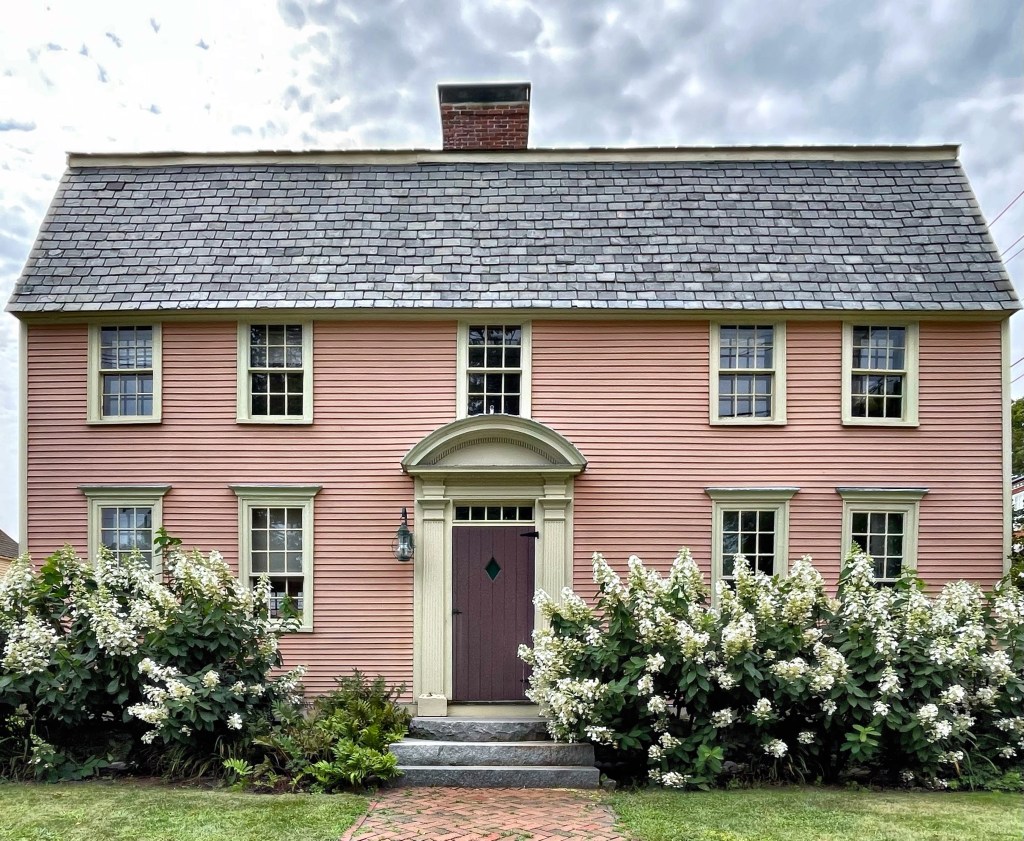
One of the oldest extant houses in Portsmouth (and New England for that matter) is this gambrel-roofed Georgian house on Marcy Street. The home was originally constructed in 1702 by Richard Wibird, who arrived to Portsmouth in the late-1600s and married Elizabeth Due (Dew) in 1701. Mrs. Due owned a market in town, and that helped propel Richard to be a prosperous merchant. Like many very wealthy residents in New England at the time, he enslaved three Africans and had five properties all over town. The house was moved two times, it was originally built behind the North Meetinghouse on Market Square. It was moved from that location c.1800 to Haymarket Square where Prescott Park is now, and again in 1937 to its present location on Marcy Street. The Portsmouth Oracle, an early newspaper, was printed and edited from this building when it was altered for commercial spaces at the ground floor. The Prescott sisters who developed Prescott Park had the foresight to move this building to the opposite corner and the home was later restored, giving us a glimpse at early 18th century merchant housing.