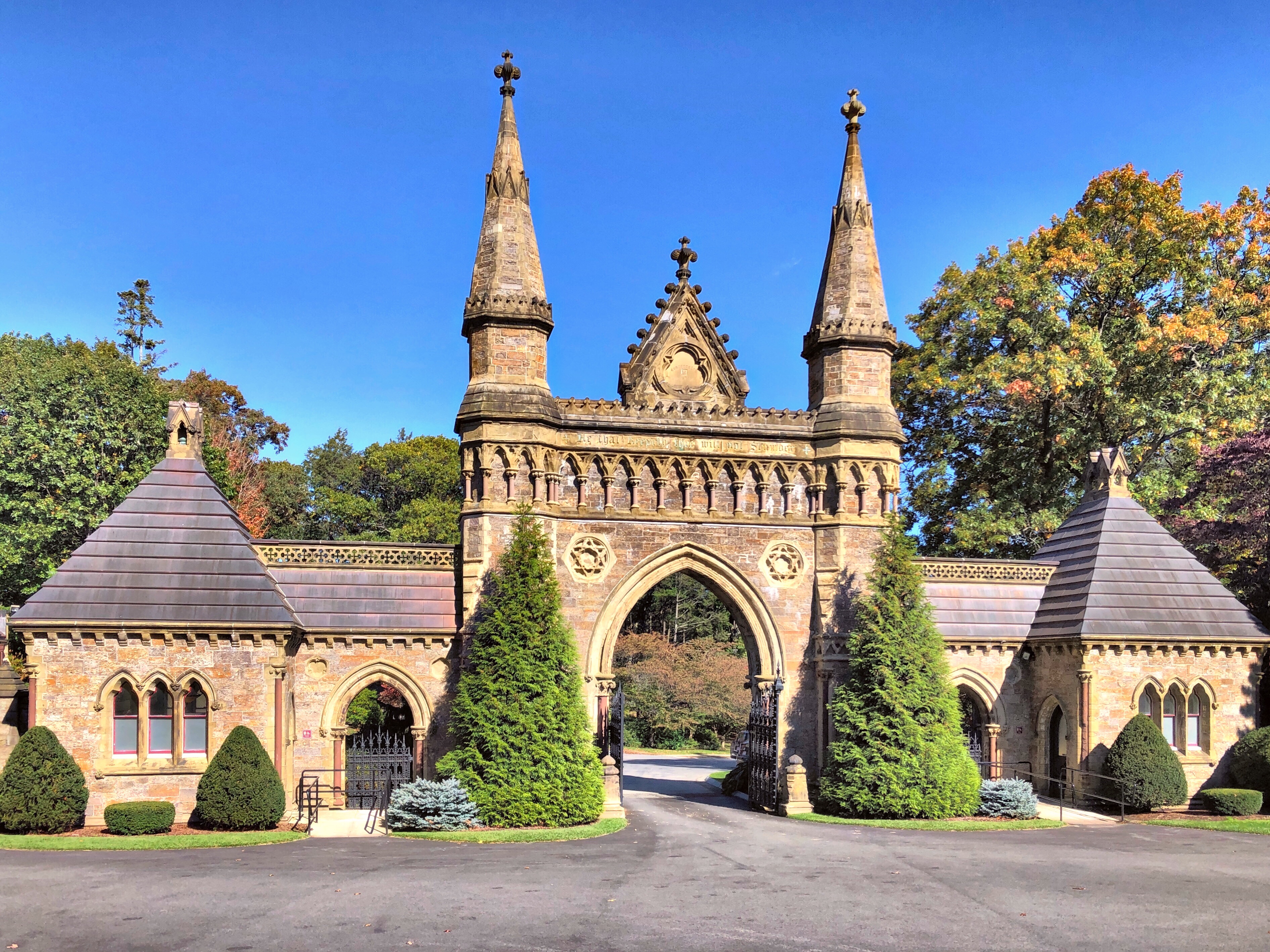
Forest Hills Cemetery, Entrance Gate // 1865

Forest Hills Cemetery was founded in 1848 by Henry A. S. Dearborn, then mayor of Roxbury. He designed this magnificent cemetery to offer the citizens of his community a place to bury and remember friends and family in a tranquil and lovely setting. Forest Hills embodies the ideals of the rural cemetery movement, which begun at nearby Mount Auburn Cemetery, in Cambridge in 1831, which was co-founded by Dearborn. Many rural cemeteries have elaborate entrance gates, possibly serving as a dramatic transition from the secular world to the spiritual realm of the cemetery, and perhaps as a metaphor for the journey from life to death. This entrance gate was built in 1865, replacing an earlier Egyptian Revival gate constructed in 1848. Designed by Charles Panter, the gate is constructed of local Roxbury puddingstone, with three arched openings with ornate iron gates surmounted by decorative scrolled ironwork. The central gateway is
framed by two conical spires and a central stone pediment, all topped with stone crosses.
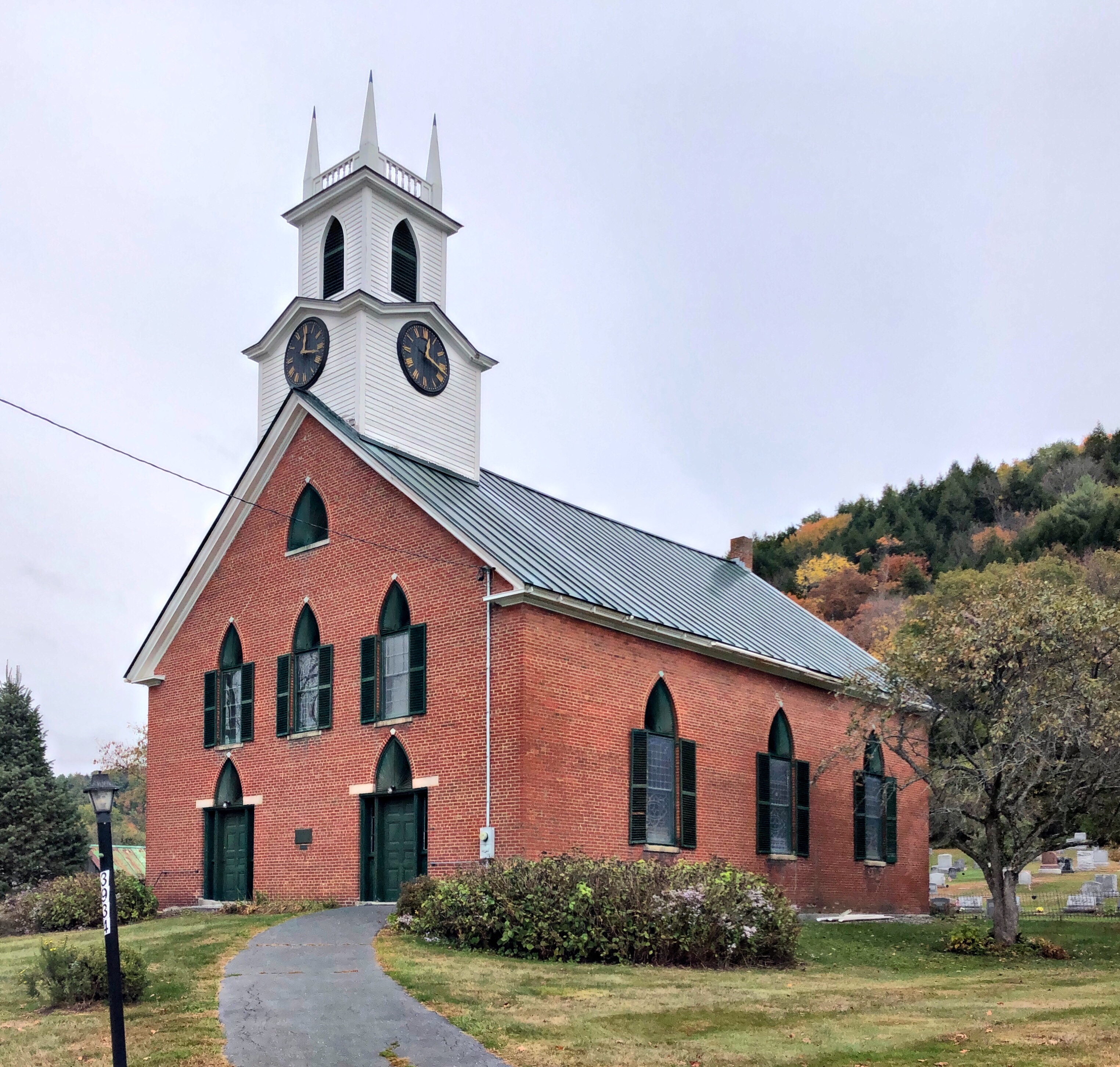
Thetford Center Methodist Church // 1838

An outstanding example of the Gothic Revival style churches in Vermont, this brick, three bay, gable front church was constructed in 1838 in Thetford Center Vermont. The Gothic Revival style is expressed here primarily in the pointed louvered insets above the windows (including the pointed louvers in the steeple) and the finials at the steeple. The church building was constructed using brick made in the local brickyard owned by Hezekiah Porter. Designed to seat 250 people, it was constructed for the cost of a mere $1,400. Behind the church is the Evergreen Rest Cemetery, administered by a Cemetery Association, in which are many of the early residents of Thetford and members of the congregation and its founders.

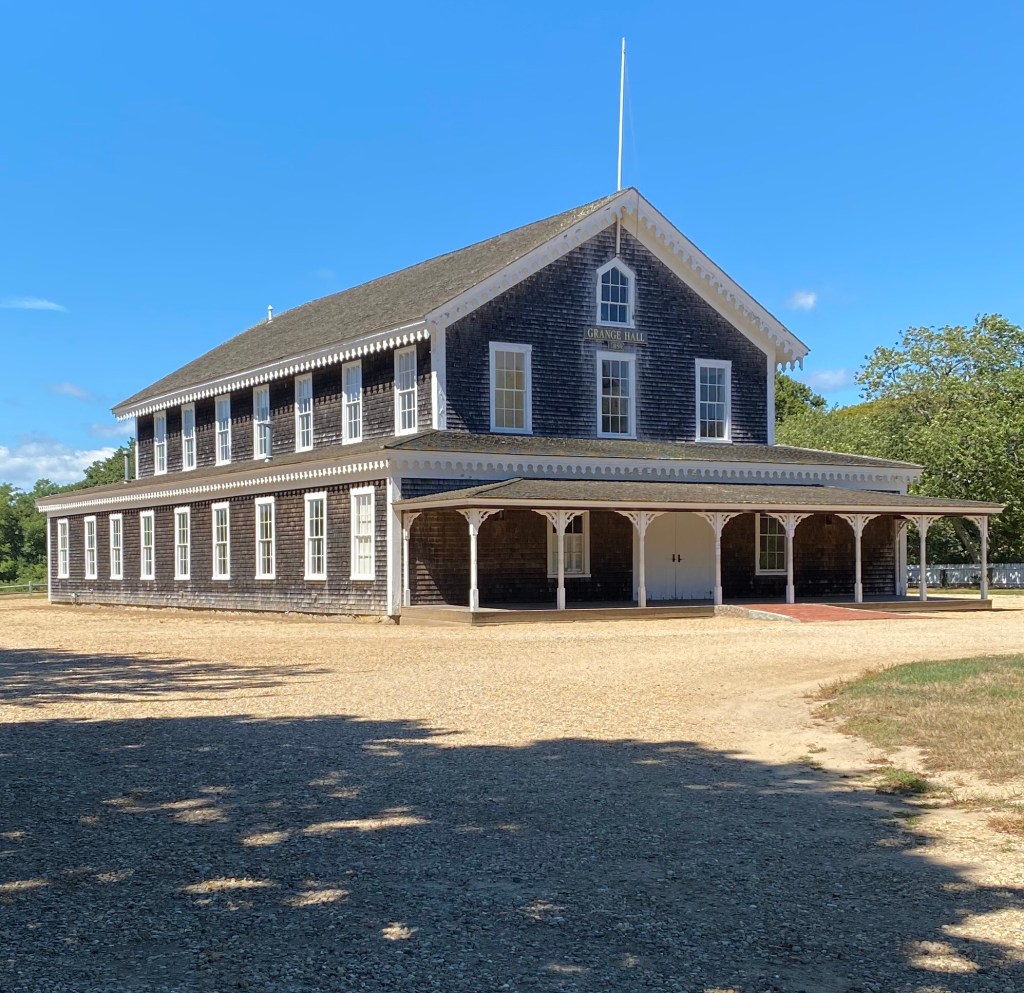
West Tisbury Grange Hall // 1859

Image courtesy of @MarthasVineyardonisland

Constructed by the Martha’s Vineyard Agricultural Society at the crossroads of the island, this Grange Hall in West Tisbury on Martha’s Vineyard, is the center of agriculture and commerce for the Vineyard. Grange Halls are traditionally where farmers have gathered to learn new agricultural practices, develop strategic business partnerships, and barter for goods and services. The building was the hub of weekly farmers markets for decades and eventually owned by the Vineyard Trust in 1997, being restored soon after. The building is a vernacular Gothic Revival building with decorative bargeboard (gingerbread trim) and full-length porch.

St. Therese of the Infant Jesus Church // 1927

This church in Agawam was built in 1927, replacing the first Catholic church in town, which was established in 1873. The earlier church was destroyed by a fire in 1925, causing the congregation and Archdiocese to fund construction of a new, fireproof church building. The Neo-Gothic Revival building features lancet windows, buttresses, and a central steeple. The building is now occupied as the Moldovian Baptist Church.

St. John’s Episcopal Church // 1868

The St. John’s Episcopal Church in North Adams, MA was established in 1855 by Rev. William Tatlock and Stephen Higginson Tyng Jr. while both were studying at nearby Williams College. A church was built in 1858, but deteriorated quickly, and the congregation gathered funding to erect this large edifice. Architect Stephen C. Earle, a leading architect in Central and Western Massachusetts, designed the Gothic church constructed out of large stone blocks quarried nearby. The church continued to grow over the next decades, and it was added onto as the immigrant community boomed in town following North Adams’ industrial growth. In 1893, the adjoining Parish House was constructed of the same stone as the main church, also designed by Earle. In the 20th century, membership shrunk due to decreasing population, and in 2011, the parishes of St. John’s Episcopal Church in North Adams and St. Mark’s Episcopal Church in Adams merged to form the All Saints’ Episcopal Church.

Captain Holley House // c.1848

This stunning Gothic Revival house in Edgartown was built around 1848 for Captain Joseph Holley and his wife Lucy. Captain Holley was a whaler who embarked on at least four long excursions of multiple years at a time, with a break between 1847-1852, at that time, he likely had this home built. Gothic Revival homes are rare in New England, especially in Edgartown where there is a matching house across the street. The home features a large dormer with a steep pitch with lancet window and appropriate shutters.

Davis House-Aunt Felicia’s Folly // 1805

If you stroll down Maine Street in Kennebunkport, you cant help but notice the most charming saltbox house. Constructed in 1805 by Samuel Davis, a master builder in Kennebunkport, the Federal home likely had a saltbox roof originally which would have housed the kitchen. After the Civil War, the home was owned by Silas Perkins, who then sold the home to his daughter, Felicia (Perkins) Cleaves and her husband, Albert, a teacher. By the 1870s, Felicia had the Colonial home completely renovated, turning into a Gothic Revival showpiece. Mrs. Cleaves added a new wing to the right of the original house, for she desired the high ceilings that were common during the Victorian era. The building became known in town as “Aunt Felicia’s Folly” and alternately, “the Witch House.” In 1966, owners restored the home back to what it likely looked like before the 1870s renovation, adding a saltbox roof.

Undated image showing “Aunt Felicia’s Folly” with Gothic alterations.