This stunning Queen Anne home in Gardiner, Maine, overlooks the Kennebec River from its high position on a hill. The home was built for Hartley Jewett, who ran a busy lumber mill in town, which sold long lumber, laths, and shingles, some of which ended up on his own home. Maine was huge in the lumber industry, and it’s vast forests were often cut and sent down to cities like New York and Boston on rail to supply their own building booms.
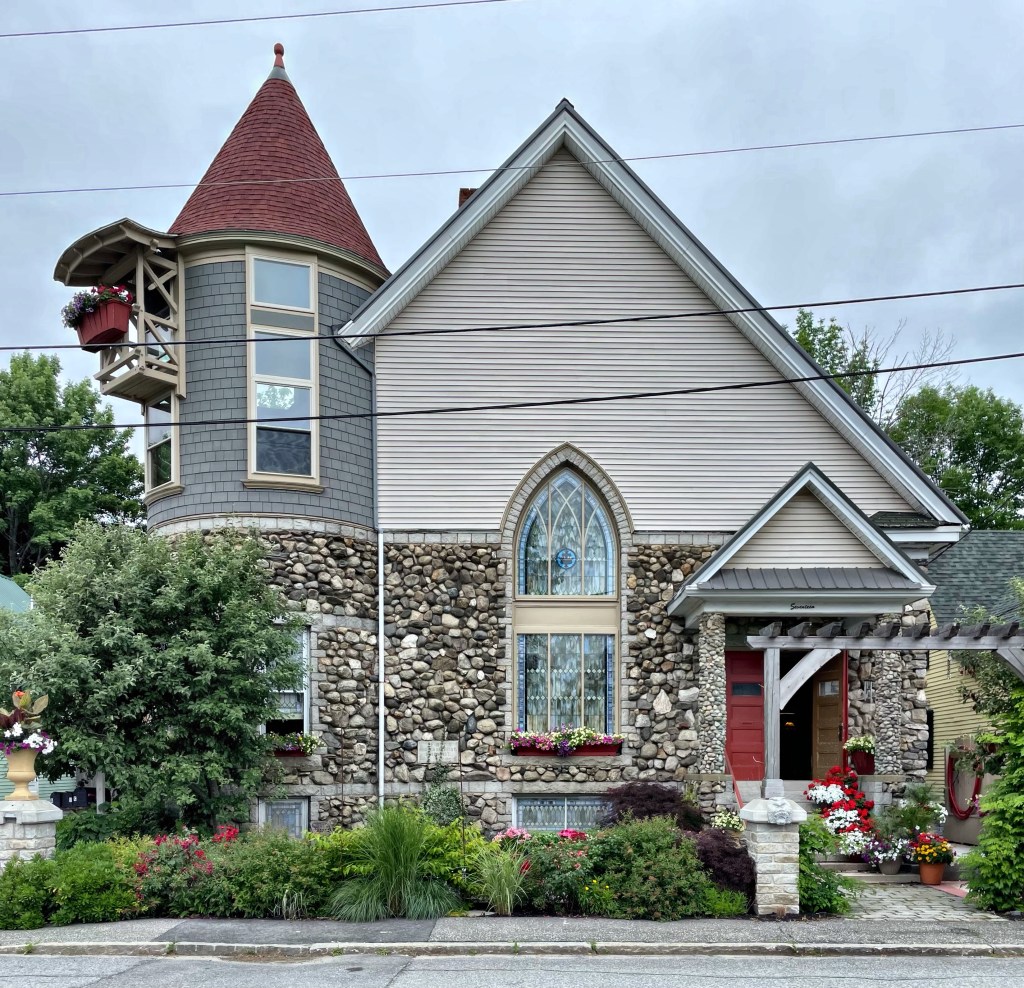
The first purpose-built Church of Christ, Scientist church in Maine is this turn-of-the-century edifice constructed in 1905 in Gardiner. Organized in 1897, this Christian Science Society of Gardiner met for several years in members’ homes and public places nearby until Palmer Noyes and his wife Caroline funded the new building. Caroline and Palmer helped establish the first such church in Chicago, after the couple witnessing a ‘healing’ and then heard Mrs. Mary Baker Eddy lecture in 1882. This church in Gardiner was seemingly designed by Caroline, who was likely inspired by architectural influences on the churches in town, from Gothic style lancet windows, to the shingle style facades. The building was eventually converted to a development center for the disabled, and is now known as “The Stone Turret”, a bed & breakfast, with amazing stained glass windows!
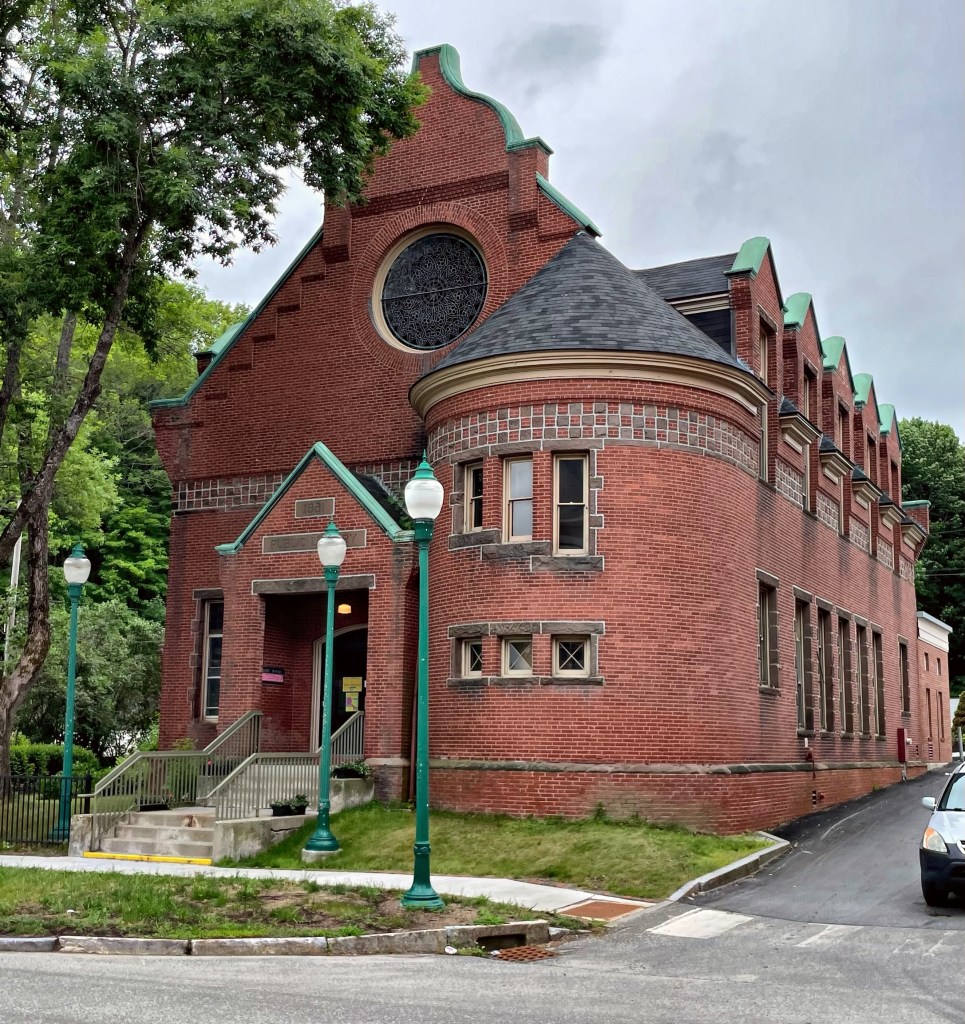
Possibly my favorite building type, the local town library buildings of New England, always amaze me with their small scale, yet architectural variety and intrigue. The library in Gardiner, Maine is no exception! This library building was constructed in 1881 from plans by Henry Richards, who was actually born in town in 1848. Henry graduated from Harvard in 1869, and soon after, took a post-graduate course in architecture at MIT. After completing schooling, he was a draftsman with Ware and Van Brunt. Soon after, he was a draftsman with Peabody and Stearns from 1872 to 1876, and then practiced architecture briefly on his own in Boston. During this time he married Laura Elizabeth Howe, daughter of Samuel Gridley and Julia Ward Howe. They moved to Gardiner, Maine and settled in a Federal house (featured previously), to learn more about Laura Richards and their house, check out the last post. Henry lived to be 100 years old! The library building is Queen Anne and Romanesque in style with a round corner tower with conical roof, brownstone and brick construction, and a stained glass ocular window with ogee parapet at the gable end roof. The small local library was added onto numerous times to hold a growing collection which includes works from Laura E. Richards, and Edwin Arlington Robinson, both Pulitzer Prize winning authors who lived in town.
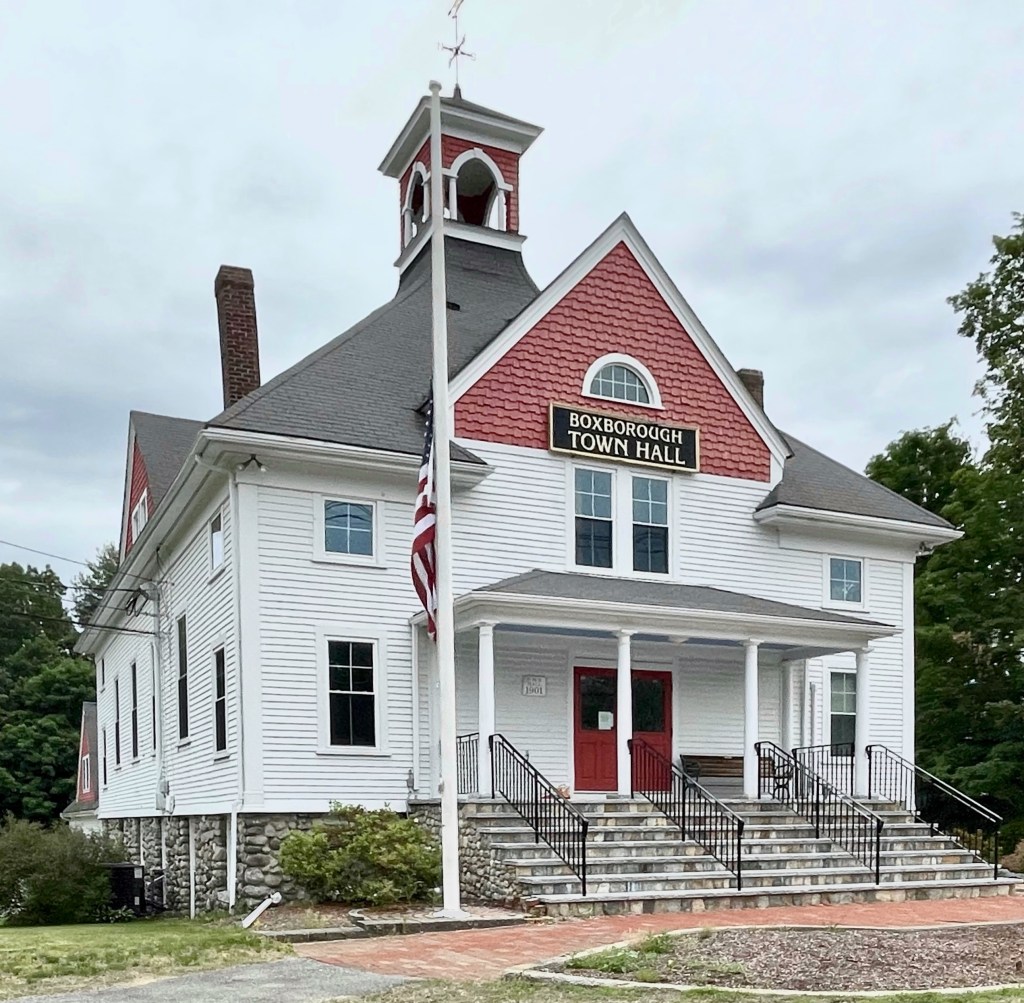
The area which became the town of Boxborough, Massachusetts, was first inhabited by the Native Americans of the Nipmuc and Pennacook tribes. Land in Boxborough was not settled by colonists until the beginning of the eighteenth century by farmers looking for fertile land to establish farms, who branched out from nearby Acton. Boxborough was formed from Harvard, Littleton, and Stow in 1783 and was incorporated as its own town. With the exception of small local industries including gristmills, sawmills, and cooperages as well as some minor boot and shoemaking, comb-making, and a lime quarry and kiln, Boxborough’s economy remained almost entirely agricultural through the 19th century. The town grew steadily and a Town Hall building was funded by the turn of the 20th century. This Queen Anne/Colonial Revival Town Hall building was constructed in 1901, atop the foundation which was constructed of locally gathered cobblestone by local volunteer farmers. Today, the town retains much of its agricultural heritage, but it is definitely under threat by subdivisions and Neo-Colonial mansions further contributing to Bostons suburban sprawl.
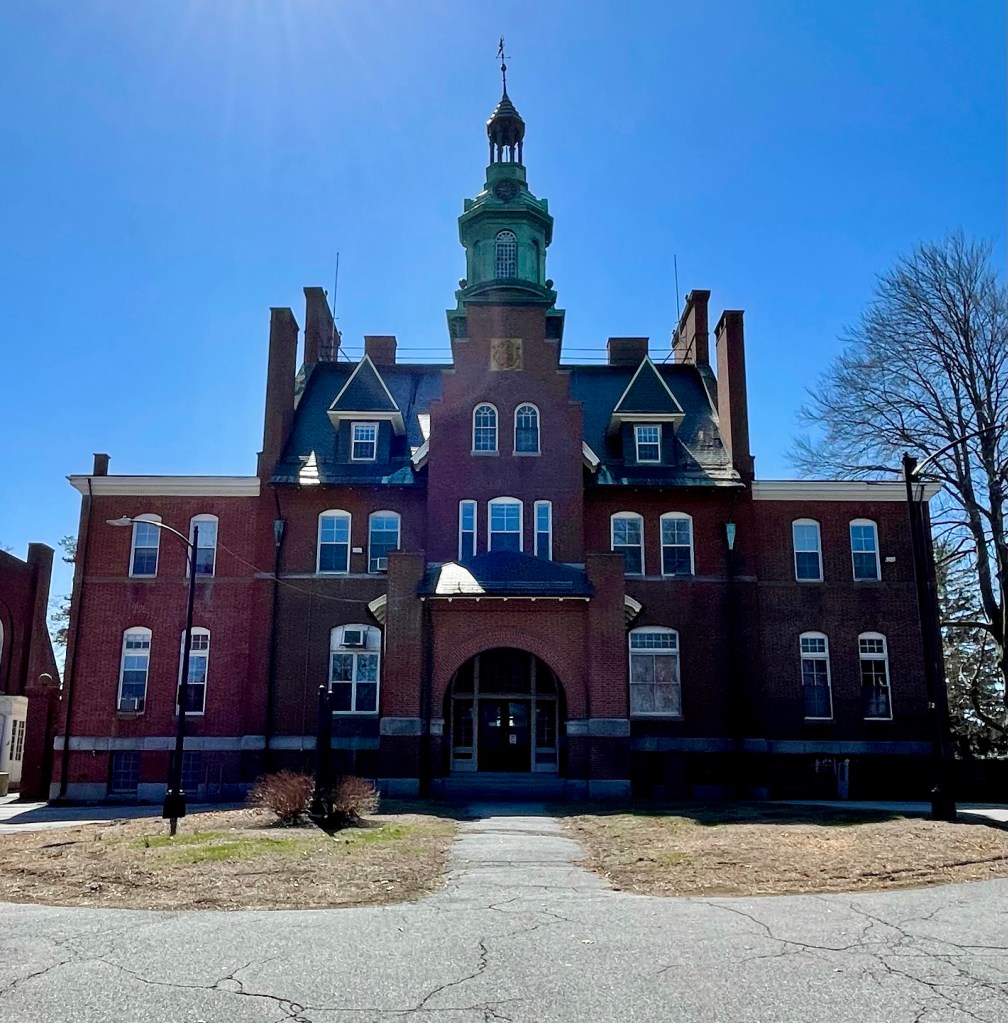
The Tewksbury State Hospital was established in 1852 as one of three Massachusetts State almshouses (along with Bridgewater and Monson). The almshouses were needed due to the unprecedented influx of Irish immigrants at that time, many of which found difficulty locating work. These almshouses represented the state’s first venture into care of the poor, a role previously filled by the cities and towns up to that time. In 1866, when Tewksbury began accepting the “pauper insane”, it became the state’s first facility to accept cases of chronic insanity specifically. Decades later, Massachusetts Governor Benjamin Butler accused the almshouse in Tewksbury in, “trading in bodies of dead paupers and transporting them for a profit to medical schools,” and “tanning human flesh to convert to shoes or other objects”. The facility was later investigated, and no conclusive evidence was found. In the late 19th century, a major rebuilding (and re-branding) campaign to upgrade the old almshouse by replacing its early wood-frame buildings with more durable and fireproof masonry ones was undertaken. One of the earliest “new” buildings was this Queen Anne-style Administration Building, standing at the head of the former entrance drive, which creates a fairly foreboding presence. This building was designed by Boston architect John A. Fox, and showcases the epitome of Queen Anne institutional design. The hospital runs today much like a traditional campus, with some of the older buildings unused, providing a strange composition. The former Administration Building is now home to the Massachusetts Public Health Museum.
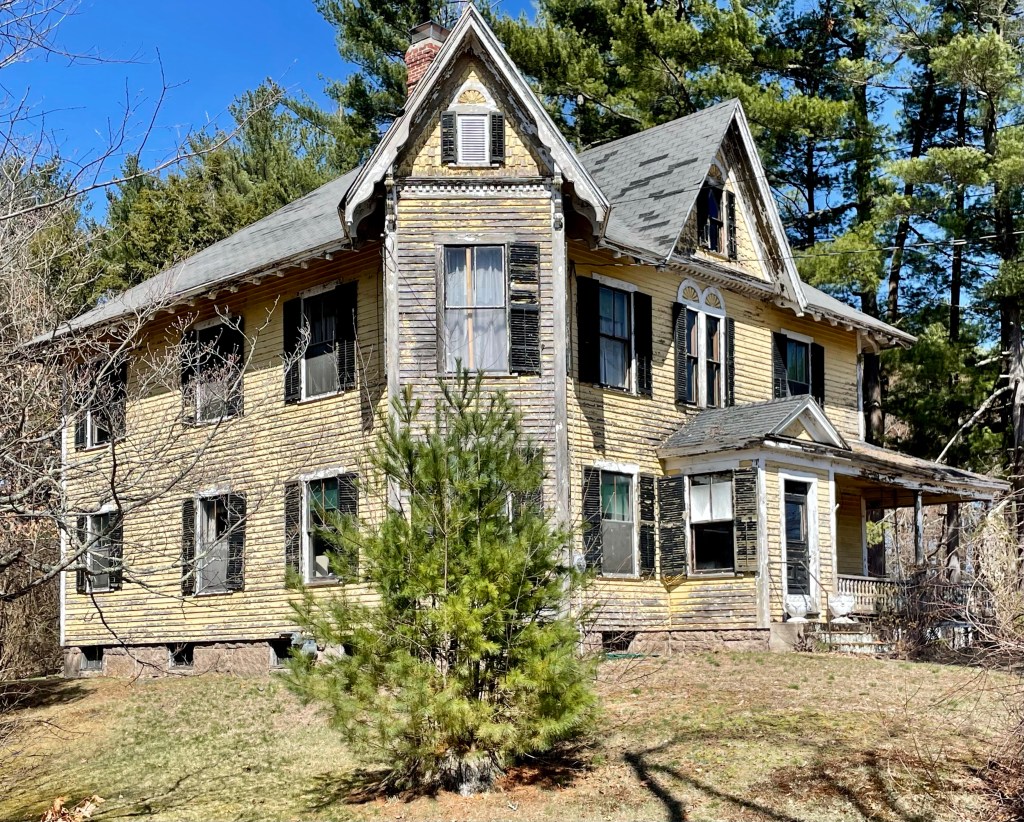
In 1894, Hiram P. Dinsmore, a clerk at the nearby Tewksbury Almshouse, purchased land not too far from his work to build a home for his family. The well-designed late-Victorian home features a wrap-around porch, a corner tower, twin sunburst or flower motifs, and the use of shingle and clapboard siding, all hallmarks of the Queen Anne style. After Hiram’s death, his wife and children lived in the home, and it was later willed to his daughter Beatrice and her husband, both of whom worked at the Tewksbury Almshouse (since renamed Tewksbury Hospital). The home has seen some deterioration with large sections of siding completely open to the elements unobscured by paint and a sagging porch roof. Hope to see this beauty restored.
One of the lesser-known historic hotels in Boston can be found at the corner of Exeter and Blagden Streets in the Back Bay neighborhood, tucked behind the Boston Public Library’s Johnson addition. Exeter Chambers (now Courtyard by Marriott Boston Copley Square), was built between 1889 and 1890 from plans by architect Theodore Minot Clark. Clark was a professor at MIT and the understudy of Boston’s famed Trinity Church architect, H. H. Richardson. Clark oversaw much of the construction of Trinity Church and his name is even engraved on the building. Exeter Chambers was constructed by the Guastavino Company, a very prominent contractor during the period noted for style and quality, known for the Guastavino tile. Cutting edge techniques such as compression arches and terracotta accents were featured throughout the structure. The hotel was vacant for many years and a renovation in 2004, which added three stories to the building, restored the ornate exterior to its former glory.
The railroad line through Crawford Notch in the White Mountains of New Hampshire was completed and opened in 1875 by the Portland and Ogdensburg Railroad, and had a transformative effect on the local economy. Soon after completion, tourists arrived in droves during the summer months to take in the area’s scenic beauty and clean air. From this, wealthy investors built large resort hotels, like the Mount Washington Hotel, to satisfy the demand of the affluent visitors. The Portland and Ogdensburg was taken over by the Maine Central Railroad in 1888, and this depot was built in 1891. It was one of the most elaborate stations built by that railroad’s Mountain Division, because of its prominent location in the mountains. The Crawford Depot presently serves as a visitor center and shop operated by the Appalachian Mountain Club. Nearby is the trailhead to Mount Willard, which has some of the best views for a modest hike.
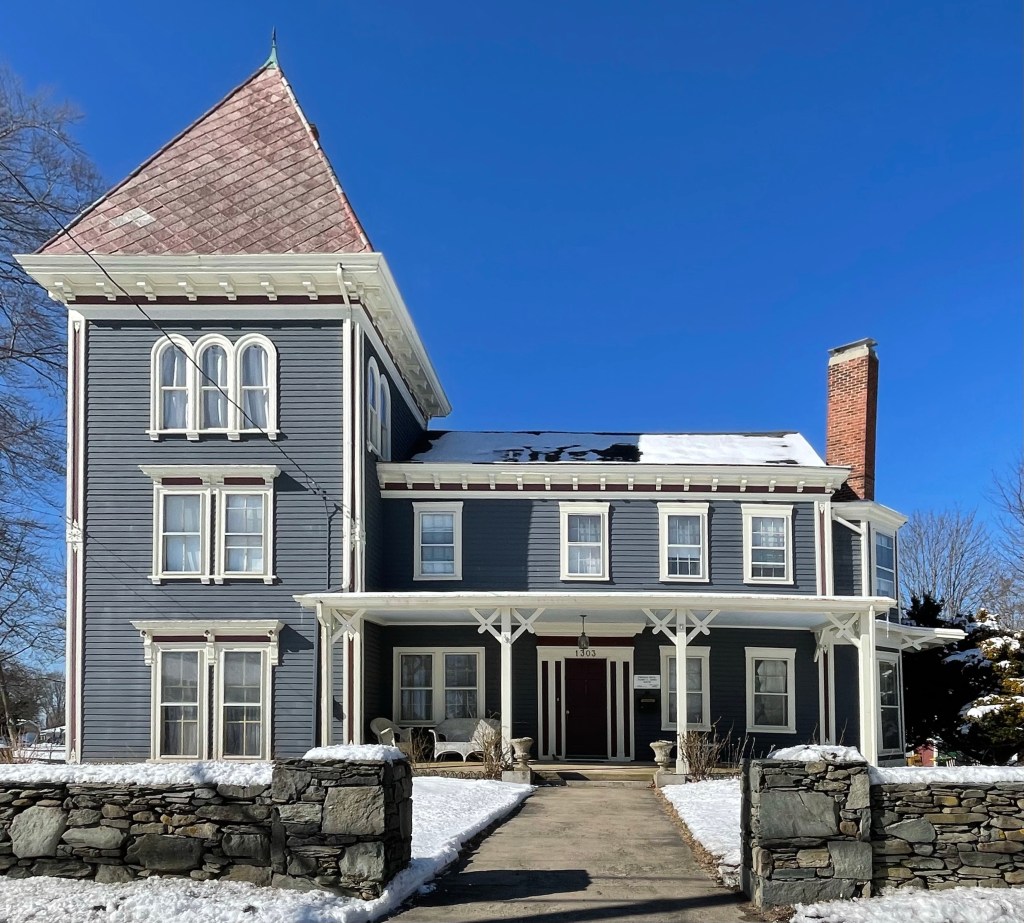
One of the most unique houses in Bristol (and the State of Rhode Island for that matter) is Ferncliffe, a colonial farmhouse that morphed into this beauty in the late 19th century. In 1749, the 200-acre farm of Benjamin Church, containing land where this home sits, was divided among his four daughters. Thomas Peck, a farmer, purchased one share in 1761; his deed refers to a house already on the property. The home was likely a five-bay Georgian home with little details. However, in 1882, James L. Tobin an undertaker, bought the property which then extended west to Narragansett Bay. He “modernized” the home with brackets, front porch, oh and a massive three-story tower with pyramidal roof! Tobin’s daughter Mary named the house for the fern plants lining the waterside cliffs at the far extent of the property, giving it the name “Ferncliffe”. Since then, the farmland was subdivided and sold off and now contains many house lots, with many of the streets laid out named after his children and wife. After Tobin’s death in 1925, he willed the home to his two living daughters, Helen and Annie.
Located just east of downtown Bristol, the Dennis Doran House stands as an excellent example of the Queen Anne style of architecture for a middle-class residence. The home was built in 1891 by Dennis Doran as his personal house. He worked as a carpenter and cabinet maker, and showcased his wood-working skills on this home. The asymmetrical facade, dominated by an octagonal corner tower, capped by a steep conical roof stands out, but is complemented by a complex hipped roof broken up by various jerkin-head and gable dormers at two tiers. The home is also clad in shingles of varied shapes to provide a complex texture.




 Buildings of New England