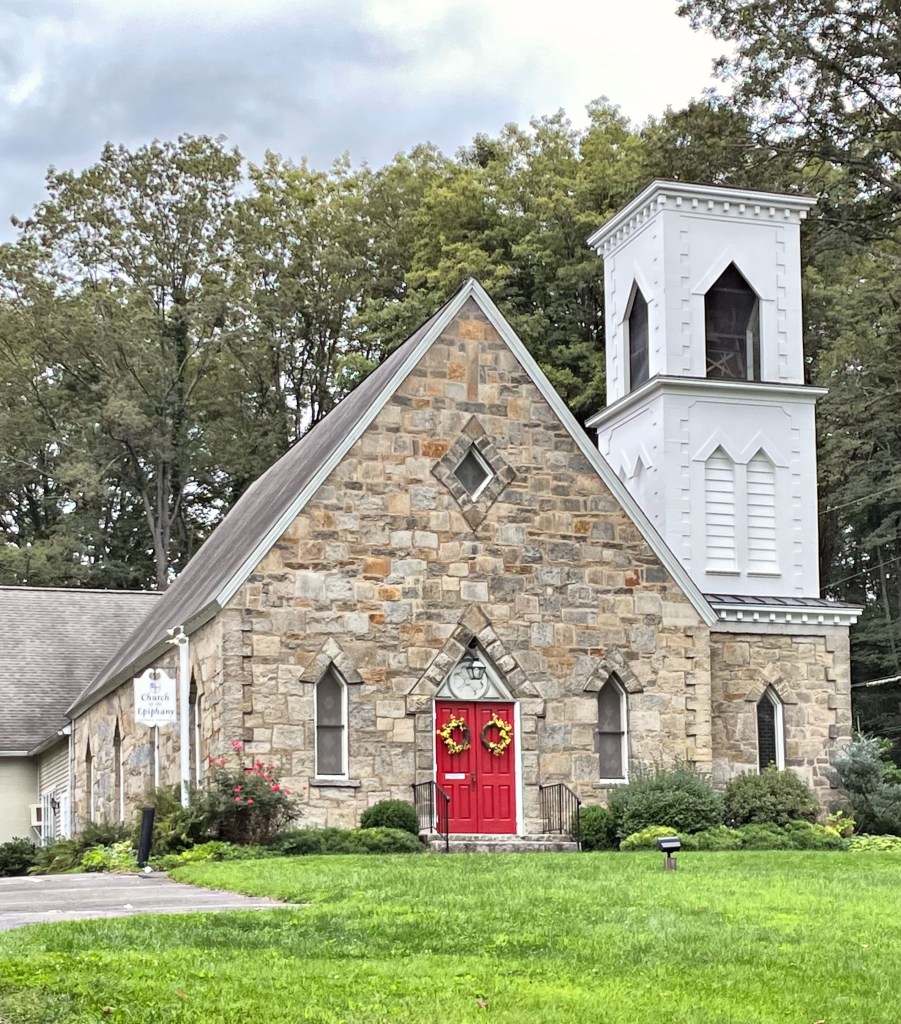
The stereotypical church in New England is the usual wooden structure with a central steeple and painted a bright white. Whenever I see an old church that breaks that oh-so-common mold, I have to snap a photo and learn more! This is the Church of the Epiphany, located on Main Street in Southbury, Connecticut. The church is an example of the Gothic style built in the Victorian period and is constructed of stone with a wooden corner belfry. Construction started in 1863, and the church was not completed until four years later in 1867. I could not locate who the architect was, but I am dying to know!
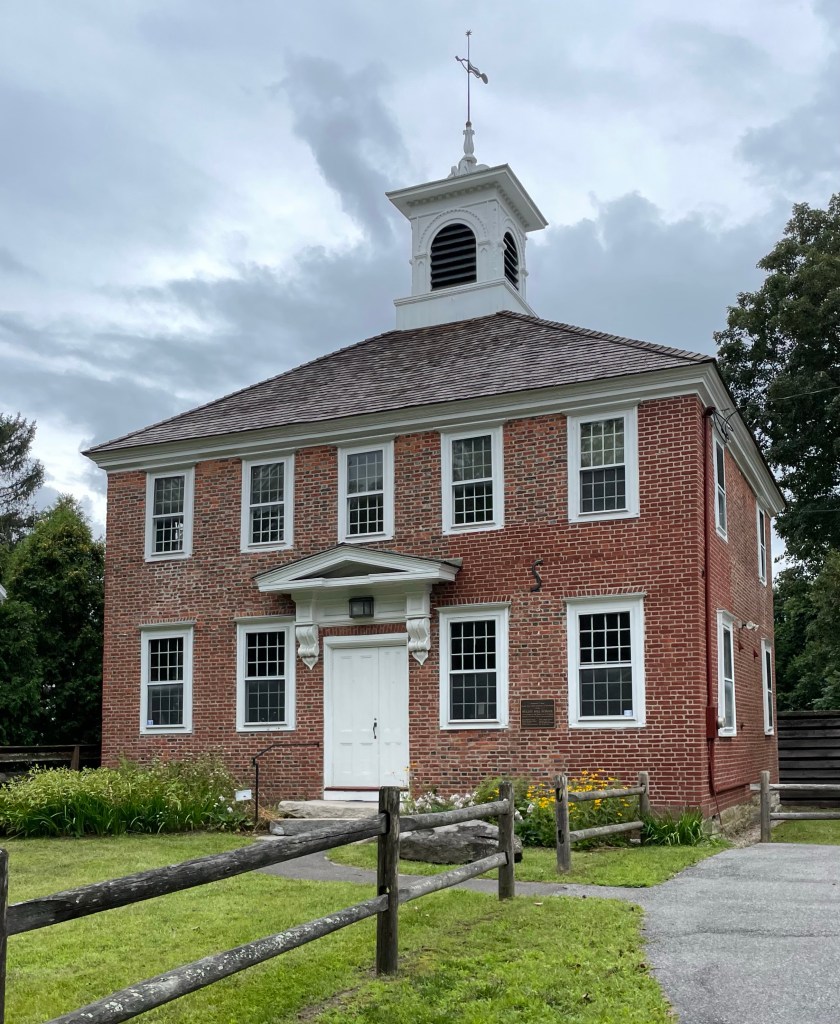
The Bullet Hill School, formerly known as the Brick School, is the oldest public building in Southbury, Connecticut and one of the oldest schoolhouses in America. Originally built in 1762 of locally made bricks, the two-story structure is a well-preserved example of a Colonial-era school building. Some sources date the building to 1790. The building remained in operation as a school for 179 years until December 1941 when the new Southbury Consolidated School, now Gainfield Elementary School, opened in January 1942. The Bullet Hill school is distinguished by its near-square proportions, locally made bricks laid up in Flemish bond, generous window sizes, and a hipped roof. The original cupola, now replaced, served as the model for Southbury’s 1977 Town Hall and other public buildings in town. Today, the former schoolhouse is maintained by the town and operated by the Historical Society as a living museum that is open for class visits and tours.
Who doesn’t love a good Colonial house in Connecticut!? This house in Southbury was originally built at the beginning of the 18th century and was later altered and expanded in the fashionable Federal style at the end of the century. The house was built around 1715 by a Nathan Strong, who sold the property to Reverend John Graham who was the town’s pastor for over forty years. The house was later owned by antiques dealers Daniel and Marguerite Croucher. They used the former White Oak Schoolhouse (nextdoor) to store and sell some of their finds! After later owners, the property (which includes the schoolhouse) was purchased by Howard K. Richmond had been a graphic designer and art director in New York. He created the original layout and logo for Life magazine in 1936. He also did advertising and publicity work for Lord & Taylor, Bloomingdale’s, Elizabeth Arden and Saks Fifth Avenue. So many layers of history in over 300 years!
When the first white settlers of present-day Southbury, Connecticut, traveled up the Housatonic on rafts in 1673, they spent their first night under a white oak tree in what is now Settlers Park. That section of Southbury became known as White Oak for this early history. As this part of town developed and the population grew, another schoolhouse was needed. In around 1840, this Greek Revival style school building was constructed and has stood proudly on Main Street in the nearly 200 years since. The school now shares the same lot as the Reverend Graham House and has most recently been occupied as an antiques store.
Originally, the parishioners living in present-day Southbury would travel to Woodbury Center to attend church services. This changed after the Southbury parish was incorporated in 1731, voting to erect a church a year later. Founded in 1732, the Southbury Congregational Church was dwelled in several sites until the third church was built on the present site in 1844. This Greek Revival style church features Doric pilasters and Ionic columns at the recessed portico with a large pediment above with ornate scroll carvings around the clock. The church remains well-preserved and a visual landmark on the Main street.
Located on Main Street in Southbury, this stately Federal style mansion stands out as one of the most unique and interesting in town! The house here was originally built in the 1760s as a more modest Georgian house by members of the Curtiss Family, one of the earliest families to settle in the area after land here was purchased from the Potatuck Native Americans. In the early 19th century, the house was modernized in the fashionable Federal style, giving the house the present appearance. The facade is dominated by an excellent doorway with a projecting Palladian portico above. The property was later owned by Benjamin Fabrique.
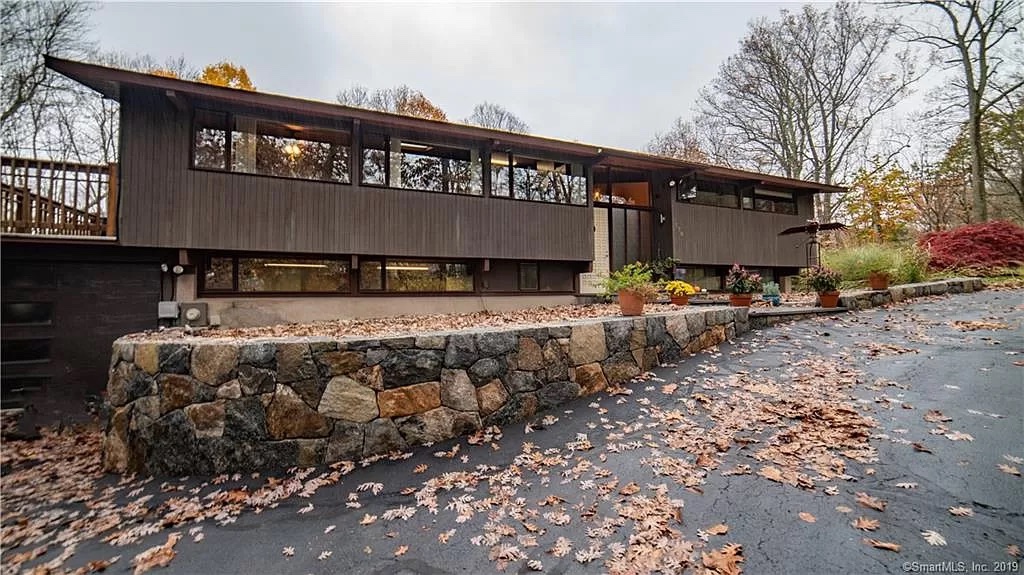
I don’t share Mid-Century buildings on here enough, mostly due to the fact that so many of the houses of the period are secluded down winding driveways and surrounded by trees! This stunning house is located in Southbury, Connecticut, and is a great example of a Deck House. The Deck House was a housing type developed by architect Carl Koch. According to At Home With Tomorrow, he began his lifelong mission to create “the good, the beautiful, and the inexpensive” in housing while at Harvard under the guidance of Walter Gropius, who is famous for the development of the Modernist Movement in architecture. After the war, he turned his focus on the housing shortage, a symptom of the Great Depression, WWII, and returning Veterans with growing families and VA mortgage loan offers. His solution was for an affordable house of pre-fabricated parts to cut costs and provide streamlined construction. In 1953, his Techbuilt house was launched, after a decade of research. William Berkes and Robert Brownell had worked with Koch at Techbuilt after graduate school, but wanted to create a design of their own. They left Techbuilt in 1959 and founded Deck House, using the same principles. The exposed Douglas fir beams, wood panel ceilings and mahogany trim and window casements are what give the deck house a lot of its signature aesthetic. A wall of glazing, open floor plan with sloping roof rafters extending beyond the walls and a low placement in seemingly untouched nature are further elements that have endeared these houses to the modern homeowner.
The Adin Wheeler House is significant as a rare house form found in this part of New England. Located in Southbury, Connecticut, the property includes the main house, a barn, and the wheelwright shop, a barn-like structure. The house is a 1-1/2-story Cape style wood-frame structure, with a front porch across the front that is sheltered by a bell-cast extension of the main roof. This type of porch roof is uncommon in Connecticut, being reminiscent of Dutch rather than English construction methods. The dwelling was built for Adin Wheeler, who owned the millworks on the nearby falls with business partner Enos Candee, a business partner (and brother-in-law) whose house also stands nearby. Theodore Wheeler, Adin’s great-grandson, built the wheelwright shop in the late 19th century, as well as the major addition to the house, which served as a tap room and public meeting space. The property is a well-preserved collection of 18th and 19th century structures.
This charming cottage shows that you do not need a stately or elaborate house to have some serious curb appeal and house envy. This is the Benjamin Osborn House, located in Southbury Connecticut. The house was built in the early 20th century for newlyweds Benjamin B. Osborn and Sarah Stiles, who married in 1808. As a gift to the couple, Sarah’s father Ephraim Stiles, who lived in a house across the street, seemingly deeded a portion of his property for his daughter and son-in-law to build their family. Tragically, Sarah died one year later, possibly during childbirth. Benjamin would marry another of Ephraim’s daughters soon after… messy. The home is a four-bay Cape, with its off-center entrance sheltered by a Colonial Revival hip-roofed portico supported by Tuscan columns.
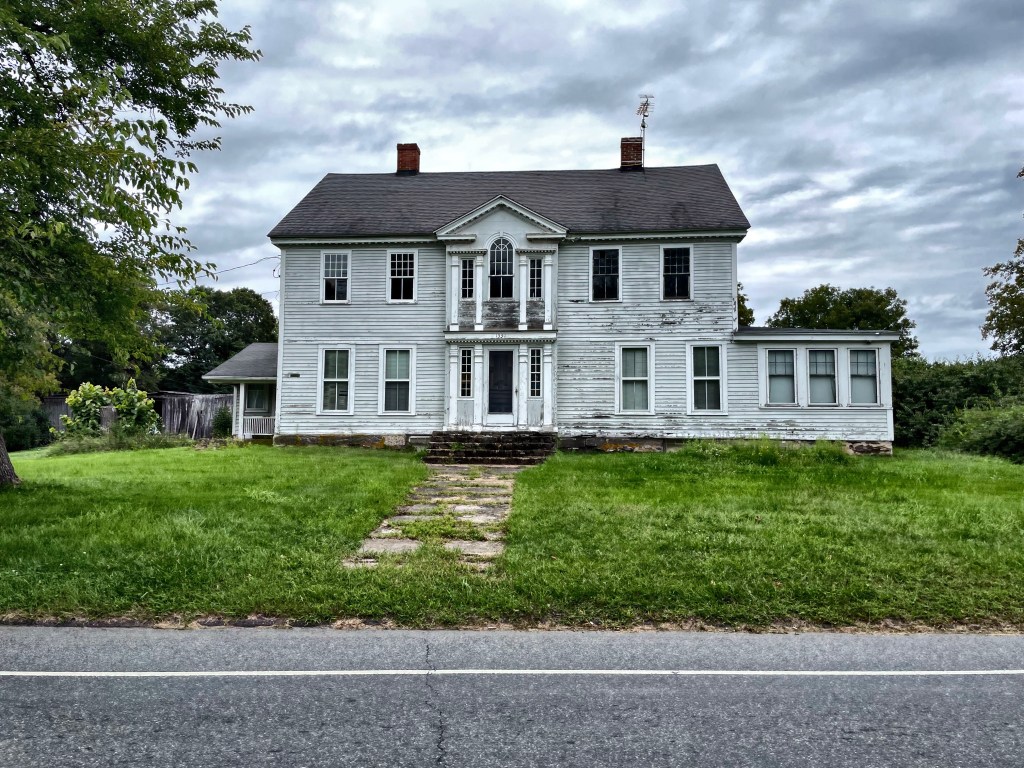
It always amazes me that even getting lost driving the winding roads in obscure places, can reveal some of the most magical old buildings and history to uncover. This stunning Federal style mansion was built in 1806 and is located on the busy Southford Road in Southbury, Connecticut. The road was a span along a turnpike was the great thoroughfare between New Haven and Litchfield, Connecticut. Present-day Southbury was about halfway between the two, so lodging was always busy here. Knowing this, brother’s in-law, John Thompson and Benjamin Hurd had this turnpike hotel built to capitalize on the flow of weary travelers. Charles R. Oatman (1827-1904), who married Orinda T. Hurd, the daughter of Benjamin Hurd, acquired the property in 1870 and operated the hotel under his name as the Oatman Hotel. After successive owners, the name remained. It was sold in the 20th century and was converted back to single-family use, and maintains much of its original fabric, including a barn at the rear of the property. It could definitely use a new coat of paint!




 Buildings of New England
