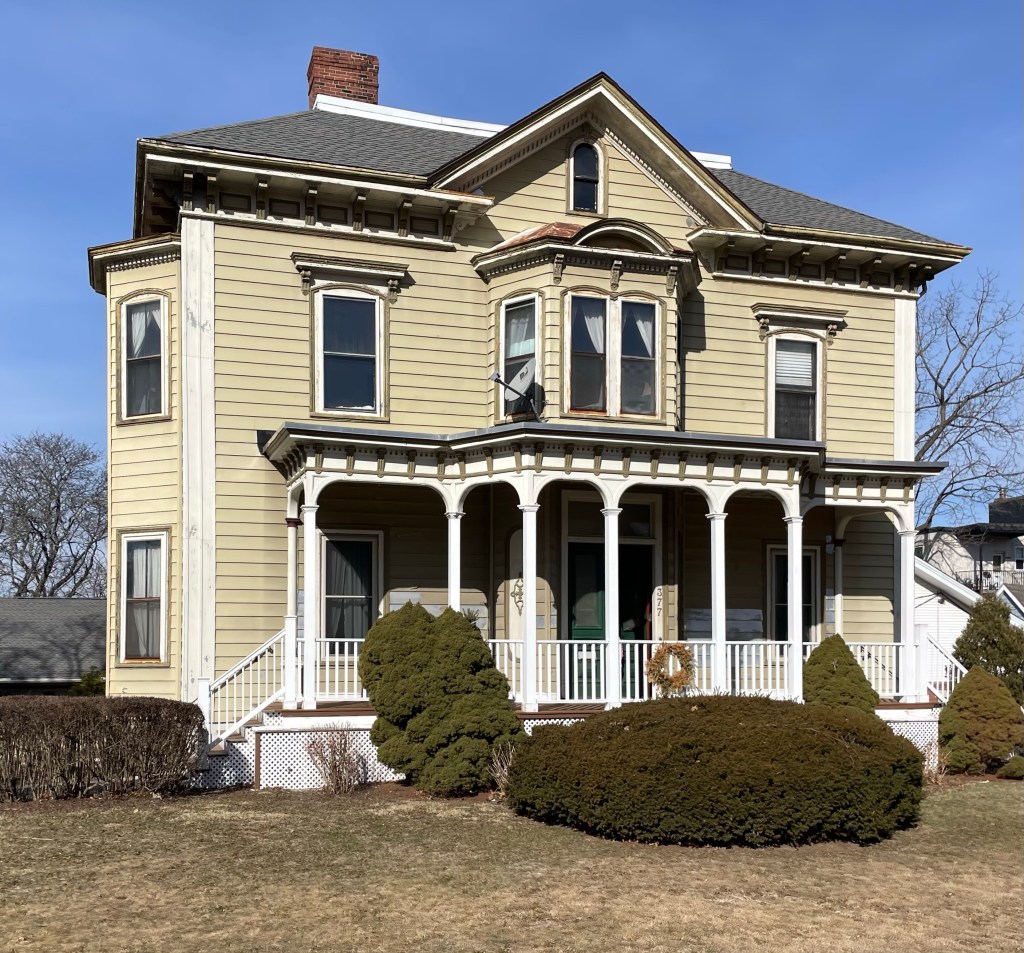
Dimock Center – Cary Cottage // 1872

The New England Hospital for Women and Children (known today as the Dimock Community Health Center), is comprised of eight major buildings on a nine acre site located on a small hill in the Roxbury neighborhood of Boston, close to the border with Jamaica Plain. The complex is significant for its role in the history of women in medicine as both a teaching and a practicing hospital, as well as for its architecture. The facility was incorporated as the New England Hospital for Women and Children in 1863, almost five years before Roxbury was annexed to Boston. The Hospital was founded by Dr. Marie E. Zakrzewska together with Lucy Goddard and Edna Dow Cheney in order to provide women with medical care by competent physicians of their own sex and to educate women in the study and practice of medicine. As such, it was one of the first hospitals of its kind in America. The oldest building in the complex is the Cary Cottage, pictured here. The charming building was constructed in 1872 by the architecture firm of Cummings & Sears. The Cary Cottage served as the hospital’s original maternity cottage, and is also important as an almost intact example of Stick Style architecture. The building was intentionally detached from the general surgical facilities to minimize the dangers of infection during childbirth.
Egleston Square Substation // 1909

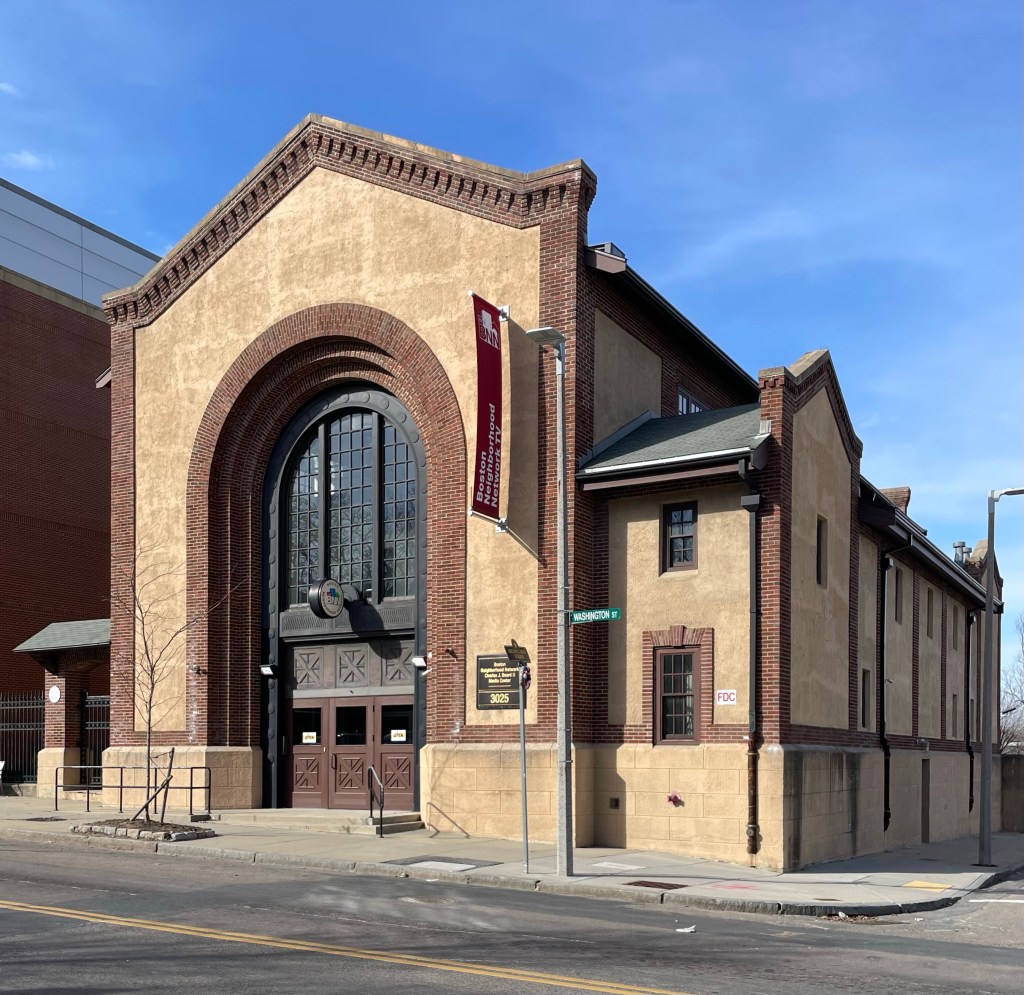
Streetcar suburbs of Boston have long been connected to the city by horse-drawn streetcars. As the city expanded and transportation shifted electrical, things changed in a big way! By the time the last horse-drawn streetcar was retired in 1897, the West End Street Railway Company had replaced its fleet of 9,000 horses with electric streetcars. Things were built upwards, with an elevated railway constructed between 1898 and 1901 that ran down Washington Street in the Roxbury neighborhood of Boston along the boundary of Jamaica Plain. The route had a stop in the middle of Egleston Square, with the surrounding neighborhood largely occupied by wood-frame, detached triple-deckers, two-family, and single-family houses, with many occupied by workers from the breweries nearby. Located on Washington Street in Roxbury, the Egleston Square substation was built in 1909 by the Boston Elevated Railway Company (predecessor of the Massachusetts Bay Transportation Authority) to convert AC (alternating current) electricity to DC (direct current) for use by its street railway cars and elevated cars. The building was designed by Robert S. Peabody of Peabody and Stearns, a prominent and expensive firm (yes the MBTA once invested in their infrastructure). After the station was effectively abandoned by the MBTA, the substation fell into disrepair, with a roof in failure in 2005. It was then acquired by Boston Neighborhood Network Media, a local nonprofit, who have converted it for use as office and television studio space. Scott Payette was the firm responsible for the intensive restoration and renovation.


Doris Bunte Apartment Tower // 1967

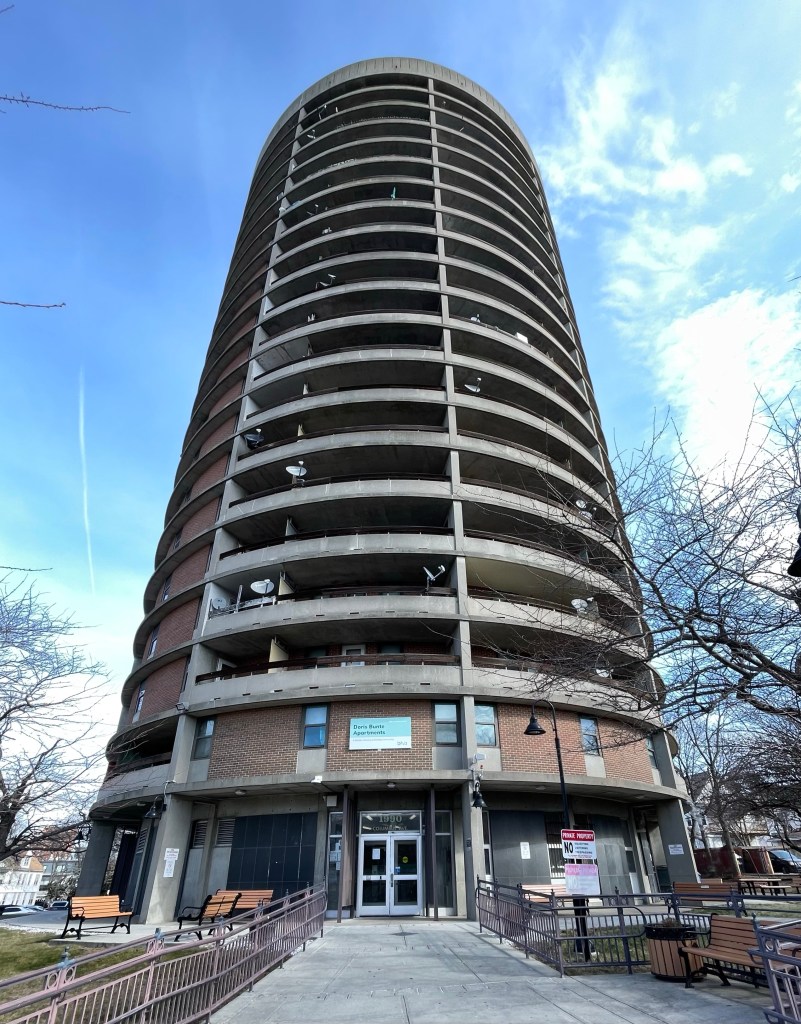
In the second half of the 20th century, parts of Boston saw disinvestment by private property owners as well as local and state government. With people leaving Boston for the suburbs, the hemorrhaging of tax revenue led urban planners to go big and institute ‘Urban Renewal‘ policies and planning to demolish what they believed to be substandard housing and invest in Modern apartments and car-oriented developments. The triangular shaped new community was as comprehensive as any urban renewal district in the region; indeed of the ten General Neighborhood Renewal Plans created by the BRA in 1961, Washington Park was the most self contained Urban Renewal District in the city. It included new police and fire stations, a courthouse, two public libraries, a shopping mall, a health center, elementary school and five garden style housing developments totaling almost 2000 apartments or townhouses. At its completion in 1975, $70.4 million had been invested to build the new community of which $31. 3 million came from the federal government. Part of this massive undertaking was the construction of elderly housing, which resulted in this 20-story cylindrical tower at the southernmost edge of the Urban Renewal area. The tower was constructed between 1967 and 1970 and was designed by Boston-based architectural firm Richmond & Goldberg, led by Isidor Richmond and Carney Goldberg. Apartments were “integrated” with with 70% Black and 30% White residents, all with private balconies and an emergency pull-chain system in kitchens and bedrooms for the elderly residents. As far as mid-century apartment towers go, this one is pretty interesting and unique. The building was renovated a few years ago and renamed the Doris Bunte Apartments. In 1969, Buntè was nominated to the Boston Housing Authority board, making her the first female public housing tenant to serve. In 1972, she was elected to the Massachusetts House of Representatives, becoming the first woman of color to serve in the Massachusetts legislature, and the first female to serve in the House leadership in 68 years. While there, Buntè helped found the Black Legislative Caucus and the Caucus of Women Legislators.

Howard House – St. Mary of the Angels Rectory // c.1867

Moving north from the Stonybrook section of Jamaica Plain, Boston, I explored around Roxbury, an area often overlooked by tourists, but has a lot of history and great buildings with rich stories! This old Victorian-era house was built around 1867 for Joseph W. Howard and his wife Lillie about the time of their wedding. The large Italianate style mansion was built in a period and location where wealthier Boston merchants could build large mansions with space in the inner suburbs of the city. The area remained fairly bucolic until the turn of the 20th century when housing development really picked up in Boston’s neighborhoods. By this time, owner Samuel Shuman sold his property on the busy corner lot to the Roman Catholic Archdiocese of Boston. In 1907, construction of the basement church on the site of the former Shuman Estate began. The original plans called for building a larger, upper church at a later date. However, due to a number of factors over the years, the upper church was never built. After WWII, Roxbury saw a demographic change and the church is largely home to a Black and Hispanic congregation to this day. The former Howard House is still owned by the Archdiocese as the rectory.

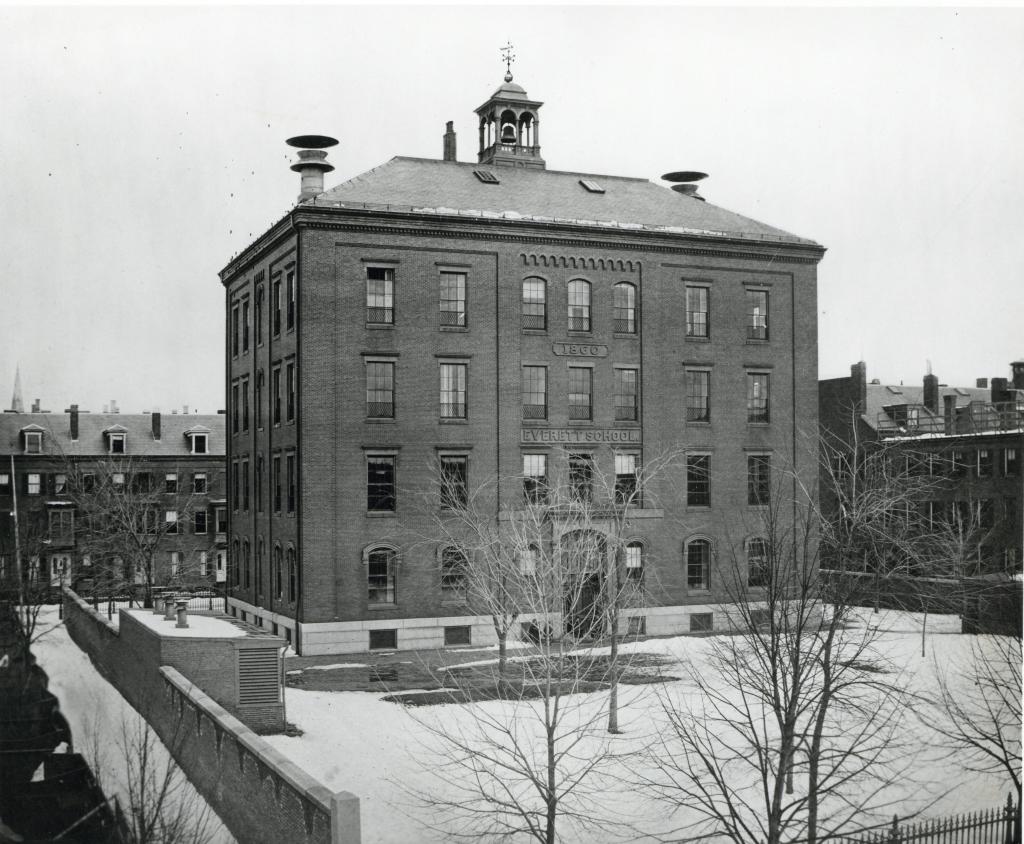
Everett Schoolhouse // 1860-1965

c. 1910 image courtesy of Boston City Archives.

The Everett Schoolhouse opened in 1860 as Boston’s most modern school at the time, serving students in the South End and Roxbury. The school was located on Northampton Street, just off Tremont Street, and stood four stories with lawns surrounding it. The building was architecturally beautiful, with brick walls and stone trim and basement, large double-hung windows, and a slate roof capped by a bell tower. The building was so special, the opening ceremonies were documented in the New York Times in 1860. The school was named after Edward Everett (1794-1865), a Boston-native who served as a U.S. Senator, the 15th Governor of Massachusetts, Minister to Great Britain, and United States Secretary of State. He also taught at Harvard University and served as its president. My favorite tidbit of history on Edward Everett is that he was a great orator, and was the featured speaker at the dedication ceremony of the Gettysburg National Cemetery in 1863, where he spoke for over two hours—immediately before President Abraham Lincoln delivered his famous two-minute Gettysburg Address! The Everett Schoolhouse in Boston saw thousands of children graduate before a fire on the top floor of the building in 1965 and subsequent water damage from fire hoses necessitated its demolition.

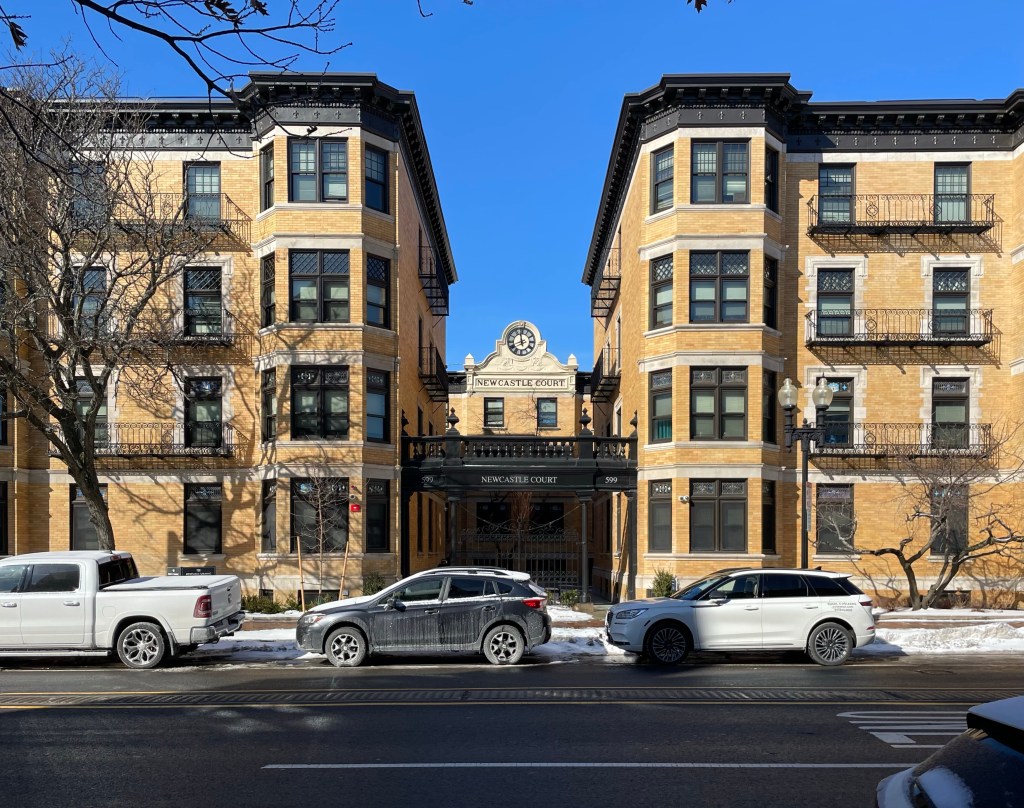
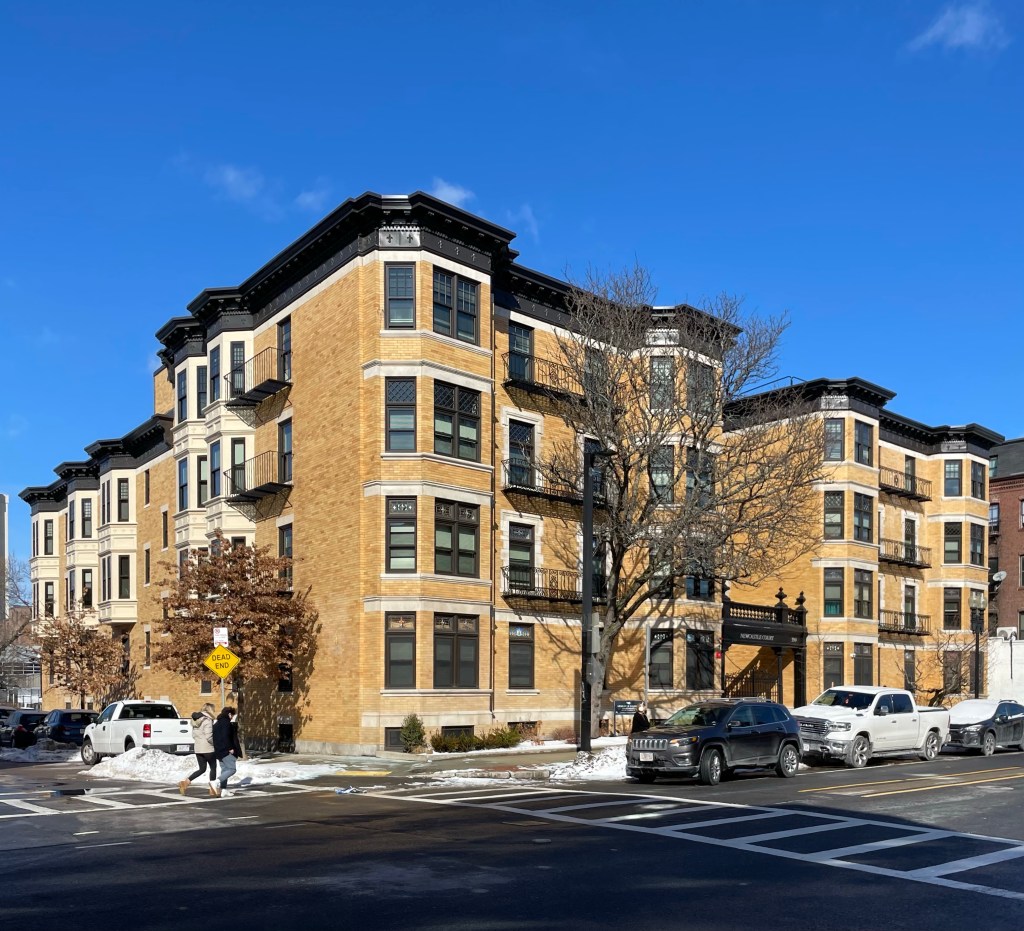
Newcastle Court // c.1907

Newcastle Court in Boston’s South End/Lower Roxbury neighborhoods is one of the finest apartment buildings in the city built in the early 20th century. The complex is U-shaped with a central courtyard off Columbus Street, to provide air and natural light in all bedrooms and units of the building. Newcastle Court was built by builder/developer Israel Nesson, who was credited as building the first fireproof apartment building in the city. Nesson and his family built and owned apartment buildings all over Boston and Cambridge, and operated many of them as landlords with massive real estate holdings. Newcastle Court stands out for the garden courtyard set behind the gate. At the back of the courtyard, the building has a raised parapet at the roof, which encompasses a clock. Many of the units retain the original stained glass windows, which are AMAZING!

Columbus Avenue A.M.E. Zion Church // 1885

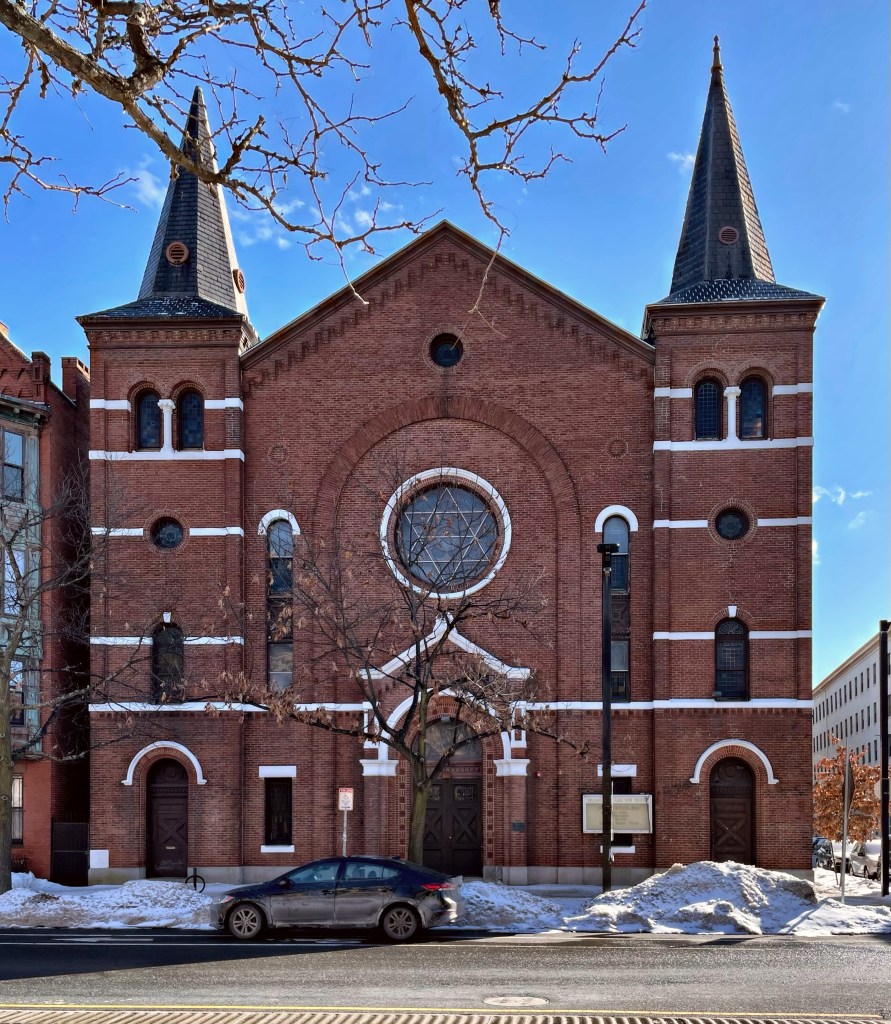
The Columbus Avenue African Methodist Episcopal Zion Church sits on the border of the South End and Lower Roxbury neighborhoods and is a great example of how the area evolved in the 19th and 20th centuries. The beautiful Romanesque Revival building was constructed in 1885 as the first synagogue of Congregation Adath Israel, which was founded in 1854. The congregation sought more space from its current location, and a closer place of worship for many of the German Jews who settled in Boston’s South End. They built this synagogue in 1885 and eventually moved west to a new Kenmore Square synagogue less than thirty years later as the neighborhood’s demographics began to shift. In 1903, the A.M.E. Zion Church purchased the former synagogue as their new home. This congregation had its beginnings in 1838 when seventeen African Americans withdrew from the communion of the Methodist Episcopal Church, then located on Joy Street in Beacon Hill. This group of Black worshippers wanted more religious freedom and desired to become part parcel of The African Methodist Episcopal Zion connection under the leadership of their own race. For many years, this church was the largest and principal Black church in the city of Boston. In 1903, shortly after moving to Columbus Avenue, the church experienced what was called the “Boston Riot.” The church hosted a debate between Booker T. Washington and William Monroe Trotter, editor and publisher of the “Boston Guardian”. Trotter, a Black Bostonian, opposed the gradual conservative approach to civil and political rights as promulgated by Mr. Washington. The debate took place on July 3, 1903 and the church was packed with over 2,000 spectators. Shortly after the opening prayer by Pastor McMullen of the AME Church, Washington was introduced. A disturbance then erupted with Trotter eventually being arrested for disturbing the peace. This building is the oldest synagogue building in Massachusetts and has been a center of Black life in Boston ever since the beginning of the 20th century.