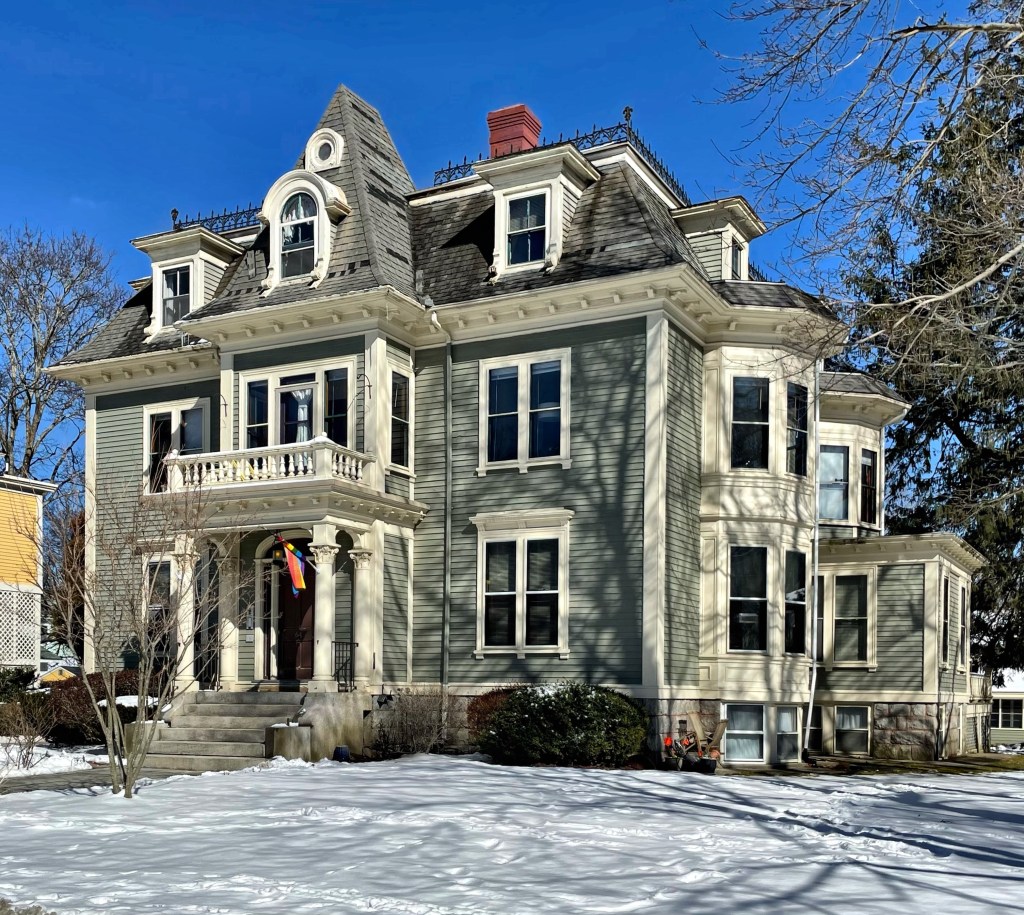
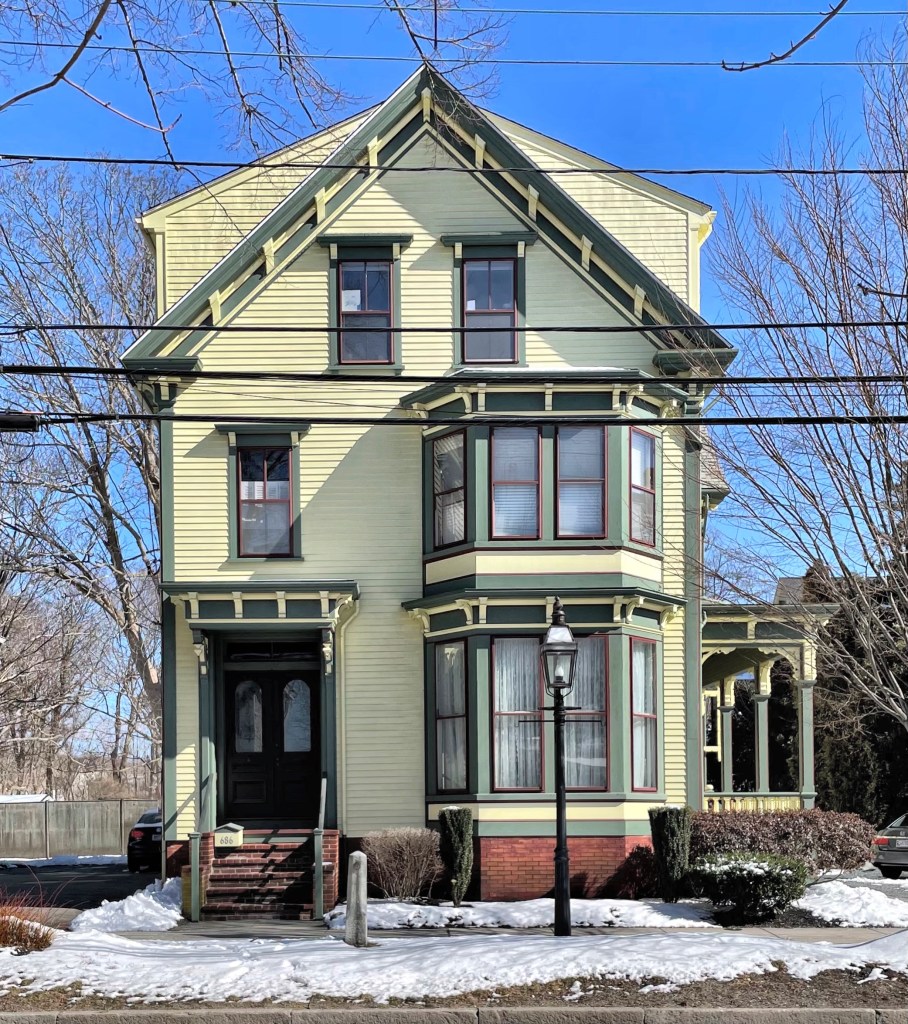
John Brown Herreshoff House // c.1870

John Brown Herreshoff, a fully-blind ship-builder, and later Founder and President of the Herreshoff Manufacturing Company in Bristol, built this house at the head of Burnside Street, overlooking his boat works (no pun intended). The home sits next to the stunning Codman Place mansion, featured previously, and takes architectural cues from its neighbor. The home is reported to have been built by J.B. Herreshoff, who despite being completely blind, developed his other senses to a high degree to overcome the handicap of sightlessness, and became renowned for his design skills in his ships. The home has a mansard roof with a central projecting entrance bay, capped with a steeply pitched roof, and a barrel-vaulted dormer and ocular window inset. While the house is now condo units, it retains its architectural integrity at the exterior.

Codman Place // 1870

In 1870, unmarried sisters of the esteemed and respected Codman Family of Boston, Catherine Elizabeth and Maria Potter, commissioned this house from the Newport Rhode Island architect George Champlin Mason. Like many who built in Bristol after the Civil War, the sisters seemed to view the location as a kind of suburb of fashionable Newport. In 1875 they were joined by their brother Henry Codman, who was given a large tower addition to dwell in, preserving the architectural significance to the Second Empire style home. Henry died in 1879, only four years after his tower was constructed, Catherine died in 1898, and Maria died in 1902 and the house was sold soon after her death. The home was converted to seven condominium units in the 1980s, yet retains its architectural grandeur from the delicate iron cresting at the roofs, down to the historic 2-over-2 windows.

Charles Greene House // 1879

Bristol, Rhode Island is dominated by Federal and Greek Revival homes, but there are some absolutely gorgeous gems built after (I can’t wait to show you a sampling). This Bracketed/Italianate home is a well-preserved example of the style with a side-hall entry, two-story bay window, and hoods over windows and the main entry with brackets. The home was built for Charles Greene, a very active citizen of Bristol. Greene (1822-1899) purchased the Bristol Phoenix in 1862 and remained its editor and publisher for thirty-one years. Active in public and civic affairs, he was first president of the Rhode Island Press Association, clerk of the Supreme and common Pleas Courts of Bristol County from 1865 to 1868, a member of the General Assembly in 1873 and 1874, Sheriff of Bristol County from 1875 to 1877, and a town council member from 1879 to 1881.

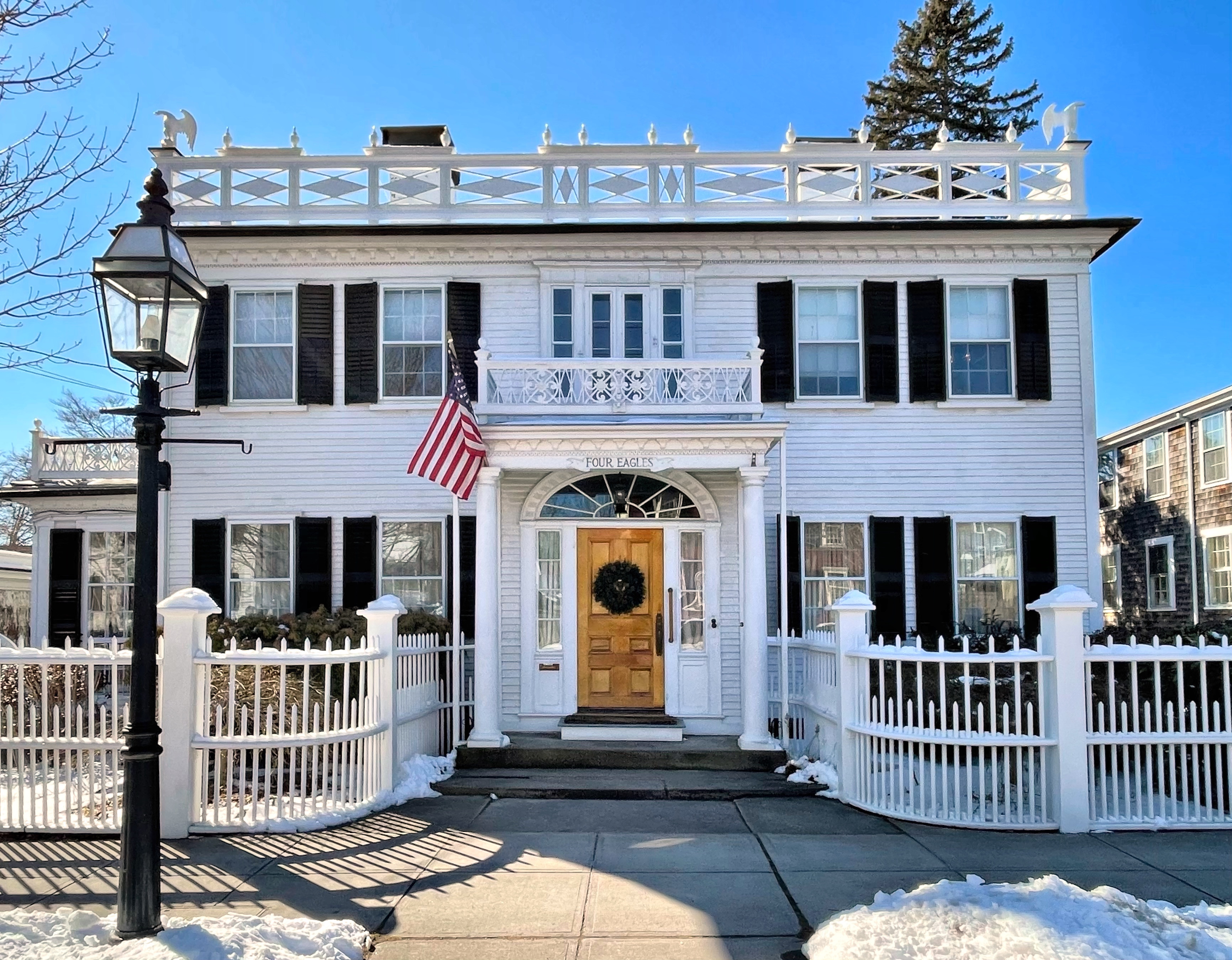
“The House with the Eagles” // 1808

In 1807, a young John Howe (1783-1864), a descendent of the DeWolf family, married Louisa Smith, and built this family home soon after. He hired local esteemed architect Russell Warren (who was the same age as Howe at the time) to design the home, which is a simply designed, hipped roof home with an elliptical fanlight and sidelights at the central entrance. It is embellished with superb architectural woodwork with an ornate roof balustrade. Howe and his family lived in the home until 1822, when it passed to ship captain, Benjamin Churchill, who appears to have been involved with the transport of slaves to the Americas. According to local legend, Churchill gave the house its name by having the sailors of his ship, the Yankee, carve four American eagles, which he placed at the corners of the Chippendale balustrade that crowned his roof. Churchill’s tenure in the home was brief, and in 1825 the house passed to Byron Diman, a powerful merchant with interests in whaling, banking, and the local cotton mills who served as governor of Rhode Island in 1846–1847. The home has been restored numerous times and is well maintained.

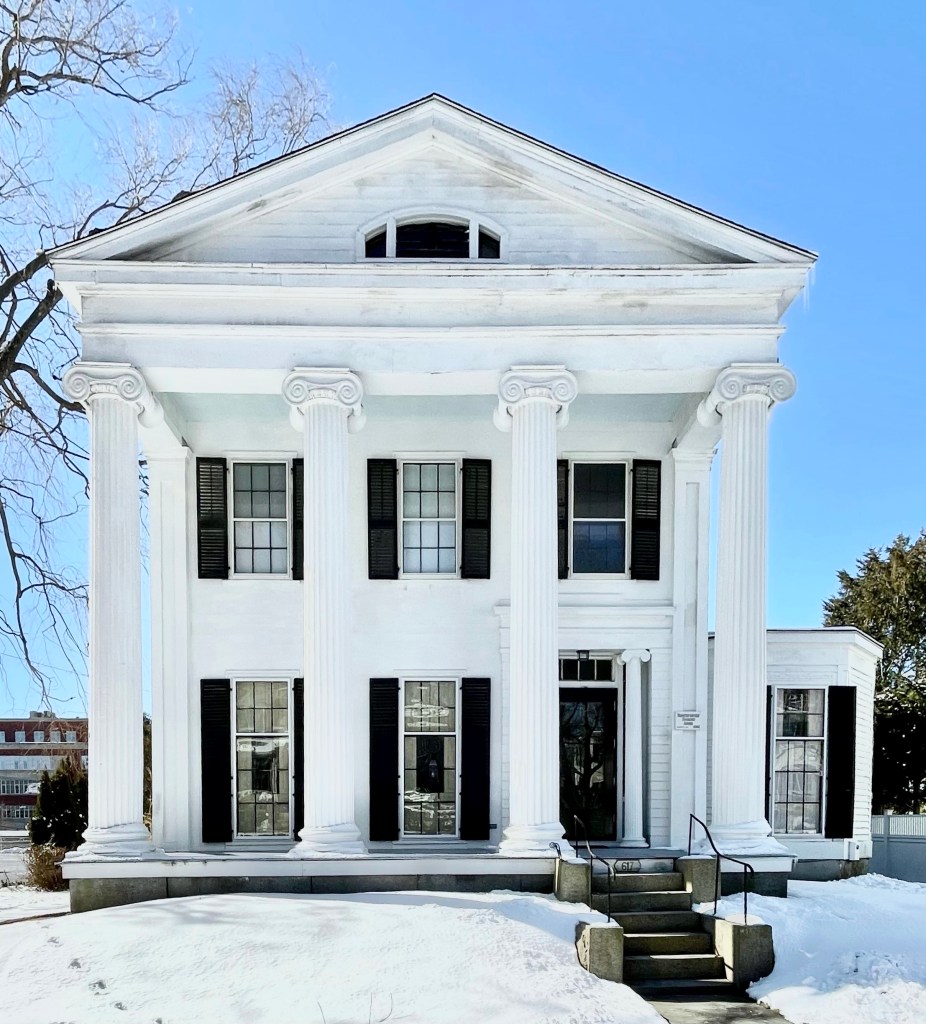
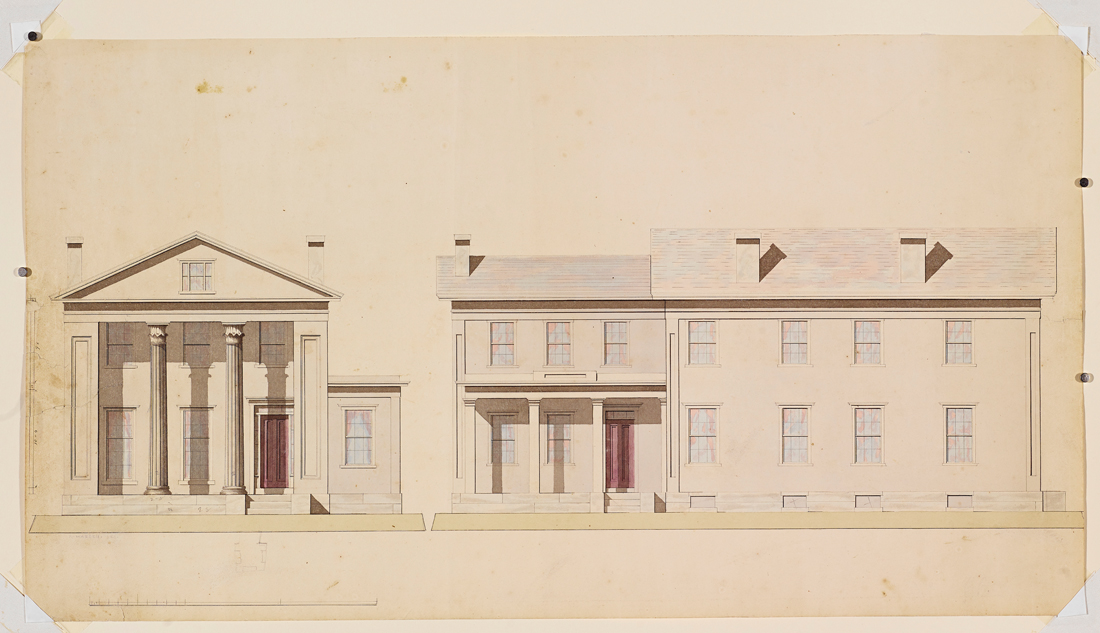
Francis M. Dimond House // 1838

Built in 1838, just three years after the Talbot House in Bristol, Rhode Island, (just two houses away), the Dimond House remains as the other of the two remaining Greek, temple-front homes in town. Like the Talbot House, this home was also designed by Russell Warren, but is unique as it is in the tetrastyle (with four columns) and utilizes the Ionic order with the capitals featuring volutes (scrolls). Additionally, a polygonal bay can be seen on the right side of the home. Images show that the bay features stunning lancet windows! The home was designed for Francis Moore Dimond (1796-1859), who was born in Bristol, and later traveled to the Caribbean and served for several years (1832-1835) as the United States consul at Port-au-Prince. It is entirely possible that Dimond was involved in the slave trade, but I wasn’t able to find more than a couple articles referencing his connections to the infamous DeWolf Family. From 1842 to 1849, Dimond was United States Consul to the Mexican port city of Veracruz. When he returned to Rhode Island, he promoted the Southern Pacific Railway and presided over its construction. He was elected lieutenant governor of Rhode Island in 1853. He became the governor of Rhode Island when Philip Allen, then Governor, resigned to become a Senator. He held the governor’s office just one year. He moved back to Bristol and lived out his final days at his home.

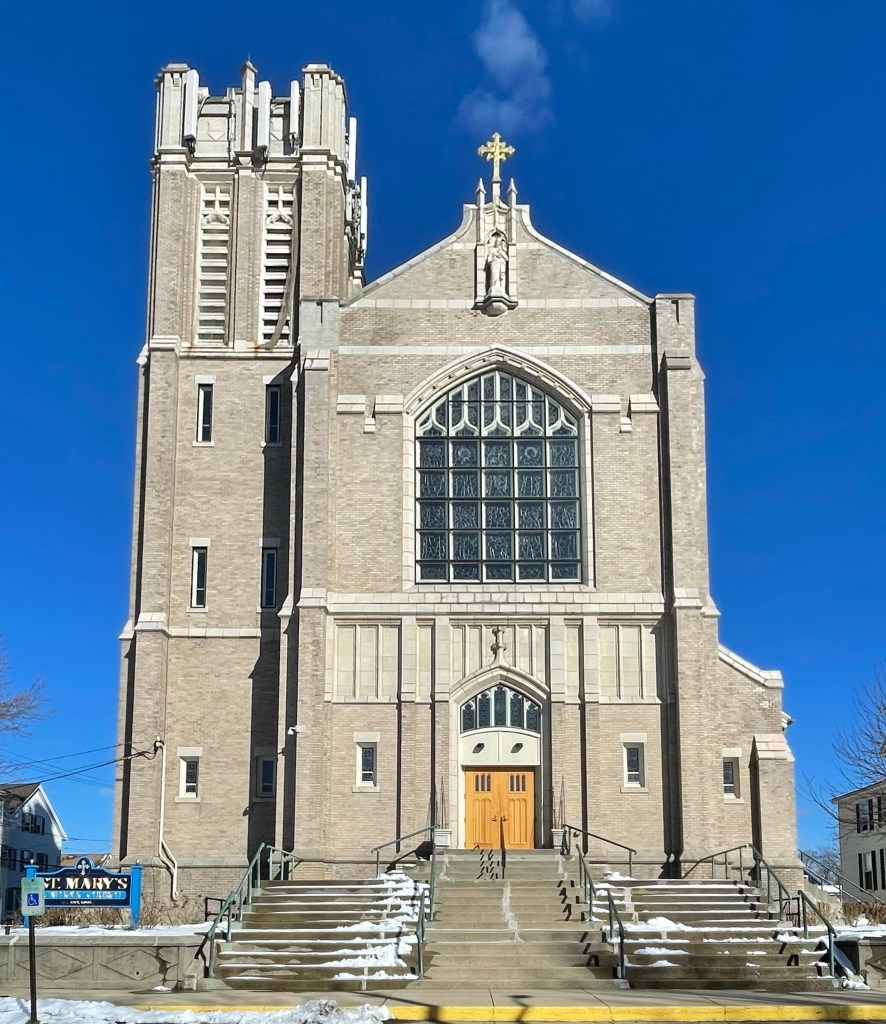
St. Mary’s Catholic Church // 1911

This 2-story Neo-Gothic Revival church constructed of buff brick and limestone, is dominated by an off-center, 4-level tower and showcases how even smaller towns in New England have some of the finest 20th century churches. In 1849 St. Mary’s parish, in nearby Warren, Rhode Island, was founded to serve residents there as well as Irish and French Canadian immigrants in Bristol, which began arriving en masse. Just years later, in 1855, the first St. Mary’s Church in Bristol, was constructed as a plain wooden structure, and operated as a mission of the Warren church. In 1874 the Bristol church became an independent parish and saw large increases to membership with more Irish families settling here. Over the next decades, the space became more cramped and a building campaign was started to get a new place of worship. The present St. Mary’s Catholic Church was built in 1911, from plans by the Providence-based architectural firm of Murphy, Hindle & Wright, who together (and separately) designed many ecclesiastical buildings, in Rhode Island and Massachusetts. The interior is even more stunning than the exterior detailing, and remains very well-preserved.

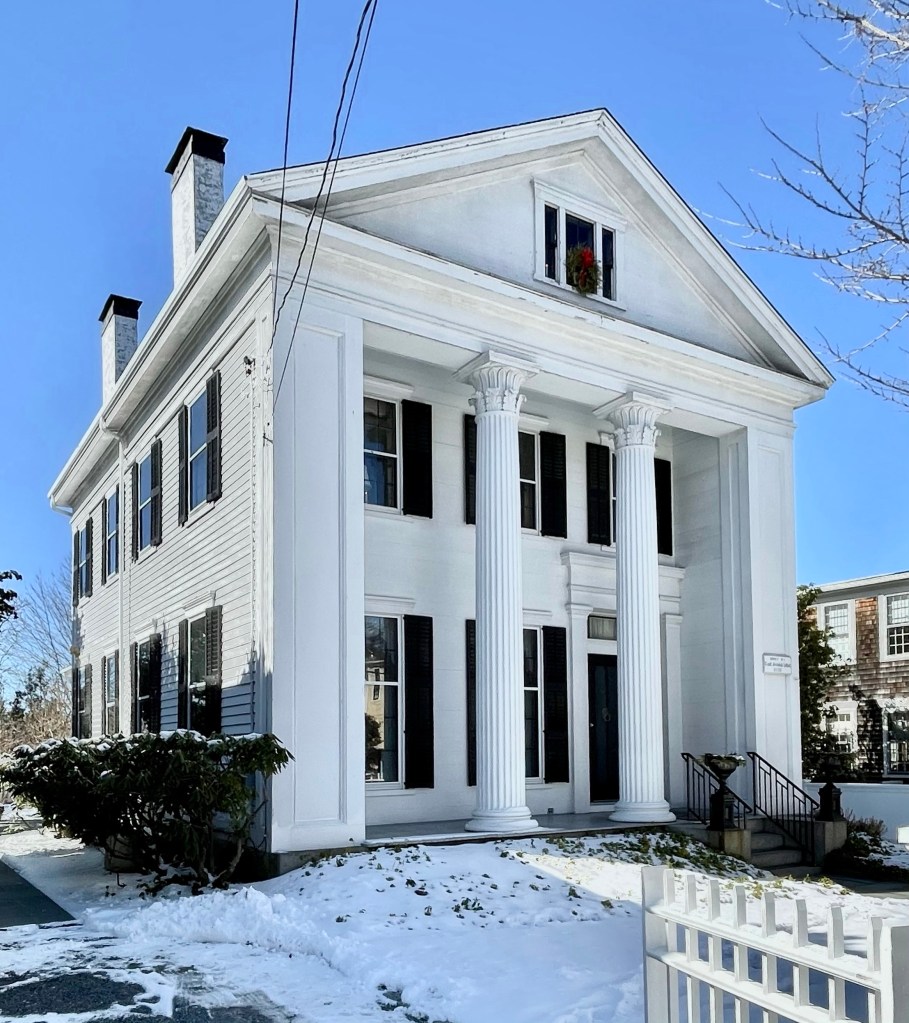
Josiah Talbot House // 1835

Anyone that has followed this account for a while knows at least one thing, I LOVE Greek temple-front homes. Designed by famed architect, and Bristol-native, Russell Warren, this 2-story, 3-bay, gable-roof Greek Revival house is one of the finest in the state. Its facade has a pair of fluted Corinthian columns, set in antis (where the side walls extend to the front of the porch). A simple side-hall entrance is framed by heavy Doric pilasters, supporting a broad, plain entablature, making this such a head-turning Greek Revival home. The walls are sheathed with horizontal flush boarding at the facade to give a smoother look and clapboards on the side and rear. The home was built for Josiah Talbot, a sea captain. The house is excellently preserved to this day, almost 200 years later.

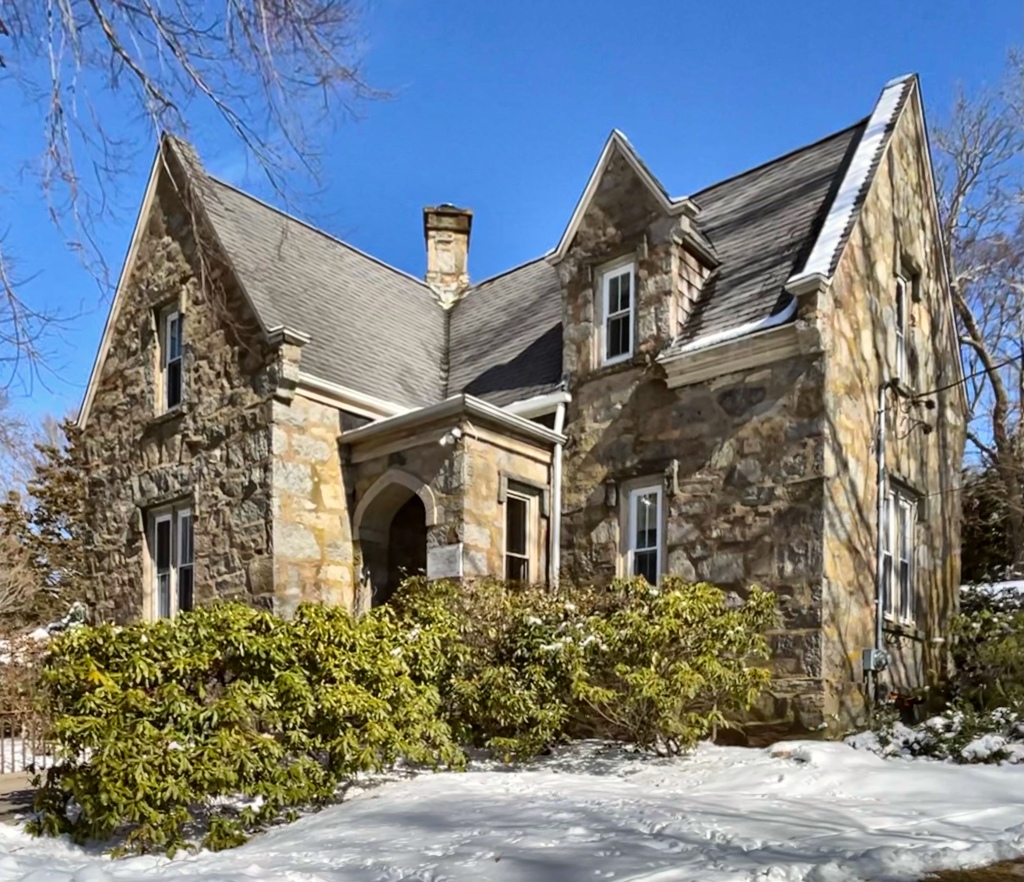
Juniper Hill Cemetery Gate Lodge and Chapel // 1869 & 1913

As Bristol grew to be a dominant financial center in Rhode Island in the mid 19th century, prominent families there decided that their loved ones (and later themselves) needed a place of beauty to rest eternally. In 1855, descendants of Levi DeWolf, of the infamous slave-trading family, donated 22-acres of land for use as a cemetery. The old Levi DeWolf home remains fronting Hope Street, featured previously as the Reynolds-DeWolf House. It is a fine example of the mid-19th century rural cemetery movement, with winding lanes and paths. The landscape was designed by Niles Bierragaard Schubarth, who had done similar work at other Rhode Island cemeteries. Upon the opening of Juniper Hill, many families relocated their loved ones from other cemeteries in town here, so the families could be interred nearby each-other. The cemetery has three main structures; a gateway, the gate lodge, and a chapel/receiving tomb. The gate is a massive stone archway set at the entry to the cemetery, and was built in 1876 by the Smith Granite Company of Westerly, R.I. The Gate Lodge was built years earlier is located at the side of the entry into the grounds, and is a stone Victorian Gothic Revival building, designed by Providence architect Clifton A. Hall and constructed of granite quarried on the site during construction of the landscape. Yards away, the charming Amory Chapel and Receiving Tomb, built in 1913, is a 1-story stuccoed structure with a tile roof, designed by the firm of Angell & Swift of Providence. The small chapel stands out as it is a rare example of the Spanish Revival style, but has seen better days, and is apparently being used as a tool shed.

William Throop Jr. House // 1805

While much of the downtown area of Bristol features early 19th century wood-frame houses, there are some substantial masonry homes providing a great layering of styles and materials in the neighborhood. This brick Federal style home was built in 1805 for William Throop Jr. (1771-1850), a stonemason and merchant, who had a shop on the DeWolf wharf in Bristol, where many slave ships set sail from. Throop himself was a descendant of William Throope, who built “Throope Place” (previously featured) on the north side of town. We understand that William Jr. likely had connections to the slave traders of Bristol based on his ties to the DeWolf Family, which is compounded by the fact his two daughters Juliana and Jane married Judge James Eppinger of Georgia. Juliana first married Eppinger in 1820, but died in 1859, and her younger sister Jane then married James Eppinger one year later. The Eppingers built a house in Bristol where they would spend time, and often brought enslaved with them to maintain their home. On October 12, 1829, Nancy Gindrat, a 22 year old slave to James and Juliana Throop Eppinger, escaped in Bristol. Eppinger frantically wrote to his father in-law William Throop and others that he would offer a large sum to anyone who could find her, though he never did. It was interesting to learn how inter-connected Rhode Island and Georgia were in the early 19th century, both bonded by the slave trade. The William Throop Jr. House remained in the family for a century until it was converted into a rooming house in the early 20th century, to house workers at the nearby industrial buildings. The home was restored and reverted back to a one-or-two-family residence in the 1970s.

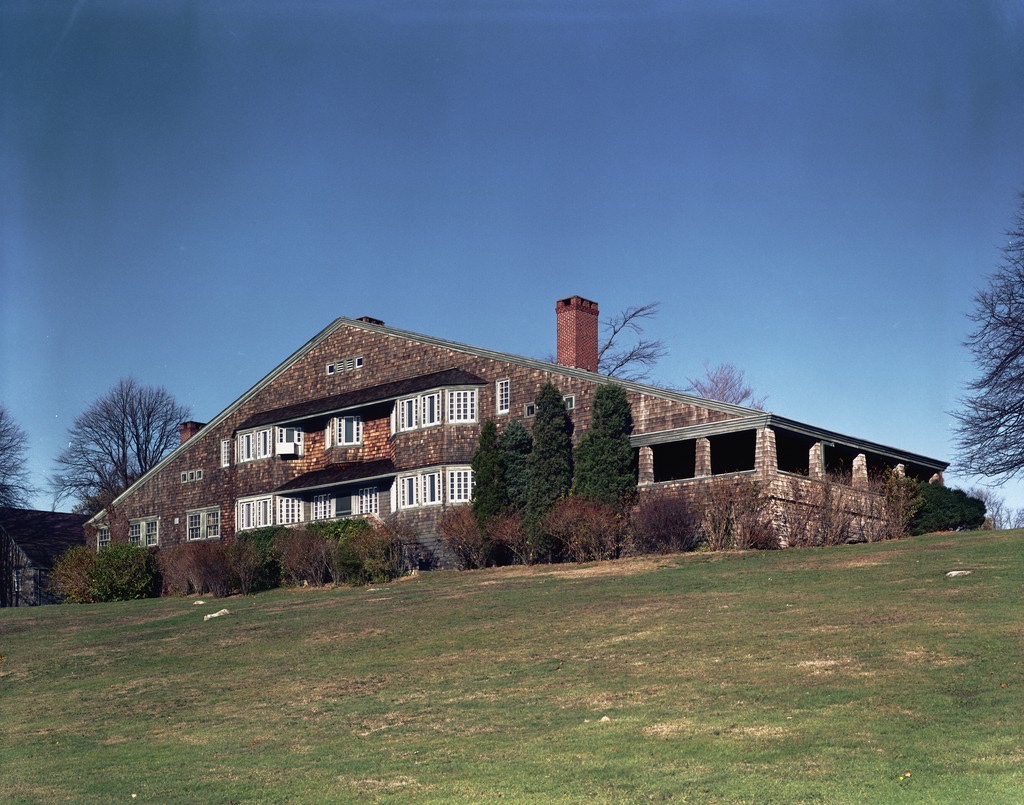
William G. Low House // 1887-1962

One of the many significant losses to American architecture is the demolition of the Low House, a perfect encapsulation of the Shingle style of architecture by one of the most prolific designers in American history. The William G. Low House was constructed at the southern tip of Bristol, Rhode Island by esteemed architect Charles Follen McKim (my personal favorite) of the firm McKim, Mead & White. The Shingle style, which took off in the Northeast United States, primarily in seaside communities in the late 20th century, the homes of the style often had a strong horizontal emphasis. The style contrasts the other Victorian-era styles, de-emphasizing applied decoration and detailing in favor of complex shapes wrapped in cedar shingles. The Low House, formerly located on Low Lane, stood out for its 140-foot long gable which appeared to protrude right from the hilly outlook. The home was demolished in 1962, but was documented by the Historic American Buildings Survey program, which documented the home inside and out before it was a pile of rubble. Architectural historian Leland Roth later wrote, “Although little known in its own time, the Low House has come to represent the high mark of the Shingle Style”.