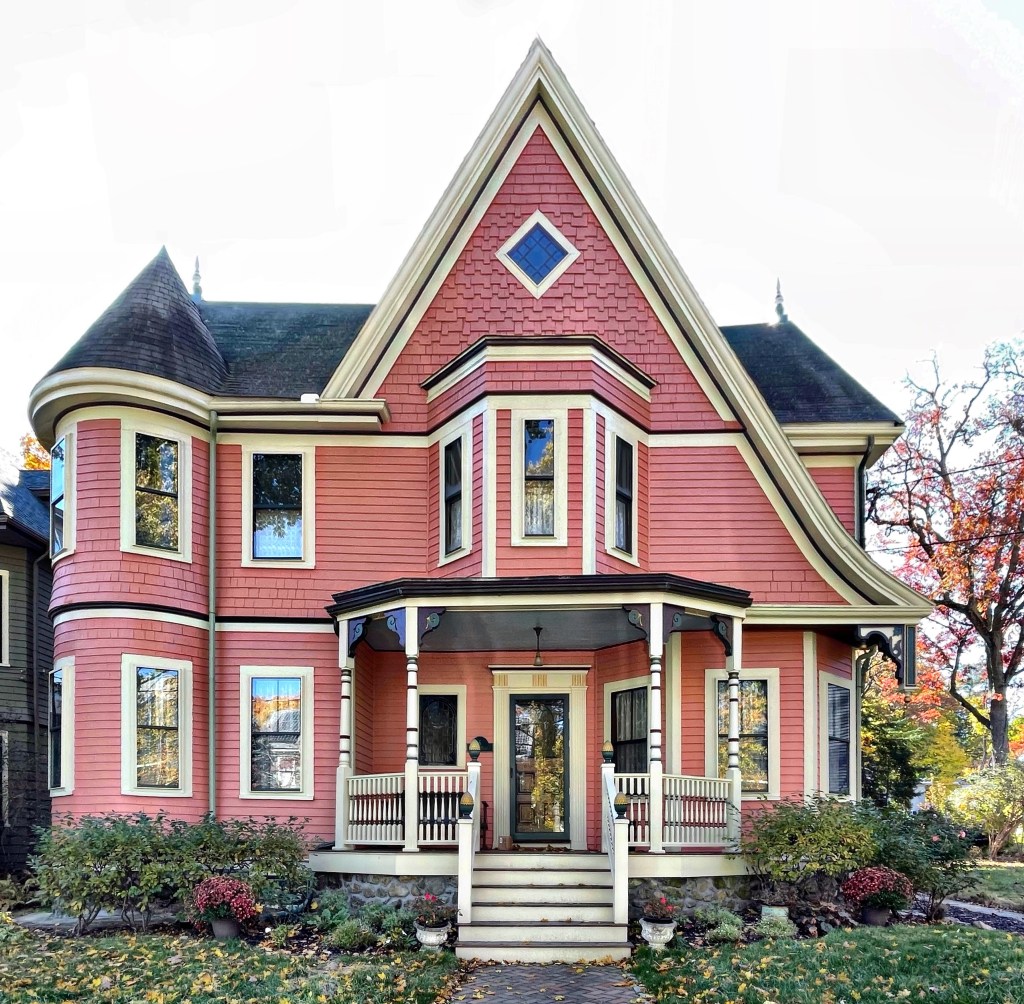
In 1852, Beacon Street in Newton was extended westward from Chestnut Hill through Newton Centre. The village’s suburban development accelerated through the activities of real estate developers as the city became connected to Downtown Boston by roadways and rail. This home was built in 1893 for Andrew and Ann Kistler. Andrew Kistler worked as a leather dealer in Boston, and commuted into the city daily. The Kistler House is an excellent example of Colonial Revival with some added oomph.
At the end of the 19th century, much of Boston’s suburban communities saw rapid development where country estates and farmhouses were razed and their properties laid out for residential development. This house in Newton was built around 1898 as a late Queen Anne and it has so many details and intricacies. The earliest known owner was Grace M. Weston who was mentioned often in local newspapers as an expert on antiques.
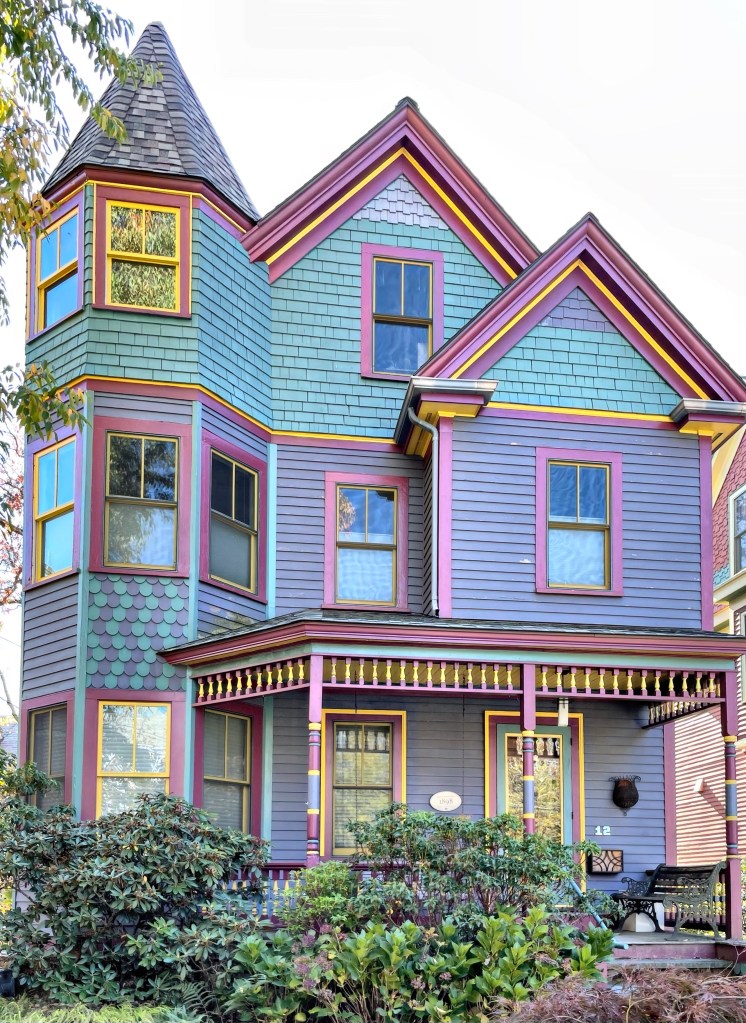
Behold this Queen Anne painted lady in all her glory! This home was constructed in 1898 as a late Victorian addition to Newton’s built landscape. The home’s earliest known owner was a T. C. Sullivan, who left the property to his family upon his death. The house is painted some pretty bold colors, which does an effective job at highlighting the many architectural details and intricacies in the design, but the home would have never been painted like this historically. A little history lesson: the “painted lady” trend took off in San Francisco when after WWII, disinvestment in the urban core led many Victorian homes there to be demolished, altered and covered with siding, and many were painted gray with war-surplus Navy paint (battleship gray). In 1963, San Francisco artist Butch Kardum began combining intense blues and greens on the exterior of his Italianate-style Victorian house. His house was criticized by some, but other neighbors began to copy the bright colors on their own houses. Kardum became a color designer, and he and other artists / colorists began to transform dozens of gray houses into Painted Ladies. By the 1970s, the colorist movement, as it was called, had changed entire streets and neighborhoods. This process continues to this day. The trend took off all over the United States as urban centers saw re-investment and gentrification. While not historically appropriate, the Painted Ladies can really make people happy and show pride in ownership.
The last (but certainly not least) building in Dorset, Vermont I’ll be featuring is the Manley-Lefevre House aka. Marble House! This stunning Federal period home was built around 1820 by Martin Manley (1783-1856) on land originally owned by his father George. The house is constructed of ashlar marble that was quarried with hand tools from the lower quarry located approximately 200′ behind the site of the house with dressed marble finished in town and brought back for installation at the lintels, sills, and door surround. In 1907, Edwin Lefevre, Sr. (1871-1943) traveled by train from Bronxville, New York to Dorset at the suggestion of the artist Lorenzo Hatch, with the intention of locating a summer residence for his family. They purchased this home, which became known as “The Old Stone House” and hired Eugene J. Lang, a New York architect, to remodel the house, design a kitchen wing and remodel the barn into a garage (1909). While in Italy, Lefevre fell in love with the formal gardens there, and wanted something like this for his country estate. Upon his return, he retained garden designer Charles Downing Lay to design the gardens that surround the house. The country estate is now home to The Marble House Project, a multi-disciplinary artist residency program.
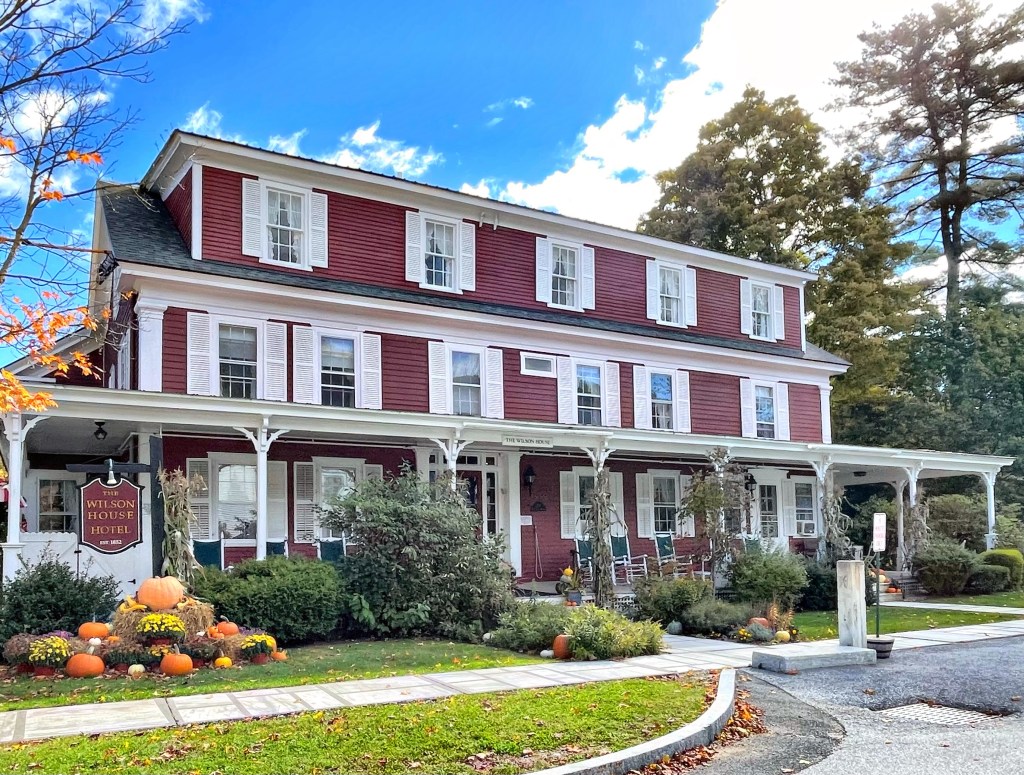
This building, the largest building in East Dorset Village, was constructed and opened as a hotel in 1852 and has ties to one of the most influential organizations in America. Entrepreneur Ira Cochran built this hotel the same year the railroad came to town, capitalizing on the influx of business and new laborers travelling to the once sleepy town now dominated by the marble industry. By the end of the 19th century, the building was owned by the Griffith family. On November 26, 1895, William (Bill) Griffith Wilson was born here, behind the bar of the hotel during a snowstorm. As a child, he moved away until the age of 11, when he returned to East Dorset to live with their maternal grandparents, the Griffiths. Bill would later go on to become the co-founder of Alcoholics Anonymous. The building would eventually sit vacant and dilapidated until Albert “Ozzie” Lepper, Wilson’s friend, purchased the property in the late 1980s and made it into a living memorial to Bill Wilson, renovating The Wilson House with the help of volunteers’ time and talent. The hotel reopened in 1998 under the historic name. The Wilson House was later established as a nonprofit organization to ensure that Wilson’s memory, spirit, and purpose in life continues on for decades to come. Today, visitors come to the Wilson House from all corners of the world. Many of them are in recovery themselves, while others are history buffs who simply want to visit the homestead, which was added to the National Register of Historic Places in 1995.
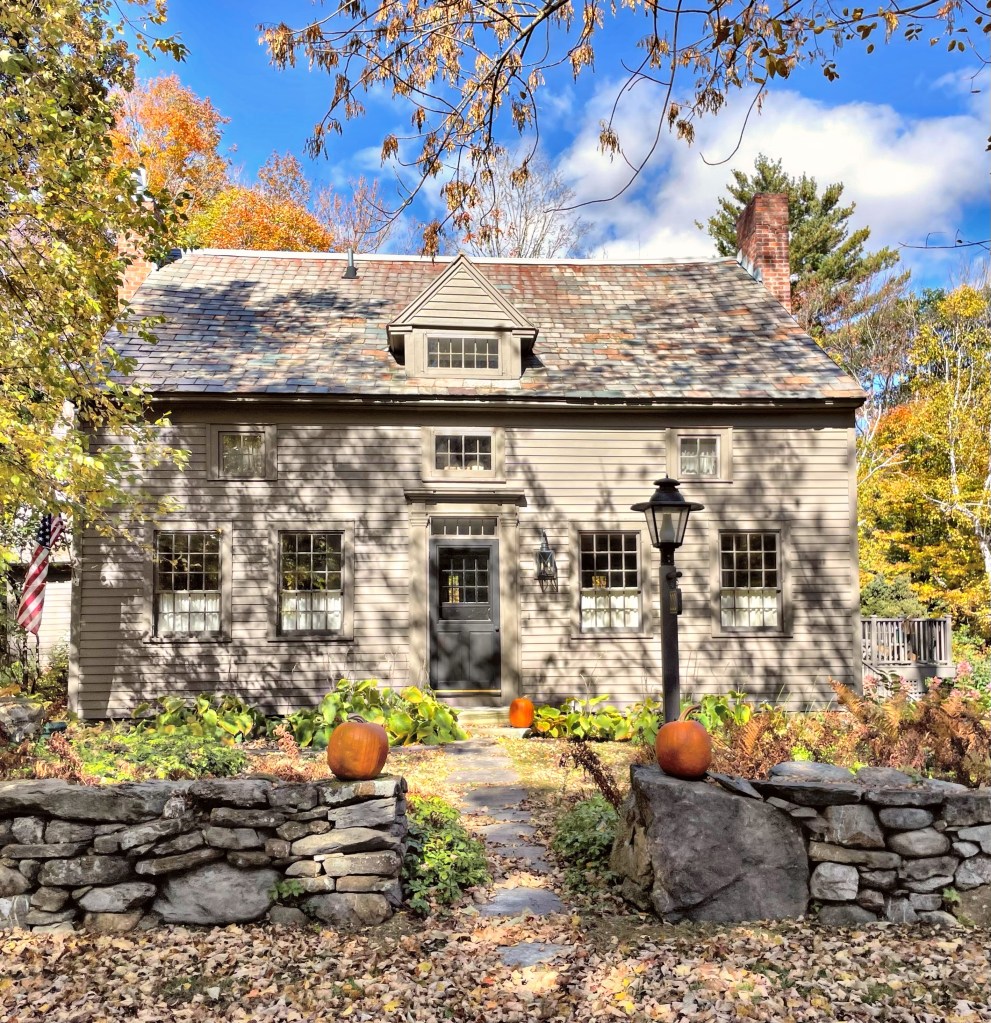
This absolutely charming vernacular Greek Revival home was built in the mid-19th century in East Dorset Village. By the end of the 19th century, it was converted to a cheese factory a model in adaptive reuse and historic preservation. In the late 1930s, as Dorset became a popular summer colony for artists and upper-middle class residents of New York and the Mid-Atlantic, the cheese factory was purchased by artists Norman and Silvia Wright. The artists relocated the small building to the Kent Hill neighborhood of town, restoring the home and adding wings onto it. I also love the chocolate color paint!
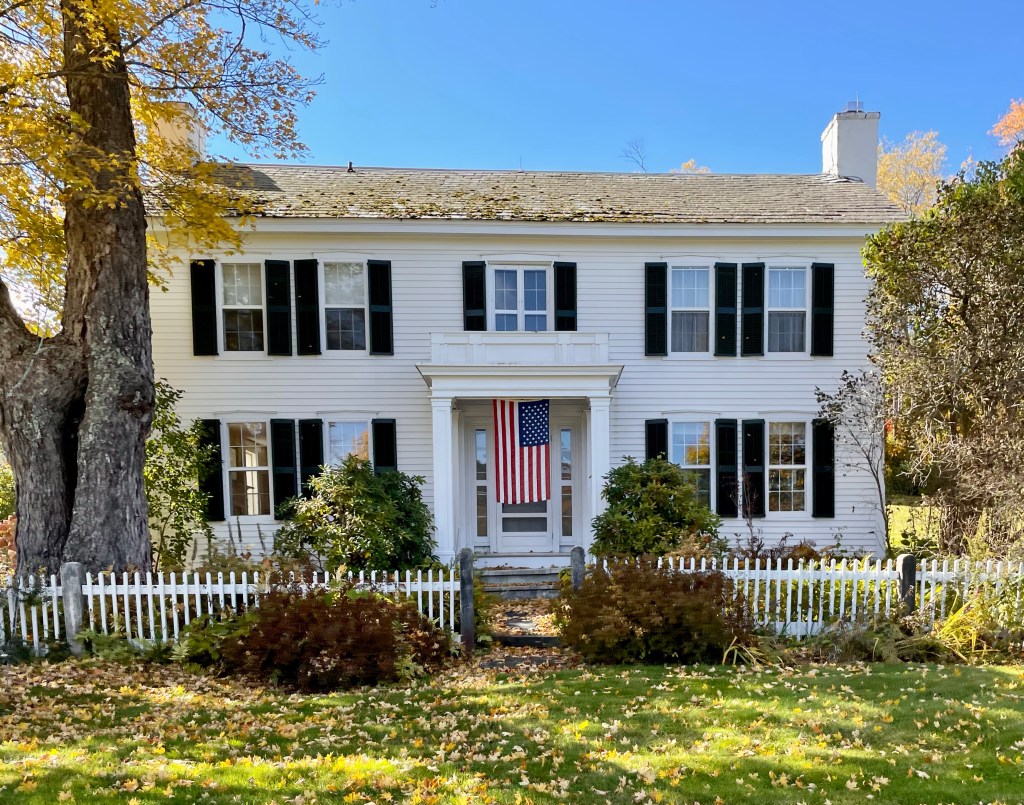
Located at the principal intersection in the Kent Hill area of Dorset, this home is the visual anchor for its surroundings. The property is a typical early 19th century Federal style house in Vermont, sheathed in clapboards, a central entrance, with a slate gabled roof and two exterior end chimneys. The house was probably remodeled not long before the Civil War, which would account for the classical entry porch, with square piers, entablature, and paneled parapet. Together with the peaked lintels, these are the only classical details on the exterior of the building. This was the home to Martin Kent (1769-1857), a son of Cephas Kent, an original settler to the area of the prominent Kent family of Suffield, Connecticut. Cephas built a house and tavern on the southwest corner of this home, which hosted four meeting of delegates from various southern Vermont towns in 1775 and 1776 to determine how to act together against New York claims to their lands, a catalyst to the establishment of the state of Vermont. Other owners of the Martin Kent House have included historian and novelist Zephine Humphrey, her artist husband Wallace Fahnestock, and Lincoln Isham, Abraham Lincoln’s great-grandson! Lot of history here!
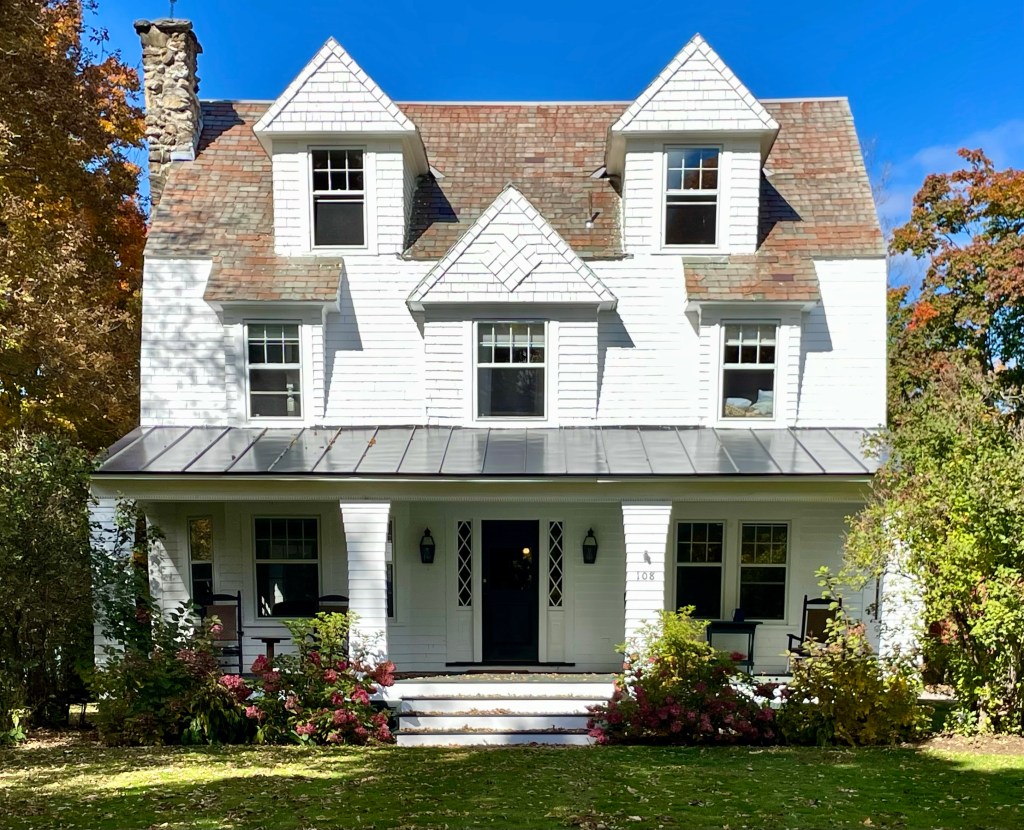
The former Dorset Methodist Church sat on this property from about 1840 to 1900 until they merged with the United Church of Dorset. A Philadelphia physician, Dr. John Herr Musser (1856-1912), built this vacation home in 1906, and passed away just six years later. His widow Agnes Harper Musser (1856-1941) and their children continued to vacation here until after WWII. The home is a rare example of the Shingle style in Dorset and was painted the bright white to fit in with the more traditional New England village vibe, but it would be better-suited with a period- and style-appropriate paint scheme. The home is now offered for short-term/vacation rentals.
One of the oldest continually operating inns in America, the Dorset Inn remains a visual and historical anchor to the charming little village of Dorset, Vermont. The Federal period building was historically known as the Hodges Hotel before becoming The Washington Hotel in about 1858 (the porch was added at that time to make it resemble George Washington’s Mt. Vernon home). The name became the Dorset Inn in 1904. As constructed in 1796, the main block possessed a five-bay facade arranged symmetrically around a central entrance; an 1858 extension added two bays on the west, when it was modernized. Though the inn has seen changes and modernizations over time, the building has such a historic character that brings in people from all over the country to experience the best of Dorset every year.
Yet another of the buildings moved to Dorset Village by Charles A. Wade, this amazing classical building stopped me in my tracks when walking along the town’s marble sidewalks. It turns out this little structure was constructed in Enfield, Massachusetts, a town that was flooded in the 1930s for the filling of the Quabbin Reservoir. The building was likely built in the 1840s as a Congregational chapel, and upon hearing about the demise of the town, Wade drove to Enfield and brought back this charming little chapel for his hometown of Dorset. Upon its arrival to Vermont in 1938, the Greek Revival building was used as the town’s post office until a larger building was constructed in the 1960s. This building was converted to a real estate office and is now home to Flower Brook Pottery.





 Buildings of New England