The only historic brick residence located in the charming Salem Willows neighborhood of Salem, Massachusetts is this stately Colonial Revival house at the corner of Bay View and Juniper avenues. The brick dwelling was constructed in 1916 for James Roope, President and Treasurer of the Salem Lumber Company. Designed by Boston architect, Gordon Robb, it is two stories high, with a shallow hipped roof. The central entry has leaded sidelights and a pedimented porch with trellises at the sides.
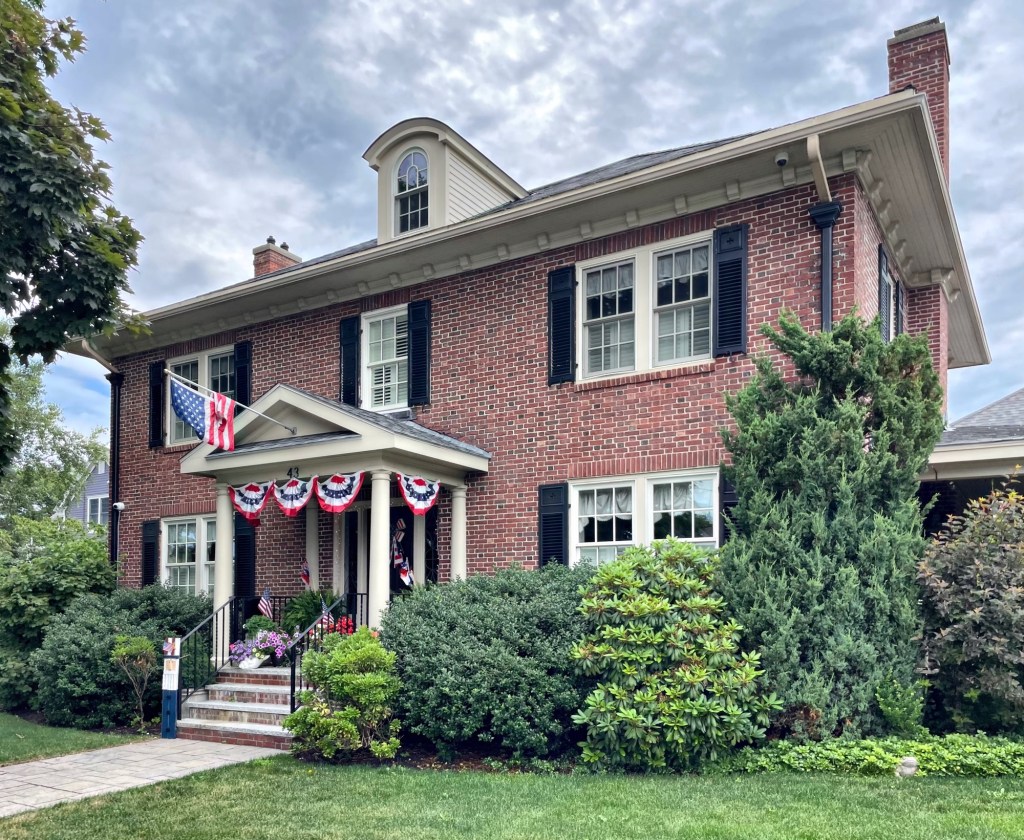
In 1910, Ralph Linder Pope (1887-1966) graduated from MIT and later became Chairman of the Board of Directors of the Northwestern Leather Co., Boston. He married Elizabeth S. Wightman two years earlier and her father, George Wightman, purchased a house lot near his own 1902 mansion in the Longwood section of Brookline, Massachusetts and had this brick residence built in 1910 for the new couple. Mr. Wightman commissioned the famed architectural firm of Shepley, Rutan & Coolidge to design his daughter’s home in the Colonial Revival style.
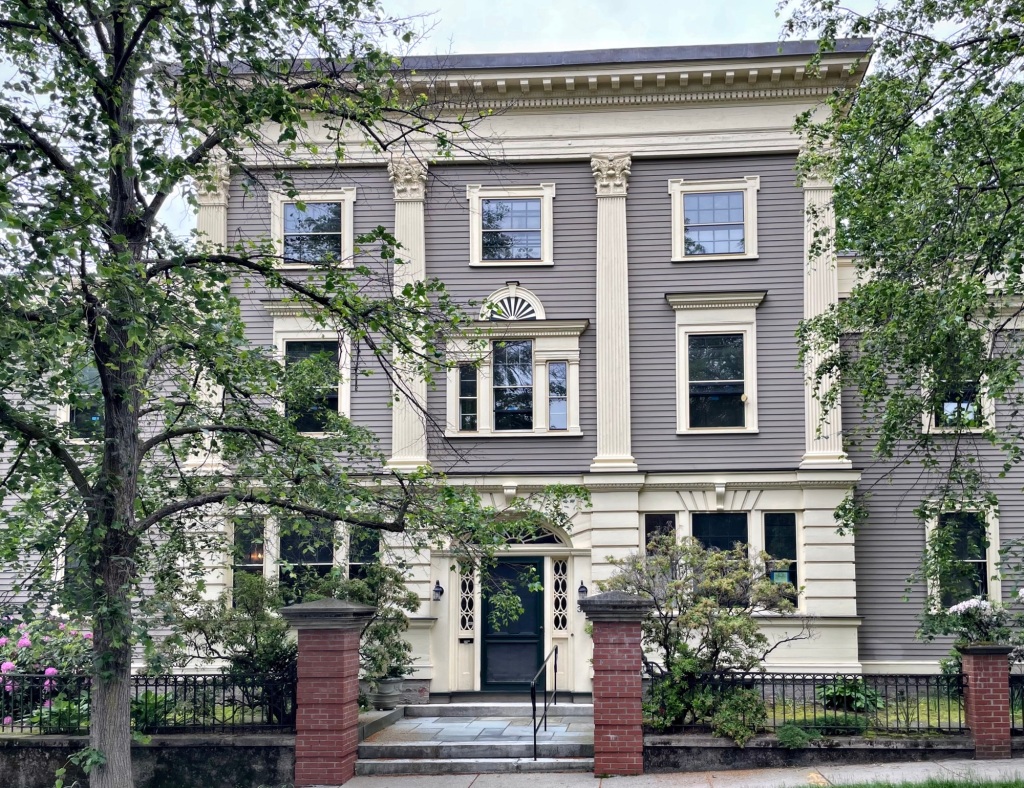
Located next door to Ms. Matchett’s house on Chatham Street in the suburban Longwood neighborhood of Brookline, Massachusetts, you will find this very unique example of a Colonial Revival style single-family home. Built by 1901 for lawyer Edwin G. McInnis (sometime spelled McInnes) and his wife, Mabel, the house is high-style Colonial Revival with symmetrical facade, rustication, two-story Corinthian pilasters framing the bays, Palladian window, and Federal style entry with fanlight transom. No records of the architect could be located sadly.
In 1905, Sarah A. Bennett Matchett (1833-1910), a widow, purchased a desirable house lot in the Longwood section of Brookline, Massachusetts. She inherited a large fortune upon the passing of her husband, William F. Matchett (1832-1901), who was the long time treasurer of the Boston and Roxbury Mill Corporation. The couple had no children, but she watched over her nieces and nephews following her brother’s death. Ms. Matchett hired architects Arthur Everett and Samuel Mead to design a large Colonial Revival style home on the lot, which was then built in 1905. Upon her death in 1910, she willed each of her four nieces and nephews $25,000 (roughly $800,000 (a piece) adjusted for inflation to today. She also willed $200,000 to Harvard College and funds to Massachusetts General Hospital and the Massachusetts Society for the Prevention of Cruelty to Animals. After her death, her Brookline residence was inherited by her eldest niece, Helen Maud (Bennett) Richardson and has been lovingly maintained over 110 years later!
If you love Colonial Revival style homes, the Longwood neighborhood in Brookline is a must-visit area to stroll around! This house is tucked away in the neighborhood and was a treat to stumble upon. This large home was designed by the underappreciated architect, James Templeton Kelley for a George G. Quincy. The Colonial Revival style dwelling is actually built of wood with a brick veneer and has an open pedimented entry with fanlight and transom surround. The round-headed windows on the first floor are especially notable.
Historians date the bones of this house in the Longwood section of Brookline, Massachusetts to the 1870s (or earlier), but its present appearance is definitely from the early 20th century. This is the Pope-Gardner-Robbins House on Colchester Street, a lovely span of stucco-sided homes in one of my favorite neighborhoods in the Boston area. An early (1874) map of the area shows this was the home of T. B. Pope, and later purchased by Harrison and Laura Gardner, husband and wife. Harrison Gardner was a founder (and served as treasurer) of the Boston Red Stockings of the new National Association of Professional Base Ball Players (NABBP). The Red Stockings eventually became the Boston Braves baseball team and are now the Atlanta Braves. The multi-lot property was likely rented by Gardner for supplemental income and was eventually sold to Annette R. Robbins, who seemingly had this home renovated in the 1920s and others nearby built or renovated as well. The house is today an excellent (and fairly uncommon) example of a Colonial Revival style house with stucco siding.
At the head of Touro Park, this large home has stood since it was built in 1864 for Daniel Edgar of New York, who made it his summer home for eight seasons. It was designed by noted local architect, George Champlin Mason in the Italianate style and included a broad veranda, brackets, and other intricate details. In 1872, Edgar sold the property to Catherine Lorillard Wolfe, who occupied the house until 1883 when her property “Vinland” was completed on Ochre Point Avenue. In 1948, the house was purchased by Cornelius C. Moore, who remodeled the exterior in 1949-1950, removing its Italianate trim and replacing it with Neo-Federal detail we see today. The house was most-recently in use as the Touro Park Inn, but was recently purchased and is a single-family home.
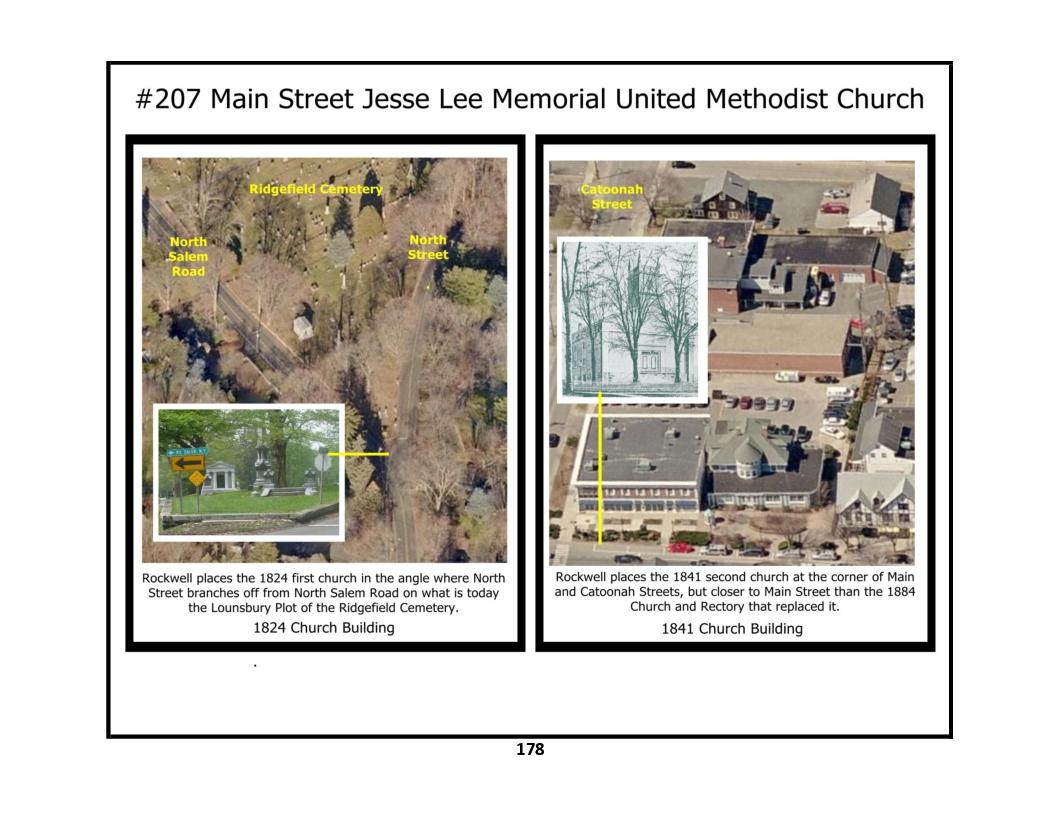
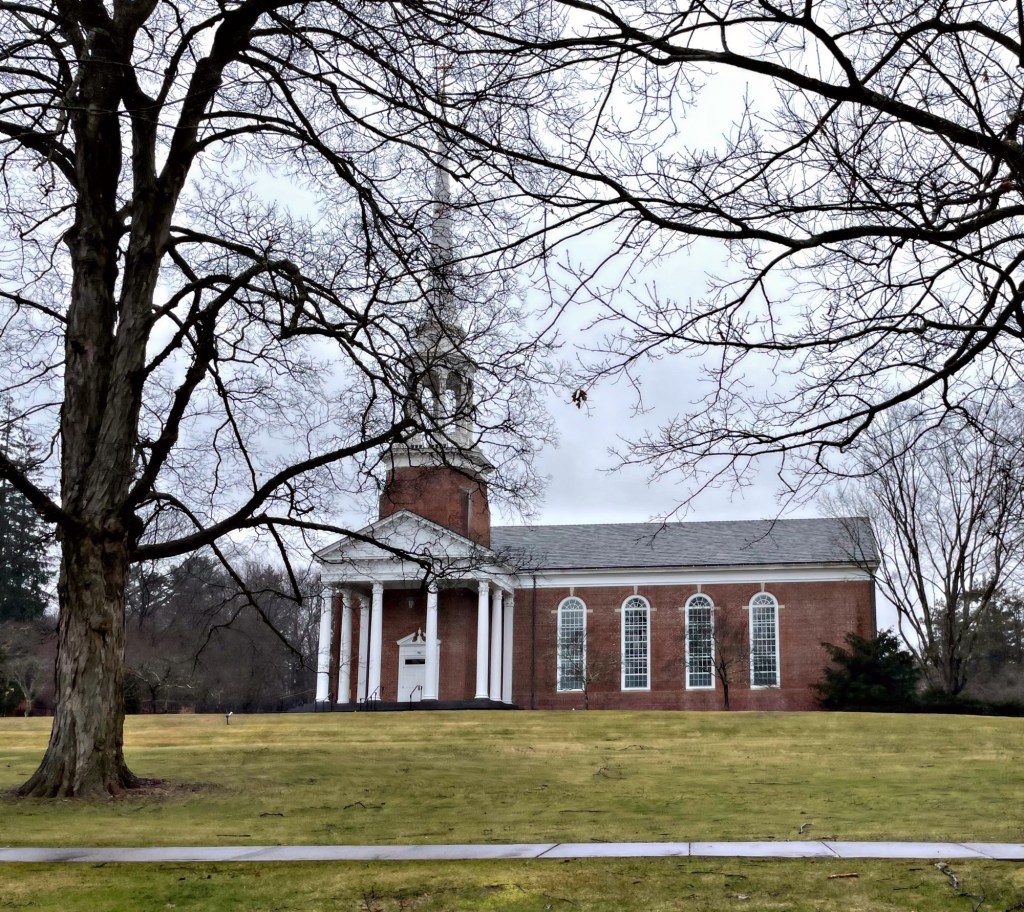
Believe it or not, this church in Ridgefield Center was built in 1965! To know its full history, we have to go back to 1787, when the Methodist Episcopal Church had its beginnings in Ridgefield, the third in New England. Its first meeting was held – just 21 years after Methodism had been introduced into the U.S. from England. In 1789 Jesse Lee, a native of Virginia, was sent north as a circuit rider. His third sermon in Connecticut was preached at the Independent Schoolhouse on Main Street in Ridgefield. In the 1840s, a second meetinghouse in town was built, and the congregation grew. A third church and rectory were built on Main Street in 1884. When a large Main Street estate was available for a new, stately building, the congregation jumped at the opportunity, and hired ecclesiastical architect Harold Wagoner to design a refined, Colonial Revival style church, which was built in 1965. Executed in brick, the church has great verticality, created by the colossal columns supporting its pedimented portico and the spire that rises over an open belfry to a height of 149 feet. Set back from the street, the church still has a commanding presence.
In 1898, before the Berzelius Society at Yale built their present “tomb” in New Haven, the organization funded one of the finest residence halls in town at the time. The building was known as “The Colony” and would house Seniors who were members of the secret society. Located on Hillhouse Avenue, the stately Colonial Revival/Neoclassical building was designed by architects Henry Bacon and James Brite. Bacon is best known for having designed the Lincoln Memorial on the National Mall. Yale purchased the Colony dormitory in 1933 for student housing, later using it for faculty offices before demolishing it in 1969 to facilitate construction of the Yale Health Services Center, one of the least inspiring buildings on the campus.
New Haven, Connecticut is known for its Gothic and Modernist architecture, but as it is located in New England, some good Colonial Revival architecture is not hard to find! The New Haven Museum building on Whitney Avenue was built for the New Haven Colony Historical Society, which was established in 1862 to collect, preserve, and publish historical matter related to the history of the greater New Haven community. The Society was housed in various locations around the city throughout the 19th century until 1929 when it relocated to its present building designed by J. Frederick Kelly, a noted colonial revival architect. The symmetrical building with its eleven-bay facade is notable for its arched recessed portico and rooftop cupola. The building remains occupied by the New Haven Museum to this day.





 Buildings of New England