The Colony // 1898-1969

In 1898, before the Berzelius Society at Yale built their present “tomb” in New Haven, the organization funded one of the finest residence halls in town at the time. The building was known as “The Colony” and would house Seniors who were members of the secret society. Located on Hillhouse Avenue, the stately Colonial Revival/Neoclassical building was designed by architects Henry Bacon and James Brite. Bacon is best known for having designed the Lincoln Memorial on the National Mall. Yale purchased the Colony dormitory in 1933 for student housing, later using it for faculty offices before demolishing it in 1969 to facilitate construction of the Yale Health Services Center, one of the least inspiring buildings on the campus.

New Haven Museum // 1929

New Haven, Connecticut is known for its Gothic and Modernist architecture, but as it is located in New England, some good Colonial Revival architecture is not hard to find! The New Haven Museum building on Whitney Avenue was built for the New Haven Colony Historical Society, which was established in 1862 to collect, preserve, and publish historical matter related to the history of the greater New Haven community. The Society was housed in various locations around the city throughout the 19th century until 1929 when it relocated to its present building designed by J. Frederick Kelly, a noted colonial revival architect. The symmetrical building with its eleven-bay facade is notable for its arched recessed portico and rooftop cupola. The building remains occupied by the New Haven Museum to this day.

Yale University – McClellan Hall // 1924

Located in the Old Campus Courtyard of Yale University, McClellan Hall stands as an early example of Colonial Revival on the college’s campus. Built in 1924 across from and as a conscious reproduction of the 1752 Connecticut Hall, McClellan Hall adds to the architectural diversity of the Yard, providing some warm red brick to the mix. The building was constructed thanks to a financial gift to Yale by Helen Mynderse McClellan in memory of her late husband Edwin McClellan (1861-1924), Yale ’84. The college hired architect Walter B. Chambers, who would design the building to provide symmetry in the yard against the one Georgian building there, Connecticut Hall. This was following a recommendation by campus architect James Gamble Rogers who advocated for this, stating that the Colonial style was enhanced by symmetrical groupings. The dormitory, which became known as “Hush Hall”, was a secret until workers began digging in the Yard. The decidedly Gothic style campus was disrupted by the Colonial building, which was more Harvard than Yale, and protest began by some students and faculty. President Angell would have to suspend construction for two months to allow the furor to die-down. Today, McClellan Hall is an important visual aspect of the yard, providing a beautiful tapestry of styles within the enclosed space.

Derby Townhouse // 1886

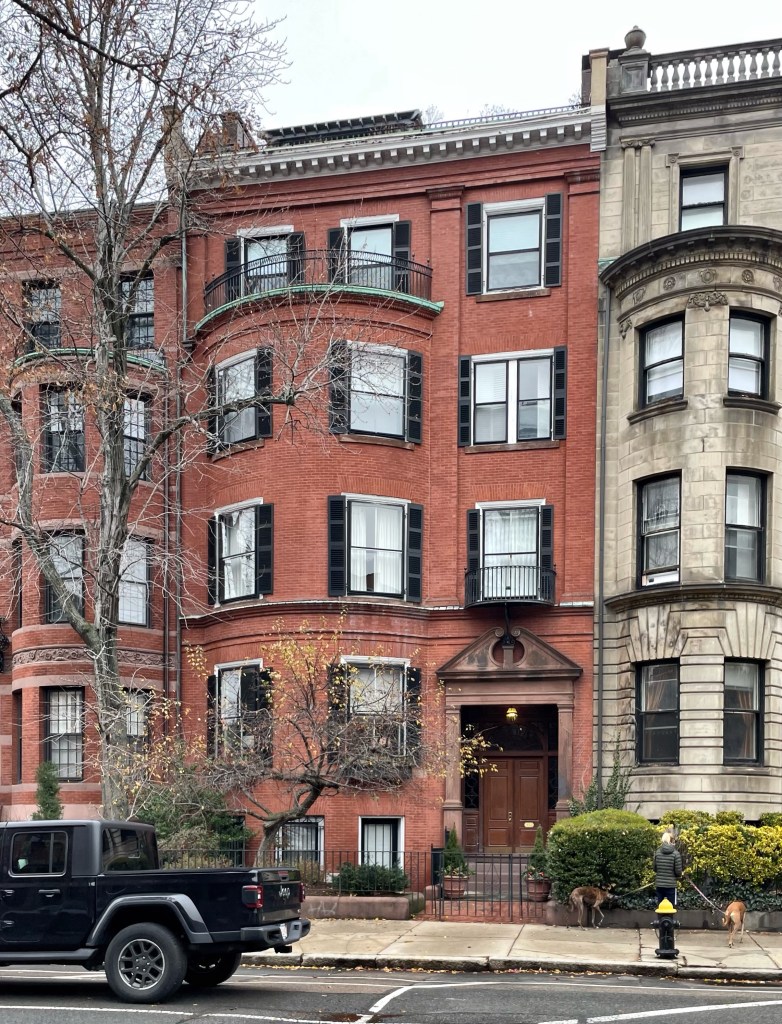
Hasket Derby (1835-1914), was the grandson of Elias Hasket Derby, a prominent trader in Salem, MA., who was thought at one time to be the richest man in the United States. Hasket married Sarah Mason and the family lived in Boston. Dr. Hasket Derby was a renowned opthamologist and had this townhouse built in the Back Bay of Boston in 1886. He hired architect William Ralph Emerson, who ditched his prototypical Shingle style for the urban townhouse in the Colonial Revival style. The townhouse exhibits a brownstone swans neck pediment at the entry, three-story rounded bow, dentilled cornice and brick pilasters framing the bays. Its an often overlooked house in Back Bay, but so very special.

Greenfield Hill Congregational Church // 1855

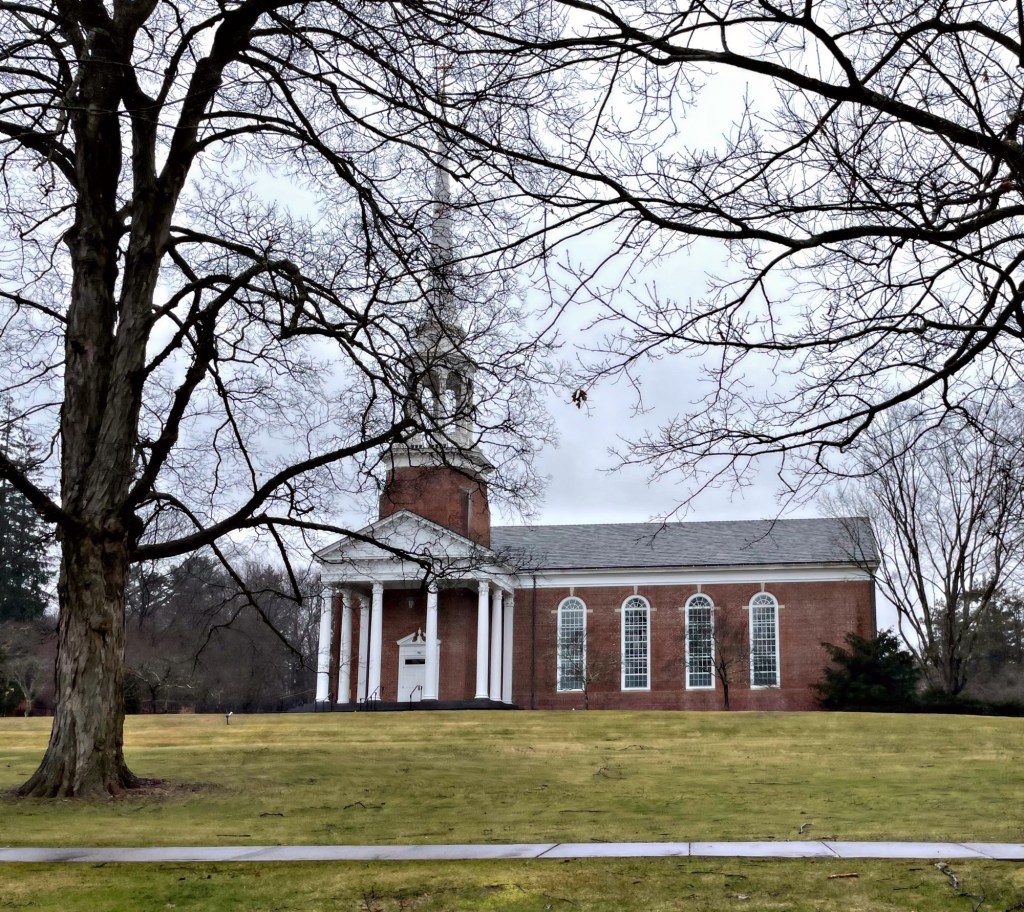
Local residents of northern Fairfield successfully petitioned the General Assembly to establish a Congregational church in 1725 as a new Northwest Parish, a distinct group from the Fairfield Congregational Church. Their first meeting house was erected just years later in 1727. A larger, more substantial meetinghouse was built in 1760. The area of Greenfield Hill has always been remote and more suburban, but became important in the late 18th century when Timothy Dwight became minister of the Greenfield Hill Congregational Church in 1783. Dwight would go on to become the eighth president of Yale College (1795–1817). With increased funds and affluent members, another church was built in 1850 from plans by esteemed architect Richard Upjohn, in the Gothic style. Sadly, just years after it was completed, a fire from a furnace inside destroyed the church. So again, they rebuilt in 1855 with the building we see today, sort of. Architect Alfred Nash furnished plans for the building which was more Italianate in design. The church would be modernized in the 1940s in the Colonial Revival style, from plans by local architect Cameron Clark, likely inspired by the collection of Colonial-era homes nearby, including his own home in Greenfield Hill. The church remains a visual anchor for the affluent neighborhood.

Blue Hill Town Hall // 1895

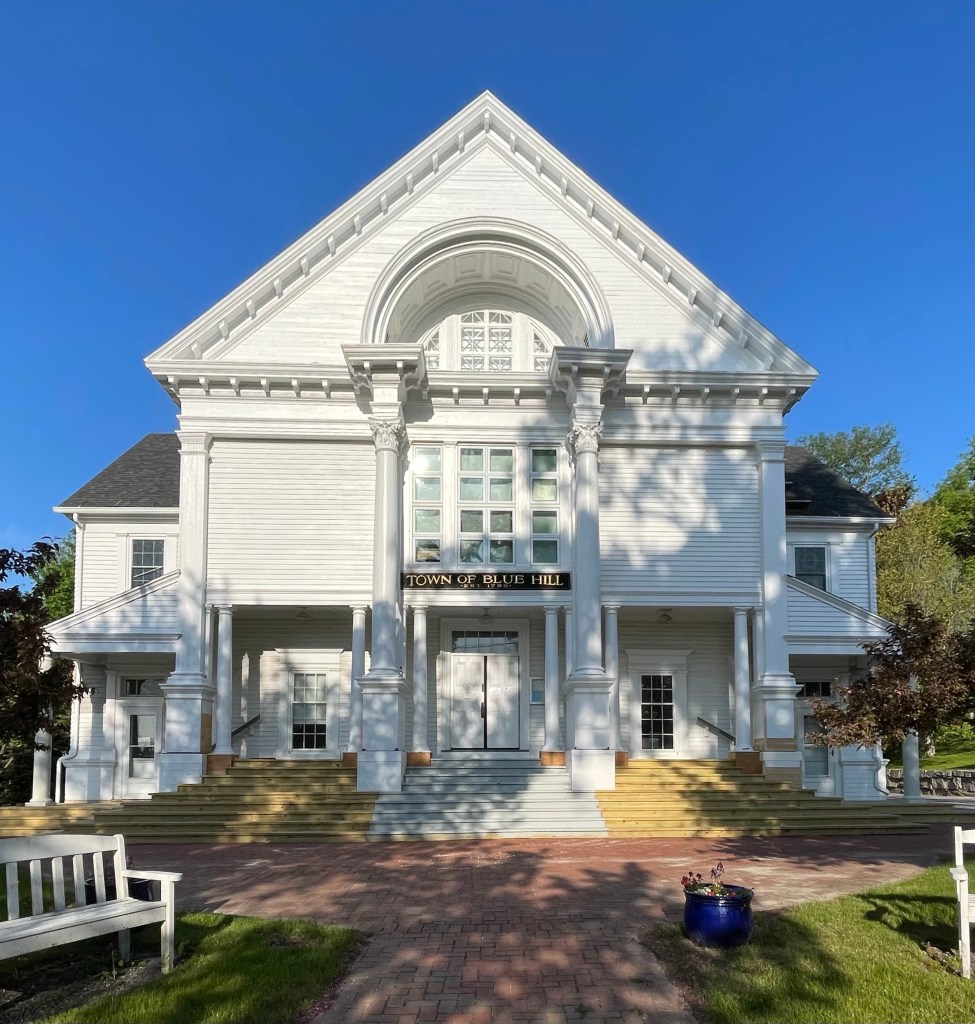
Blue Hill is a charming coastal town in Hancock County, Maine that retains so much of the charm that has been lost in many other coastal New England villages. Originally settled by the Penobscot Tribe, the town as we know it was incorporated in 1789 under the name “Blue Hill”, named after the summit overlooking the region. The town thrived early as a lumber and wood shingle exporter, later shifting to shipbuilding. The town was also noted for the quality of its granite, some of which was used to build the Brooklyn Bridge, New York Stock Exchange Building, and the U.S. Custom House at Norfolk, Virginia. In 1876, local quarries employed 300 workers. The town’s wealthy summer residents likely sought a new Town Hall for Blue Hill, as in the 1890s funding was acquired to erect a new building. It came as no surprise that George Albert Clough, an architect born in Blue Hill would furnish the plans for the new town hall. George was the son of Asa Clough an early settler and shipbuilder in town. He moved to Boston to work as an architect and later became the City of Boston’s first “City Architect” designing municipal buildings. For the Blue Hill Town Hall, he designed it in the Colonial Revival style, which remains well-preserved to this day.

Stephen O. Metcalf House // 1892

I am on a Colonial Revival style kick lately, so bear with me on this recent span of posts on houses in the style! This estate house is an earlier example in Providence, built in 1892 for Stephen Olney Metcalf (1857-1950) a multi-millionaire who was in business in woolen textiles and insurance before diversifying his portfolio further serving as President of the Providence Journal and Evening Bulletin. To make an architectural statement, Mr. Metcalf called the renowned Boston firm of Andrews, Jacques and Rantoul to design his new residence. The oversized Colonial Revival house is an excellent example of how Revival architecture tend to be a more free interpretation of their prototypes, being larger and having exaggerated features and proportions. In his will, Stephen O. Metcalf bequeathed this residence to the Rhode Island School of Design (RISD), an institution his mother helped found, and his daughter served as President. The mansion remains the RISD President’s House to this day.

Henry Samuel Sprague House // 1902

Colonial Revival houses just exude New England charm! This house in Providence’s East Side/College Hill neighborhood was built at the turn of the 20th century in 1902 for Henry Samuel Sprague, a Providence grain dealer, for $15,000. Mr. Sprague clearly did well for himself financially as he could afford a house lot on one of the city’s most beloved streets, Prospect Street. The large mansion has many architectural details which stand out including contrasting brick and shingle on the first and second floors, a massive projecting portico covering a prominent entry, bold fluted pilasters at the center bay, and three pedimented dormers at the slate roof. Inside, this old house has some amazing woodwork and details too!

Sarah and John Tillinghast House // 1904

This stately yellow brick Colonial Revival sits on the edge of the College Hill neighborhood of Providence, and I couldn’t help but to take a few photos! This residence was completed in 1904 for Sarah and John Tillinghast in the later years of John’s life (he died less than two years of moving into this home). The house exhibits a large semi-circular portico with balustrade above, the portico is flanked and surmounted by Palladian windows with elliptical reveals. The house was recently proposed to serve as a suboxone clinic, but that was shut down by neighbors. It appears to be divided into residential units now.

Kennebunkport Post Office // 1941

During the Great Depression, the federal government built over 1,100 post offices throughout the country as part of the New Deal’s Federal Works Agency. Many of the post offices funded and built in this period were designed by architect Louis Simon, Head of the Office of the Supervising Architect for the U.S. Treasury. Few architects had such a role in designing buildings nationwide than Federal architects who designed buildings ranging from smaller post offices like this to courthouses and federal offices. They really are the unsung designers who impacted the built environment in nearly every corner of the nation. As part of the Treasury Department Section of Fine Arts, artists were hired to complete local murals inside many post offices built in this period, depicting local scenes and histories of the towns they were painted in. In Kennebunkport, artist Elizabeth Tracy who submitted a preliminary sketch of her piece “Bathers” which was approved depicting a beach scene, though the townspeople had not been consulted. Unfortunately, the opinion of a vocal part of the Kennebunkport populace was highly negative to Tracy’s painting, largely due to the fact that her beach scene depicted people on a beach in adjacent Kennebunk, not Kennebunkport! Within a few years, the townspeople gathered funds to hire artist Gordon Grant to paint a satisfactory replacement mural in 1945. The new mural remains inside the post office.

Edward Aldrich House // 1902

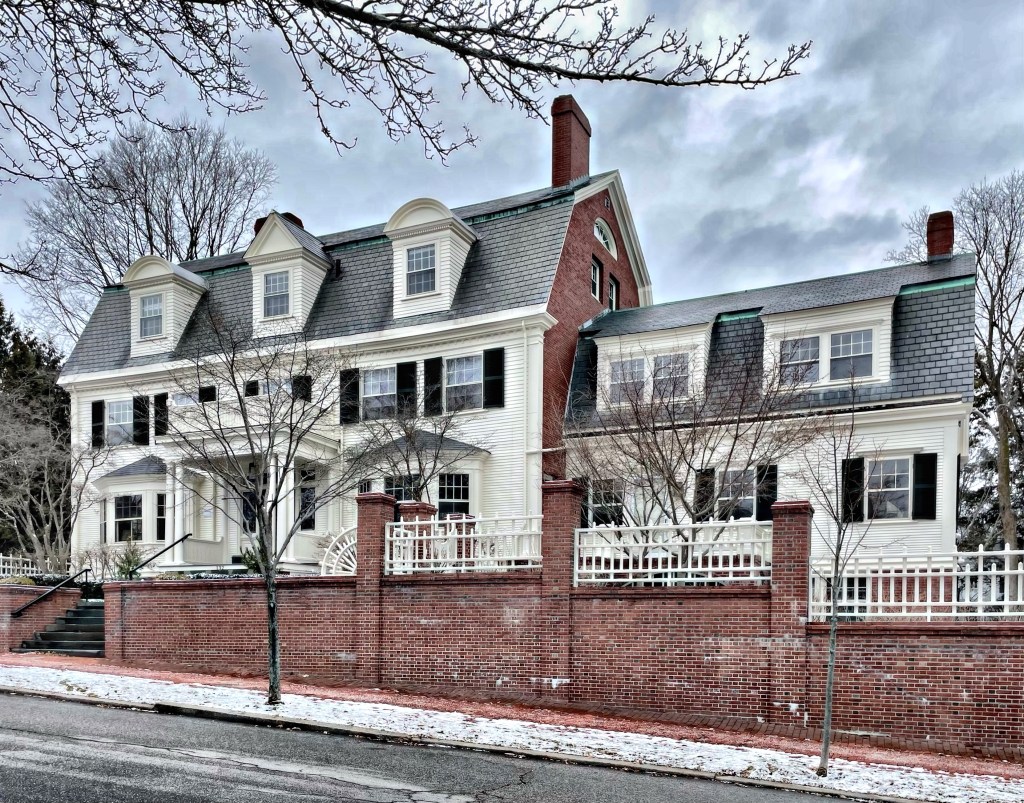
Built next door and just a year after the Hidden Family House (last post), the Edmund Aldrich House in Providence’s College Hill neighborhood shows how stately a wood-frame Colonial Revival house can be! The property was purchased by U.S. Congressman and U.S. Senator, Nelson Wilmarth Aldrich (1841-1915) who quickly sold the lot to his son Edward Aldrich, who worked as president of the Times Publishing Company and was very engaged in Republican politics along with members of his family. The Colonial Revival style dwelling was designed by Providence architecture firm, Stone, Carpenter & Willson, who were pretty prolific in this part of the region by this time. It exhibits a gambrel roof punctuated with segmental pedimented dormers along with a segmental pedimented portico over the entrance. Swoon! In his will, Edward left the property to Brown University, who apparently saw no need for the property and eventually sold it to private owners. The owners today maintain the house very well.

Walter and Kate Hidden House // 1901

I love a good high-style Colonial Revival home with big proportions and warm red brick! This example on College Hill in Providence is a great example. The 2 1/2-story dwelling is five bays at the facade with a center entrance under a hollow pediment hood with an enframement which reads much in the Palladian-realm. Owners Walter and Kate Hidden hired local architect Wallis Eastburn Howe to design their elaborate Colonial-inspired home in 1901, they moved in within a year. Mr. Hidden worked at his father’s business, and in 1875 became a member of the firm of H. A. Hidden & Sons. He did well for himself and became a member in many social and outdoors groups including the Audubon Society, the Squantum Association, the Hope Club, and for five years was president of the Agawam Hunt Club.

Dimock Center – Cheney Surgical Building // 1899

With funds for expansion at the New England Hospital for Women and Children in Roxbury, the hospital’s board commissioned architect Willard T. Sears (also the architect of the earlier Cary Cottage and Zakrzewska Building) to design a new surgical building at the hospital’s growing campus. Construction began on the new Cheney Surgical building in 1899 on the birthday of its namesake, Edna Dow Cheney an original incorporator of the hospital and then President. The Cheney Surgical Building was designed in the Colonial Revival style in brick, with a four-story central block with three-story wings. The central entranceway is accentuated by a classical porte-cochere topped by a Palladian window, in keeping with the Georgian Revival tradition of symmetry and classical vocabulary. The building is one of the first you see when climbing the hill into the campus.


Dimock Center – Sewall Maternity Building // 1892

As the New England Hospital for Women and Children continued to grow in the decades following its founding in 1862, expanded facilities were needed to deal with increased patients along with new nurses and doctors to treat them. Land was acquired across from the Cary Cottage and Zakrzewska Building, and a second building campaign began to expand the facilities and grow the women’s hospital. The management of the hospital did not hire Cummings and Sears, but went with architect John A. Fox to furnish plans for a new maternity building. The Sewall Maternity Building was designed in the Colonial Revival style, a relatively modest example that features a unique broken pediment over the door housing a large window. In 1916, the building was expanded by an addition at the rear which enclosed a central courtyard, it was also designed by John Fox.

Margaret Fuller Primary School // 1891

The Margaret Fuller Primary School (now Community Academy) is a public school in Boston that shows how much attention to detail the school department and the city architect paid when designing these structures in the late 19th and early 20th centuries. The Fuller School was constructed in 1892 to alleviate an overcrowded school district resulting from rapid urbanization. Jamaica Plain was one of Boston’s first streetcar suburbs largely spurred by the growth of the Boston and Providence Company Railroad between 1860 and 1890, when the area saw a shift from large bucolic estates to subdivided urban housing (largely triple-deckers and apartment buildings along major routes). With the surge in population, many new schools were built city-wide, including this primary school which was designed by Edmund March Wheelwright (1854–1912), a prominent Boston-based architect who served as City Architect for Boston from 1891 to 1895. Architecturally, the building is a stunning example of the Colonial Revival style with red and buff brick walls which are laid in a Flemish bond and rusticated at the first story with single recessed courses of buff brick. An arched entrance and Palladian window with iron false balcony sit at the central bay. The school was named after Margaret Fuller Ossoli (1810-1850) an early transcendentalist and writer advocating for women’s rights born in Cambridge.