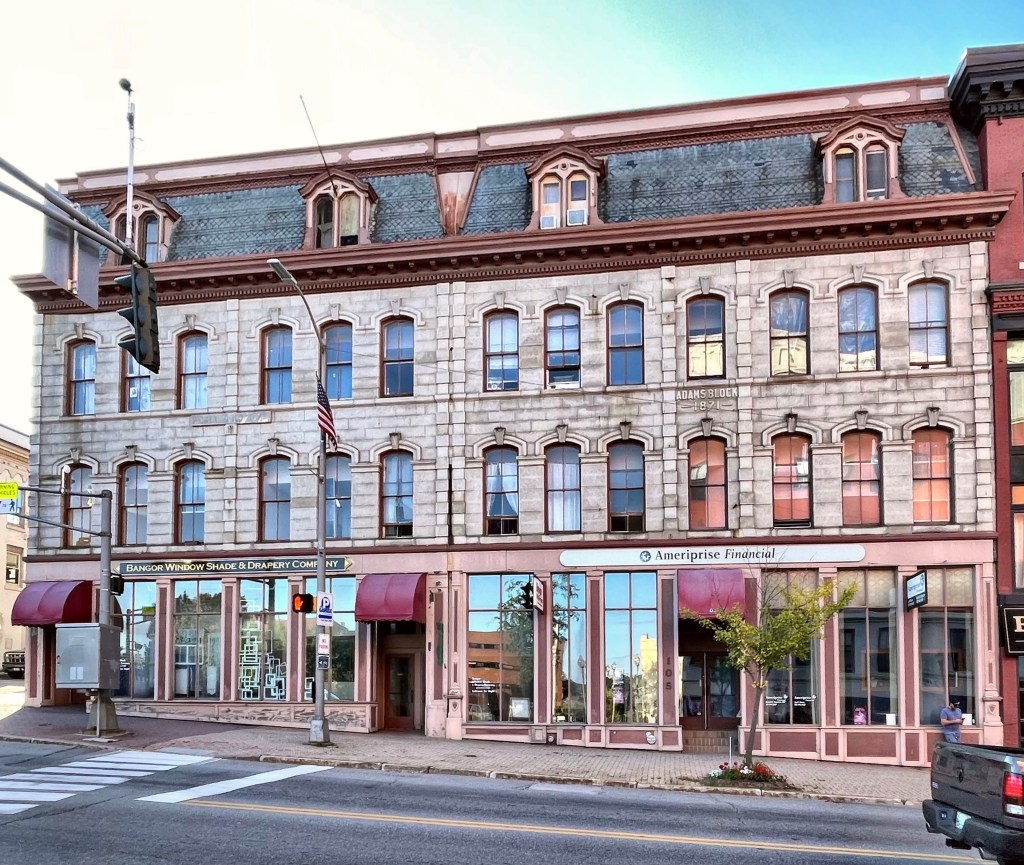
Adams-Pickering Block // 1871

Main Street USA! I just love historic Main Streets and Downtowns in New England, so many are full of old buildings and were designed for pedestrians, not cars (though some towns and villages have definitely caved to the automobile). Erected in 1871, the Adams-Pickering Block building was one of several grand, mansard roofed commercial structures which local architect George W. Orff designed for Bangor’s business district in the 1870’s. With its first-story cast iron front and its granite facade, from stone quarried nearby in Hallowell, Maine, the Adams-Pickering Block and its similar contemporaries were the most sophisticated Victorian commercial buildings in Eastern Maine. The Bangor Fire of 1911 and subsequent urban change, especially urban renewal in 1968, destroyed most of the city’s nineteenth century business district. The Adams-Pickering Block is a rare survivor and shows us how old buildings at a human scale can create vibrant, people-centric places.

Chester Tin Shop // c.1830

Located on the edge of the Chester Town Green, you can find this beautiful Federal style commercial building. The use of blind arches at the facade is a fairly common feature found in brick Federal style buildings in Vermont. The structure was built around 1830 and has served a variety of uses through its existence, the most notable being the tin shop owned by various members of the Miller and Hadley families that sold stoves and hardware during the latter half of the 19th century. The tin business in New England grew rapidly after 1820. Tin shop owners imported tinplated sheet iron from Great Britain, shaped it into a variety of forms, and distributed their finished goods through peddlers and country stores. They also sold tinware in their shops. Colanders, dippers, dish kettles, funnels, measures, and pans were in greatest demand. Other common items included lanterns, foot stoves, teapots, coffeepots, “tin kitchens”, skimmers, and sconces. After its use as a tin shop, the building was occupied as a telephone exchange and electric utility company office. It presently is home to an antique store.

Blanchard Building // c.1855

Image courtesy of Boston Archives.

Did you know that Boston once had it’s own Hogwarts? While we didn’t have wizards and witches in the streets, we did have young magicians learning the tricks of the trade! The Boston School of Magic was founded in the 1880s by William Davis LeRoy (1862-1919), a professional magician who also served as President of the Conjuror’s Club of Boston. Upon opening its doors, the Boston School of Magic was one of a handful of such schools in the country. For $75, you could learn how to escape from a pair of handcuffs from a professional instructor at W.D. Leroy’s “School of Magic”, and even buy some magic items for shows from his large catalogue. Mr. LeRoy was also friends with the famous Harry Houdini, who purchased items from his store and consulted with him on new acts. Houdini was extremely popular in Boston and held many acts and feats of strength here. The Boston School of Magic was located in the second floor of the Blanchard Building at 103 Court Street, a brick commercial building with stone facade constructed in the middle of the 19th century. The building was demolished in the 1920s and replaced with a two-story structure, which too was razed for Government Center.

Paine Furniture Building // 1914

Located on Arlington Street between St. James and Stuart streets in Boston’s Back Bay, this gorgeous masonry commercial block stands as a testament to the amazing architecture built in Boston in the early 20th century. The Paine Furniture Building was constructed in 1914 to house the extensive showroom, offices, and manufacturing operations of the Paine Furniture Company. Founded in 1835, the company was at one time the largest furniture manufacturer and dealer in New England and had a nationwide business. The company was founded by Leonard Baker Shearer, who was joined in business in 1845 by John S. Paine. Upon the death of Shearer in 1864, the name of the firm was changed to Paine’s Furniture Company, a name which stuck until the company closed in 2000. The architects for the building, Densmore & LeClear, were very busy in the early decades of the 20th century and designed many iconic buildings nearby and in towns surrounding Boston through the 1940s.

Richardson Building // 1895

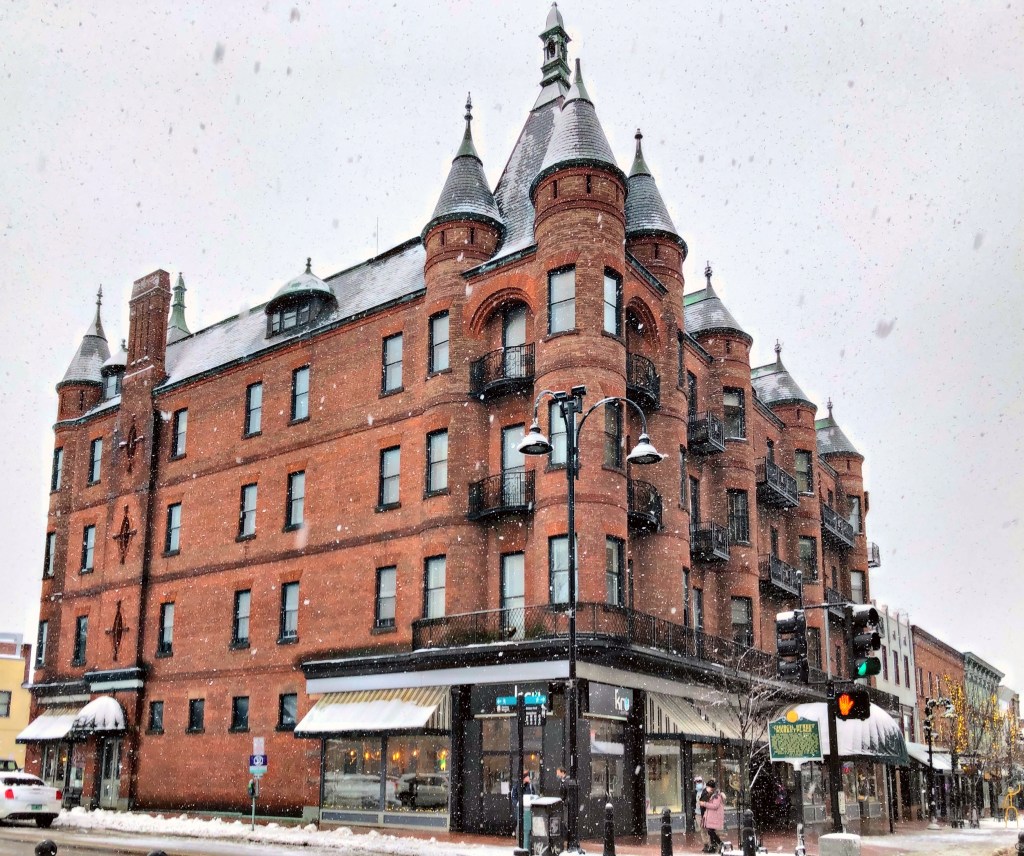
Located across from the Federal style Unitarian Church and Romanesque style Masonic Temple and rounding out the nicest intersection of Burlington Vermont, I present, the Richardson Building. The Richardson Building was constructed in 1895 by developer Albert Richmond, and can be classified as Chateauesque with its rounded bays surmounted by conical roofs and finials, showing the complexity of a French Chateau. The building was likely constructed for a commercial interest as an income property with retail at the ground floor and professional offices above. In 1911, the famous building was purchased by Frank D. Abernethy, who purchased his partner’s share of their business and created the Abernethy’s Department Store, soon the largest department store in town. Despite being a prominent, long-term fixture on Church Street, Abernethy’s went out of business in November 1982. The building was later renovated and new tenants moved in.

Burlington Trust Co. Building // 1891

This narrow, four-story commercial block is located near the Burlington City Hall, and fronts the park it sits on. Constructed in 1891 from local redstone in a unique Romanesque Revival style, the building stands out as one of the most unique in the commercial downtown area. The building was built for the Burlington Trust Company from plans by Clellan W. Fisher, an architect who soon after joined a firm with Stephen C. Earle in Worcester, MA. The design features an unusual checkerboard pattern of inlaid red and white ashlar paired with a stone cornice which similates dentils and brackets. The building is now home to a Burton snowboard retail store, a company started in Vermont in 1977, now the leading snowboard company in the country.

Lewis Block // 1886

Following the granting of the royal charter in 1761, Newport, NH was incorporated and named after Henry Newport, a distinguished English soldier and statesman. With excellent soil for farming, and abundant water power from the Sugar River to run mills, Newport grew prosperous. The main street developed, leading to a proliferation of hotels and taverns that were soon situated along the length of Main Street to service the many travelers who stopped along the route, many such structures were wood frame construction. A fire devastated much of Main Street in Newport in 1885, leading to a massive rebuilding campaign by the town’s richest citizens. One of the earliest buildings constructed after the fire was the Lewis Block, developed by Frederick Lewis, who lived a block away, and his son Samuel DeWolf Lewis, who designed the block. The two-story building is broken up by brick pilasters with recessed corbelled detailing which give rise to buttresses capped by gablets (yes its a word), punctuating the flat roof profile.

Strong’s Block // 1896

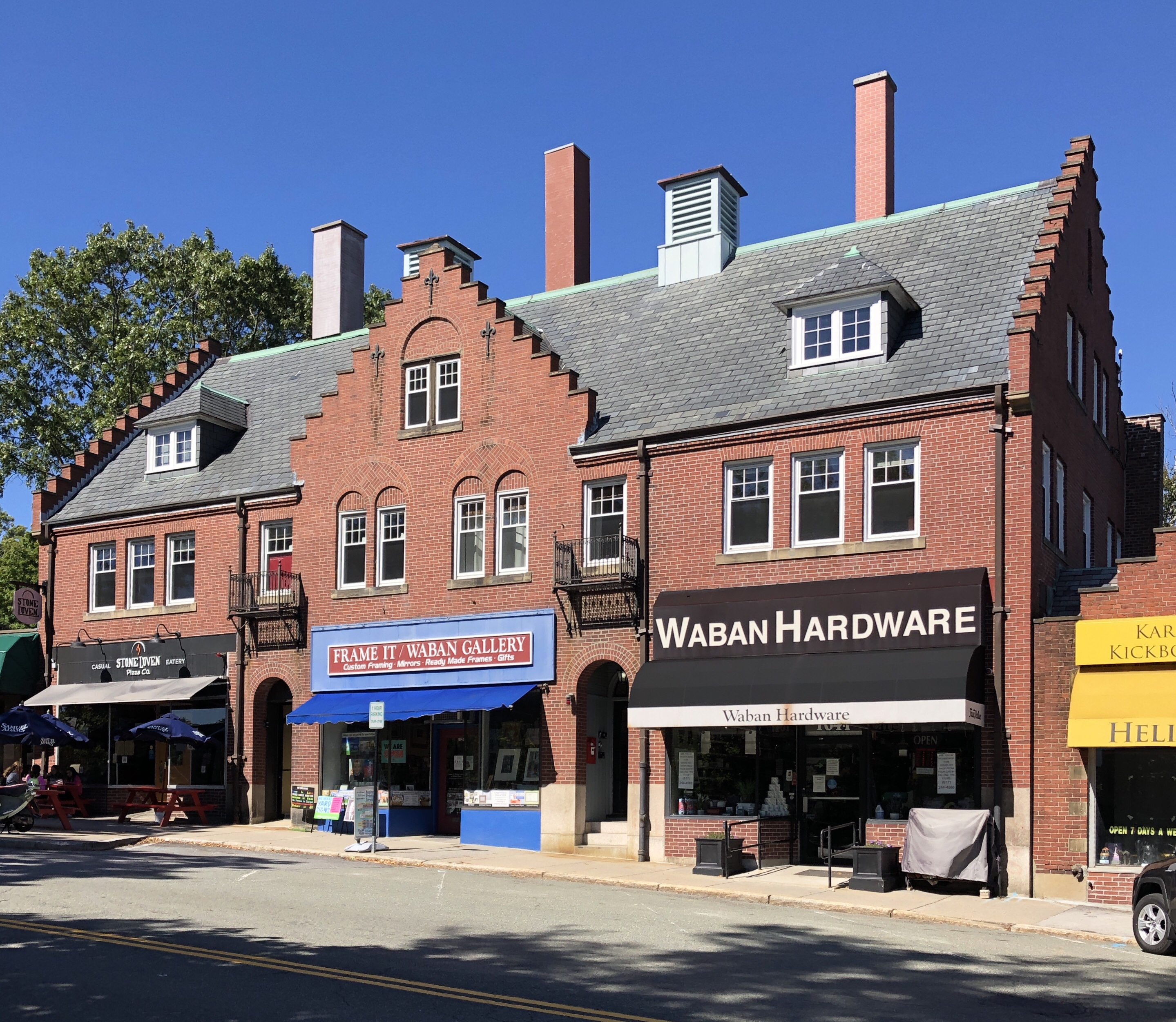
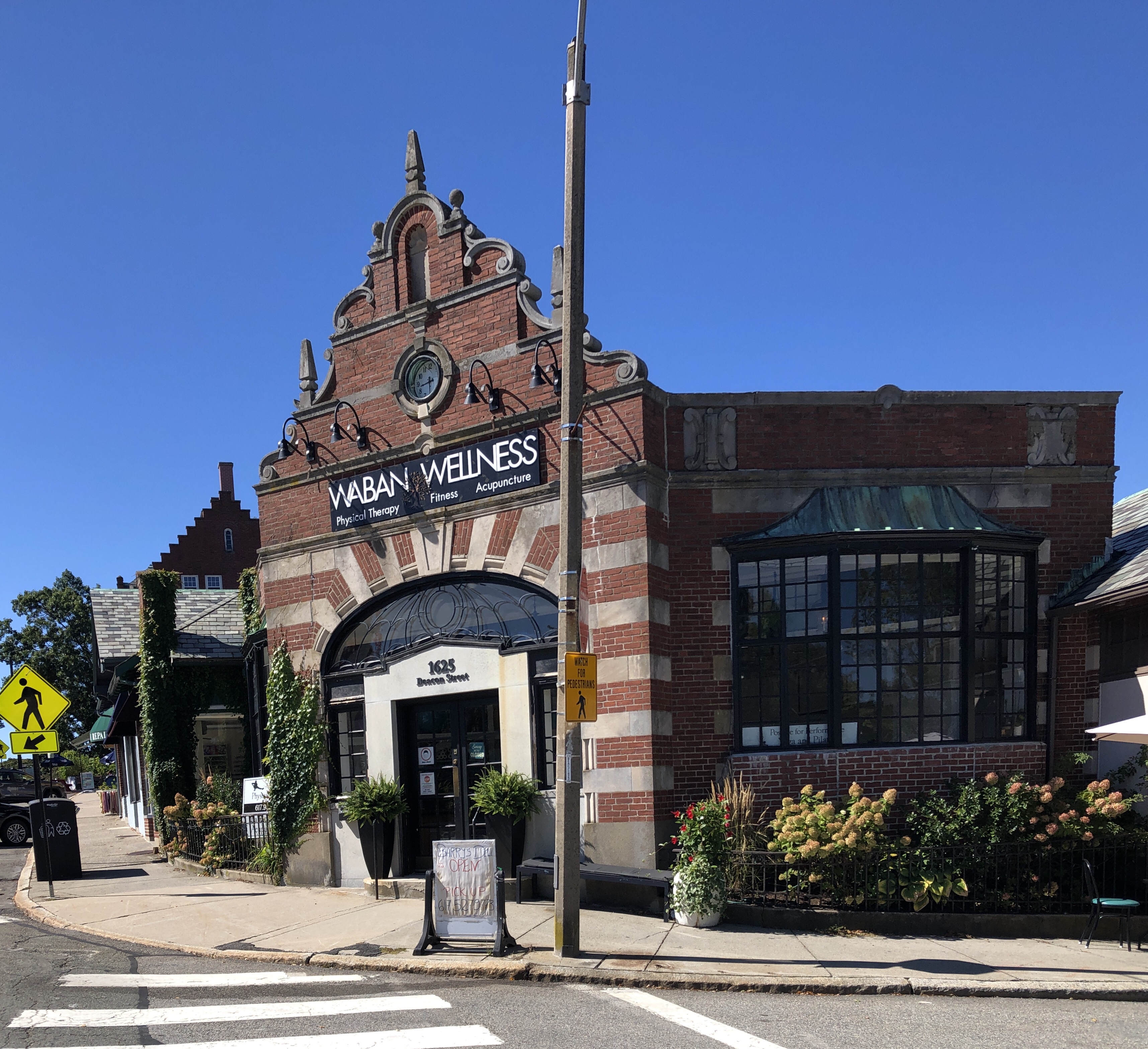
William C. Strong, a prominent local citizen who resided nearby, had this stylish commercial block built to serve the expanding population of the village which eventually became known as Waban. After the completion of the Waban Train Station, the demand for neighborhood retail became apparent and William Strong was an early developer to realize this. He hired Lewis Bacon, an architect who resided nearby, to design the commercial block. The result is a stunning Dutch Revival building with gables showcasing stepped parapets. The upper stories were apparently used as apartments when completed. Notwithstanding Strong’s efforts, the Waban commercial district developed rather slowly. It was not until 1924 that the row of one-story shops was added to its right. The addition was designed by Edward B. Stratton, who followed suit with Tudor and Jacobean motifs, to compliment the Dutch Revival block.

Richards Building // 1859

One of my favorite buildings in Downtown Boston is the Richards Building on State Street for its rare and lavish cast-iron facade. Built in about 1859, the building was developed by Quincy A. Shaw and Gardiner H. Shaw (uncles of Robert Gould Shaw, who led the famed African American regiment that is the subject of St. Gaudens’ and Charles McKim’s Boston Common monument), merchants who then leased out commercial space in the building. The architect of the building is unknown; however, the sheet metal was supplied by E.B. Badger & Sons. The original design was a five-story, eight-bay cast iron front structure, in the Northern Italian mode of the Renaissance Revival style. The facade is only a screen attached to the front of the building. It is made of pieces of cast iron that were fabricated in Italy and bolted together in Boston. In 1889, the building was sold to Calvin A. Richards, a wealthy street railway tycoon and it is presumed that the two upper stories and corner oriels were added at that time. The building features one of a handful of extant cast-iron facades in Boston, which was restored in the 1980s.

Union Block // c.1842

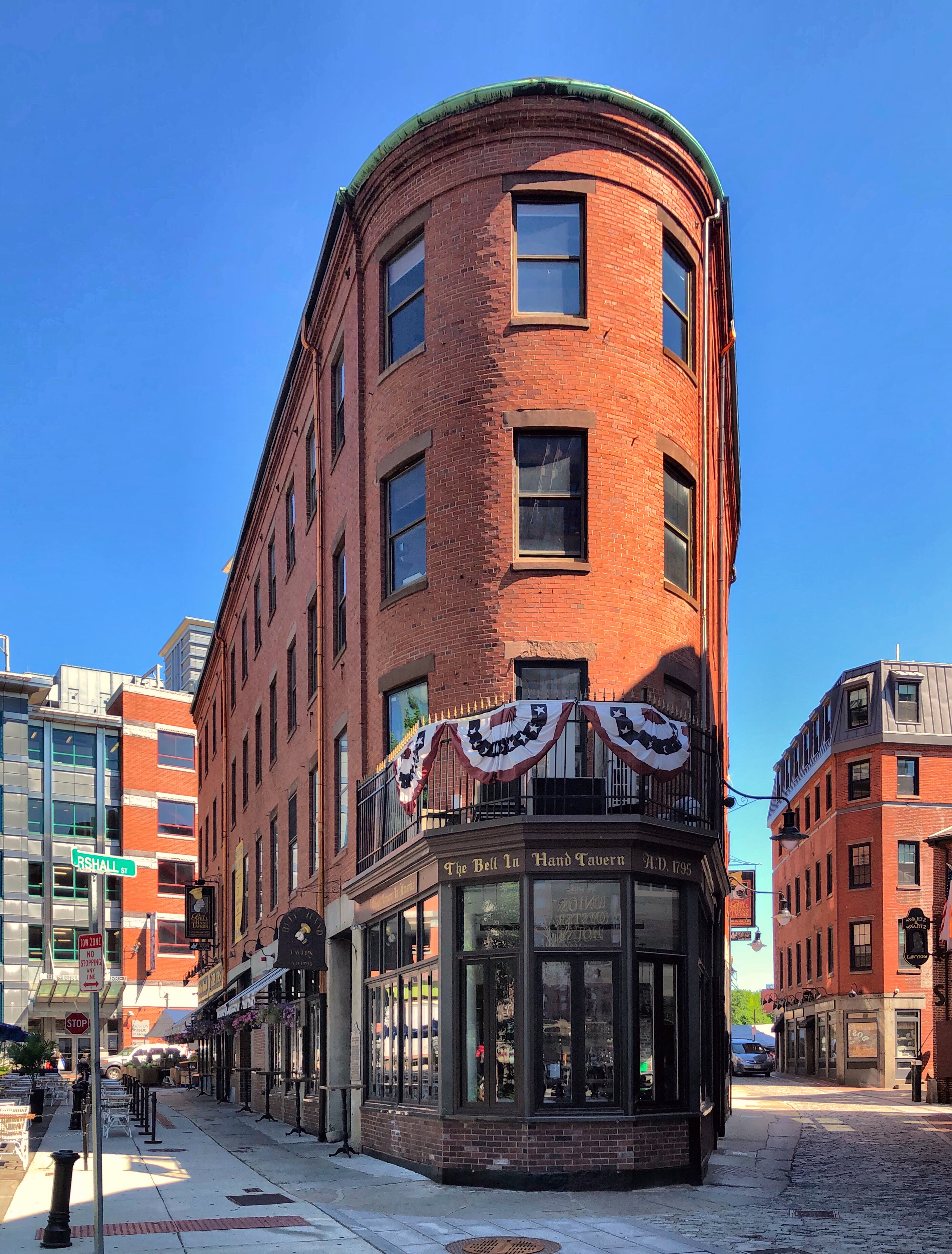
Located in the Blackstone Block of Downtown Boston, this flatiron building encloses Marshall Street on the Freedom Trail, creating a tight, pedestrian-oriented street that once covered old Boston. The Union Block (c.1842) is a Greek Revival commercial block which typifies this network of short, narrow streets which somehow survived Urban Renewal and the coming of the highway in Boston. The longest running occupant of the building was Ward & Waldron Paper Hangings, which from my understanding, made wallpaper for the estates of Beacon Hill which were being built on the other side of town. After successive ownership, atlas maps show the ownership of the building in 1888 conveyed to Massachusetts General Hospital, which still held title to it past 1938. The building is now home to Bell in Hand, an iconic local pub that was founded in 1795 at another location.