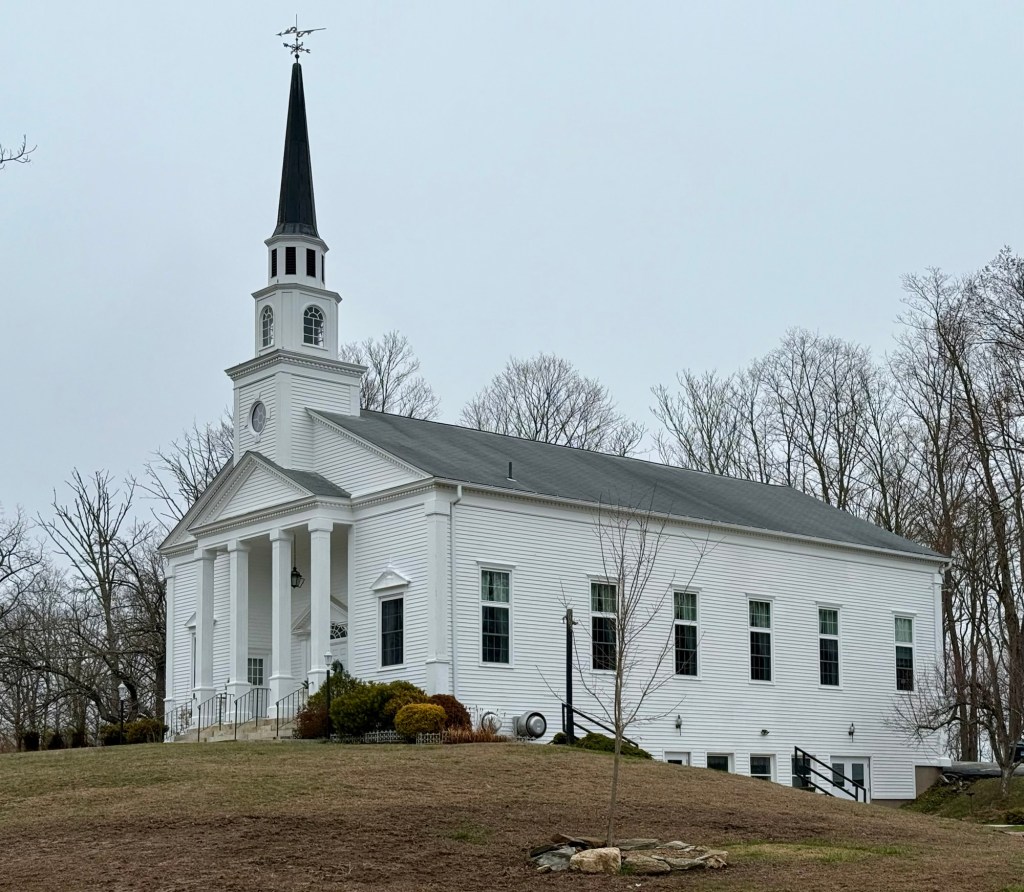
First Congregational Church of Canterbury // 1964

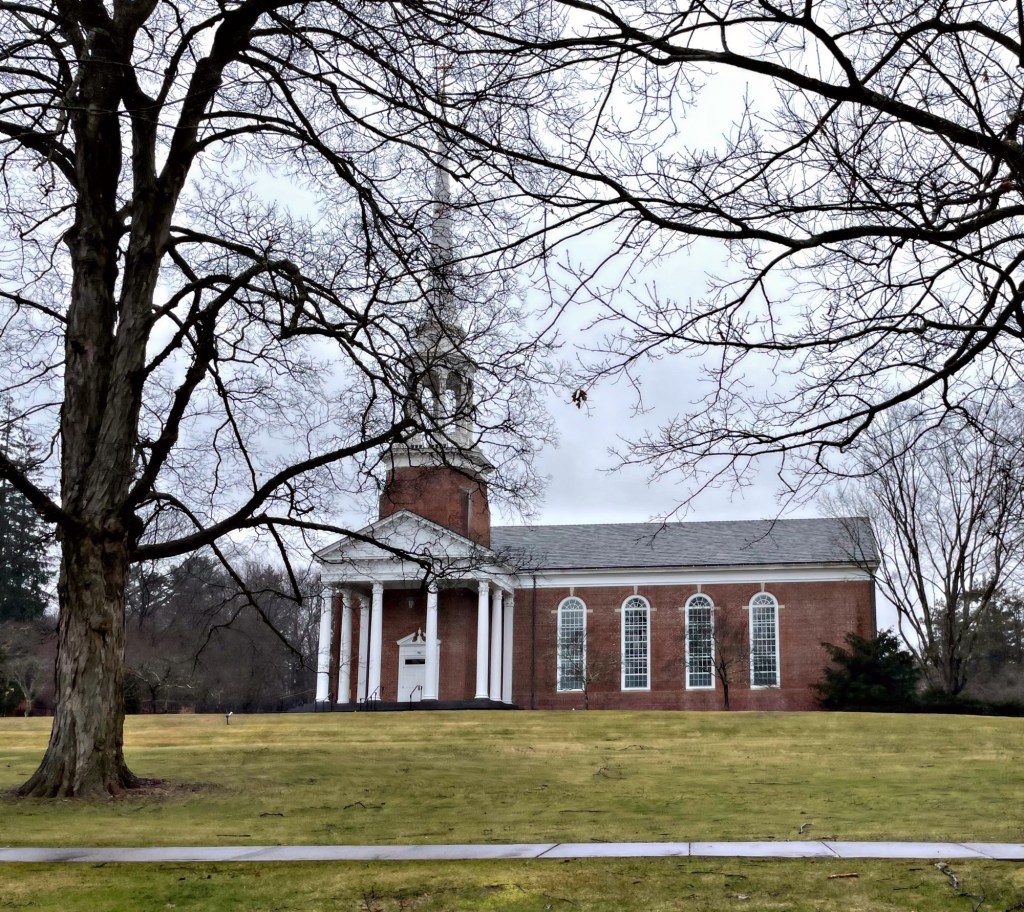
The Canterbury Green has been home to four congregational churches in its history. Originally established in 1711, a modest frame church was built here and in 1736, a new meetinghouse was constructed as a more permanent building. The rustic structure was deemed insufficient for a wealthy rural community, so in 1805, a stately, Federal style edifice was built. Designed by Thomas Gibbs, a local architect/builder who also designed other nearby high-style Federal homes, the building was destroyed by fire in December, 1963. Within a year, this church was constructed on the ground of its 1805 building. While designed and constructed during the mid-20th century, the town clearly wanted its new church to contribute to the village’s Colonial character, having this Colonial Revival style church serve as the new anchor to the green.
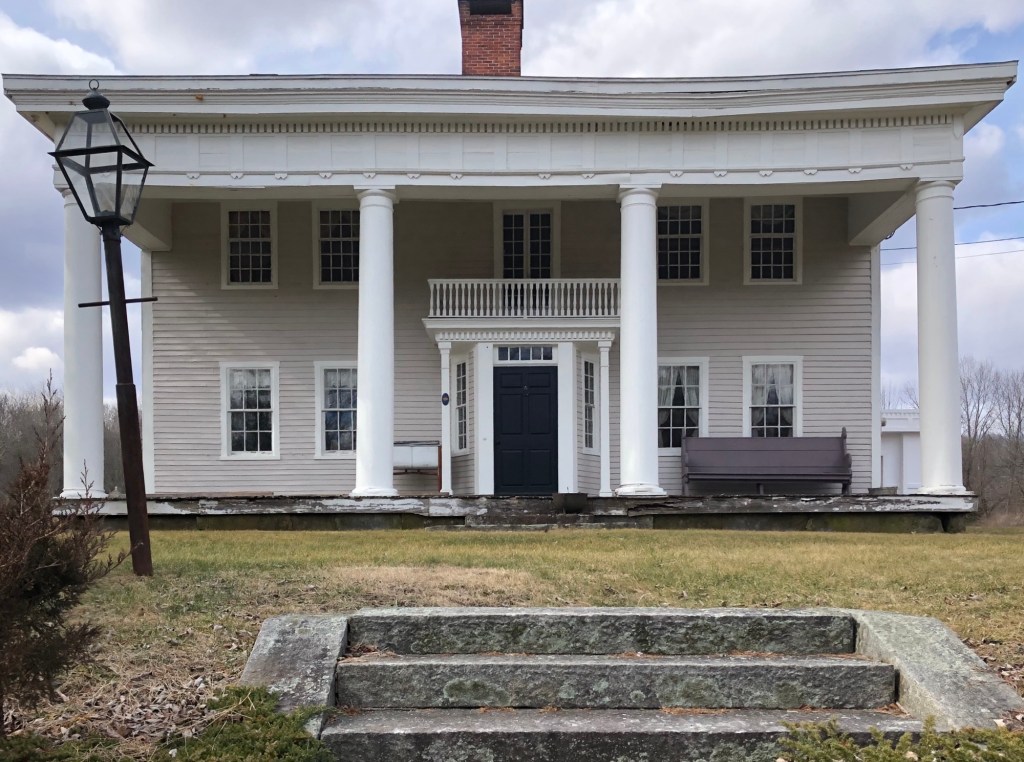
“The Pillars” // c.1780

Renovated in the early 20th century from a Federal style farmhouse, “The Pillars” in Canterbury, Connecticut, is an extravagant example of a Colonial Revival style residence in this quiet part of the state. The Pillars was the creation of Frank Edwin Miller (1856-1947) and his wife, Hattie Jenks Miller. The Miller’s retired here in 1913 after Hattie inherited the family homestead, which dated to the late 18th century, and they had the home renovated, adding the massive two-story columned porch and projecting entry. The house is a visual representation of the difference between Colonial and Colonial Revival styles as this home, the latter example, is a free interpretation of its prototype with exaggerated architectural details in a scale not seen centuries earlier.

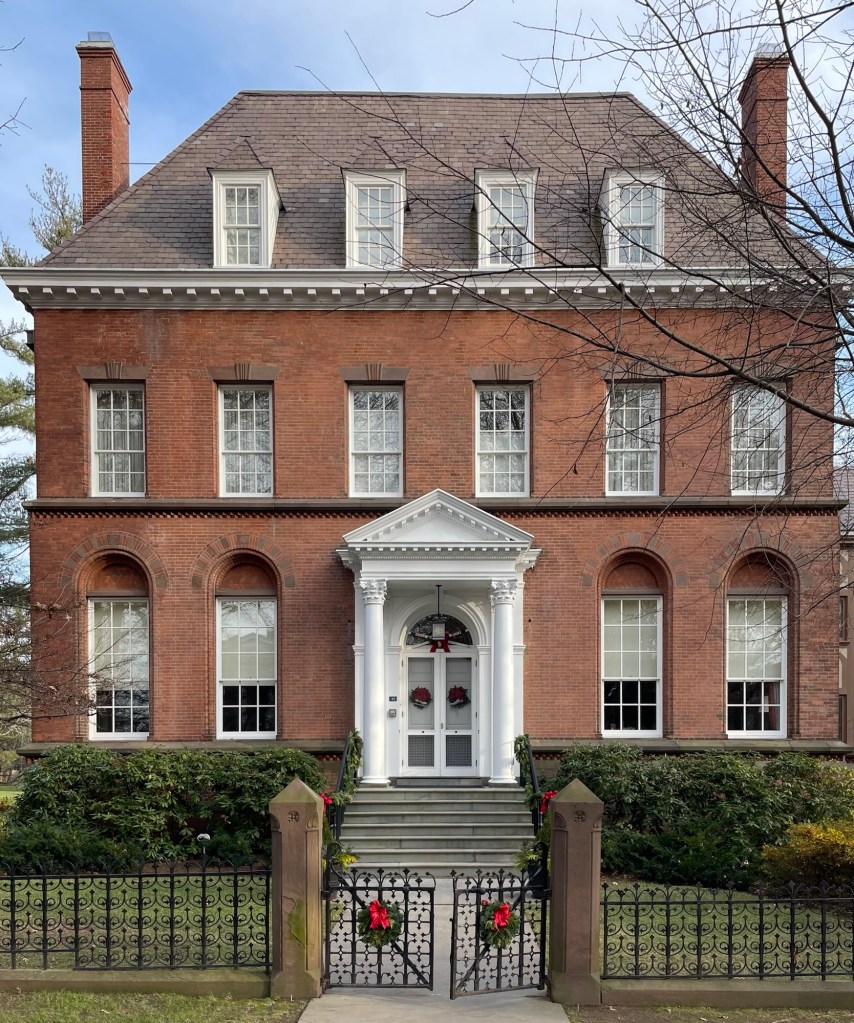
Farnam House – Yale President’s House // 1871

In 1871, wealthy engineer and philanthropist, Henry Farnam (1803-1883), purchased a house lot on the desirable Hillhouse Avenue in New Haven, Connecticut, where he would live out his final days in retirement. Mr. Farnam made his fortune beginning in 1839, when he was instrumental in building the railroad connecting New Haven to New York. In 1850, he moved to Illinois where he partnered with Joseph E. Sheffield to build the Chicago, Rock Island and Pacific Railroad, becoming that railroad’s president in 1854. In 1868, Farnam moved back to New Haven when he hired Russell Sturgis, Jr., to design and oversee construction on his home there. Henry Farnam also worked with Sturgis on Farnam Hall at Yale, where he is the benefactor and namesake of the building. Henry Farnam died in 1883, and in his will, he stipulated that he would gift his property to Yale College under the condition that his son, Henry W. Farnam, could live there until his death. Henry Walcott Farnam was an economist, and served as president of the American Economic Association. In 1933, the property ownership was officially transferred to Yale University, who in 1936, renovated the property, changing its appearance from Victorian Gothic to Colonial Revival. Architects, Richard A. Kimball and Ellery Husted furnished the designs for the stately residence. Since that time, the Farnam House has served as the residence of the Yale President.

John E. Calhoun House // c.1912

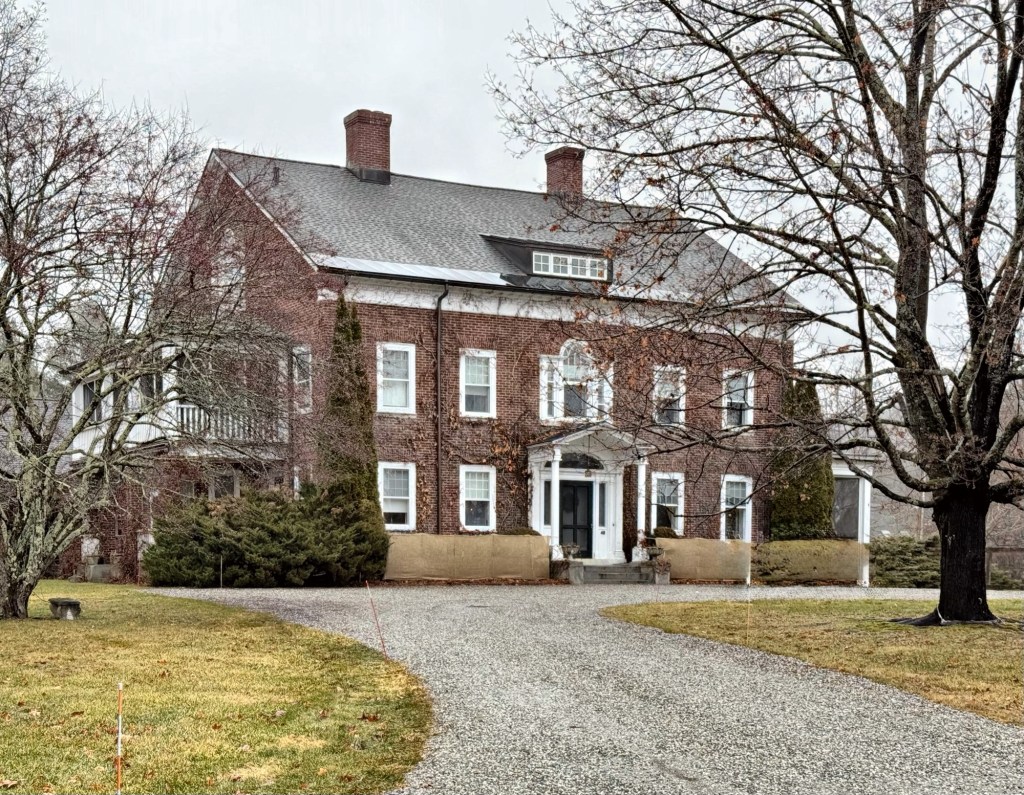
This site, in the heart of Cornwall village, was once occupied by an early 19th century Federal style residence, built by the wealthy Pierce family in town. The Pierces’ large home was acquired by John E. Calhoun (1859-1940), a successful New York businessman, who retreated to his father’s hometown for summers away from the city. In 1911, a fire destroyed the home, which was wood-frame construction. This event mobilized Mr. Calhoun, who was untrained but interested in architecture, to begin planning a new summer residence, but of fireproof construction. Calhoun is said to have designed (and funded) the town’s library just years before, and modeled his home in line with the Colonial-era residences in the village, just larger and of brick. From the 1950s through the 1990s, the house was occupied by the headmaster and administration of the local Marvelwood School, but was re-established as a private home, a use that remains today.

Harriet Bennett House // c.1912

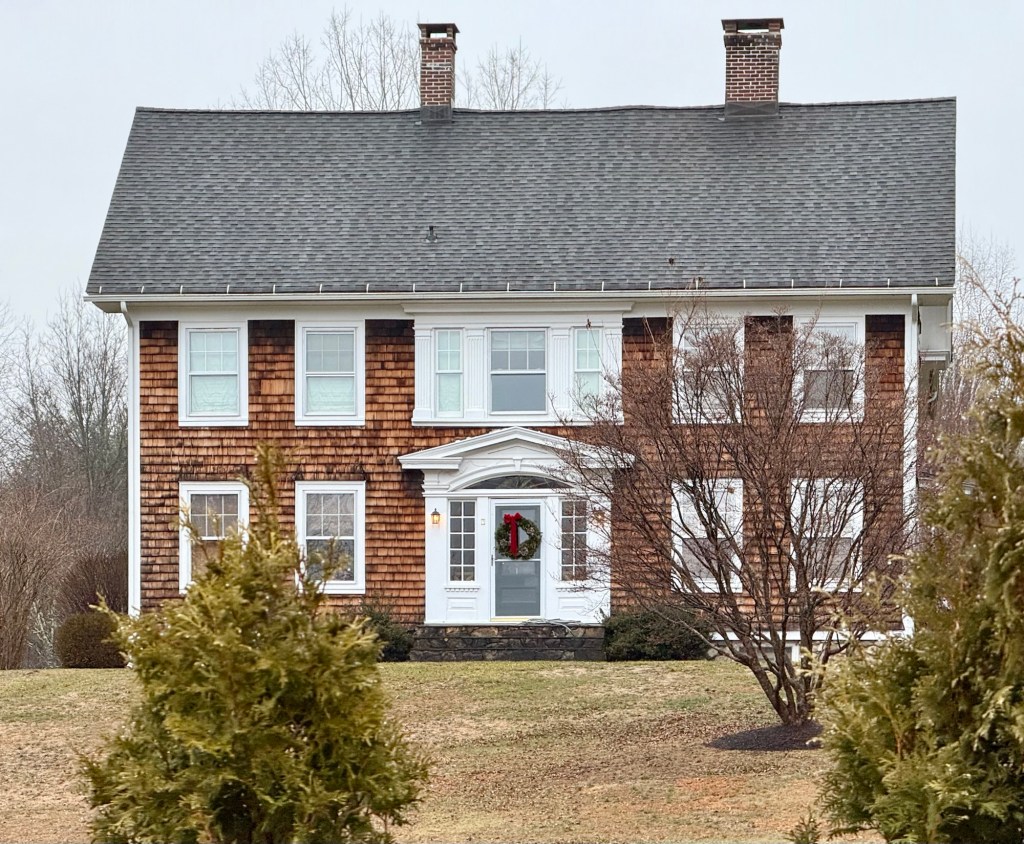
While most houses I have featured in Cornwall date to the early-mid 19th century, there are some great examples of early 20th century Colonial Revival dwellings, built at the time the town became eyed as a wealthy retreat for city-folk. This Colonial Revival residence was built for Ms. Harriet Bennett (1841-1928), an ardent suffragist and an active member of the Connecticut Woman Suffrage Association. Harriet was married to William C. Bennett and after his death in 1898, she devoted the rest of her life to charitable causes and giving back to others. As a widow and in her seventies, Harriet oversaw construction of this house, which was completed by 1912, in that same year, established the Cornwall Equal Suffrage League, hosting many of its events and meetings from this house. The League’s activities mirrored the efforts of suffragists throughout the nation. The house remains a well-preserved example of a house in the Colonial Revival style in town.

Jesse Lee Memorial Church // 1965

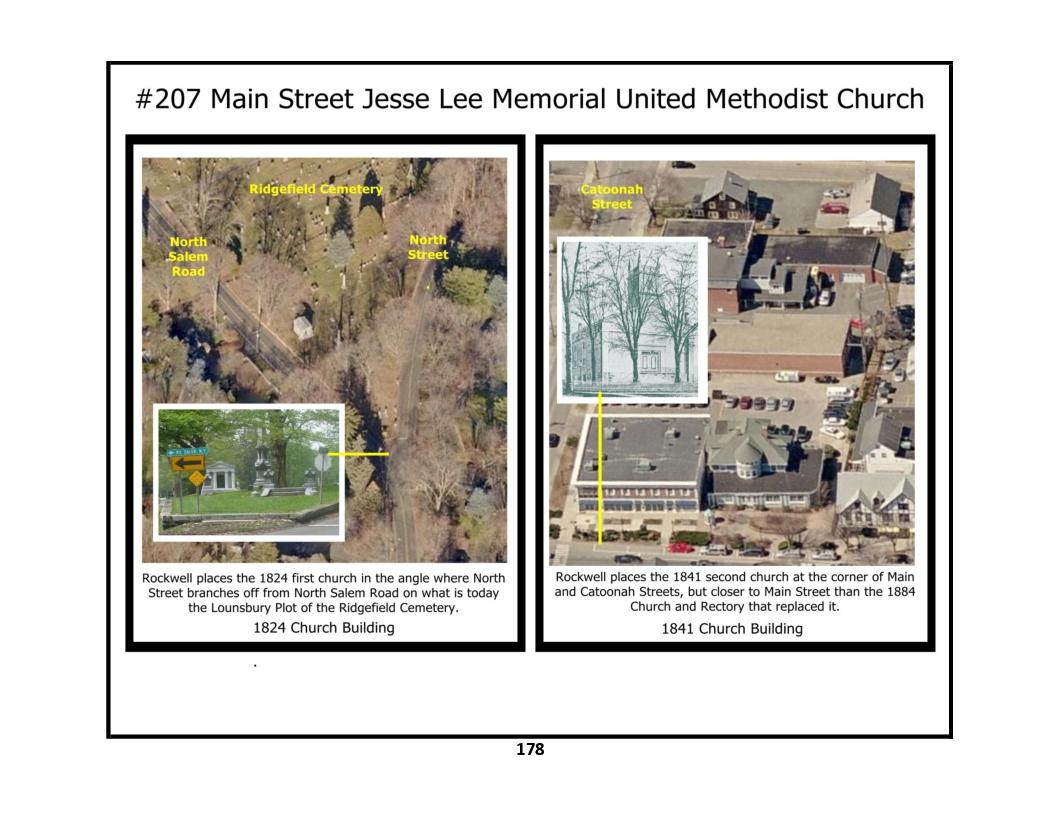
Believe it or not, this church in Ridgefield Center was built in 1965! To know its full history, we have to go back to 1787, when the Methodist Episcopal Church had its beginnings in Ridgefield, the third in New England. Its first meeting was held – just 21 years after Methodism had been introduced into the U.S. from England. In 1789 Jesse Lee, a native of Virginia, was sent north as a circuit rider. His third sermon in Connecticut was preached at the Independent Schoolhouse on Main Street in Ridgefield. In the 1840s, a second meetinghouse in town was built, and the congregation grew. A third church and rectory were built on Main Street in 1884. When a large Main Street estate was available for a new, stately building, the congregation jumped at the opportunity, and hired ecclesiastical architect Harold Wagoner to design a refined, Colonial Revival style church, which was built in 1965. Executed in brick, the church has great verticality, created by the colossal columns supporting its pedimented portico and the spire that rises over an open belfry to a height of 149 feet. Set back from the street, the church still has a commanding presence.

New Haven Museum // 1929

New Haven, Connecticut is known for its Gothic and Modernist architecture, but as it is located in New England, some good Colonial Revival architecture is not hard to find! The New Haven Museum building on Whitney Avenue was built for the New Haven Colony Historical Society, which was established in 1862 to collect, preserve, and publish historical matter related to the history of the greater New Haven community. The Society was housed in various locations around the city throughout the 19th century until 1929 when it relocated to its present building designed by J. Frederick Kelly, a noted colonial revival architect. The symmetrical building with its eleven-bay facade is notable for its arched recessed portico and rooftop cupola. The building remains occupied by the New Haven Museum to this day.