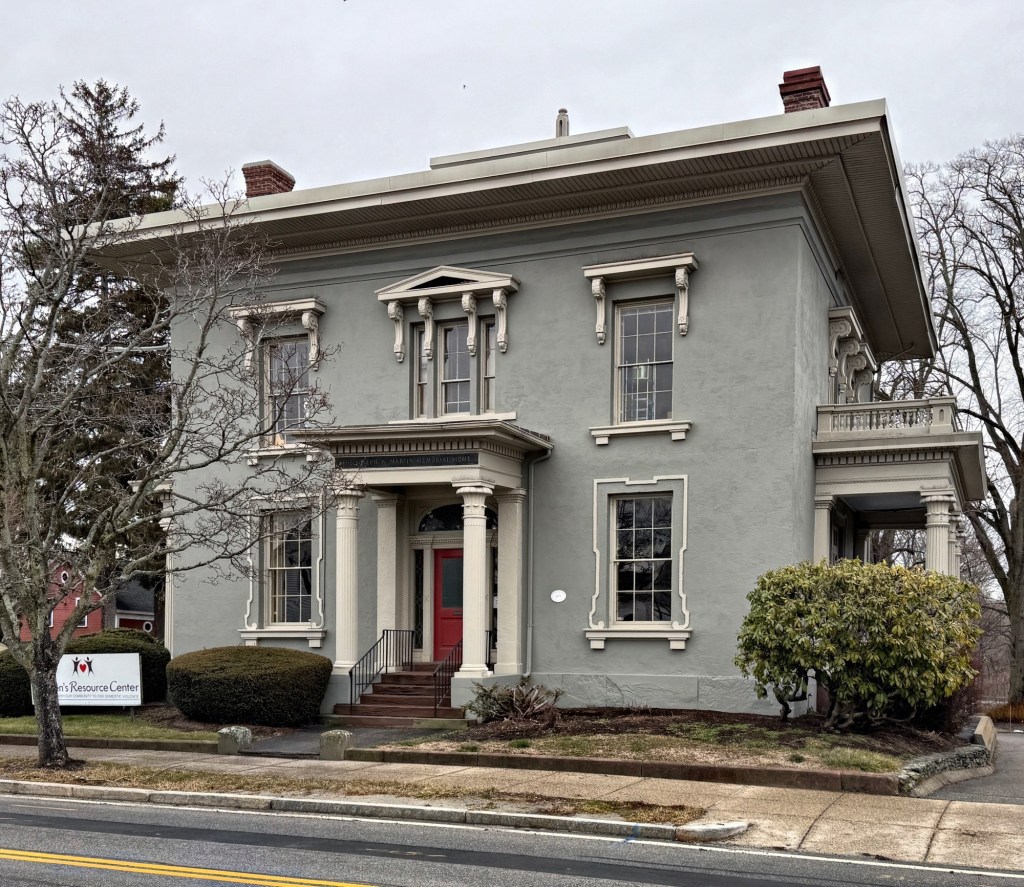
Littlefield-Van Zandt House // 1836

In the late 1830s, Captain Augustus Littlefield (1803-1878) purchased a house lot on Pelham Street in Newport, Rhode Island and commissioned housewright John Ladd to design and build his new residence. Littlefield reportedly asked his Ladd to design an “authentic copy of an Italian Villa” he had seen during a trip in southern Italy. The result is a more traditional Greek Revival, temple-front house with a portico supported by four monumental columns with capitals that combine Corinthian and Egyptian lotus motifs. The minimal Italian Villa detail can be seen in the bracketed cornice and in the pediment. Built around 1836, the house remained in Littlefield’s possession until his death in 1878. The property was purchased by Charles C. Van Zandt, attorney and later the 34th Governor of Rhode Island. Gov. Van Zandt died in 1894 and was interred at Island Cemetery in Newport. The Littlefield-Van Zandt House remains a significant early, high-style Greek Revival house in the state and one with a great state of preservation.

Touro Jewish Cemetery and Gate // 1677

Located just a short walk from the oldest extant Jewish synagogue in the United States, Touro Synagogue (last post), the Touro Jewish Cemetery and stately gate, showcase the significance and position Jewish residents held in Newport, going back to Colonial times. The earliest Jews in Newport arrived from Barbados, where a Jewish community had existed since the 1620s. They were of Spanish and Portuguese origin; their families had migrated from Amsterdam and London to Brazil and then to islands in the Caribbean. After the completion of the synagogue in 1763, the Jewish community in Newport realized the need to acquire land for a Jewish cemetery. Two of the original immigrants, Mordechai Campanal and Moses Pacheco purchased the lot at the corner of what is now Kay and Touro Streets for this purpose. In 1843, the cemetery funded the erection of a cemetery gate and fencing to surround the plot. They hired architect Isaiah Rogers to design the gate, which he took inspiration from his design at Boston’s Granary Burying Ground, completed just two years earlier. The Egyptian Revival gate is a very rare example of the style in the United States. On the granite gate, the torches turned to face downward are an acknowledgement of the ending of life’s flame.