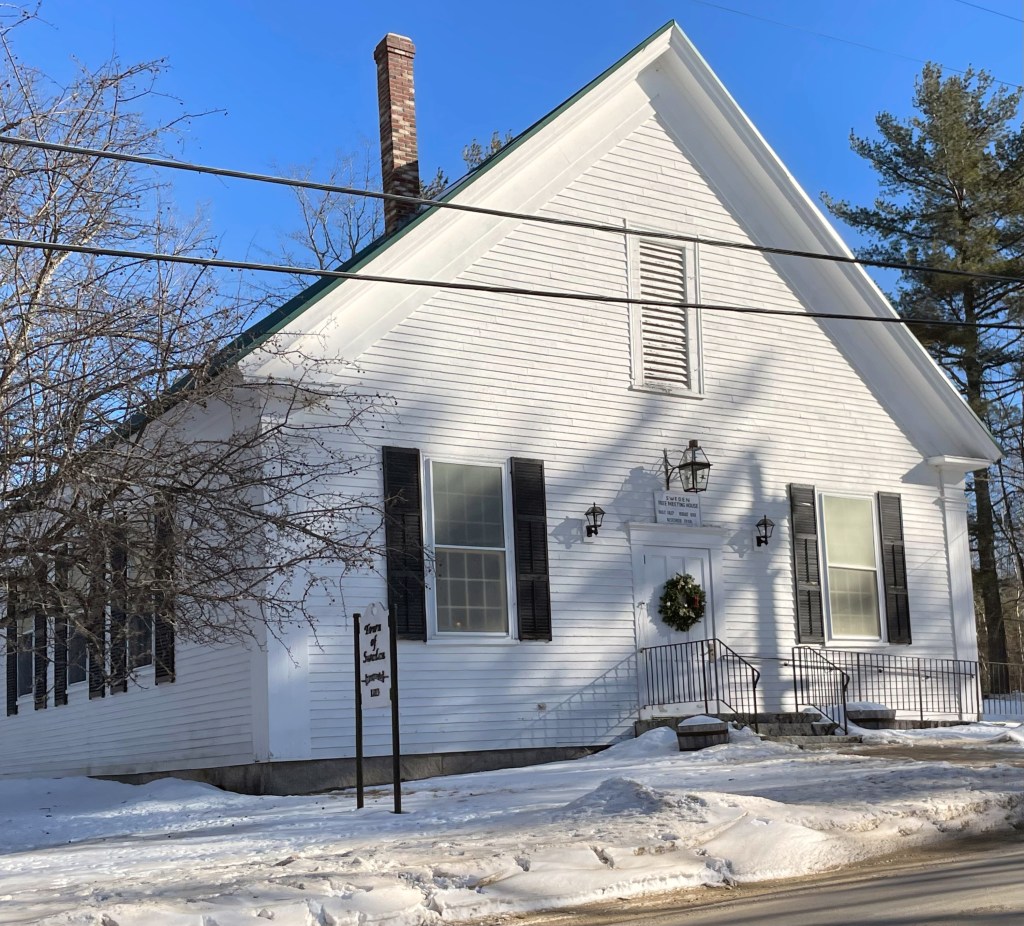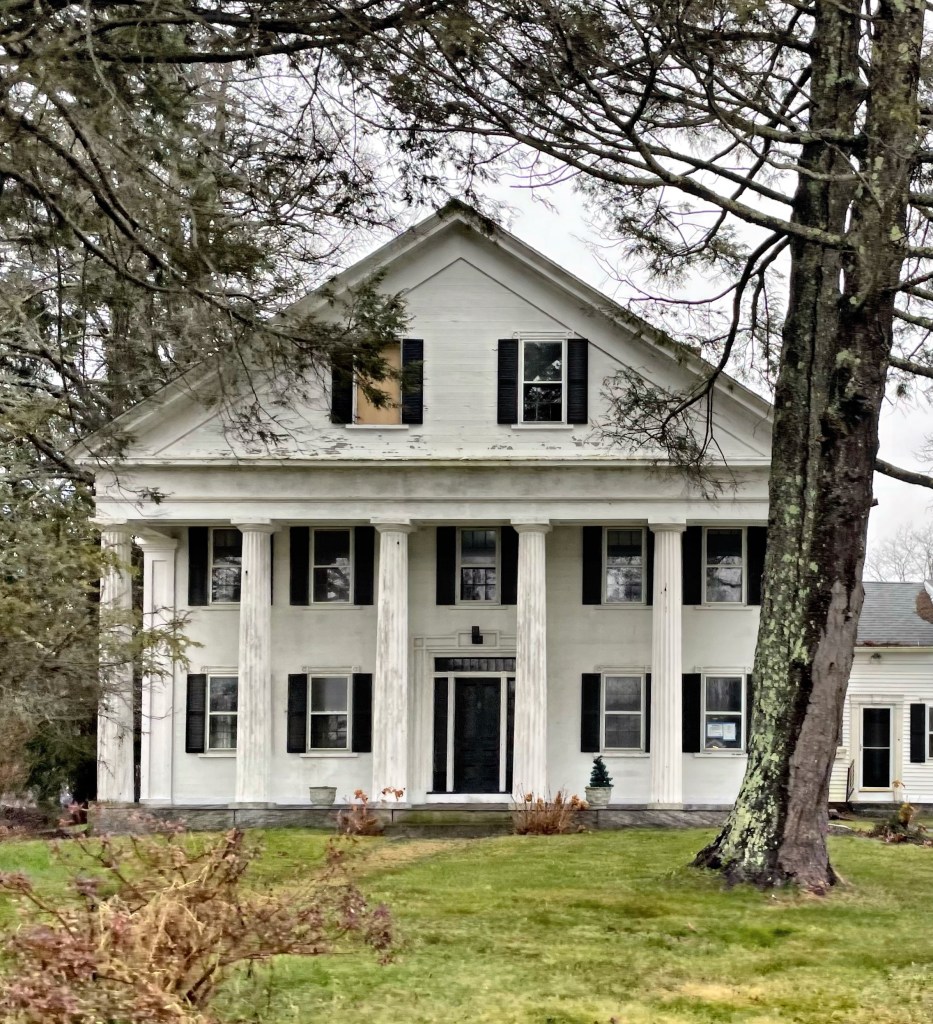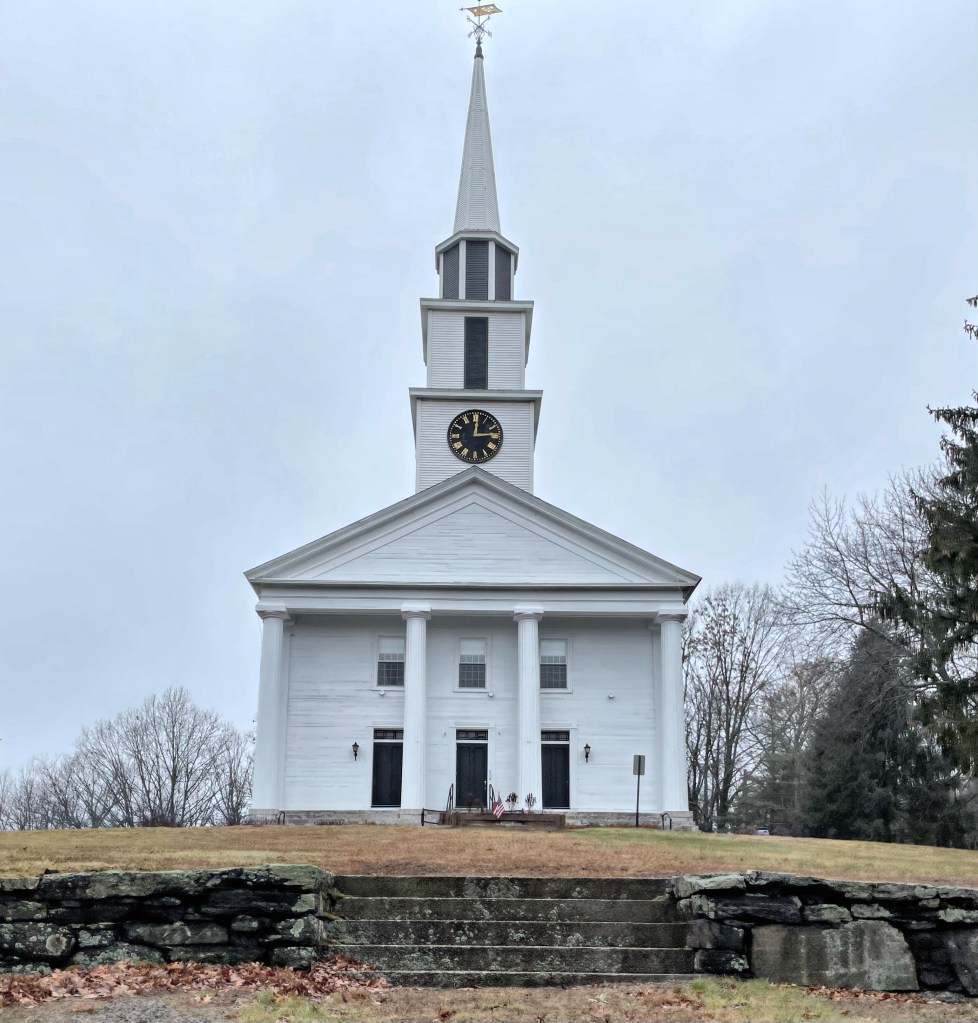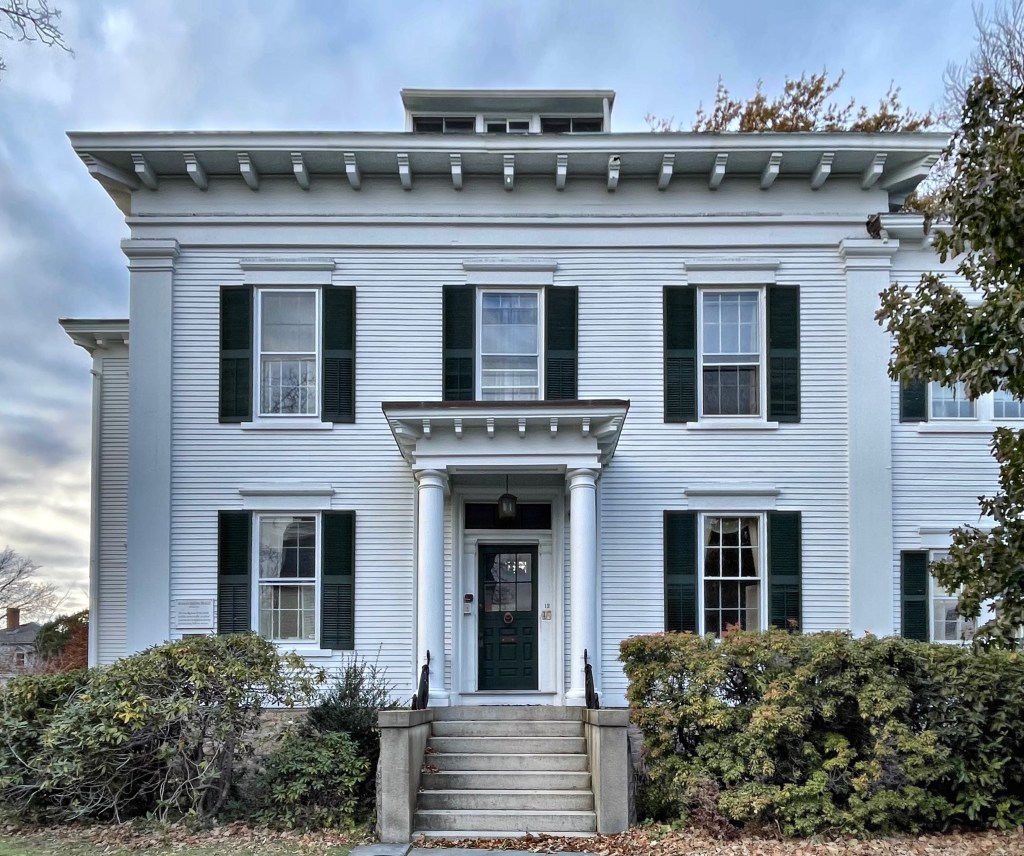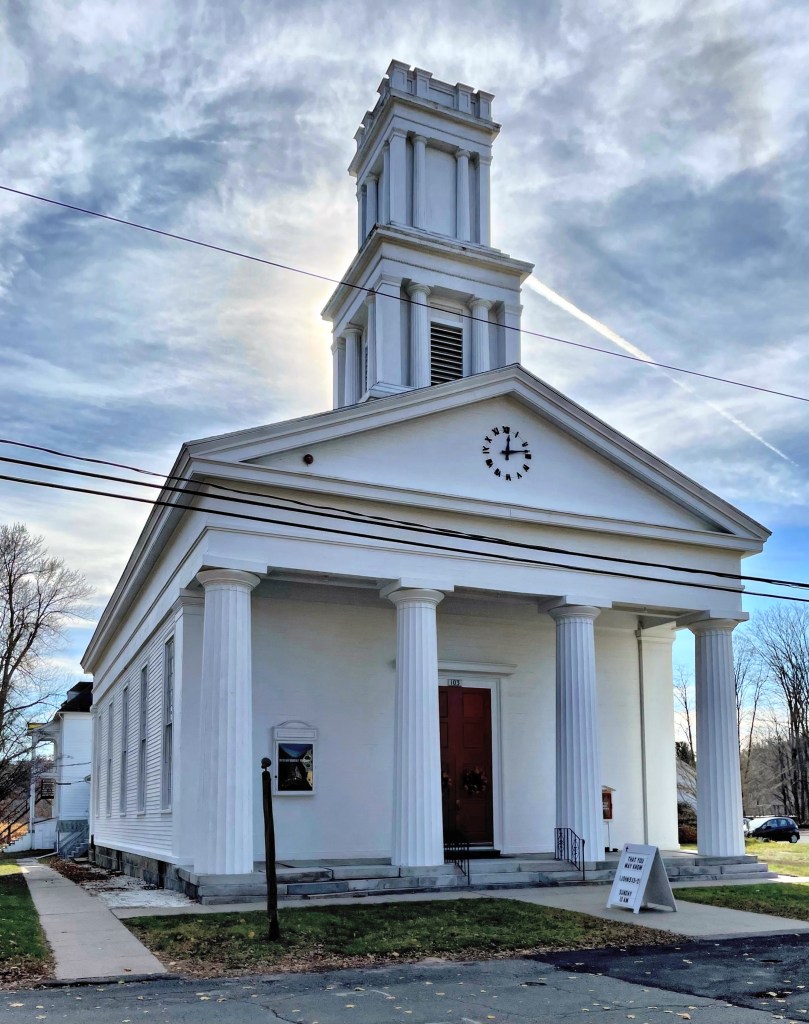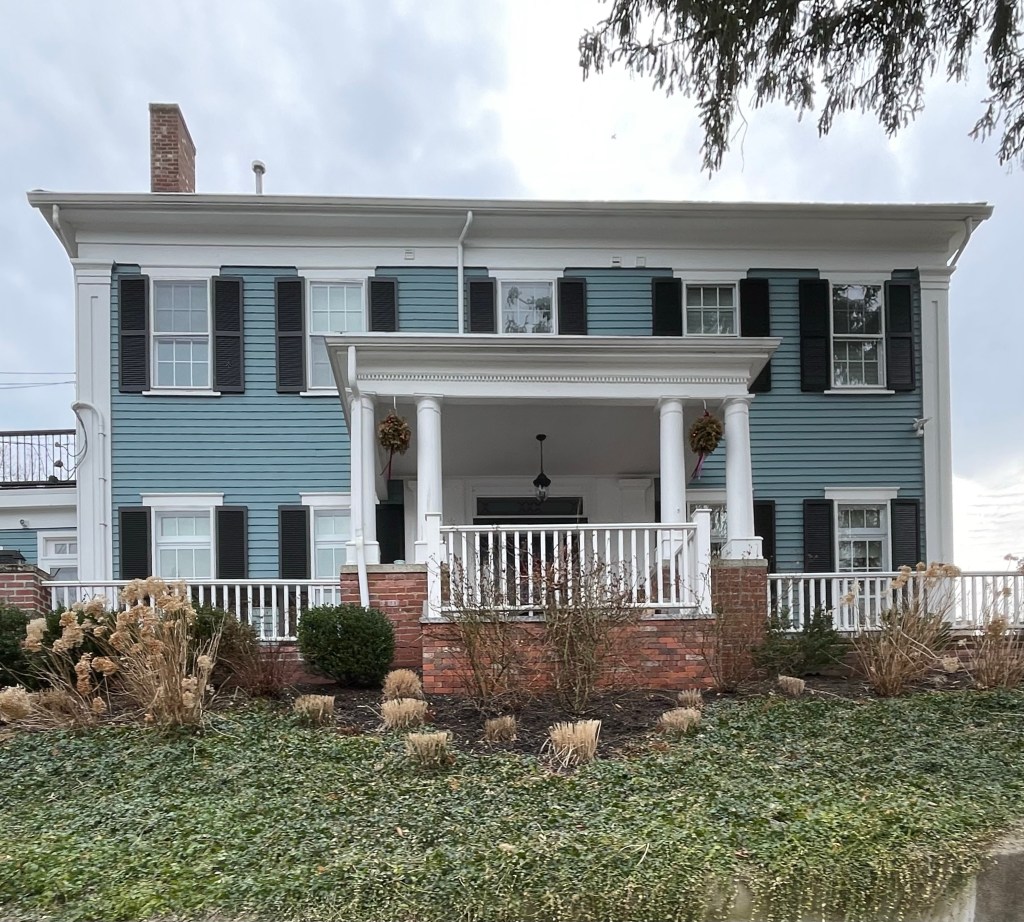
Collinsville Congregational Church // 1858

Shortly after Collins and Company was founded in 1826, religious services were held in various homes in the South Canton Village which came to be known as Collinsville. In 1830, the Collins Company erected its first office building on Front Street, and religious services were held there on the second floor. The first church building was erected on land bought by Collins and Company in 1826. By the mid-1850’s, the church membership was outgrowing the building. Although there may have been plans to enlarge the building, tragedy struck and in January 1857, and the church was consumed by fire, which started in the chimney, during a winter storm. The current building was erected almost immediately and dedicated on February 25, 1858. The present church is a grand Greek Revival style building, with a full pediment and large entablature supported by four monumental fluted columns. The two-tiered, square belfry has engaged columns as well. What a great example of a New England church!

South Canton Center School // 1848

Located across the street from the Canton Congregational Church (last post) you can find the cutest one room schoolhouse in central Connecticut. The schoolhouse, built in 1848, was one of nine one-room schoolhouses in Canton at the time. The perfectly proportioned classically designed school features two front doors, one on each side of the recessed entry, with the right door for girls and the left for boys. There were also two outhouses behind the building for students and the teacher. This building served the community as a school until 1942. In the years following, the building was used as a meeting place for women from the congregational church, a community library, and a small public space for members of town. It is owned by the Congregational Church, who maintain it to this day.

Thomas A. Hill House // 1836

One of the nicest homes in Bangor, Maine, is the 1836 Thomas Hill House, a stunning Greek Revival home constructed of brick just outside downtown. The home was built for Thomas A. Hill (1783-1864), a lawyer and banker in town. He clearly made substantial money in his time in Bangor, because he hired architect Richard Upjohn, who was in town at the time overseeing designs for his first church St. John’s Episcopal Church (burned in 1911) and the Farrar Mansion. Thomas Hill suffered financial losses during the Panic of 1837 and the bank foreclosed on his properties. The bank allowed him to stay in the house and pay the insurance, heat and taxes until the home was sold by the bank to Samuel and Matilda Dale, who purchased the home in 1846. Mr. Dale came to Bangor in 1833 as a sail-maker. Eventually he would own grocery and ship chandlery businesses downtown before serving as Mayor of Bangor from 1863-1866 and again in 1871. The Sons of Union Veterans bought the house in 1942 and named it the Grand Army of the Republic Memorial. During 1952 the Bangor Historical Society was allowed to use the house, which was placed on the National Register of Historic Places in 1972. In 1974 the house was deeded to the Bangor Historical Society, who occupy the home to this day.

Zebulon Smith House // 1832

The Zebulon Smith House in Bangor is one of the earliest temple-front Greek Revival homes built in the state of Maine. The house was constructed in 1832 for Zebulon Smith, a businessman who moved to the Maine frontier in the early 19th century, likely to get involved with a lumberyard as this section of the state shipped timber all over the region. The substantial home was built just south of downtown Bangor, and has survived fire and urban renewal. It sits alone in a sea of parking lots and industrial buildings in what was once likely a lovely neighborhood.

Isaac Farrar Mansion // 1836

The Isaac Farrar Mansion in Bangor, Maine not only looks gorgeous, it is significant as the one of the first known works of architect, Richard Upjohn. It is important because it shows that English-born Upjohn, who is best-known for launching the popularity of the Gothic Revival style in the United States, began his career by building in the Greek Revival style, the traditional style of the time. This mansion was designed for Isaac Farrar, a lumberman and merchant, and later, President of the Maritime Bank of Bangor. Charles B. Sanford, who lived in the house from 1865-1878, was proprietor of the Sanford Steamship Lines. The home had a few more subsequent owners until 1911, when it was acquired by the University of Maine Law School, which used it as a residency until 1929. It was soon after purchased the Bangor Symphony Orchestra, who renamed it “Symphony House”, and operated the Northern Conservatory of Music on the premises, also hosting the music branch of the Bangor Public Library. In 1972 the school closed, and the symphony sold the building the following year to the local YMCA, which now uses it as an exhibit and reception space. While some aspects of the house look to be from the early 20th century, it retains much of the Greek Revival design by Upjohn. Talk about a full history!

Henry Russell Jr. House // 1844

Henry Russell Jr. (1811-1857) was a prominent mason in Salem and after receiving the commission to complete the masonry on the East Church (last post), purchased a site nearby for the erection of his own stately mansion. Henry and his wife Maria lived here together until he died unexpectedly at just 46 years old from an internal abscess and infection, his widow died just two years later. The home was constructed in the Greek Revival style and of course, features amazing brick and stone construction. The interior’s wood paneling and fireplaces are in a great state of preservation as well, visible from a real estate listing. Swoon!

North Rochester Congregational Church // 1841

The North Rochester Congregational Church is located in a distinctly rural, area in the northwest corner of the largely pastoral town of Rochester, Massachusetts. This church, built 1841, is locally important to the development of religion and community in North Rochester. In Rochester as in other early New England towns, the building of a church symbolized the founding of a community. North Rochester’s first church was built in 1748, about 1 mile west of the present building, and was served by traveling ministers from other communities. The church congregation was formally organized in 1790, and a new church was built at that time, serving a larger area. The current church building was built in 1841 by Solomon K. Eaton, a noted regional builder whose credits include several other area churches. The church is of the Greek Revival style, which was frequented in the designs of hundreds of churches all over New England in the mid-19th century.

Dr. Ellis House – Sippican Historical Society // 1839

This house was built in 1839 Dr. Walton Nye Ellis (1808-1867), who served as physician in Marion in the second quarter of the 19th century. Born in Wareham, Ellis moved to Marion, and married Susan Delano (1809-
1840) after her death, within the year, he married Lucy Clark Allen (1820-1885); he had a daughter with his first wife and four daughters and three sons with his second. By 1838, he purchased a lot in Sippican Village for the price was $225. In 1855, Dr. Ellis organized a meeting of prosperous Village men, mostly sea captains, with the purpose of planning a library for the town. They pooled resources and funded a library which was located in a large closet on the second floor of his home seen here. The library’s books could be borrowed for a few cents a week. Subsequent funding from Elizabeth Taber helped create the Taber Library just decades later. In the 1960s, the home was gifted to the Sippican Historical Society, who remain in the building to this day.

Peter Grant House // 1830

The this 1830 home in Farmingdale ranks as one of the first Greek Revival temple style residences in Maine. Situated on a rise overlooking the Kennebec River, the house reflects a dignity befitting the commercial success of its original owner, Peter Grant. Peter Grant was born in 1770 in Berwick, Maine. He was a fourth generation descendent of an earlier Peter Grant, born in Scotland in 1631, and one of 3,000 Scots taken prisoner by Cromwell’s army at the Battle of Dunbar. In 1650, he was sent as a convict laborer to the iron works in Lynn, Massachusetts, for a term of seven years. A number of the Grant family settled in Berwick, Maine, and from there, Peter, builder of this house, and his father, Capt. Samuel Grant, moved to Gardiner. Peter Grant soon involved himself successfully in land speculation and shipping in the area. In 1796 he and a group of associates, purchased a large tract of land along the west shore of the Kennebec River, which later became Farmingdale. Grant became sole owner of better than 200-acres of this land in 1800 and built a substantial house soon after. The original house was destroyed by fire and was replaced by Grant with the present house in 1830 six years before his death in 1836.

Rye Town Hall // 1839

Rye, New Hampshire sits on the short coast of the state, between the busy towns of Portsmouth and Hampton, and provides a respite from the swarms of tourists and beach-goers alike. Modern-day Rye was the first settlement in New Hampshire by Europeans, and was originally named Pannaway Plantation, established in 1623 at Odiorne’s Point (more on that later). The settlement was eventually abandoned for Strawbery Banke, which became Portsmouth, the historic port town we know today. The town was later a village of New Castle, and was known as Sandy Beach Village, before it was called “Rye”, for Rye in Sussex, England, and incorporated as its own town in 1785. The town met in a Meeting House until it purchased an old 1839 Methodist church in town. In 1873, the building was purchased by the town of Rye for $1000, with an additional $2658 spent on renovations, which added a new ground floor to increase the height from 1.5 stories to 2.5 stories, added 10 feet in depth to the building, and the two-stage tower and belfry. The Greek Revival building has long been a landmark in town, hosting dances, concerts, whist parties, singing schools, oyster parties and immunization clinics, beyond the typical governmental functions. There were calls to demolish the building for a modern town hall, which saw resistance (thankfully) and now the town has agreed on a land-swap with a bank, demolishing an old house to take over the bank building, turning it into some town offices.