Stone Memorial Building // 1896

Designed by New Hampshire architect William Butterfield in 1896, the Stone Memorial building in Central Weare is a significant example of a Neo-Classical style structure in a village setting. The building was constructed with money donated by Joseph Stone in honor of his father, Phineas J. Stone, who was born in Weare and moved to Charlestown, MA, later serving as its seventh Mayor. The building would “provide suitable room for a public town library” and a room for memorials to the Civil War soldiers who fought and died for the Union. When the town hall burned, offices there were relocated to this building. Eventually, the library and town offices left this small building, and it has since been home to the Weare Historical Society.

Osborne Memorial Hall // 1920

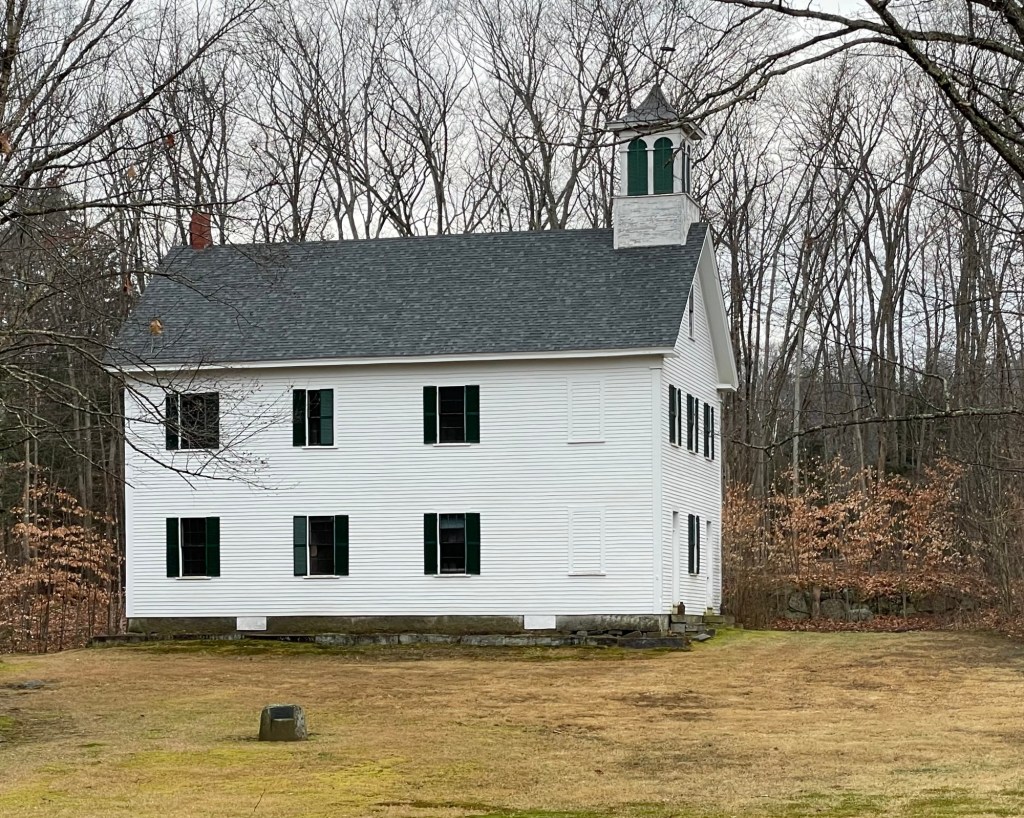
Weare is the largest town in Hillsborough County, New Hampshire by land area. As a result, the town’s villages historically were fairly isolated (especially before the arrival of the automobile). Social halls were important gathering places for some of these rural communities, allowing for events and celebrations to be held in a designated location. Before 1920, South Weare only had a Union Church which could meet this demand. In her will, Nellie Osborne donated funds in the memory of her husband Wellman Osborne, who grew up in Weare, to erect a social hall there. South Weare residents established the South Weare Improvement Society to make use of the money and oversee construction of the Memorial Hall. The Arts and Crafts style community building with its pyramidally roof opened in 1921. After numerous decades of deferred maintenance and dwindling use of the facilities, Osborne Hall was in decline and danger of demolition. Luckily, new members banded together and funded a restoration and modernization of the building. Here’s to another 100 years!

Clinton Grove Academy // 1874

Clinton Grove Academy of Weare, New Hampshire was the first Quaker seminary in the state when it was founded in 1834 by Moses Cartland (1805–1863). Moses Cartland was a Quaker abolitionist who served as the first Principal of the school and for fourteen years after. He later would move to Lee, NH, and aided those who escaped slavery in the south, sheltering them and assisting them on their way north to Canada. The original Academy here served as a private high school and included a classroom building, boarding house, barn and sheds. Students came from as far away as Ontario, Nova Scotia, Minnesota and Texas to study here under Mr. Cartland. In 1872, the Academy complex burned. It was quickly rebuilt as one structure here, in 1874. This building served as a district school until the 1930s. Today, it looks like the building is largely vacant, anyone know what its purpose is?

Weare Town House // 1837

Weare, New Hampshire has a pretty cool history. Located at the northern edge of Hillsborough County, the land presently known as Weare was granted to veterans of the Canadian wars in 1735 by Governor Jonathan Belcher, who named it “Beverly-Canada” after many of the veteran’s hometown, Beverly, Massachusetts. After various disputes over the settlement and naming of the town, it became known as “Weare’s Town” before being incorporated by Governor Benning Wentworth in 1764 as Weare, after Meshech Weare, who served as the town’s first clerk and later went on to become New Hampshire’s first Governor. The town grew slowly during the 18th and 19th centuries around five major villages, with farmland and forests connecting them. Near the geographic center of town, this Town House was built in 1837 to be a government and religious center of the town. Originally, town meetings were held on the first floor and the Universalist Church met on the second floor and the local high school was installed on the second floor in 1919. The building remains the town offices with event space for rent inside today. The building is a great example of a vernacular Greek/Gothic Revival town house of the period with a two-stage tower with pinnacles at the corners of each stage and a louvered belfry at the bell.

Charles and Asenath Burke Mansion // 1889

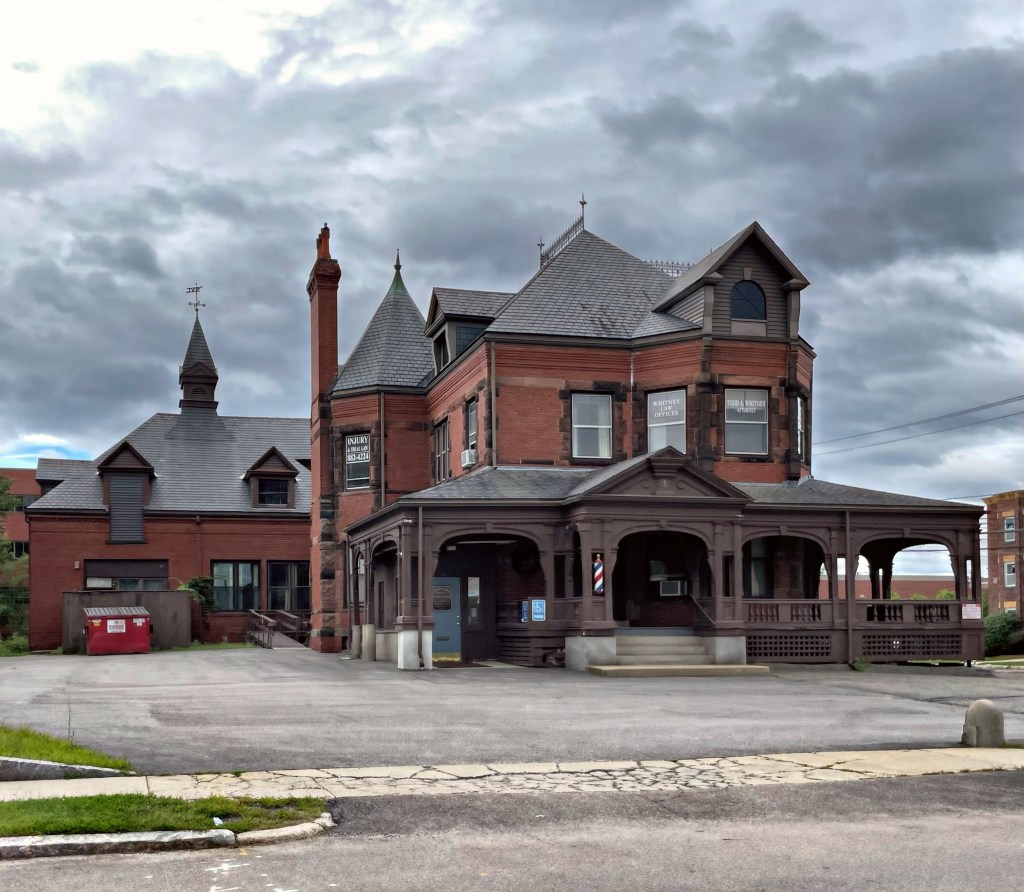
One of the finest homes in Nashua, New Hampshire is this stately brick and brownstone mansion at the corner of Main and Prospect streets. It was built for Charles Horace Burke (1850-1912) and his wife, Asenath Burke (1856-1943) in 1889 as one of the most up-to-date residences in the city. As a young man, Charles was known as “the busiest businessmen” in Nashua. He would become the president of the Nashua Iron and Brass foundry as well as the director of the Second National Bank. In 1878, he was the city’s tax collector and he served as Mayor from 1889 to 1890, soon after he had this estate built. As mayor, Mr. Burke was responsible for the building of the Soldiers and Sailors Monument in Abbot Square and the Court Street Police Station. As Mayor, Burke also improved the sewage system, streets, sidewalks, and highways of Nashua. He hired architect Charles J. Bateman to furnish the plans for the house, which would take over a year-and-a-half to build. Bateman would later be named City Architect for the City of Boston, designing schools, firehouses, and more during his time there in 1893-4 and 1898. The house is a high-style Queen Anne Victorian home of brick with brownstone trim. There is an intact former carriage house at the rear. The house was inherited by Charles and Asenath‘s only child, a daughter, Tena, in 1914. She sold it two years later to Dr. Augustus W. Shea and his wife, Lucy. When Lucy passed away in 1948, her daughter sold the property to the Nashua Medical Center. It has seemingly been used as offices ever since. The large corner lot and adjacency to a large medical center across the street have me worried that this property may be threatened in the future for redevelopment, here’s to hoping Nashua can preserve this significant and architecturally grand estate! Thank you to the Nashua Historical Society for assistance researching this post!

Litchfield Old Town Hall // 1851

The town of Litchfield, New Hampshire is located at the southern section of the state across the Merrimack River from the town that carries its name. Land which is now known as Litchfield, was once populated by the Abenaki people. The New Hampshire Archaeological Society has located over 30 Native American sites along the shore of the Merrimack River in Litchfield, with artifacts several thousands of years old being uncovered. European influences started in the 1650’s with early records showing that Litchfield was then a part of Dunstable, Massachusetts. Both sides of the Merrimack River were granted in 1656, to William Brenton, colonial governor of Rhode Island. The name was changed to “Brenton’s Farm” in 1729. Chief Passaconaway of the Penacook lived in a Litchfield settlement at least part of the year around this era. In 1728, sixteen proprietors divided up the Brenton Farm Land. In 1749, the land was granted to another group of settlers and named “Litchfield” after George Henry Lee, Earl of Lichfield. The town has historically been comprised of farmland without a true town common or center. A small enclave of buildings did center in town, where the town hall was built. This building, the Old Town Hall of Litchfield, was built in 1851 from parts of an older meetinghouse, which was built across the road from where the building now stands. A shift in the course of the Merrimack River during the early 1800s forced the dismantling of the original Meeting House and a new structure to be built. It is a modest Greek Revival structure with corner pilasters, entablature, and gable end facing the street which reads as a pediment. It is very well maintained to this day as the home to the Litchfield Historical Society.

Cragin-Frye-Savage Mill // 1858

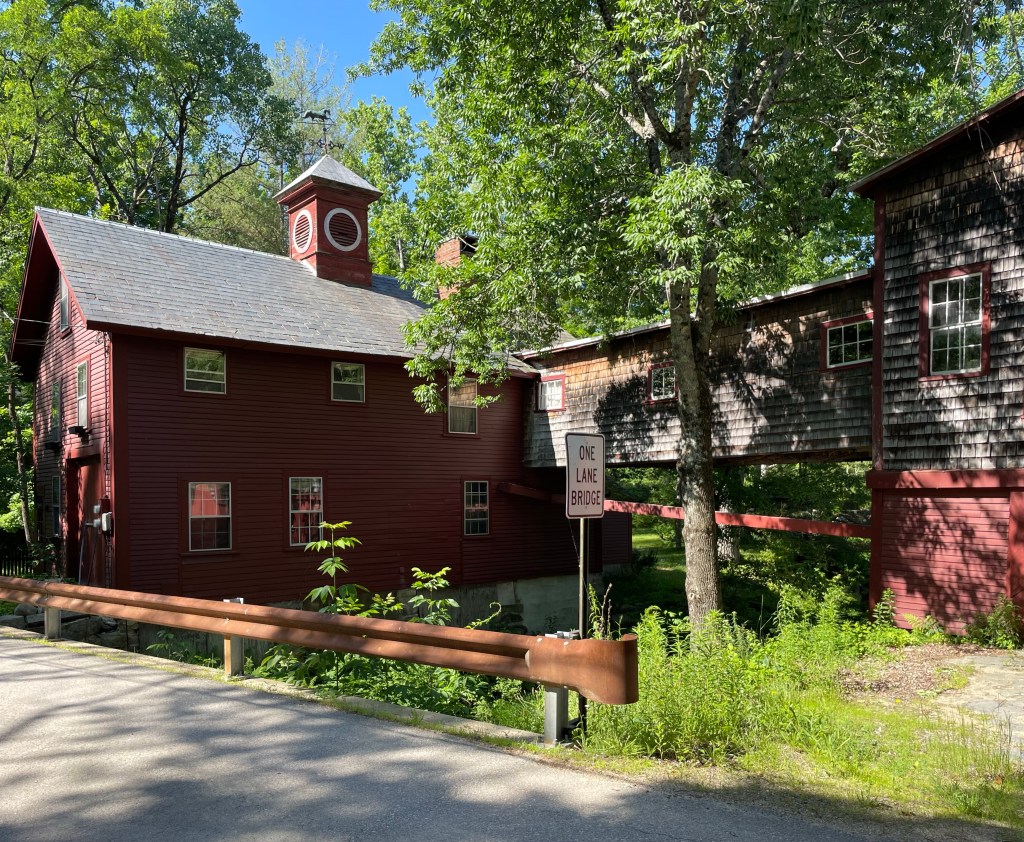
There’s not much that is more picturesque and stereotypical New Hampshire than old, wooden mill buildings. When I was looking for a town to explore in NH, I got stuck on a photograph of the old Cragin-Frye Mill in Wilton, and off I went! Daniel Cragin (1836-1921) was born in Merrimack, NH of Scottish descent. In 1856, age 21, he rented a room in a woolen goods mill, and he built knife trays and wooden toys which he turned into a business. He started his business with ten dollars, and turned a profit from the beginning, so much so that by 1858, he accumulated enough money to purchase a nearby existing building for his own operation. The mill was water-powered and grew quickly. The Daniel Cragin Mill began production of sugar boxes and dry measure boxes. The mill closed briefly after Cragin retired in the early 20th century. In 1909, Whitney Morse Frye and his father, Dr. Edmund Bailey Frye, bought the mill from Cragin. Frye continued the Cragin line of wooden trays, boxes, and pails in addition to his normal processing of grains. Whitney Frye died in 1961, and his employee, Harland Savage Sr. purchased the old mill, continuing operations. After his retirement in 1981, his son Harley and his wife Pam Porter Savage took over operations and they have operated the mill to the present day as Frye’s Measure Mill. The mill is one of a few remaining operating water-powered measure mills in the United States!