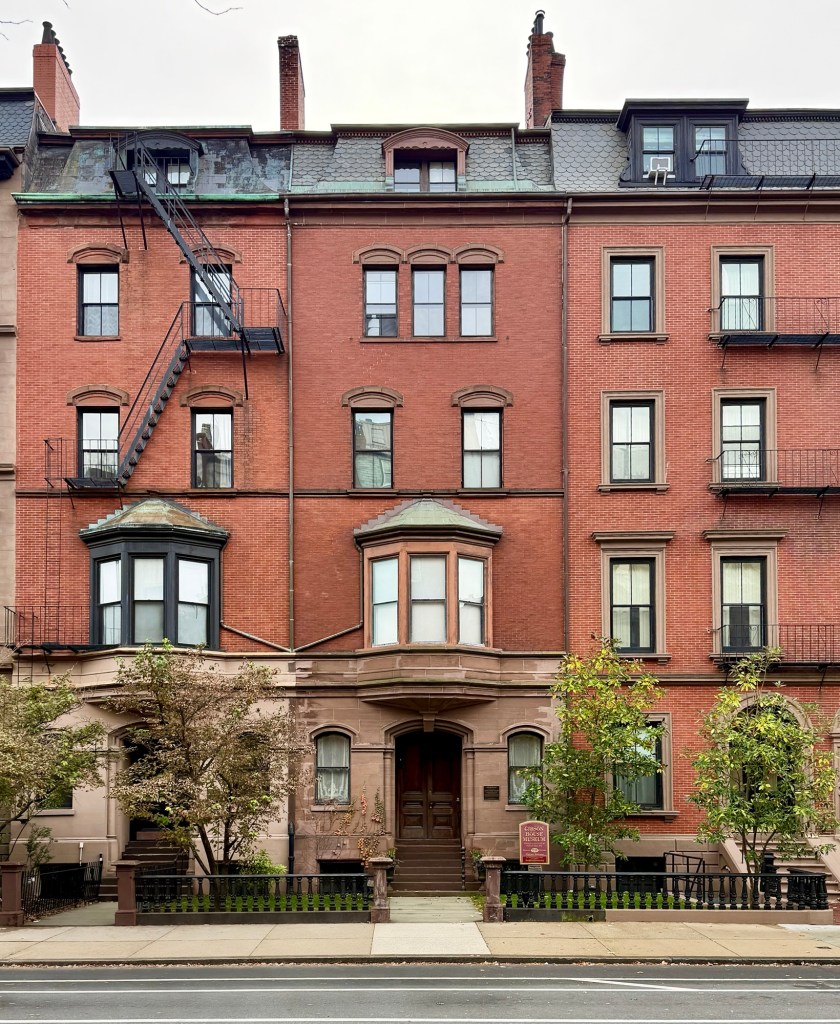
Set amongst the rows of historic townhouses and apartment buildings in the Back Bay neighborhood of Boston, the Gibson House Museum on Beacon Street remains as a rare time capsule of Victorian-era Boston, that is open to the public! Built in 1860 and designed by architect Edward Clarke Cabot, the Second Empire-style townhouse was among the first homes constructed in the newly filled Back Bay, a neighborhood literally reclaimed from tidal marshland. It was commissioned by Catherine Hammond Gibson (1804-1888), a wealthy widow, and later passed to her son Charles Hammond Gibson (1836-1916) and then to her grandson Charles Hammond Gibson Jr., a poet, traveler, preservationist who lived there until his death in 1954. “Charlie” Gibson was part of the vibrant sub-culture of Boston’s early 20th century queer community, centered around artistic pursuits like architecture, writing, and interior design. He never married or had a long-term partner, but had a known romantic relationship with Maurice Talvande, the Count de Mauny, during his twenties while in France. Charles Gibson preserved the family home exactly as his family had known it, and that stubborn devotion is why the interior remains so remarkably intact. Visitors can wander through original wallpapers, ornate woodwork, gas fixtures, and the family’s furniture and keepsakes, all arranged as though the owners had just stepped out. The house also reveals the rhythms of upper-class life in the era, including the separate spaces for servants, whose stairways and work areas tell the other half of the story of Victorian-era Boston. Opened as a museum in 1957, the Gibson House Museum offers an intimate look at how Boston’s elite once lived, and it stands as one of the best-preserved Victorian interiors in the country.

