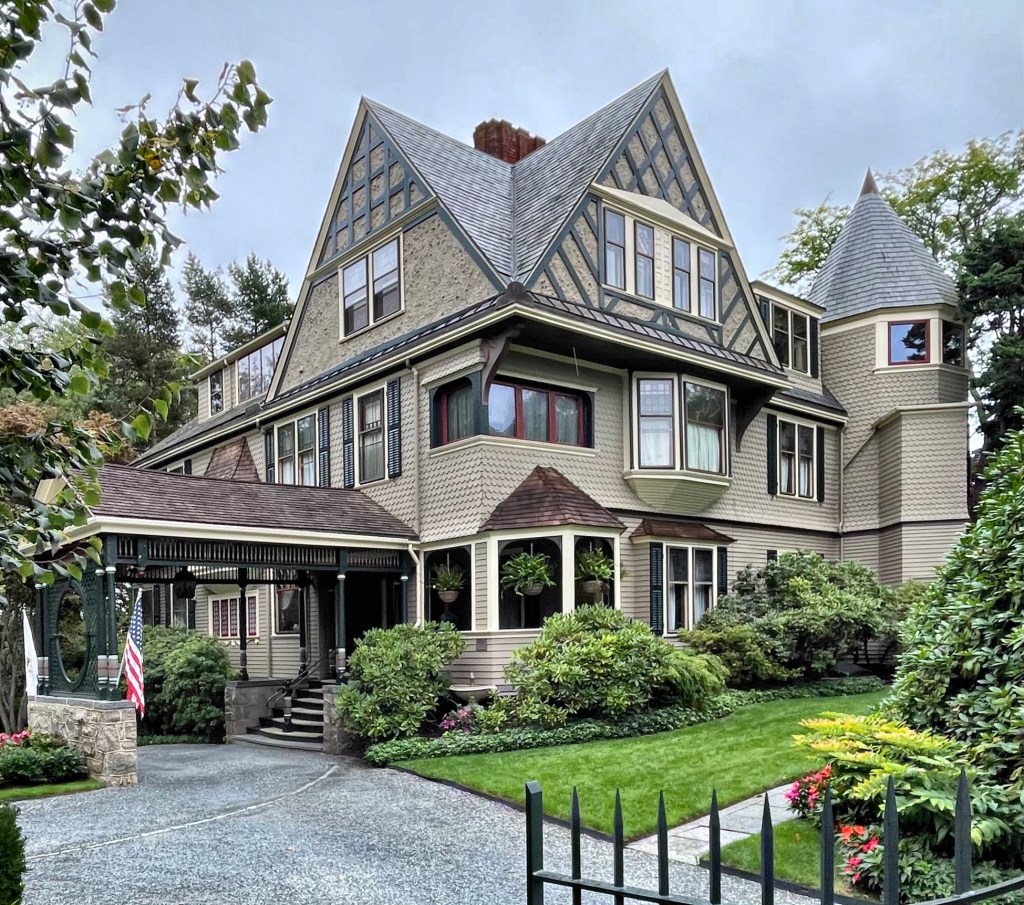
Maple Shade Cottage // 1871

“Maple Shade” is a historic, Second Empire style summer cottage located at 1 Red Cross Avenue in Newport, Rhode Island. The house was built in 1871 from plans by George C. Mason, a prominent local architect who designed many summer homes for summer residents in the late 19th century. He even lived in a home adjacent to this house! Maple Shade was built for John Doughty Ogden and his second wife, Mary C. Moore. John originally married Mary’s older sister Margaret, but remarried after Margaret’s death in 1845. The house gained attention again in 1934, when it served as the venue for the wedding reception of John Jacob Astor VI and Ellen Tuck French, then owned by Donald O. Macrae. The house, like many other former estates in Newport, has since been converted into condominiums, but retains its architectural grandeur and presence in town.
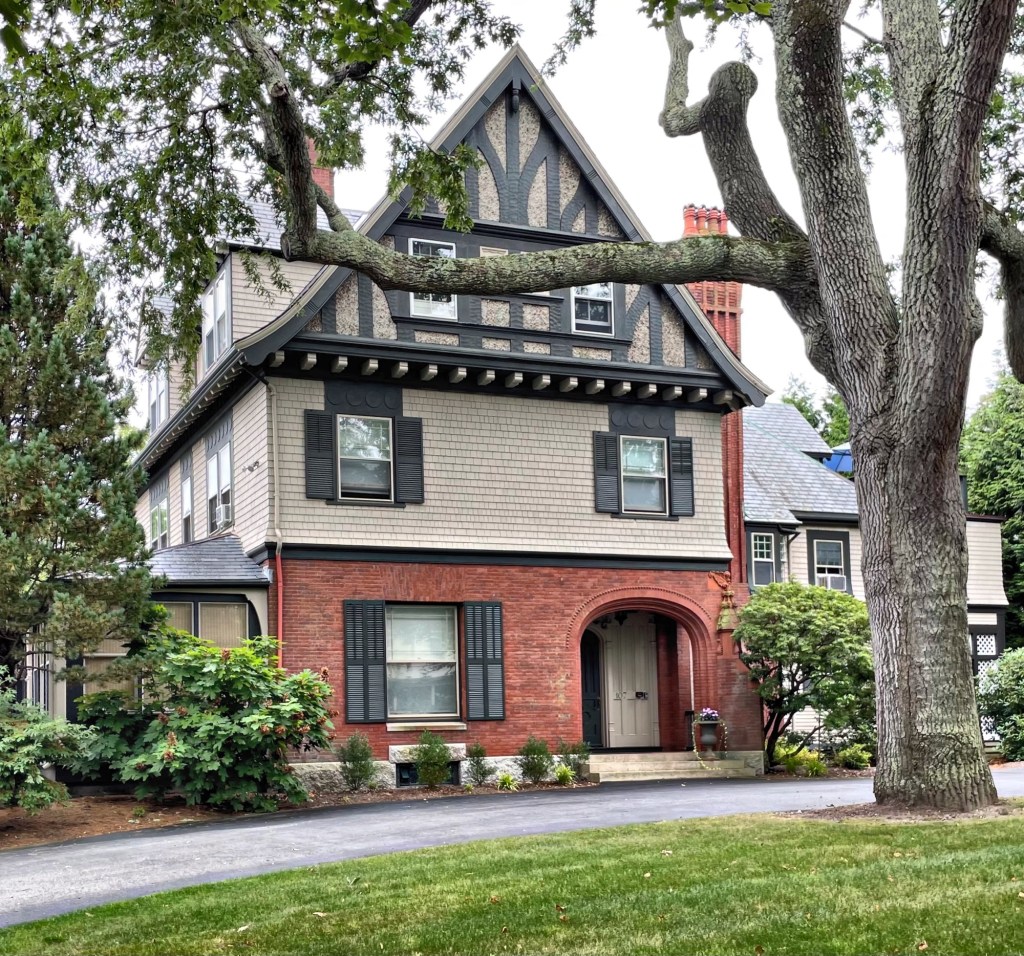
Oakwold Cottage // 1883

Oakwold, a stunning Queen Anne residence on Old Beach Road in Newport, Rhode Island was supposedly built on speculation and purchased by Augustus Jay (1850-1919). Mr. Jay was born in Washington, D. C., the son of Peter Augustus Jay and Josephine Pearson Jay. Augustus Jay graduated from Harvard College in 1871 and from the Columbia Law School in 1876, and worked as a diplomat. His wife was Emily Astor Kane (1854–1932), a daughter of DeLancey Kane and Louisa Dorothea (née Langdon) Kane. Emily was a descendant of John Jacob Astor. The “cottage” was named Oakwold, and was designed by architect Clarence Sumner Luce, who designed many summer residences in Newport, and specialized in the Queen Anne style. Particularly noteworthy in the design of Oakwold are the brick first floor with entrance within a recessed arched opening and pebble-dashed and half-timbered gable ends.

Rosevale // 1876

“Rosevale” was built in 1876 as a summer residence in Newport, Rhode Island, for couple, Grace Sears Rives and William Cabell Rives. Grace was the daughter of David Sears of Boston, who developed the Longwood neighborhood of Brookline; and William was the son of William C. Rives Sr., a Virginia congressman and Senator. The High Victorian Gothic mansion was designed by the Boston architectural firm of Peabody & Stearns who formed their practice just years earlier. The house was enlarged in 1881 by architect George Champlin Mason, Sr. The stonework of the lancet windows, the large octagonal tower, and the carved moldings give the relatively boxy home a more ecclesiastical feeling. The estate retains its original siting, at the middle of a large lot between Red Cross and Rhode Island avenues, which has thus far resisted infill housing on the estate. For years, Rosevale has been occupied as a funeral home, but it appears to have sold a couple years ago.

Eveherdee Cottage // c.1889

This Queen Anne style “cottage” is located on Gibbs Avenue, one of the lesser-visited streets for house-stalking in Newport, Rhode Island, but wow is she something! The summer cottage here was built by 1890 for Ogden Hoffman Burrows, a merchant who went into business with his father and brother in San Francisco, shipping goods from East Asia to America. He purchased two adjacent lots here on Gibbs Avenue in 1884 and 1889, having this house built as a summer residence, where he could mingle with other wealthy neighbors. The Queen Anne style house was reportedly designed by local architect, John Dixon Johnston, who incorporated all the hallmarks of the style: varied siding types and materials, turned post porte-cochere, applied ornament, and complex, asymmetrical form. Burrows would sell this house by the turn of the 20th century. Later owners, Herbert E. Stride and Daisy Thompson Stride, who would reside here with Daisy’s mother, Eve. The Stride’s named the home “Eveherdee” an amalgamation of their individual names: Eve (Eveline), Her (Herbert), and Dee (Daisy). The home was most recently owned by television producer, Vin Di Bona, who restored the house to its grandeur we see today.

Bay Crest Cottage // c.1850

Located across from the Winthrop-Eckley Double House on Corne Street, this gorgeous Italianate style summer cottage is a perfect blending of stature and whimsy. The house was built around 1850 and owned by Charles B. Peckham. Built in the Italianate style, the symmetrical house stands three-stories with covered side entrances divided by a projecting two-story bay. The house exhibits broad, overhanging eaves and paired and ganged round arched windows. The property was known as “Bay Crest” and remains one of the unsung landmarks of the 1850s in Newport.

Winthrop-Eckley Double House // c.1855

Newport has no shortage of amazing architecture. From the grand Gilded Age mansions along the coast to the pre-Revolutionary Colonial houses, there are always new buildings to stumble upon and learn about. This charming stone double-house on Corne Street was built in the mid-19th century and had two owners by the 1870s, John Winthrop (1809-1886) and Julia Ann Eckley (1800-1874), a widow, who owned the smaller side. The stone cottage sits atop a raised basement with bold stone quoins at the corners. Dormers with delicate wood trim are at the roofline with the detail reflected in the porch on the Winthrop half. This double-house is one of the many “hidden” treasures in Newport’s warren of narrow streets.

Edgar-Wolfe-Moore House // 1864

At the head of Touro Park, this large home has stood since it was built in 1864 for Daniel Edgar of New York, who made it his summer home for eight seasons. It was designed by noted local architect, George Champlin Mason in the Italianate style and included a broad veranda, brackets, and other intricate details. In 1872, Edgar sold the property to Catherine Lorillard Wolfe, who occupied the house until 1883 when her property “Vinland” was completed on Ochre Point Avenue. In 1948, the house was purchased by Cornelius C. Moore, who remodeled the exterior in 1949-1950, removing its Italianate trim and replacing it with Neo-Federal detail we see today. The house was most-recently in use as the Touro Park Inn, but was recently purchased and is a single-family home.

“Park Gate” Cottage // 1879

“Park Gate” Cottage sits on Bellevue Avenue near Touro Park in Newport, Rhode Island and is one of many summer “cottages” for wealthy summer residents. The home replaced the Atlantic House, a large summer hotel formerly on the site. The wood-frame dwelling was designed by Newport architect George Champlin Mason for Seth Bunker Stitt of Philadelphia and constructed in 1879. Mason’s design for “Park Gate” includes many features typical of the Queen Anne style including the asymmetrical facades, wrap-around front porch, tower, and even the small details like dentils, spindle work and balustrades. The house was later purchased by Newport Lodge #104 of the Benevolent and Protective Order of the Elks in 1920, who own the building to this day.

Gardner House // c.1847

This perfect Greek Revival style house sits on Pelham Street in Newport, overlooking Touro Park and the iconic Newport Tower/Old Mill. Built around 1847 for Captain Robinson Gardner, the house exhibits flushboard siding, a heavy portico with wrought iron balcony over the door, and entablature with corner pilasters, all hallmarks of the style. The home became known as “White House” and has likely been painted white for much of its history.

Smith-Cottrell House // 1887

Located next to the Channing Memorial Church and the Derby Cottage on Pelham Street, this Queen Anne style cottage stands as a significant Victorian era residence on the street dominated by Greek Revival homes. Built in 1878 for a William H. Smith for his residence and office. The home is an excellent example of the Queen Anne style with asymmetrical form and massing, complex roofline with multiple gables and towers, varied siding, and intricate millwork. By the early 20th century, the property was owned by John and Mary Cottrell, and later purchased by the Channing Memorial Church as “Channing House”.