The Elms // 1899

One of my favorite things to do each holiday season is to explore Newport and the mansions all gussied up with lights, ornaments and holiday cheer. This year, I visited The Elms, one of my absolute favorite buildings in Newport, which is a house museum! Stay tuned for some room features, similar to my series last year on The Breakers mansion.
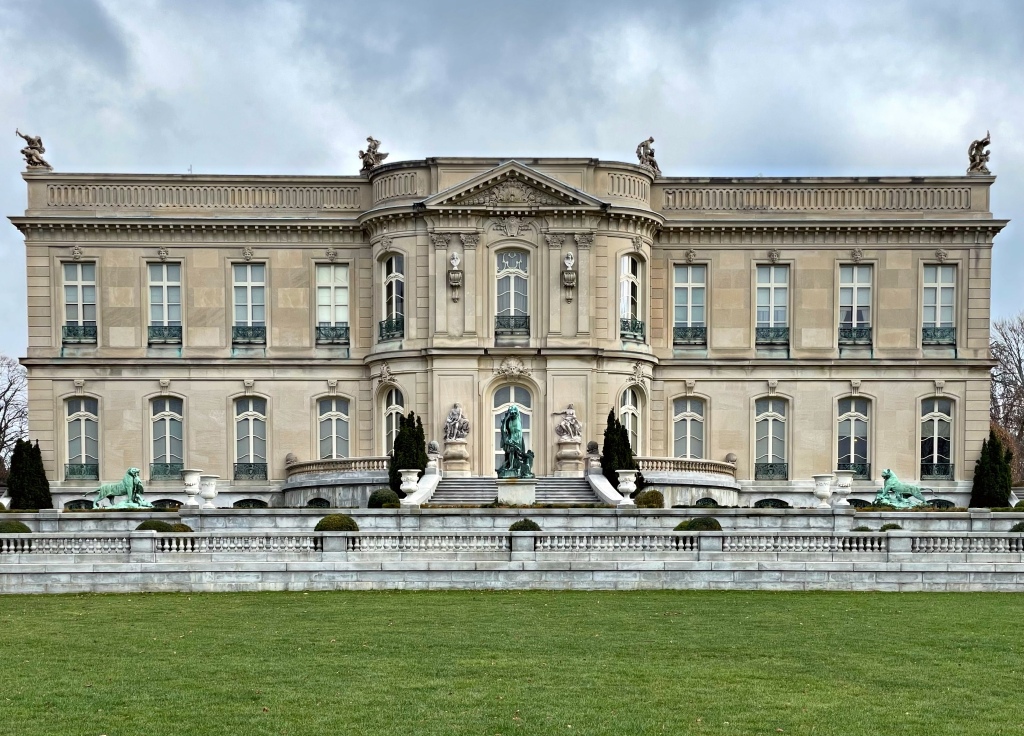
The Elms was commissioned in 1898 by coal baron Edward Julius Berwind (1848–1936) and his wife Sarah Torrey Berwind (1856-1922) as a summer cottage where the couple could escape the woes of city life for a few weeks of every year. Edward was “new money” (his parents were middle-class German immigrants); and by the 1890s, he was hailed as “one of the 58 men who rule America”, making him one of Newport’s most important summer residents. To live up to his new status, he hired Philadelphia architect Horace Trumbauer, who took inspiration from the 18th century Château d’Asnières in France. The site on the iconic Bellevue Avenue is not directly on the water, so Trumbauer sought to enhance the siting of the mansion by elaborate landscaping (more on that later). The house was built to be fireproof, after the complete loss of the original Breakers mansion in 1892 and is clad with Indiana limestone. The couple held many lavish parties in the Elms until 1922, when Mrs. Berwind died. Mr. Berwind invited his youngest sister, Julia, to become his hostess at his New York and Newport houses. Mr. Berwind died in 1936 and Julia continued to summer at The Elms until her death in 1961. Childless, Julia Berwind willed the estate to a nephew, who did not want it and fruitlessly tried to pass The Elms to someone else in the family. Finally the family auctioned off the contents of the estate and sold the property to a developer who wanted to tear it down. In 1962, just weeks before its date with the wrecking ball, The Elms was purchased by the Preservation Society of Newport County for $116,000. It remains one of the most visited house museums in the nation to this day.

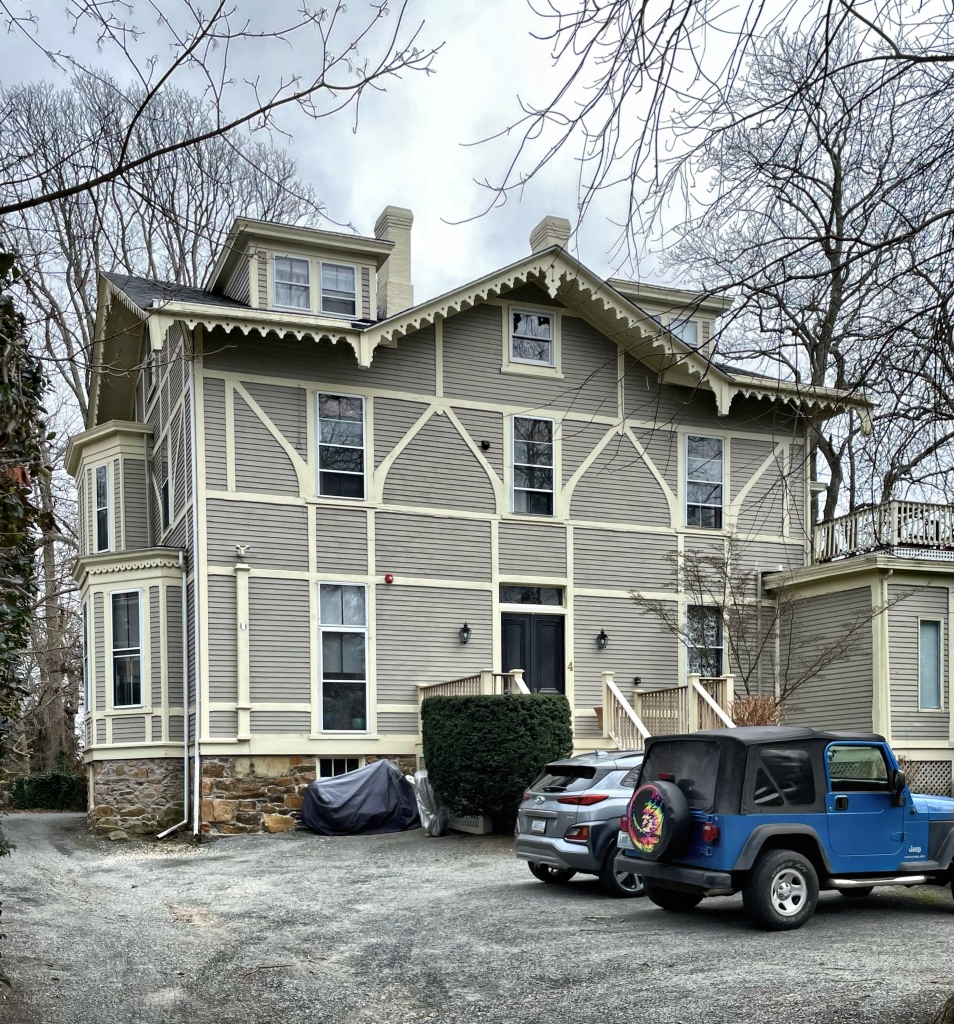
Sunnycroft // 1873

Sunnycroft in Newport was built in 1873 as the summer cottage for Philadelphia socialite couple Elizabeth K. Ashhurst Willing and her husband Richard Willing on land given to them by Elizabeth’s father William. The house is a blending of Gothic and Stick styles, with half-timbering and bracing across wall surfaces and bargeboard at the eaves. By the turn of the 20th century, the house was owned by Henry Casimir DeRham and his second wife, Georgiana. DeRham was the grandson of a wealthy New York banker of the same name. This house (while still ornate) is a more modest example of the summer cottages in Newport and shows the wide-range of tastes seen in the Gilded Age.

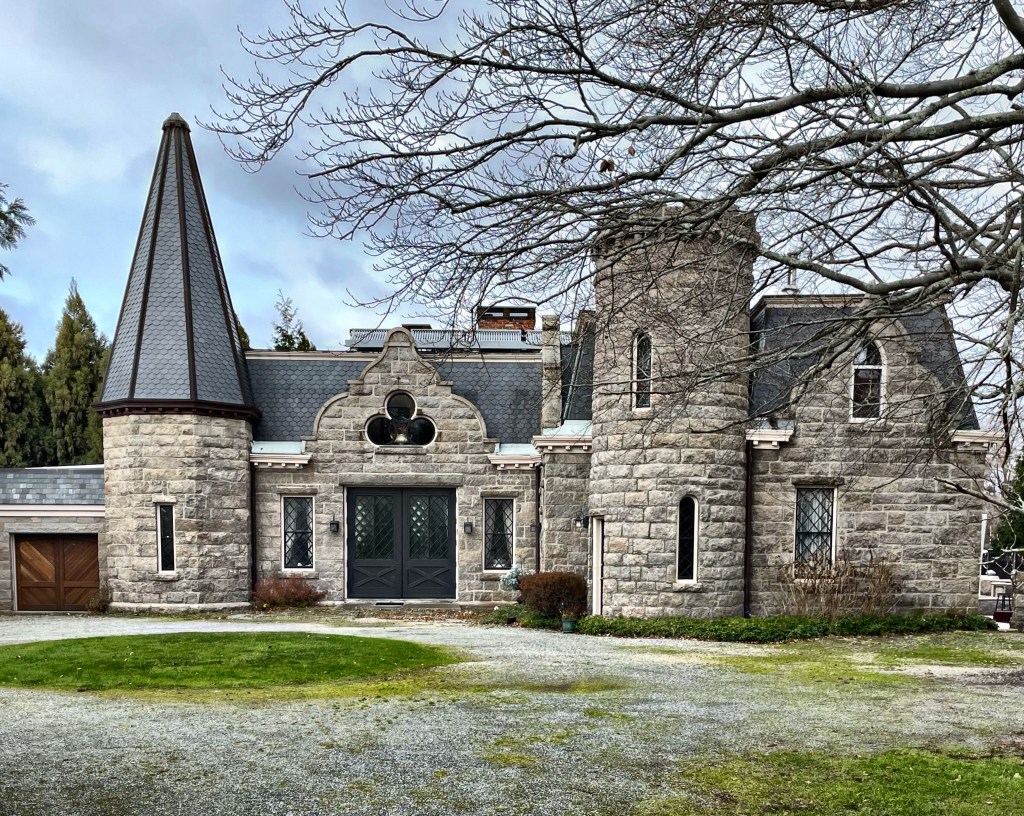
Belair Stable // c.1875

Just past the Belair Gate Lodge (1870), you w5ll find one of the most eclectic and interesting buildings in Newport, Rhode Island. This structure was built around 1875 as the stable to the larger Belair estate, just a stone’s throw away. When it was built, local papers stated the building was “probably one of the most expensive stables in the city.” It was designed by Newport architect Dudley Newton at the same time he redesigned the main mansion and furnished plans for the new gate lodge for owner George H. Norman. Architecturally, there is A LOT going on here. The 1½-story, rough-face-granite-ashlar building is capped by a hexagonal-tile slate mansard roof. On the left is an octagonal tower with an out-of-scale roof pitch and at the other side of the carriage door is a circular-plan tower with battlemented parapet. At the center is a really unique trefoil gable with trefoil window centered within. So cool to stumble upon this!! Oh, and it’s now a single-family home. Swoon.

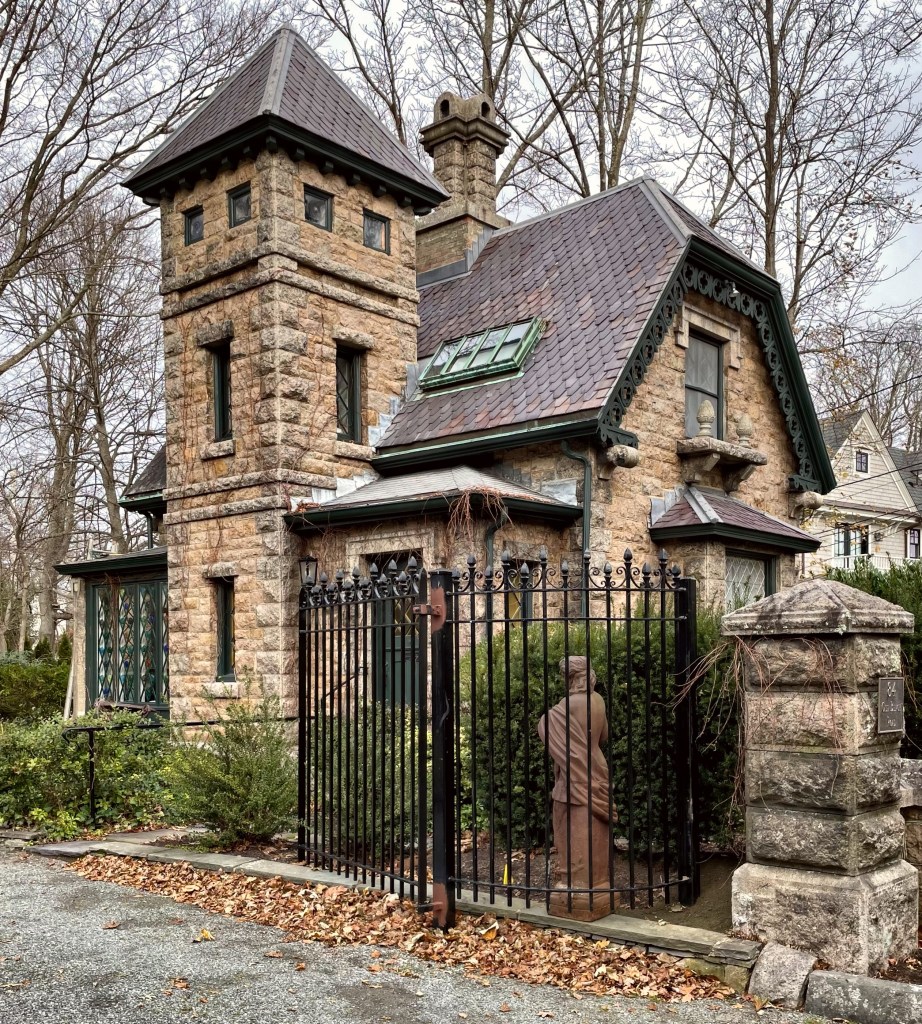
Belair Gate Lodge // 1870

Located at the historic entry to Belair (last post), one of the largest estates in Newport, you would be greeted by this charming stone building, the Belair Gate Lodge. The building is symmetrically massed, 1½-story and built of rough-face-granite-ashlar, similar to the main house. This building can be classified as French Eclectic in style and was designed by Newport architect Dudley Newton, who also designed the 1870 Second Empire renovations to the main house at the same time for owner George Henry Norman. When the Belair estate was subdivided, the gate lodge was sold off as a separate unit, and is now a single family home, aka my dream home. There is something so enchanting about gatehouses!

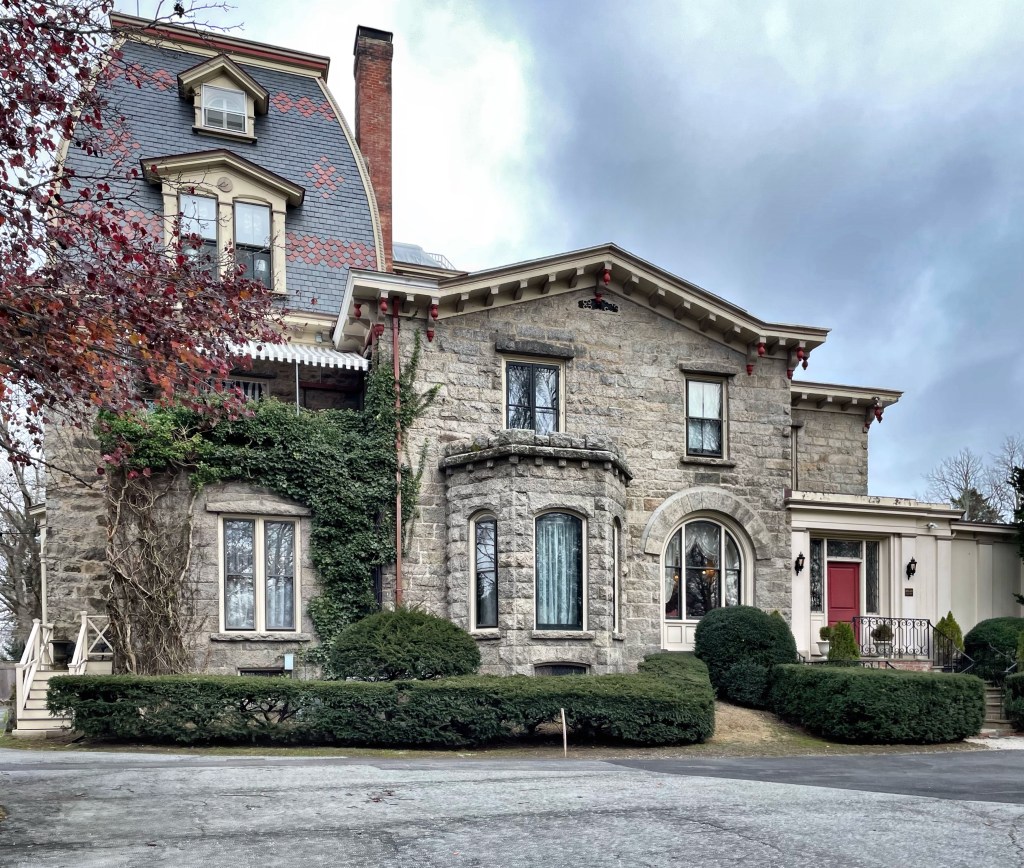
Belair Mansion // 1850

One of the most stunning summer “cottages” in Newport, Rhode Island is this stone behemoth named “Belair”. The house is set back way off the street and was one of the first summer estates built in this section of Newport. Belair was built in 1850 for New York oil baron H. Allen Wright in the Italianate style and constructed of roughly dressed stone and was originally about half of the size of the current footprint. The mansion was designed by architect Seth C. Bradford, who is also credited as architect of the similarly designed Chateau-sur-Mer, built one year later. Wright sold this house to George H. Norman two years after its completion. Norman (1827-1900), founded the Newport Daily News in 1848 and made his fortune as an engineer, first establishing gas works and later water works systems across New England, New York, and the Midwest. Norman made a fortune, and renovated and expanded his mansion in 1870 from plans by Newport architect Dudley Newton, with grand Second Empire additions, including the high convex-mansard corner tower. The original four acre Belair property has been extensively subdivided, and this house now occupies a lot of about an acre; with the original outbuildings sold off, and Belair is now 11 condominium units!

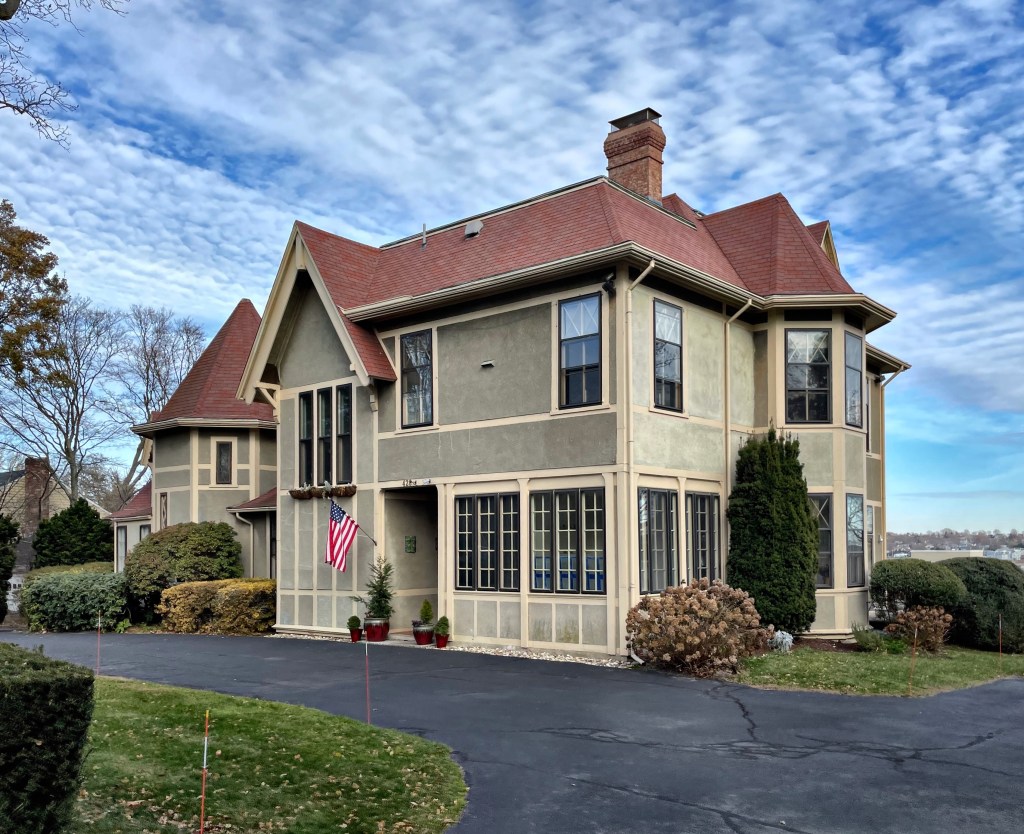
“Morningside” // 1872

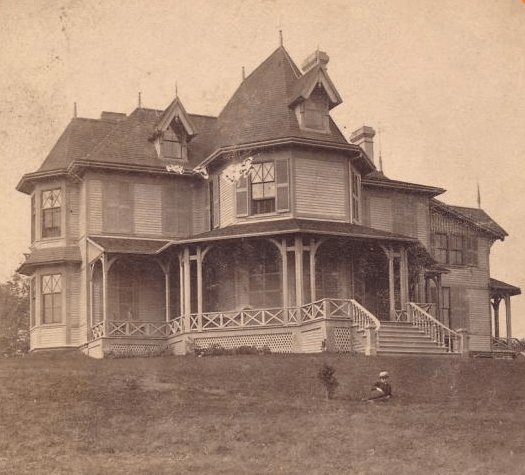
While many of the summer cottages in Newport retain much of their architectural and historical integrity, it is not always the case. This cottage, named “Morningside” barely resembles its original 1873 design. The summer home was built for William Barton Rogers (1804-1882), a scientist, educator, and best-known as founder of the Massachusetts Institute of Technology. He sought a place of rest and leisure, away from the stresses of Boston and running a new college, so he hired the Boston firm of Cabot & Chandler to design a Stick style cottage for him to spend the summer months at. In his diary for October 11, 1872, Mr. Rogers wrote, “Removed [from Cliff House Cottage] to our new home on Gibbs Avenue, at 4.30 o’clock. I have decided to name the place ‘Morningside.'” The house was his respite from stresses and he loved to spend time here with his family. President Rogers died after collapsing during a speech at MIT’s 1882 commencement exercises. His last words were “bituminous coal.” After the property sold out of the Rogers estate, the house was remodeled with stucco siding and much of the original Stick detailing was removed or covered. Morningside is now divided into condominiums.

Morningside c.1880s

The Anchorage Cottage // 1878

This charming Victorian cottage in Newport was built in 1878 for Henrietta and Dr. Stephen Cambreleng Powell as their summer cottage. The well-connected couple hired New Haven architect David R. Brown to design the residence, which is an excellent example of the Queen Anne and Stick/Eastlake architecture styles. David Brown, the architect, apprenticed under the famed Henry Austin for years in New Haven, Connecticut before becoming a partner of the firm. As any good summer cottage needs a fun name, the couple named their cottage “The Anchorage”. The cottage is now known as the Old Beach Inn, and is among Newports many charming old inns.

Anderson-Muenchinger House // c.1850

One of the most eccentric and over-the-top houses in Newport (a town full of over-the top houses) is this home on Cottage Street. The original house was built around 1850, likely as an Italianate style residence with a flat roof. Early owner Elbert J. Anderson (1800-1888) who was born and raised in New York City. In Manhattan, Anderson was a director of The Manhattan Fire Insurance Company; the Farmers’ Loan & Trust Company; and The Phoenix Bank. He married Martha Maria Ellery, the eldest daughter of the late Abraham Redwood Ellery. In 1847, his wife inherited the Redwood Farm at Portsmouth, six miles from Newport, and they eventually moved there permanently. They maintained this summer cottage in Newport to remain close to high-society. The home was sold to George and Annie Collins, who likely modernized the residence with the bays, porches, and frilly details. By the early 20th century, the property was owned by Gustave and Amanda Muenchinger, who ran a hotel at the corner of Bellevue and Catherine streets.

Tew Brothers House // 1845

This Greek Revival house in Newport was built in 1845 for the Tew Brothers. The home was likely a double-house with two doors for each family, as the current entry looks to be of a more recent vintage. The house features a full-length columned porch which has small brackets in the eave, an early nod to the emerging Italianate style. The property was recently renovated and sold for just over $1 Million. Talk about a steal!

Tillinghast Tompkins House // 1854

This large frame house in Newport, Rhode Island was built for Tillinghast Tompkins in 1854. The house is a formal example of the Italianate style of architecture, of which many great examples can be found in the coastal town. Character-defining features of the style on this house include the elaborate round-arch bargeboard with acorn pendants, tripartite round-arch windows in façade’s attic, and the important wide cornice with large triple-arch paired brackets with acorn pendants. The house was occupied by Tillinghast for just a few years until his death in 1860. His widow, Charlotte owned the property until her death in 1899, upon which time it was inherited by their son, Hamilton Bullock Tompkins, a historian and author.