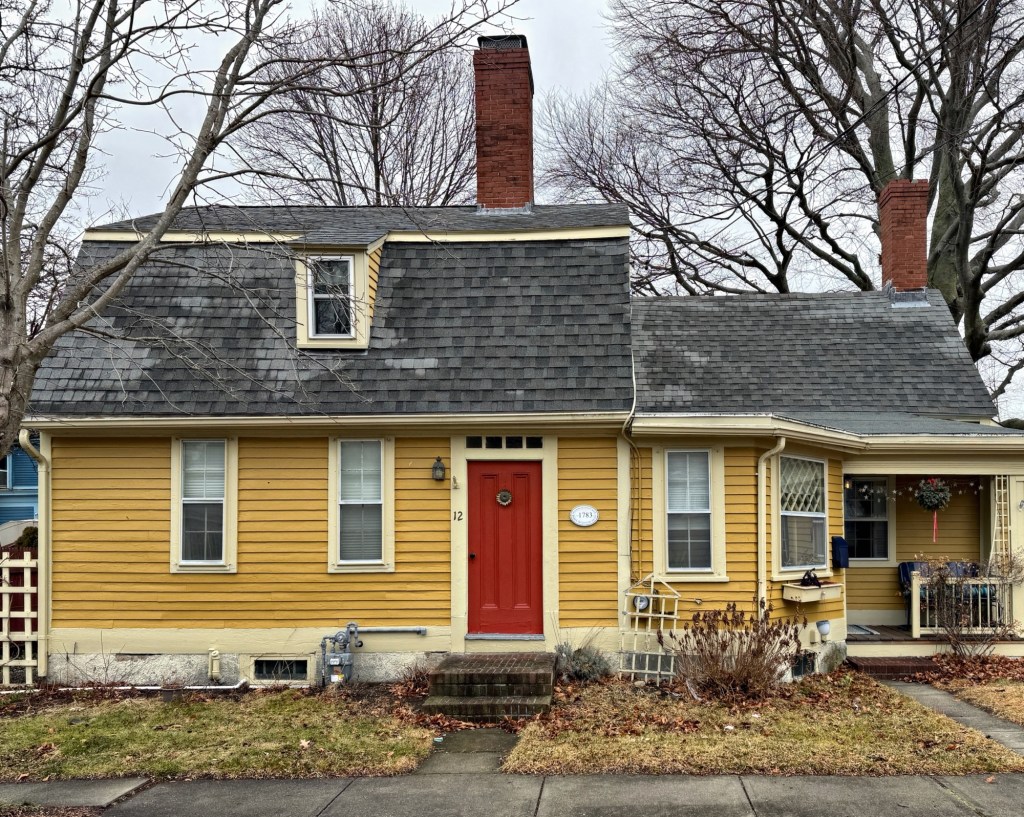
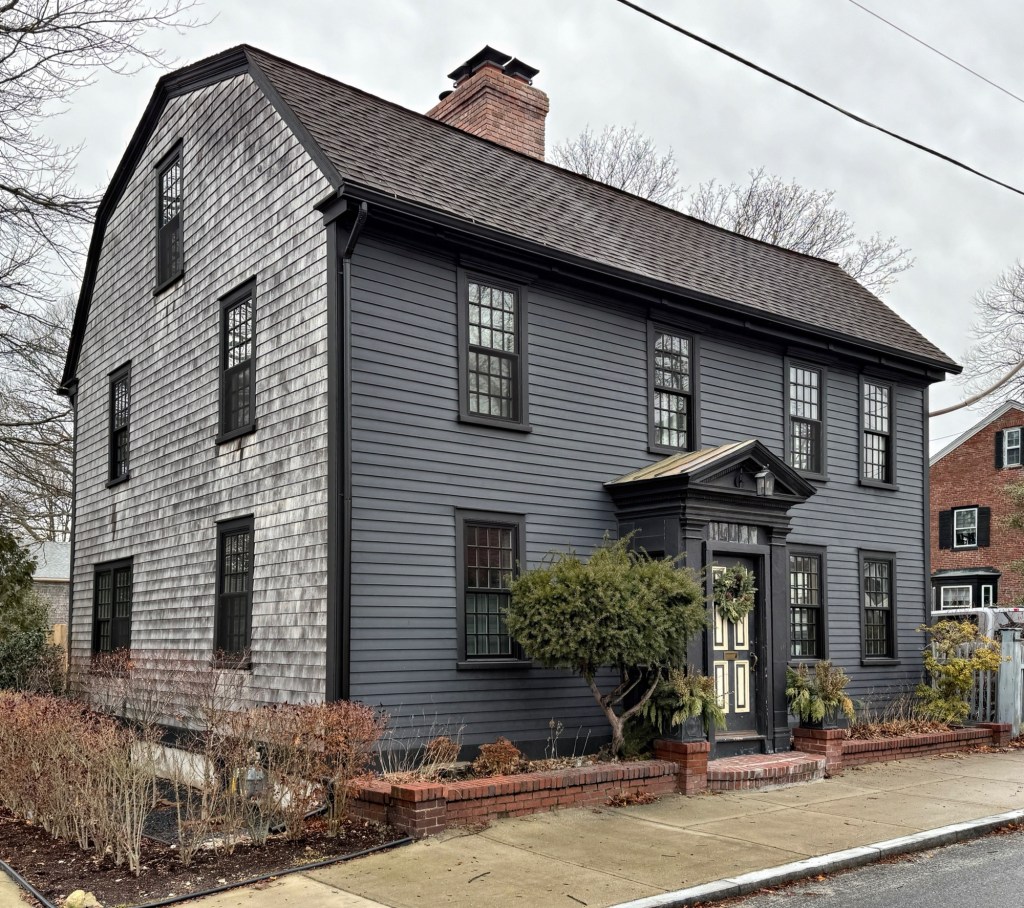
The Cranston Cottage on School Street is one of the few such Revolutionary-era gambrel-roofed cottages in the charming town of Warren, Rhode Island, and showcases how many early New England homes were originally built before later additions as families grew. The house was likely built soon after Queen Street (since renamed School Street) was laid out in 1765, or it was moved to the site after the street was laid out and house lots platted. The original owner, Benjamin Cranston, had the house built, which was then just a three-bay, two-story cottage with central chimney for heating. Over time, additions were made to the cottage, including the kitchen ell on the side with chamfered hyphen with diamond pane window.
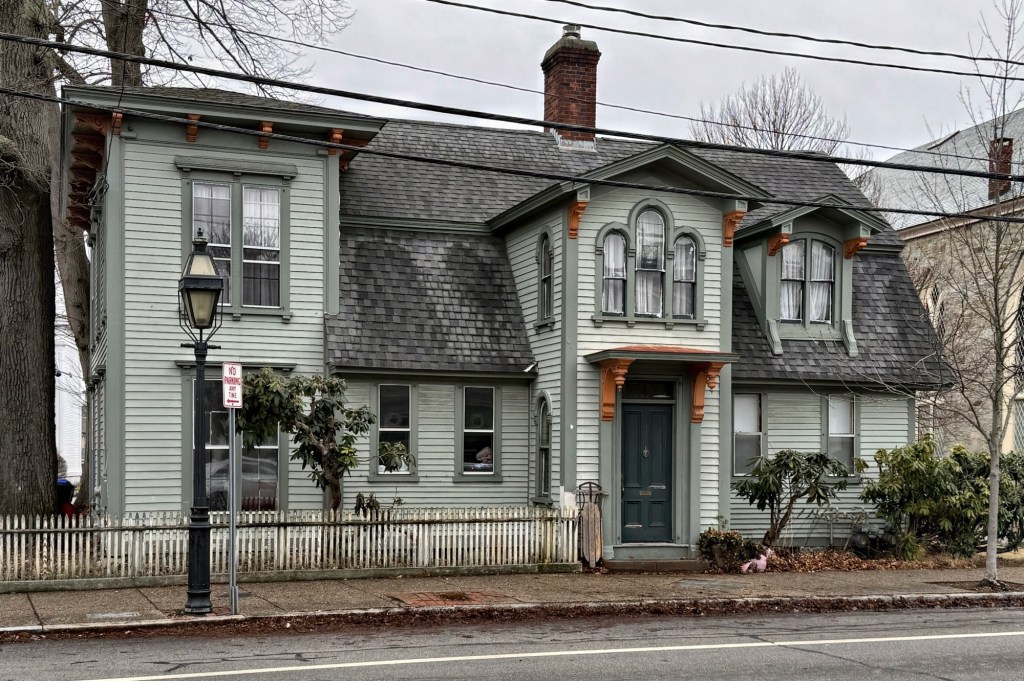
One of the most historic and architecturally unique houses in Warren, Rhode Island, is this pre-Revolutionary cottage on Main Street, that was modernized in the mid-19th century for later owners. Historians state that the house was built by Jesse Baker (1708-1751), who must have died shortly after its completion. At the time of the British burning of Warren during the Revolution in May 1778, Jesse’s widow resided here and saved the modest cottage from the hot embers of the adjacent burning Baptist Church, parsonage and arsenal by wetting every blanket and sheet in the house and spreading them over the roof of the home. The once modest, gambrel-roofed Georgian cottage, was purchased in 1868 by Dr. Joseph Merchant, a physician and surgeon, who “Victorianized” the house to the eclectic beauty we see today. Dr. Merchant added the projecting two-story corner tower, two-story front entry vestibule with Rundbogenstil tripartite window which reads like a Palladian window, projecting eaves with brackets, and stickwork in the north gambrel roof. The home was later inherited by Dr. Merchant’s daughter, Mary, and her husband, Howard K. DeWolf.
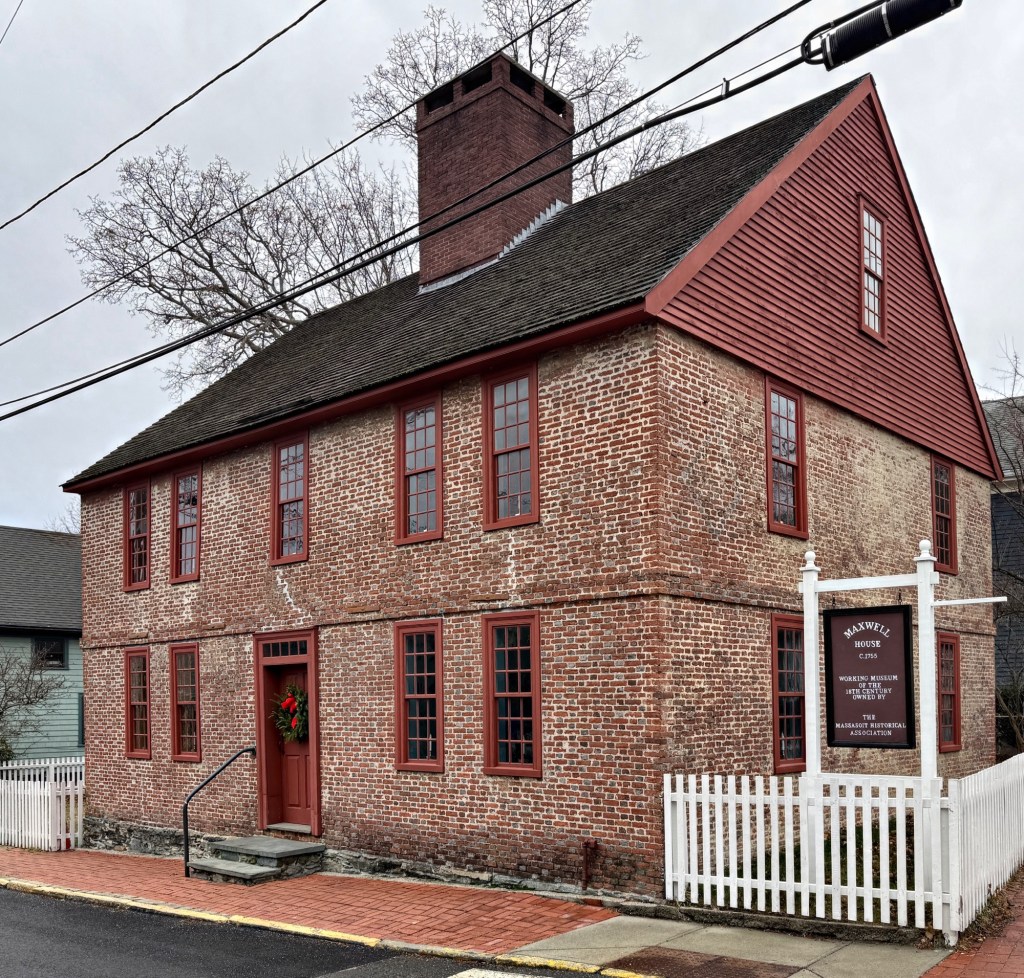
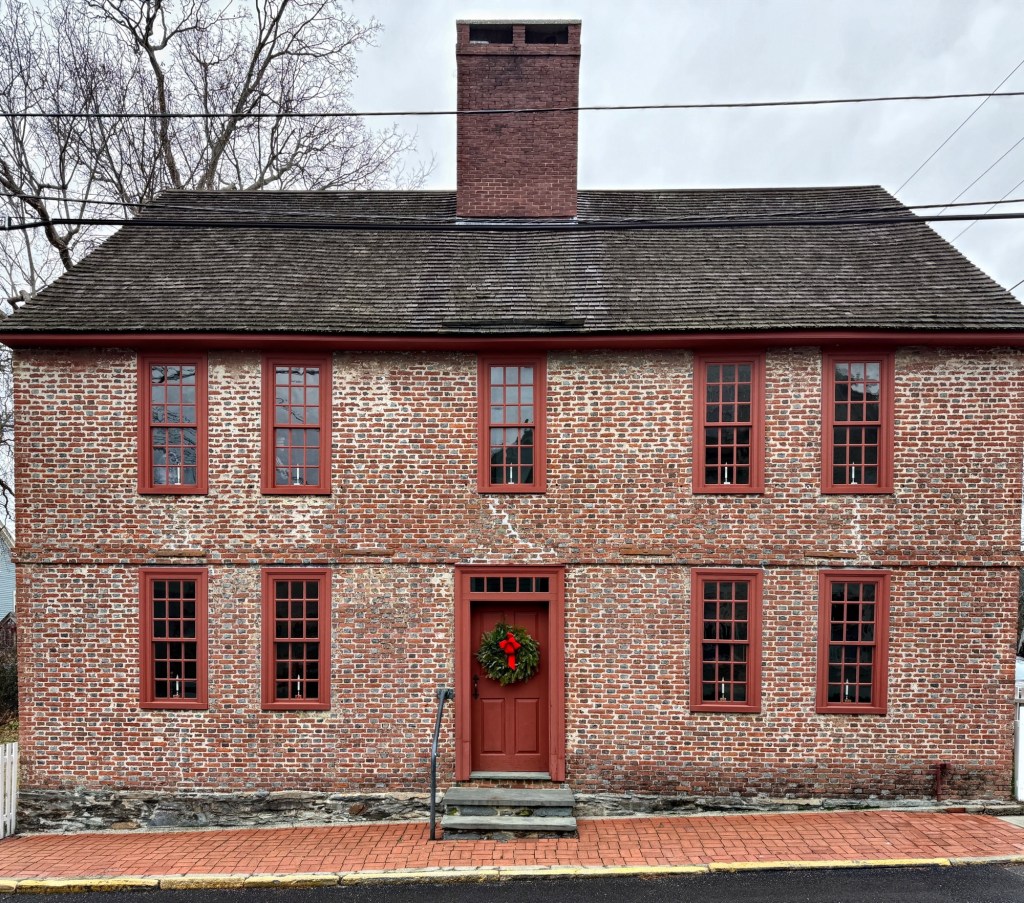
The Maxwell House in Warren, Rhode Island, is a striking example of mid-18th-century colonial architecture and one of the oldest brick dwellings in the waterfront town. Built before 1755, the house is one of the finest brick Georgian-era residences in New England with its characteristic Flemish bond brickwork, fieldstone foundation, wood-frame gable ends, and massive central chimney that anchors its historic pre-Revolutionary form. Originally constructed for the Reverend Samuel Maxwell (1688-1778) and later home to members of the Maxwell family, prominent shipowners, merchants, and slave-owners in town. The Maxwell family’s wealth was tied to the maritime economy of the era, which tells the story of many Rhode Island merchants of the time, who participated in the trans-Atlantic slave trade that enriched local elites and shaped the region’s economic growth, a history that communities are increasingly confronting alongside preservation efforts to this day. Today, the Maxwell House serves as a house museum preserved by the Massasoit Historical Association, who (hopefully) share the full story of the house, from its architecture to funding to construct it.
One of the more significant old homes in Warren, Rhode Island, the Gov. Josias Lyndon House on the aptly named Lyndon Street, dates to 1767 or earlier, and has connections with a colonial governor. It is not clear who originally owned this property, but the residence is best-known for its most famous resident, Governor Josias Lyndon (1704-1778), who lived here during the final years of his life with his wife and enslaved Africans. Lyndon worked as Clerk of the Assembly for the colony and in 1768, he was appointed Rhode Island’s last Colonial Governor, serving until 1769. His election is believed to have been a compromise between Samuel Ward and Stephen Hopkins, both of whom had already served multiple terms as governor. After his one term, Lyndon declined reelection and served as chief clerk for the General Assembly of the Superior Court of the County of Newport. At the time of the British occupation of Aquidneck Island (Newport), Gov. Lyndon moved to this home in Warren, where he remained until his death from smallpox in 1778. An often undertold fact about Josias Lyndon is that he enslaved a man named Caesar Lyndon. Caesar was highly literate and was entrusted to carry out Lyndon’s business, acting as both a purchasing agent and secretary. Caesar also held his own small lending business with enslaved as well as free Blacks and whites borrowing money from him. Josias allowed Caesar to marry, which he did to Sarah Searing. It is not clear if/when Caesar was granted his freedom, or if he accompanied Josias to Warren or remained in Newport.
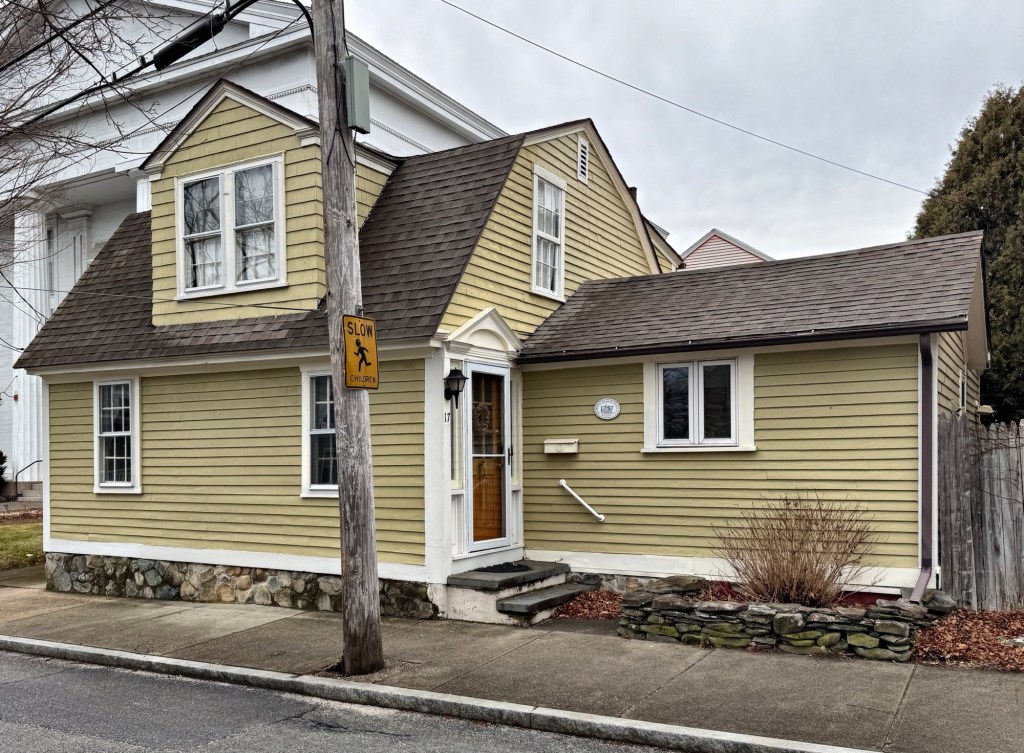
One of the pre-Revolutionary homes in the picturesque town of Warren, Rhode Island, the Easterbrooks House on Church Street is definitely one of the smallest, but oozes charm. This one-and-a-half-story gambrel roofed cottage stands across from the Town Common and adjacent to what may be the tallest building in town, the First Methodist Church of Warren. The home was built by 1757, likely by William Easterbrooks (1731-1772), and by the time of the Revolution, was occupied by Ms. Nellie Easterbrooks (1761-1853). Nellie and her mother rented a room in their home to Warren schoolmaster, John Holland, who earned the nickname “Traitor Holland”, after he had secretly been sharing news to General Pigot, the British General in charge of forces in Rhode Island. Long thought to have supported the local Patriots, it was learned that he was a loyalist, after the British and Hessian soldiers raided Warren and were leaving the town in 1778. It is said that troops stopped at this house and John Holland accompanied them, cheering alongside and leaving with them. He was never seen in Warren again. Soon after this, a young Nellie Easterbrooks, then in her teens, sought revenge against the British who pillaged and assaulted her friends and family. As the troops were leaving, she is said to have gathered a group of other angry Patriot ladies of town and captured a drunken drummer marching through town. Then they dragged their bewildered captive into a nearby hotel and locked him into a closet there. Nellie would later marry Nathaniel Hicks West (1751-1836), a Revolutionary War veteran, and received a widows pension until her death in 1853. The Easterbrooks House is a rare, intact surviving Georgian home that tells a rich history of Colonial New England and the stories during the American Revolution.
 Buildings of New England