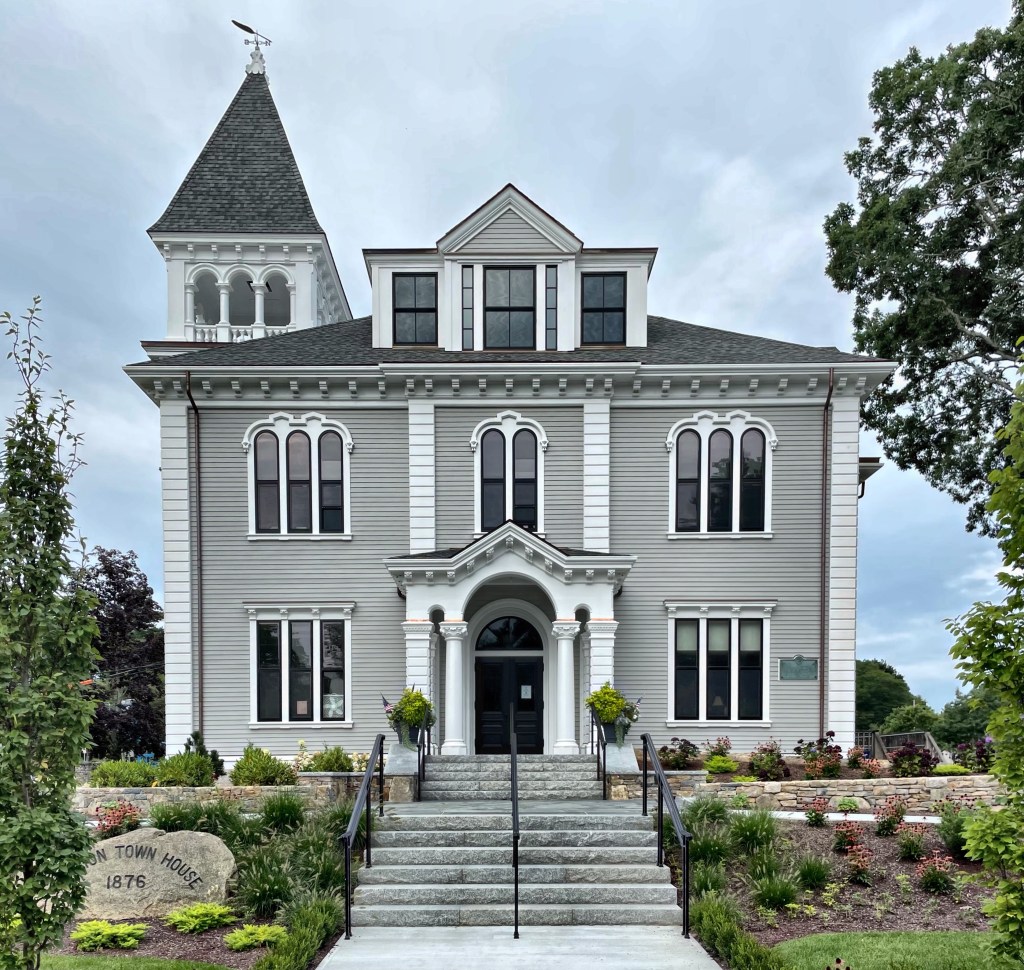
Marion Town Hall // 1876

Welcome to Marion, Massachusetts! Colonized in 1679 as “Sippican”, the town was once a district of adjacent Rochester, Massachusetts. The name, which also lends itself to the river which passes through the north of town and the harbor at the heart of town, was the Wampanoag name for the local tribe that once utilized these lands. Native settlements in present-day Marion dates as far back as 3000 B.C. as the local people were members of the Wampanoag tribe who, when the Pilgrims came, lived in a number of villages in Southeastern Massachusetts under the leadership of the great chief Massasoit. By the 19th century, the town was mostly known for its many local sea captains and sailors whose homes were in town. Today, the coastal town is known for its charming village and large waterfront homes, oh and amazing architecture!

This building was constructed in 1876 by Mrs. Elizabeth Taber (1791-1888), who, at the age of 85, founded Tabor Academy in town. She named it after Mount Tabor in Palestine rather than after herself. The school was built towards the end of the “Age of the Academies”, when in 1852, Massachusetts became the first state in the country to make education compulsory. While some major private institutions already existed, many more were founded in the mid-19th century. Tabor Academy served as a private school for boys and girls over 12 years of age, and was to remain free for local students. With the rise of public schools in the state, many academies began to struggle with admitting students, especially those that had parents willing to pay additional money for enrollment. The school struggled around the Great Depression and thus, traded buildings with the Town of Marion in the 1930s and this building became the Marion Town Hall, a use it retains to this day. The building itself is a stunning Italianate design constructed from plans by Boston architect William Gibbons Preston.

Stay tuned for more buildings and history on one of my favorite Massachusetts towns!

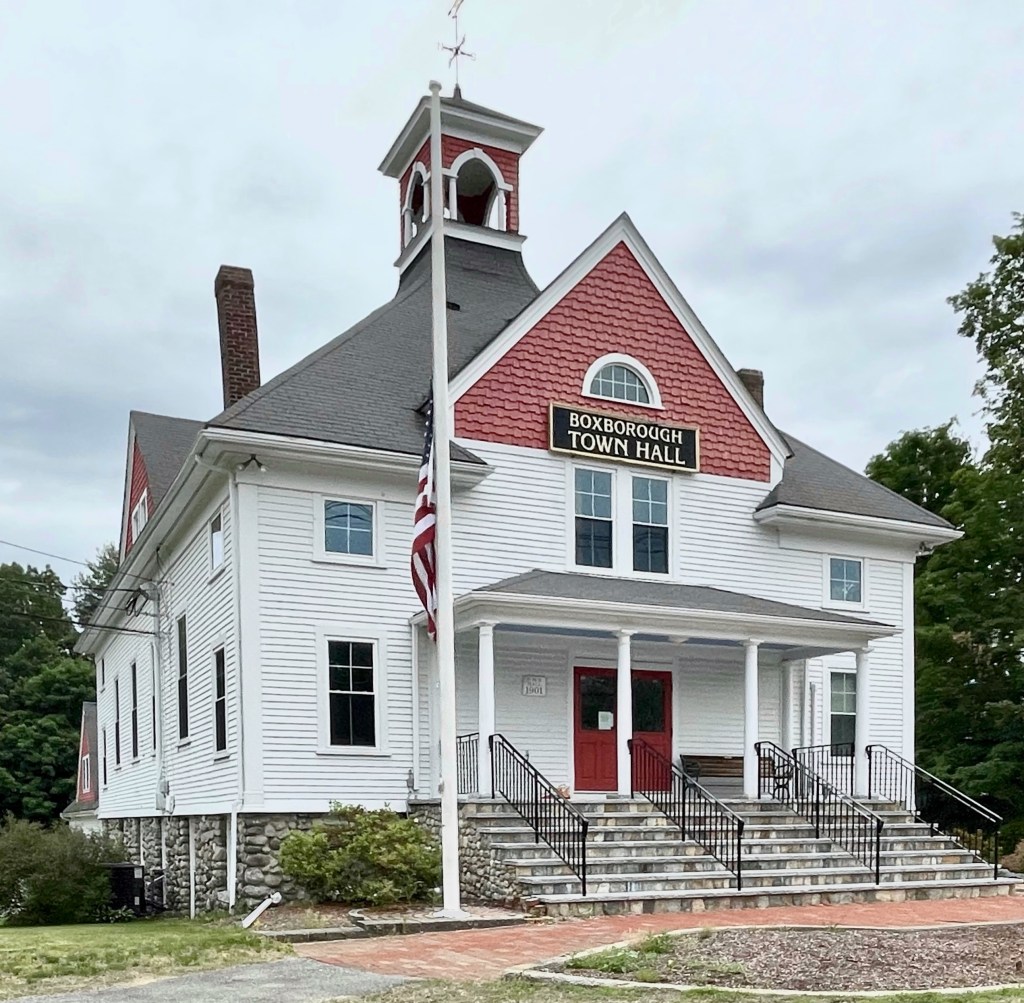
Boxborough Town Hall // 1901

The area which became the town of Boxborough, Massachusetts, was first inhabited by the Native Americans of the Nipmuc and Pennacook tribes. Land in Boxborough was not settled by colonists until the beginning of the eighteenth century by farmers looking for fertile land to establish farms, who branched out from nearby Acton. Boxborough was formed from Harvard, Littleton, and Stow in 1783 and was incorporated as its own town. With the exception of small local industries including gristmills, sawmills, and cooperages as well as some minor boot and shoemaking, comb-making, and a lime quarry and kiln, Boxborough’s economy remained almost entirely agricultural through the 19th century. The town grew steadily and a Town Hall building was funded by the turn of the 20th century. This Queen Anne/Colonial Revival Town Hall building was constructed in 1901, atop the foundation which was constructed of locally gathered cobblestone by local volunteer farmers. Today, the town retains much of its agricultural heritage, but it is definitely under threat by subdivisions and Neo-Colonial mansions further contributing to Bostons suburban sprawl.

Hopedale Town Hall // 1886

In 1886, when the Town of Hopedale was incorporated, George Draper (who basically created the town for his company) bankrolled $40,000 for the design and construction of a town hall building for the new town. This Richardsonian Romanesque building was built of local Milford granite with brownstone trim. The town hall building was designed by architect Frederick Swasey and was intended to always house two commercial spaces at the ground floor. To the right of the storefronts is the entry to the town hall, which is framed by an entry arch with engaged colonettes. Before the building was completed, George Draper died, and the building was officially donated to the town by his heirs.

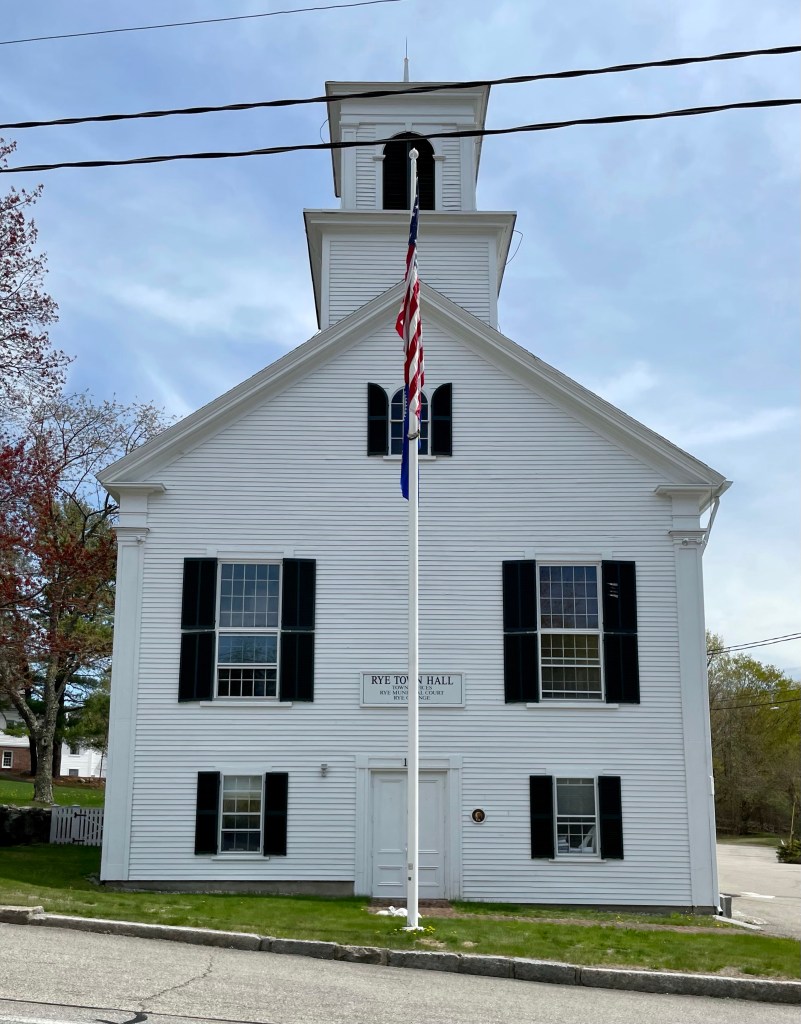
Rye Town Hall // 1839

Rye, New Hampshire sits on the short coast of the state, between the busy towns of Portsmouth and Hampton, and provides a respite from the swarms of tourists and beach-goers alike. Modern-day Rye was the first settlement in New Hampshire by Europeans, and was originally named Pannaway Plantation, established in 1623 at Odiorne’s Point (more on that later). The settlement was eventually abandoned for Strawbery Banke, which became Portsmouth, the historic port town we know today. The town was later a village of New Castle, and was known as Sandy Beach Village, before it was called “Rye”, for Rye in Sussex, England, and incorporated as its own town in 1785. The town met in a Meeting House until it purchased an old 1839 Methodist church in town. In 1873, the building was purchased by the town of Rye for $1000, with an additional $2658 spent on renovations, which added a new ground floor to increase the height from 1.5 stories to 2.5 stories, added 10 feet in depth to the building, and the two-stage tower and belfry. The Greek Revival building has long been a landmark in town, hosting dances, concerts, whist parties, singing schools, oyster parties and immunization clinics, beyond the typical governmental functions. There were calls to demolish the building for a modern town hall, which saw resistance (thankfully) and now the town has agreed on a land-swap with a bank, demolishing an old house to take over the bank building, turning it into some town offices.

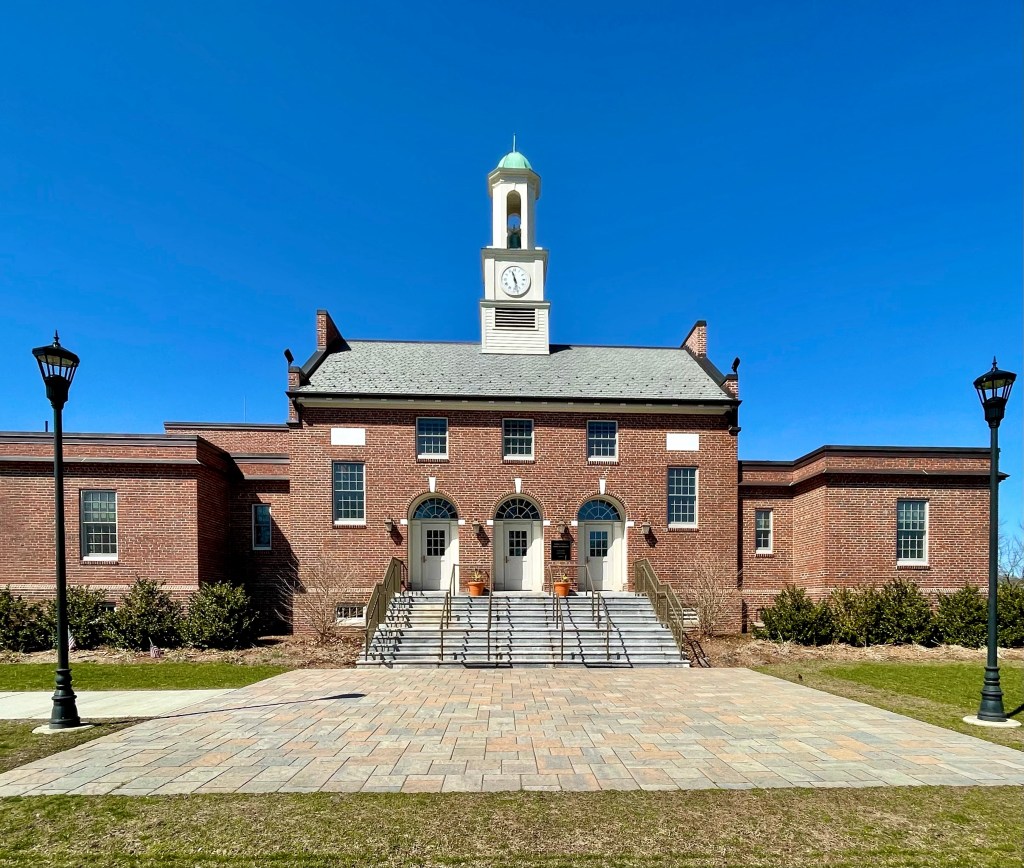
Tewksbury Town Hall // 1920

The town of Tewksbury, Massachusetts was colonized in 1637 and was officially incorporated in 1734 from the town of Billerica. The town was historically home to at least two raids by native peoples during the infamous King Phillip’s War, which killed dozens of men, women and children settlers. The town is named after Tewkesbury, England, likely inspired by some of the original settlers. The town grew as a rural village until it became a suburb of adjacent Lowell and Andover, Massachusetts. The town’s older Town Hall building burned in 1918, and funding was quickly acquired to erect a new, suitable building for the town. The Boston-based architectural firm of Kilham & Hopkins was hired and they designed this gorgeous Colonial Revival building. The symmetrical building features a main two-story block with a rear and side wings. The facade features three entrances with recessed fanlights above. A slate roof is capped by a towering cupola, which adds an additional flair to the building. The structure was so well-designed, it was featured in the Architectural Record in 1919, a national publication.

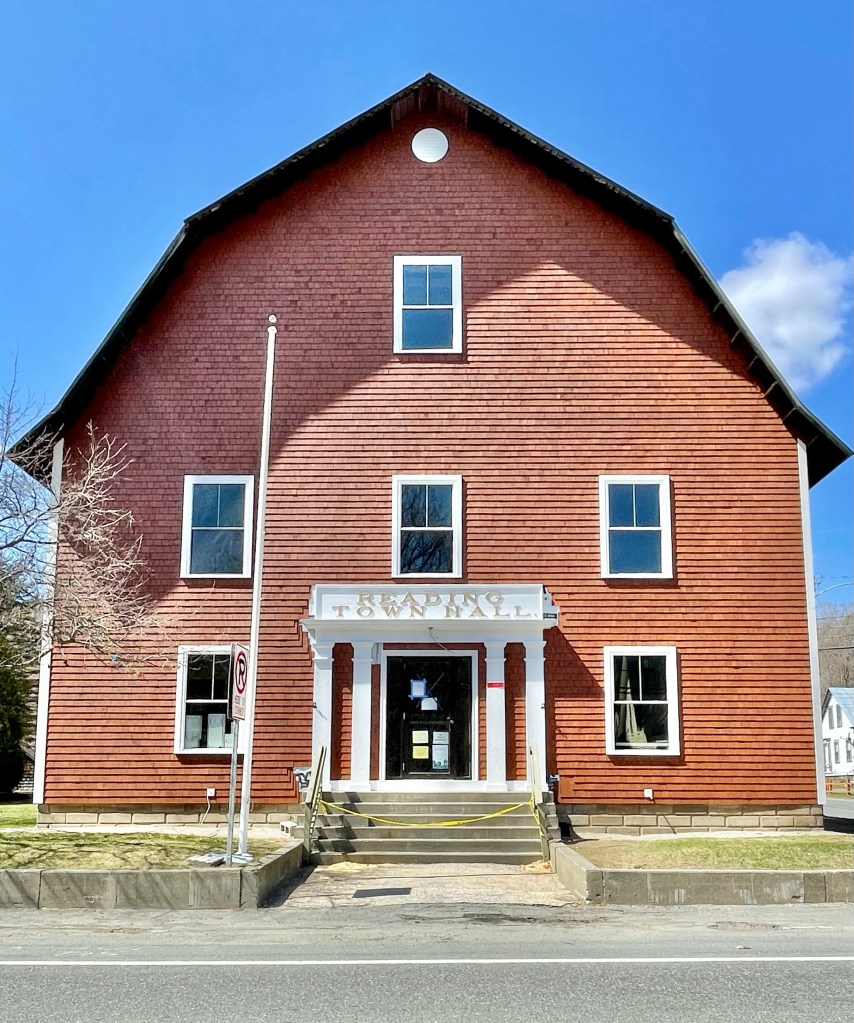
Reading Town Hall // 1911

The Reading Town Hall in Reading, Vermont is an imposing shingle-clad, gambrel roof building which sits in the village of Felchville. The hall was built in 1911 as a gift to the citizens of Reading by Wallace F. Robinson. Wallace Robinson was born in Reading in 1832. He went to Boston as a young man and entered into the provisions (groceries) market, and became quite successful, expanding into the wholesale provisions business and meat packing. He was active in civic and business affairs of Boston, most notably as the President of the Boston Chamber of Commerce and as a State Representative in the Legislature for two terms. By around 1900, Robinson had retired and had taken up a life of philanthropy, spending much of his wealth on memorial buildings and to places that had a lasting impact on him, including Robinson Hall at Dartmouth College and renovations at UVM. The design for the Reading Town Hall is especially notable for the fact that it was designed to resemble historic gambrel roofed barns found in the state.

First Stockbridge Town Hall // 1840

The Town of Stockbridge, MA was incorporated on June 22, 1739. After that time the town held meetings and conducted business in the First Congregational Meeting House until 1840 when this Greek Revival town hall building was erected on the church’s property as a gift. A stipulation was made that if the Town government constructed or moved to a new town hall building, the property ownership would revert to the Church. The town outgrew the building and constructed a new building toward the center of town, but named it Town Offices, a cheeky way to retain ownership of this building. Eventually, that building too was outgrown, and the town hired Pittsfield-based architect Harry E. Weeks to modify and enlarge the building in 1903, in the Neo-Classical style to compliment the original Greek detailing. As expected, the town moved again in the 2000s to a former school, on Main Street, but again retained the building.

Hollis Town Hall // 1886

Constructed in 1886, the Hollis Town Hall in New Hampshire is a distinctive example of Queen Anne civic architecture showcasing an asymmetrical design and a variety of forms, textures and materials. The building was designed from plans by Manchester-based architect William Butterfield. As originally constructed the building was painted in dark tints to harmonize with the roof which was covered with shingles and painted dark red. In 1902, the clocks were added atop the tower with a clock designed by George M. Stevens of Boston. Sadly, the buildings’ original polychromatic paint scheme which highlighted the architectural details was updated with a solid white color.