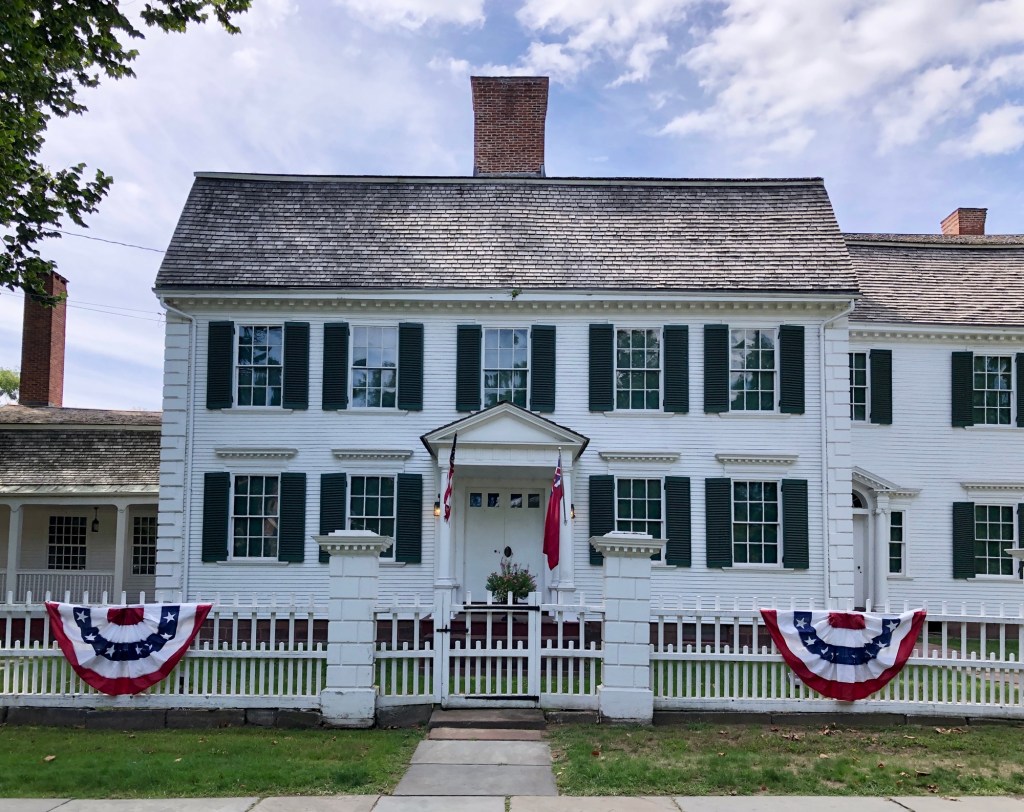
Set back from tree-lined Main Street in Suffield, Connecticut, the Phelps-Hatheway House stands as one of the largest, and best-preserved Colonial era homes in New England. The center-chimney residence was built by 1762 by Thomas “Shem” Burbank, where he and his wife, Anna Fitch Burbank, raised nine children. Due to the unstable national economy during and after the American Revolution, the family’s financial situation suffered and they would sell the residence in 1788 to Oliver Phelps. at the beginning of the Revolutionary War, Phelps joined the Continental Army and fought in the Battle of Lexington. He served as Deputy Commissary under George Washington and following the War, he became a prominent businessman and was elected to the Massachusetts Senate in 1785 and served on the Governor’s council in 1786 (Suffield was still a part of Massachusetts at this point). In 1794, Phelps commissioned the addition of a substantial wing designed by Thomas Hayden of Windsor. Under the employ of Hayden, a young Asher Benjamin, later to become one of the most important architects of the Federal period, was one of the workers on the new wing and is believed to have carved the Ionic capitals of the wing’s entryway. Inside, the addition was decorated with imported Parisian wallpaper. When Phelps died, the house was owned by the Hatheway family for a century and is currently open as a house museum, the Phelps-Hatheway House & Garden, administered by Connecticut Landmarks.

