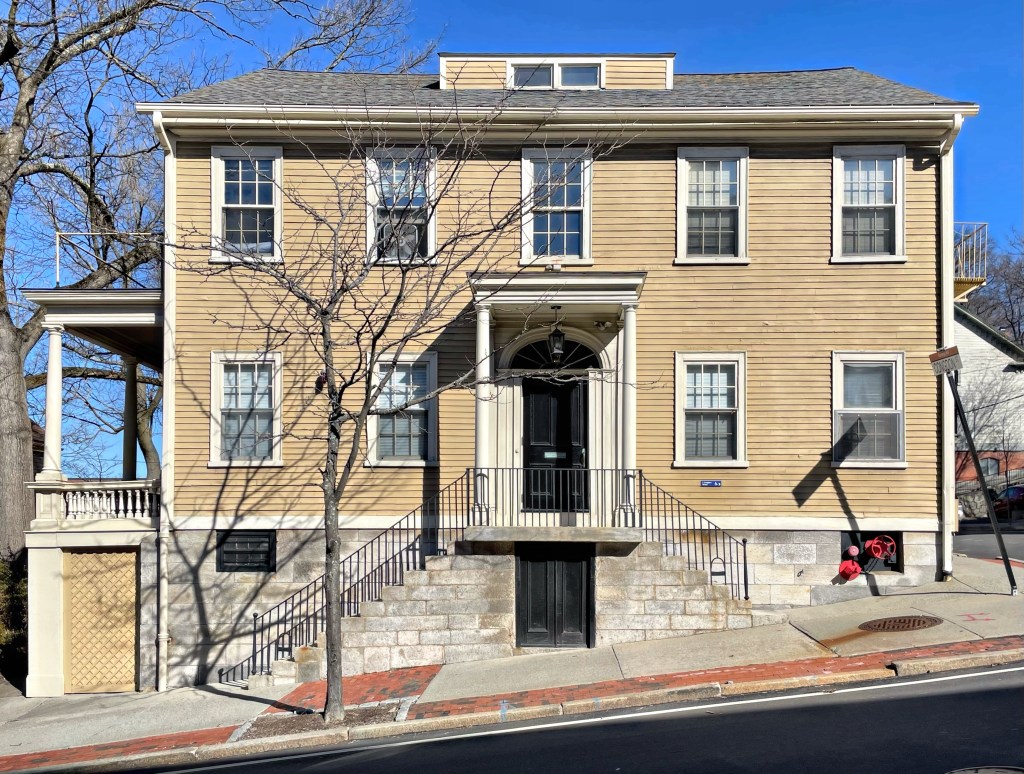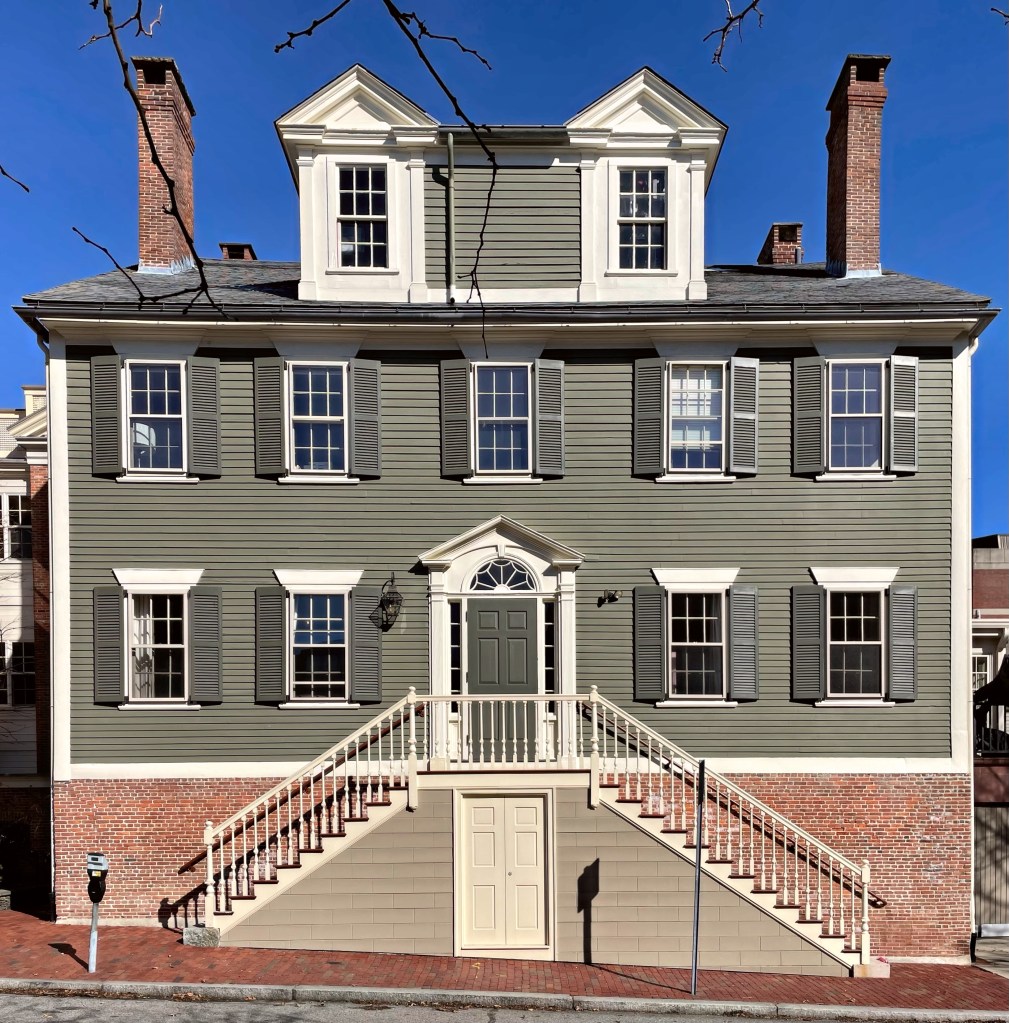
When visiting Downtown Providence, I couldn’t help myself but to cross the river into College Hill, a neighborhood of such architectural diversity I could run this entire page just featuring that area. This beautiful Federal style home was built onto the downward slope of the hill in 1798 for William Holroyd, a merchant and active Baptist in town. The home sits atop a raised basement with brick end walls and clapboard siding on the front and rear. The property exhibits a symmetrical facade, splayed lintels above the windows, and a perfect center entry with fluted pilasters and pediment containing a fanlight. The building today appears to be a part of the Brown-RISD Hillel.
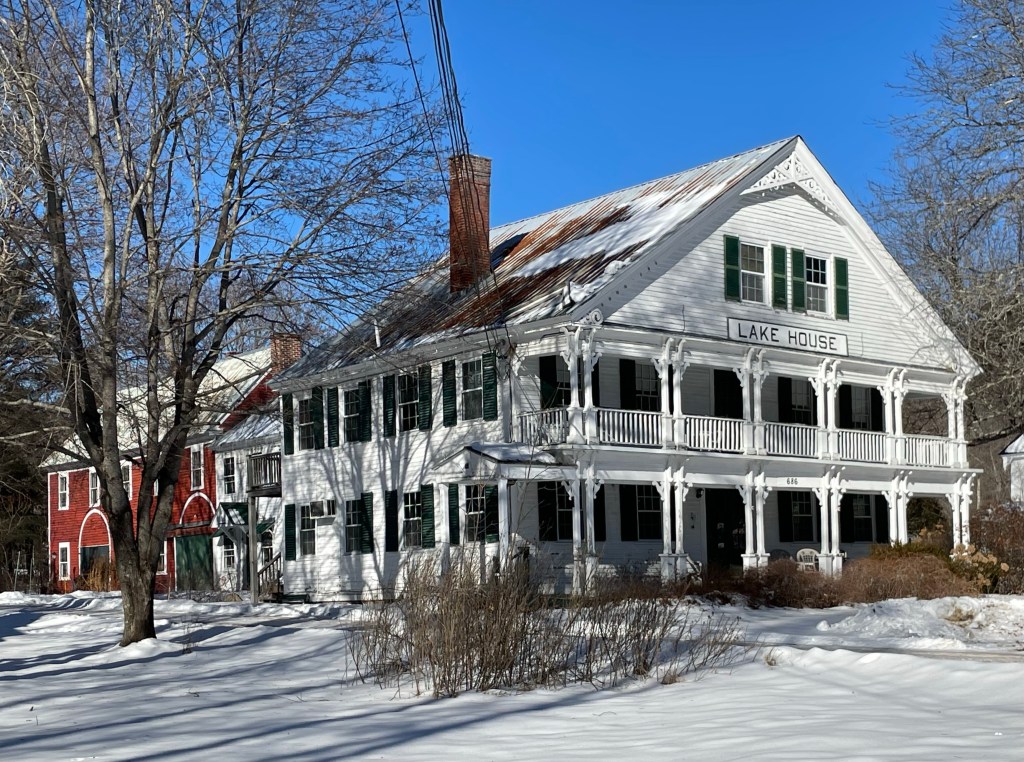
Eli Longley (1762-1839) came to Waterford, Maine by way of Bolton, Mass., in 1789 and erected a log cabin in town. As the first settler to build in this part of town, he owned a substantial piece of property, which was frequently travelled through as the area was being developed. Seeing a need for lodging, he built a one-story tavern in the location of this building, which was added onto and modified as demand and the area’s population grew. Longley would also subdivide some of his land for house lots along the new town common, selling to new settlers as they arrived. Longley sold the tavern in 1817, which was acquired later in 1847 by Dr. Calvin Farrar. Taking advantage of a nearby mineral spring, Dr. Farrar opened a successful hydropathic spa, which used natural waters to cure patients of their ailments. The spa was taken over by Dr. William P. Shattuck, who expanded the site as the “Maine Hygienic Institute”, a hospital exclusively for lady patients employing eclectic treatment. This business and the tourism it generated helped shift the town from a sleepy village to a tourist destination by the late 19th century, where city-dwellers would flock to view the natural scenery and breathe in the clean air. In the 1860s-70s, Shattuck “modernized” the Lake House Hotel with the two-story Victorian-era porch and sawn decorative trim.
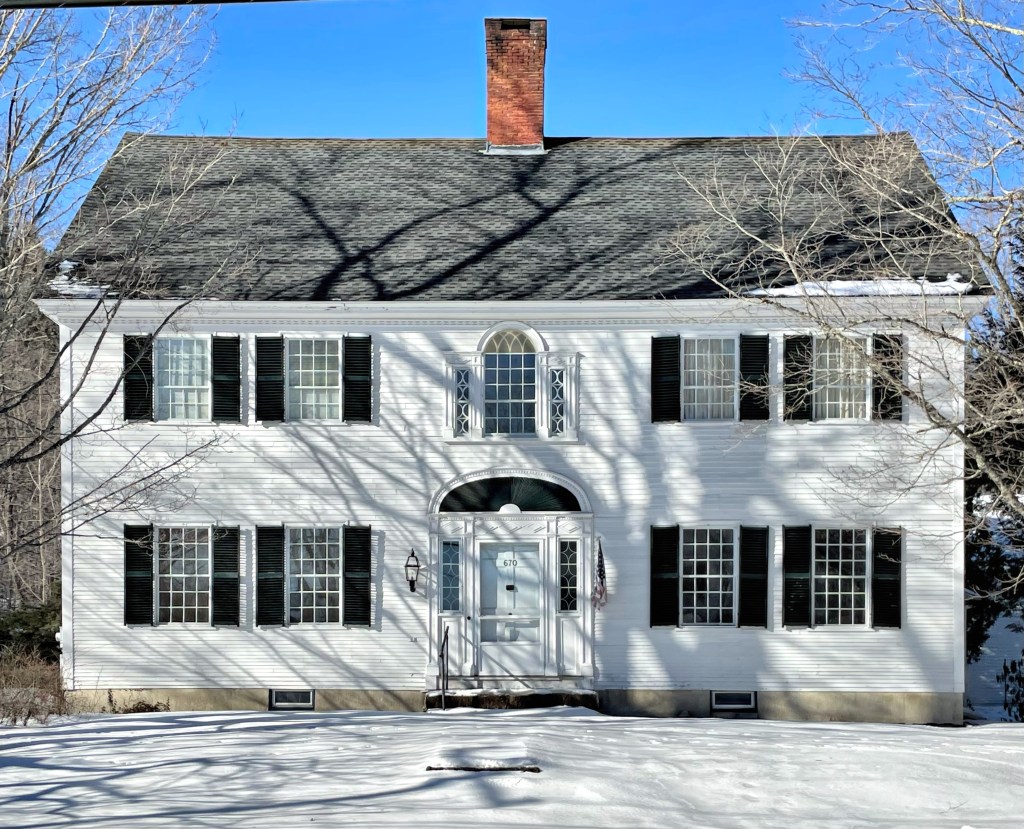
The most architecturally significant example of the Federal style in Waterford, Maine, is this c.1810 home built for Ambrose Knight, who operated a store in town. The high-style Federal home features a well-proportioned fanlight over the entrance with a Palladian window above, all with geometric moulding. The home was likely built by a housewright who employed designs from Asher Benjamin’s pattern books for builders, as the high-style features and Palladian windows are uncommon in this part of Maine.
Dr. Leander Gage (1791-1842) came to Waterford from Bethel, Maine in 1817. He erected and lived in this Federal style house which overlooks much of the South Waterford village. Gage was a prominent medical practitioner in town and involved in local politics as a moderator at town meetings and as a school committee member until his death. The home has a Federal style stable and 1840s barn attached and had remained in the Gage family until at least the 1980s.
Set along Beacon Street, one of the finest streets in Boston, this townhouse has uninterrupted views of the Boston Common and Public Garden. The house was built around 1825 after a large fire destroyed nearly all the homes on the block. Build it and they will come, and the upper-class Boston elite did! Attorney William Minot (1783-1873) purchased the land here as early as 1817, and is said to have hired Peter Banner, the English architect who designed Park Street Church, to design the first house on this site, which stood less than 10 years. Minot had a new home built in the 1820s and lived there until his death in 1873. By the late 1920s, Christian Archibald Herter lived here. Herter held a number of important offices in state and national government, serving as the Speaker of the Massachusetts House of Representatives, Governor of Massachusetts, and President Eisenhower’s Secretary of State (1959 to 1961). It was Herter who likely added the Federal Revival features on the house, including the porch, dormers and updated door surround.
One of my favorite houses in Boston is this absolutely perfect townhouse on Pinckney Street in Beacon Hill. This house was built on speculation in 1829-1830 for Hollis Chapin by architect John Kutts. Kutts was active as a Boston architect between 1828 and 1838, but he is much less well-known compared to his peers today. I hope someone who is a better researcher than me stumbles upon this article because I would love to learn more about this architect! Kutts (possibly also Kutz) is a unique name for Boston, so it is likely he was a German immigrant who settled in Pennsylvania before moving up here. Back to the house. It was finished and sold in 1830 to Ebenezer T. Pope for four thousand dollars. The home was quickly bought and sold a couple more times as the values on Beacon Hill continued to grow. The property was purchased in the 1870s by Noah Bodge, as a rental property and it remained in the family through the 1920s. The home retains all the original details and provides a needed pop of color with the door and shutters.
One of the oldest extant homes in Waban Village, Newton, is this 18th century farmhouse which is an excellent example a Federal-period home in the Boston area. Dates of construction for this house have ranged from c.1765 to 1790. The earliest recorded ownership of 38 acres of land at this location is attributed to Eleazer Hyde (1664-1731), one of Newton’s earliest citizens and one of a long line of Hydes in Newton. From 1772 to 1791, the house was owned by Josiah Starr. Immediately after, this property was owned by a housewright named Capt. Ebenezer Richardson, who possibly built or re-built this house in the current configuration. Thaddeus Tower owned the land from 1844-1866, when the City of Boston took a portion of it in 1848 for the new Cochituate Aqueduct, which ran right behind his home. Not long after, Thaddeus sold the farm to Edward Wyman, a linen importer from Roxbury. He subsequently sold it to his brother Dr. Morrill Wyman in 1869. Dr. Morrill Wyman sold 150-acre property to developers, never appearing to have lived in the home, after the railroad came west from Boston in 1886 and increased the value of the surrounding farmland, later known as the village of Waban. All of the land was developed with homes, and all that remains of the old farm is the farmhouse seen here.
This colorful cape house sits in rural Norway, Maine. The home appears to date to the 1830s or 1840s and was a gentleman’s farm in the early 20th century. A gentleman farmer was a landowner who would farm for pleasure rather than profit or sustenance. It was typically a role that wealthier city-dwellers took to feel more like the average Joe! A 1880 map of the town shows the owner as an F. Cox but I don’t know much more than that!
Last up on our tour of Scandinavia (Denmark, Sweden and now Norway) Maine, is Norway. The town of Norway centers around Pennessewasse Lake, which supported native people in the region for thousands of years. It wasn’t until after the American Revolution that European settlers established the town. By 1789, a sawmill and gristmill were established, the first road was built in 1796, and the town of Norway was officially incorporated on March 9, 1797. Before incorporation, the township adopted the name Rustfield, to recognize the contributions of prominent landowner Henry Rust of Salem, Mass and the community once petitioned the Massachusetts General Court to be named Norage, meaning “falls” in the native peoples’ language. Norway won the name, but the origin of the town’s name remains unknown. The town leaned more towards industry than Denmark and Sweden due to the stronger rivers, and its population increased as a result.
This historic farmhouse sits on the eastern edge of Pennessewasse Lake and is one of the oldest extant homes in town. It was built in 1792 just years after land here was purchased by Nathaniel Bennett in 1790. Nathaniel and Elizabeth Bennett resided in the home until they died, childless. The home was eventually purchased by Don Carlos Seitz, publisher of the New York World, who grew up and was educated in town. Seitz operated the property as a gentleman’s farm, and is responsible for naming the property “Cedarbrook Farm”. His estate sold the property to one of his hired hands in 1927. It remains very well preserved and was listed on the National Register of Historic Places in 1996 as the Nathaniel and Elizabeth Bennett House.
In 1820, just seven years after the incorporation of Sweden Maine, a homesteader, Amos Parker purchased fifty acres of land and began to erect a two-story, Federal house with a center chimney and a detached store beside it. Plagued by debt, Parker sold the unfinished house to Samuel Nevers circa 1833–1835, who purchased the property with the store for his recently married son, Benjamin. By 1860, Benjamin Nevers had a successful store and prospering farmstead. Benjamin died in 1883, and in the next two years, their daughter Charlotte, and her husband, Charles Bennett, dramatically remodeled and modernized the farmstead, adding a connected two-story ell building outward from the main house toward the old 1840 barn, connecting the entire property. I believe that the property remains in the Nevers-Bennett Family, as recently, Steve and Judy Bennett, recently negotiated an easement with the Maine Farmland Trust to protect their hay, beef, and maple sugaring acreage as farmland into the future.