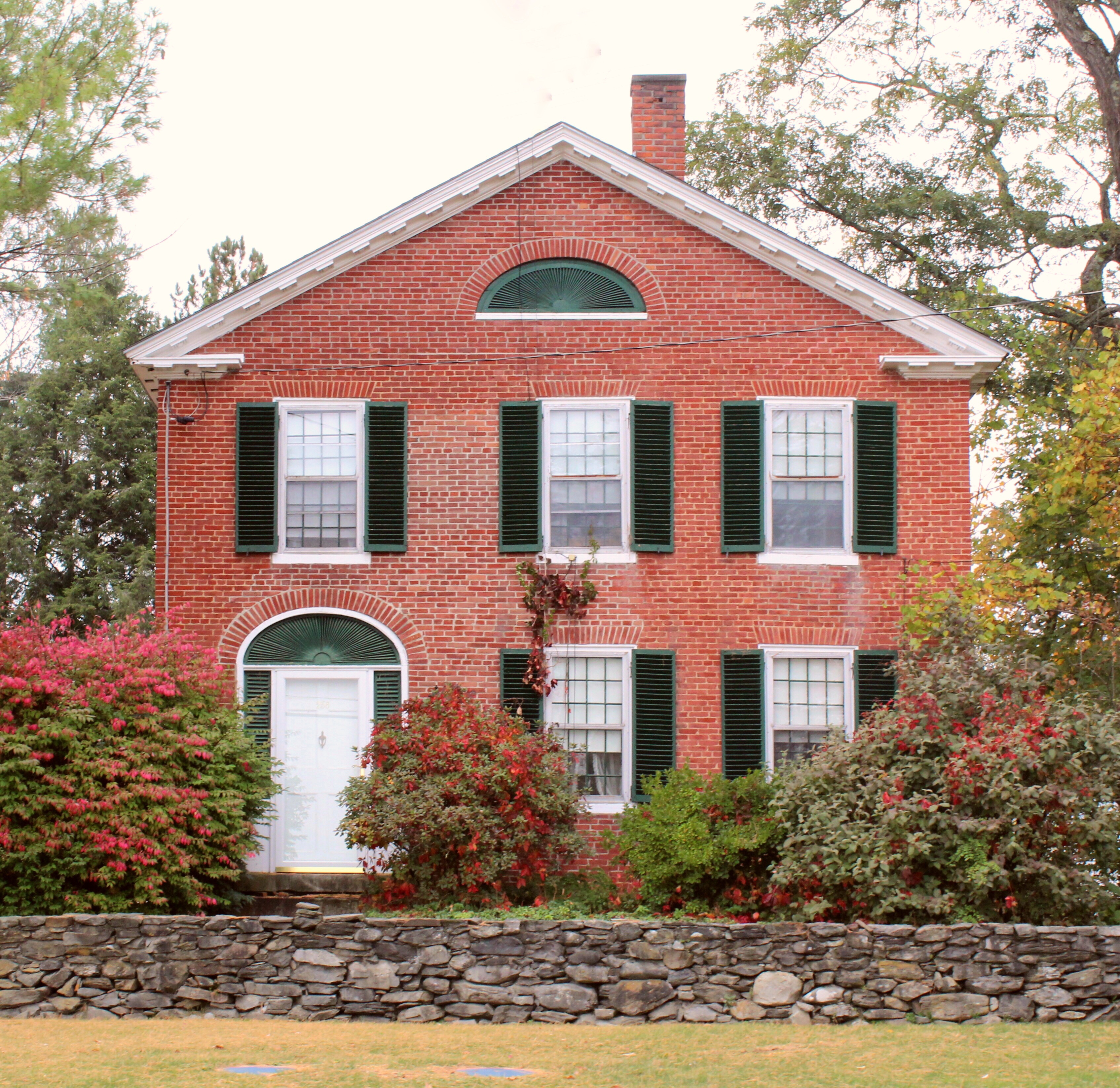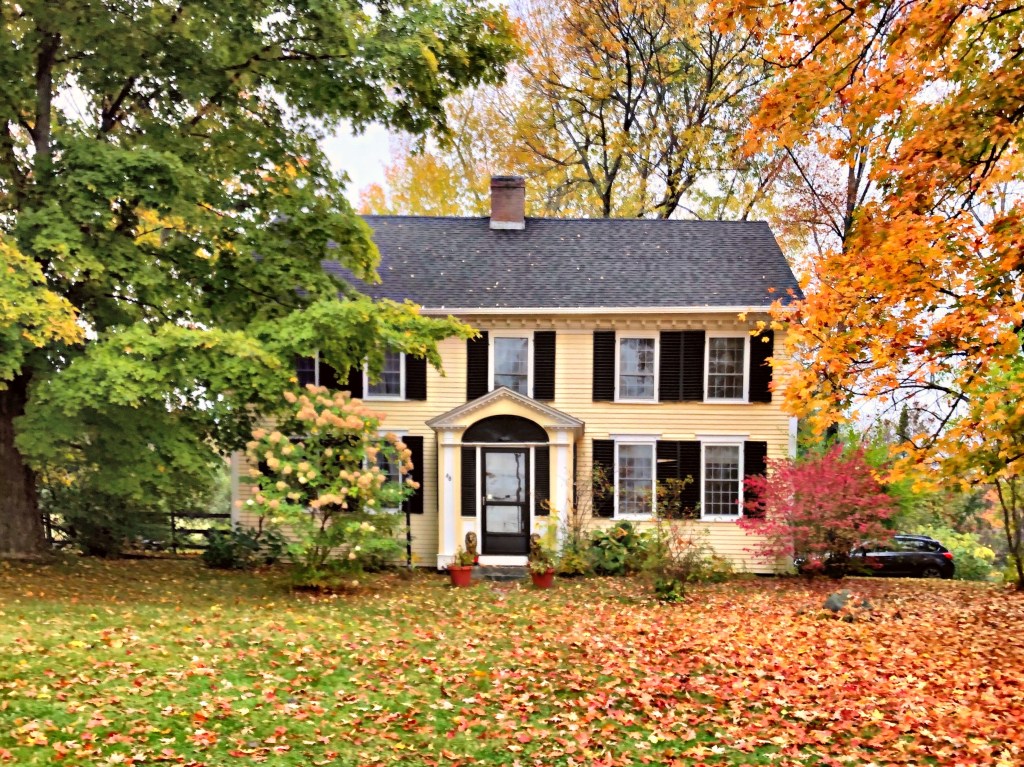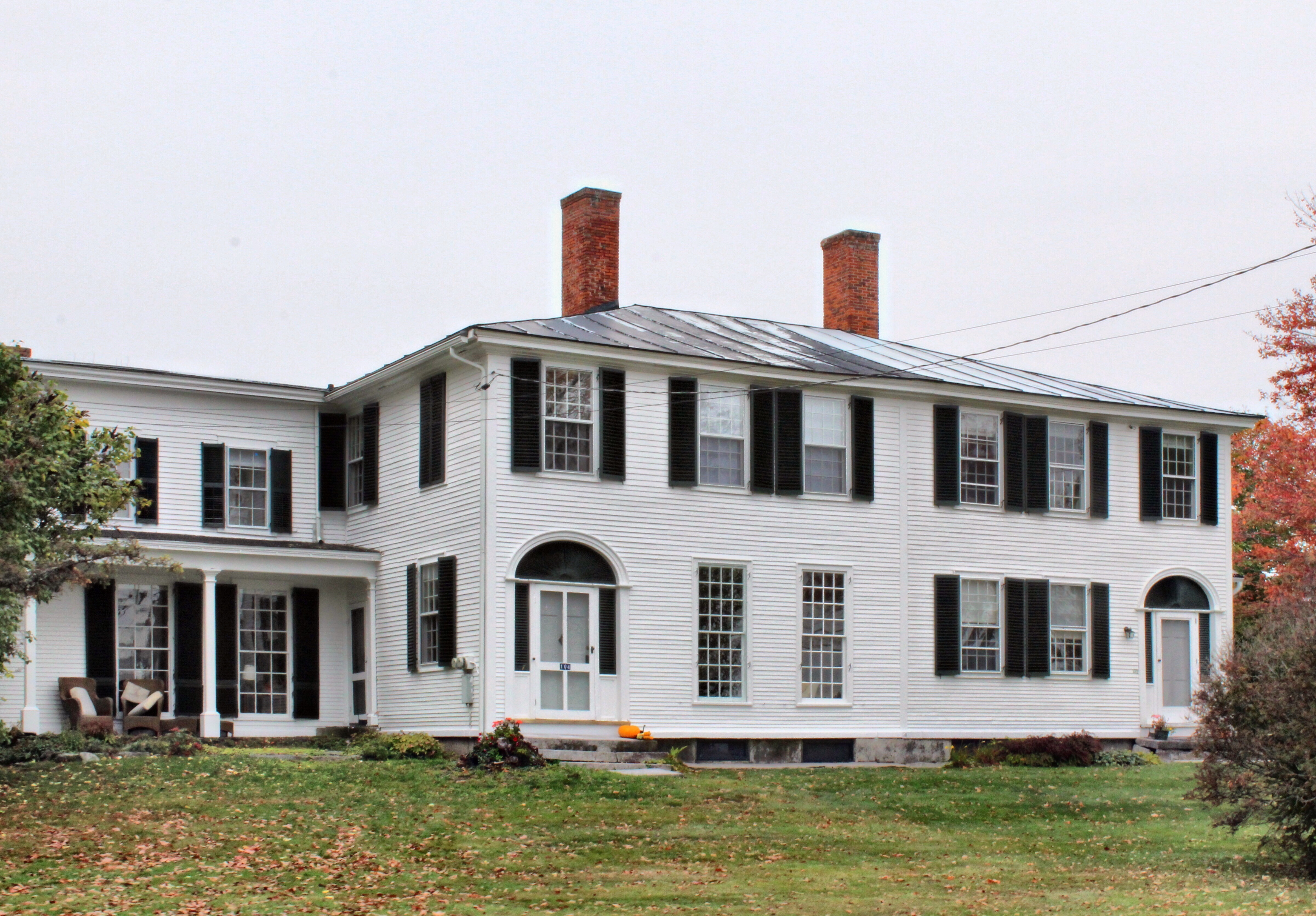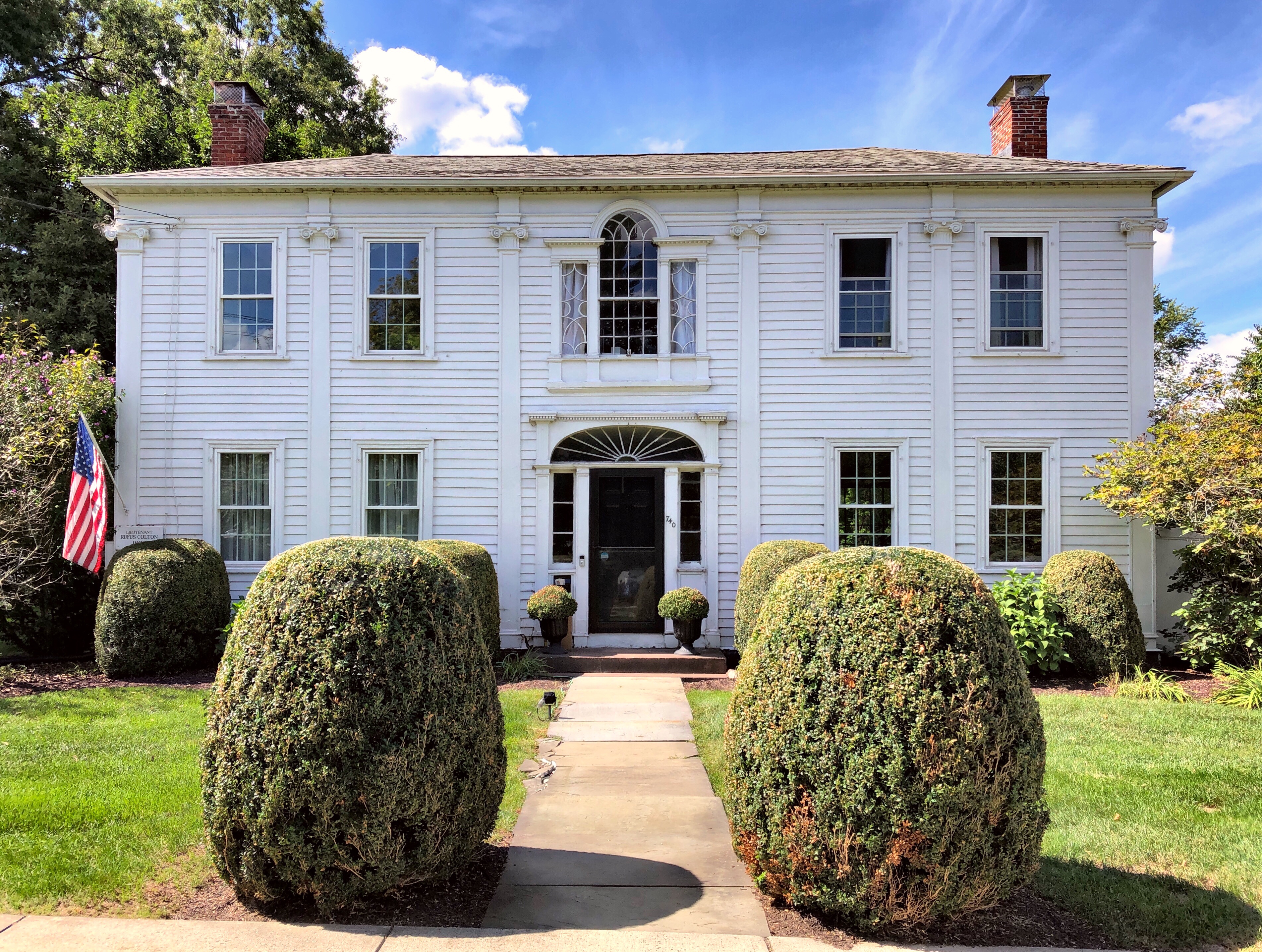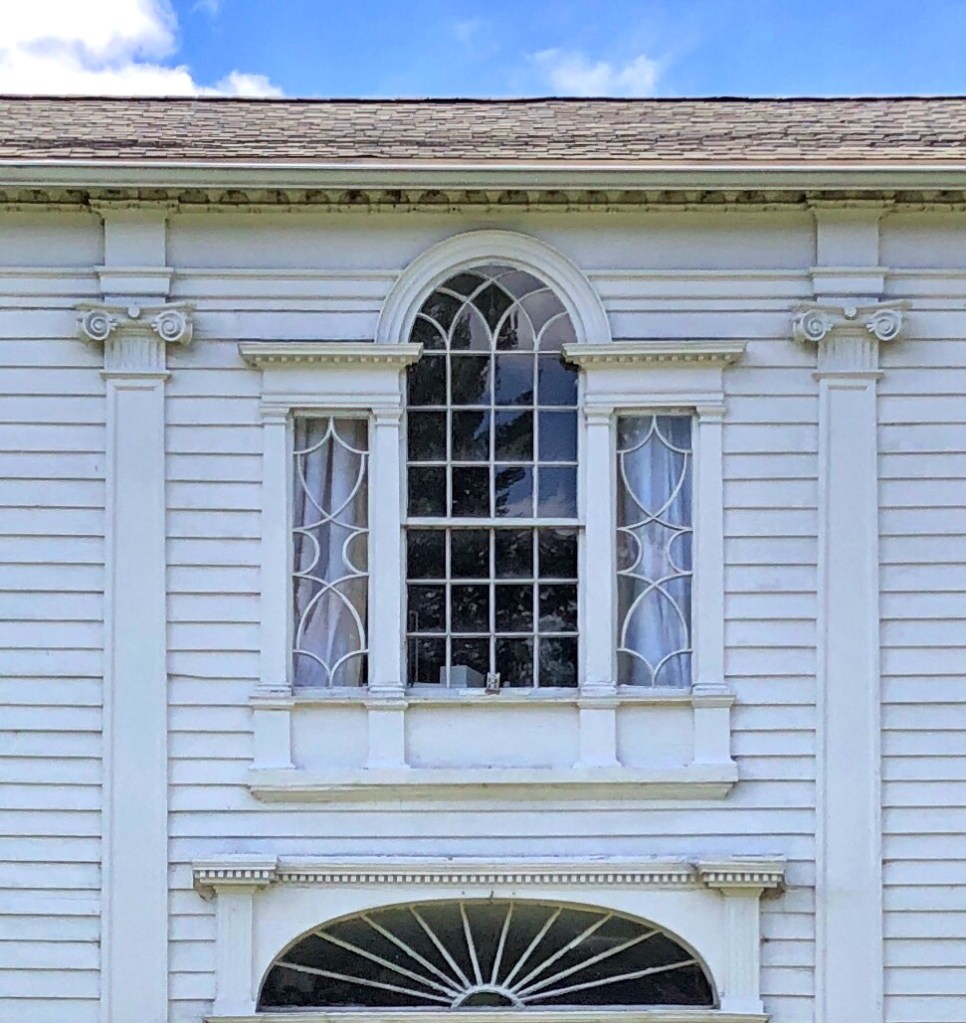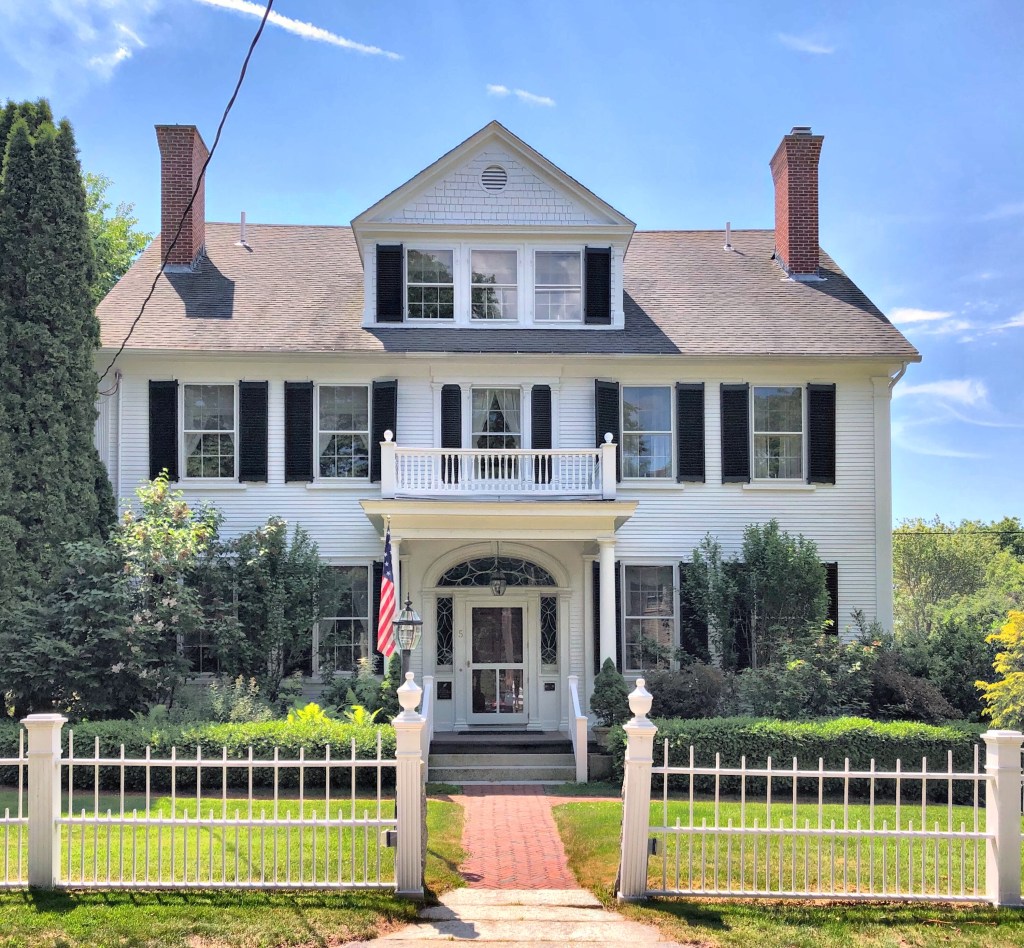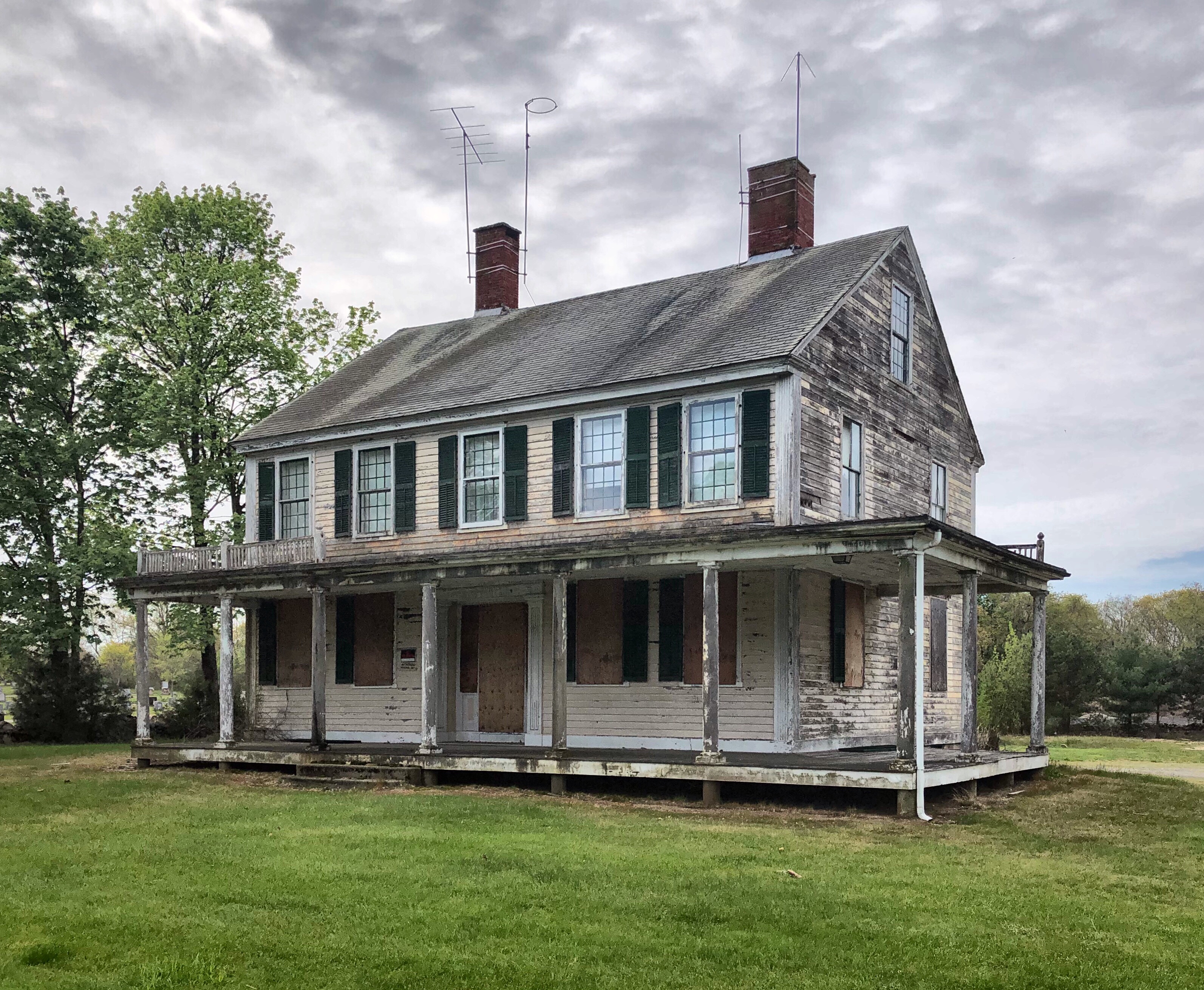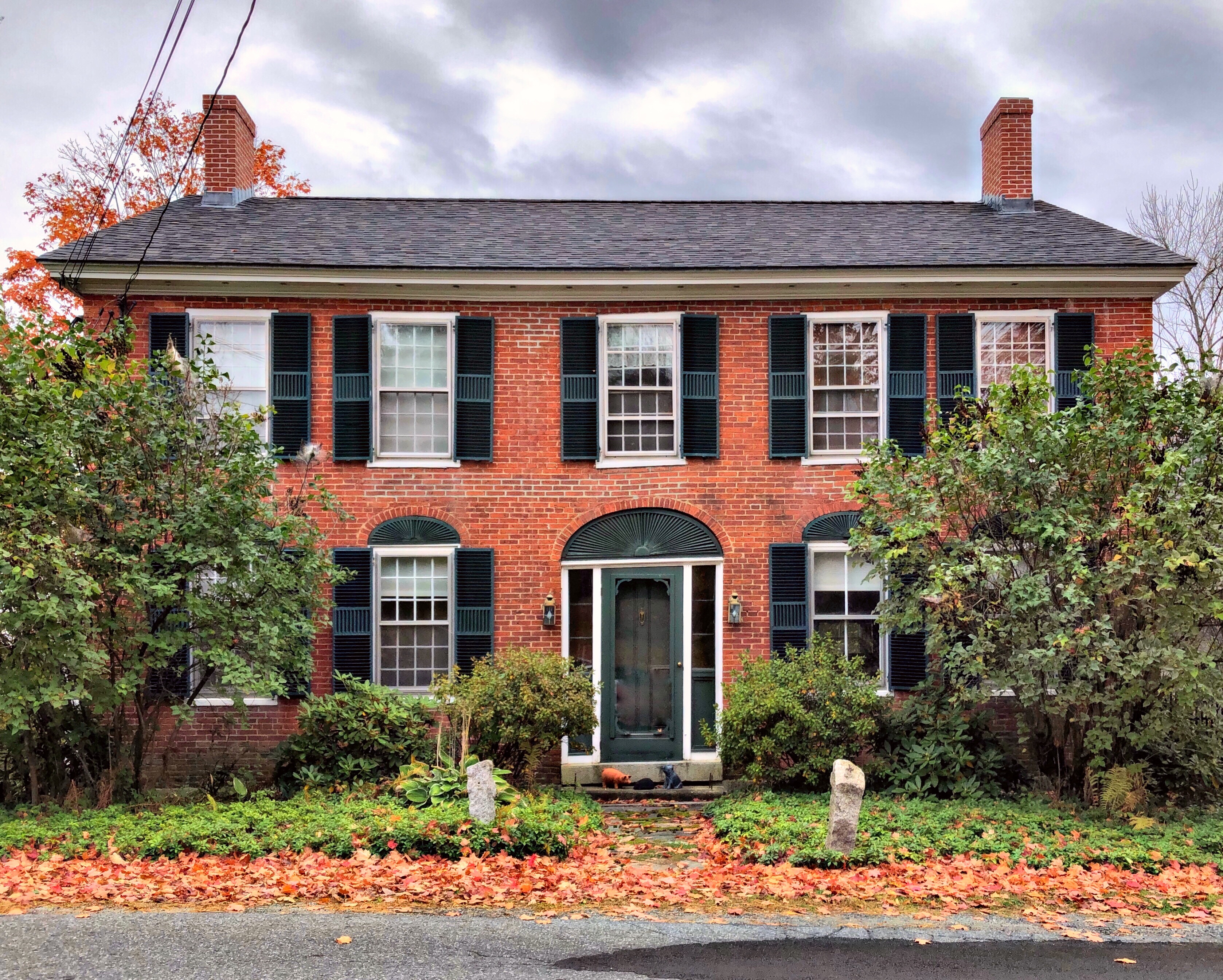
Located next to the Blanchard House, the old Wilton Center Baptist Church stands as one of the only brick buildings in Wilton Center, New Hampshire. Baptists in town originally met and worshipped in nearby Mason, NH, but eventually began services in town. By the 1820s, a new edifice was needed, and the members pooled resources, largely from wealthier members for funding for a new church. The Federal style brick church is stunning with its recessed arched panels surrounding the windows and doors, and its steeple. The building has been converted to residential use.
The oldest portion of this beautiful brick farmhouse in Cavendish, Vermont, its rear ell which was built about 1796 by Aaron Parker Jr., the son of one of Cavendish’s early settlers. Aaron married Susan Sherman in 1796 and likely had a home built here where they could start their family. Sometime in the 1810s, Aaron built the brick main block to which it is now attached. The blind arches and simple transom window above the door were common in brick Federal homes in this region at the time. The Federal style really took off in popularity in New England after the 1797 architectural pattern book, “Country Builder’s Assistant” by Asher Benjamin, who was a resident of nearby Windsor, VT. This home remained in the Parker family until the Great Depression, when it was sold off. The home remains extremely well preserved and is a great example of a rural Federal-period farmhouse in Central Vermont.
Oliver Tarbell and his wife Sandy erected this stunning brick Federal farmhouse in Cavendish around 1830 for their ever-growing family. The couple had thirteen children who survived infancy, so even this large home was likely stuffed to the gills and hectic! Oliver appears to have built the home, incorporating his ancestral home onto the rear of this brick house, as a rear ell. The house recently sold in 2022, so of course I had to gawk at the amazing interior photos…
In the early 1780s, Leonard Proctor and Salmon Dutton and their families, moved from Massachusetts and settled in present-day Cavendish, Vermont and gave their names to the two major settlements on the Black River, Proctorsville and Duttonsville. Leonard Proctor was born in Westford, Massachusetts and fought in the Revolutionary War at a young age. He settled in Cavendish in 1782 and built a modest house/tavern, and underwent developing the village in his name, Proctorsville. By the early 1800s, Leonard was a highly esteemed member of town and had the funds to erect the finest Federal style manse in the village, to showcase the stability and wealth of his community. The home exhibits scalloped cornice moldings and the carved wood flowering vines springing from urns on the upper pilasters that have a folk/Federal quality that stands out as a very unique design detail. Carved Adamesque bell flowers that flank the door suggest Asher Benjamin’s Windsor influence. Elliptical sunbursts above the pilasters, elaborate guilloche friezes, and the broad semielliptical attic light have a later Federal character. It is possible that Leonard had this house built, and it was “modernized” by one of his heirs.
This beautiful farmhouse in Cavendish, Vermont is located along a winding dirt road and has ties to one of the town’s original family’s. A home was built here in 1785 and changed hands numerously over the first few decades of its existence. The farmhouse that was built also served as a tavern for travellers along the newly laid out Wethersfield Turnpike. It is possible that the cheap land and rural character of the new town was appealing to some, but reality away from true commerce may have made many sell the farm after a few years, which could explain why the property was bought and sold so often early on. The property was purchased by Jonathan Atherton, a Revolutionary War veteran, farmer, surveyor and lawyer, who acquired large landholdings in Cavendish. In 1821, Jonathan Atherton was sued in court by his neighbor, Jedediah Tuttle for beating Tuttle’s wife Lydia. In order to finance the bonds, Atherton mortgaged all his real estate in Cavendish to his brother Joseph, and Elihu Ives, Jonathan Atherton Jr.’s father-in-law. Atherton St. lost the case and had to pay a fine. The property was eventually inherited by Stedman Atherton, the youngest son of Jonathan, who seems to have demolished the old homestead and constructed the present home on the site. The original dwelling was also the childhood home of Henry B. Atherton, a staunch abolitionist and soldier in the American Civil War, who later served as a lawyer and state legislator for New Hampshire, and his sister Eliza (Atherton) Aiken, a Civil War nurse who has been referred to as America’s own “Florence Nightingale”. The old Atherton farmstead was recently renovated.
John Hart (1733-1790) a ropemaker in pre-Revolutionary Portsmouth, New Hampshire, built a house in the city’s North End where he and his family resided. He died in 1790, and apparently willed the home to his housekeeper as he must not have had children. Early in the 19th century, the home underwent a huge overhaul, with a third floor added to the two-story Georgian home and the facade altered in the Federal style, all to resemble a traditional merchant “mansion house”. In the 1830s, the Greek Revival portico (porch) was added to the entry, to really make this house a blending of styles! In the 20th century, the Hart House was converted to a nursing home. In the 1960s, urban renewal plans were unveiled which would raze this home and hundreds of others. Luckily, this and just over a dozen more, were moved and saved from the wrecking ball.
Continuing with my mini-series on The Hill, a neighborhood of 18th and 19th century houses and buildings saved from Urban Renewal in Portsmouth’s North End neighborhood, I present the James Neal House. Built in 1831 and taxed a year later, the house stands out as a late Federal style property, a style that was well on its way out in popularity. Additionally, the home is the only extant brick house in this area of town from the period. James Neal was listed in directories as a merchant, possibly being involved in the shipping of goods from plantations in the Caribbean, which were farmed by enslaved Africans. James died just a few years after his home was built. The brick house is three-stories with a hipped roof. The entry is surmounted by a semi-circular fanlight set within a recessed opening, a modest take on the Federal style.
One of the oldest homes remaining on The Hill in Portsmouth, New Hampshire is this Federal-era house which survived the period of Urban Renewal in the city’s North End. The house was built for Simeon P. Smith in 1810 a few years after his marriage to Anna C. Dudley. Simeon worked as a cooper, which made wooden casks, barrels and other containers from timber staves that were usually heated or steamed to make them pliable. The home is a great example of a preserved working-class house built in early 19th century Portsmouth, a house that would only be affordable to the rich today. The house, like many others on The Hill, was moved to this location from nearby and houses offices today.
Originally constructed in 1787 on Newfane Hill, the main block of this historic inn was moved in 1825 for owner Anthony Jones, to its present site overlooking the Common in Newfane, Vermont. The Federal style building was oriented towards the main street, with its length extending along the town common. The inn was a busy stop for lawyers and judges who worked at the courthouse across the street. Porches were added likely in the early 20th century. After a period of neglect, the inn was restored by decorator Christoph Stumpe Castou, and later sold. The inn was run for 42 years in the second half of the 20th century by Eric and Gundela Weindl, a couple who were both from Germany, yet met at Stratton Mountain in Vermont in 1963, marrying in 1968. They operated the inn until 2011.
When the Windham County courts were transferred from Westminster in 1787, they were housed in the village known as Newfane on the Hill. Four decades later, influential residents convinced their townsmen to shift the village down to their land in a flat part of town, a location better suited for waterpower and commerce and ease of travel in the winter months. The first two buildings constructed were the courthouse and jail on a common. The village center grew rapidly as people moved old buildings down the hill and remodeled them or built anew, establishing a particularly unified townscape. This courthouse building is very stately for such a small town and packs an architectural punch. The two-story building is capped with a belfry and was designed in the Federal style with fan motifs over the windows and door. In the 1850s, nearby Brattleboro tried to usurp Newfane’s county seat status, so they in turn expanded the courthouse, raising the ceiling on the upper floor and adding the monumental Doric portico and pediment to give the building a decidedly Greek Revival appearance.