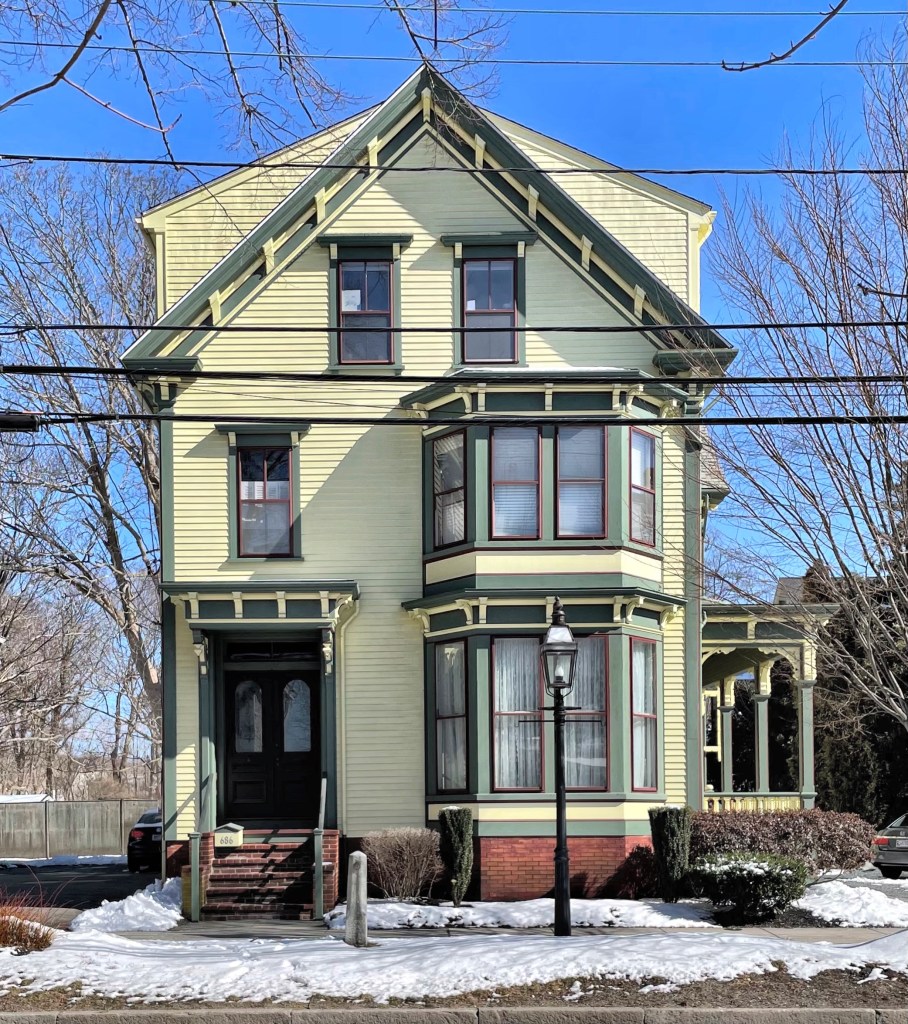
Bristol, Rhode Island is dominated by Federal and Greek Revival homes, but there are some absolutely gorgeous gems built after (I can’t wait to show you a sampling). This Bracketed/Italianate home is a well-preserved example of the style with a side-hall entry, two-story bay window, and hoods over windows and the main entry with brackets. The home was built for Charles Greene, a very active citizen of Bristol. Greene (1822-1899) purchased the Bristol Phoenix in 1862 and remained its editor and publisher for thirty-one years. Active in public and civic affairs, he was first president of the Rhode Island Press Association, clerk of the Supreme and common Pleas Courts of Bristol County from 1865 to 1868, a member of the General Assembly in 1873 and 1874, Sheriff of Bristol County from 1875 to 1877, and a town council member from 1879 to 1881.
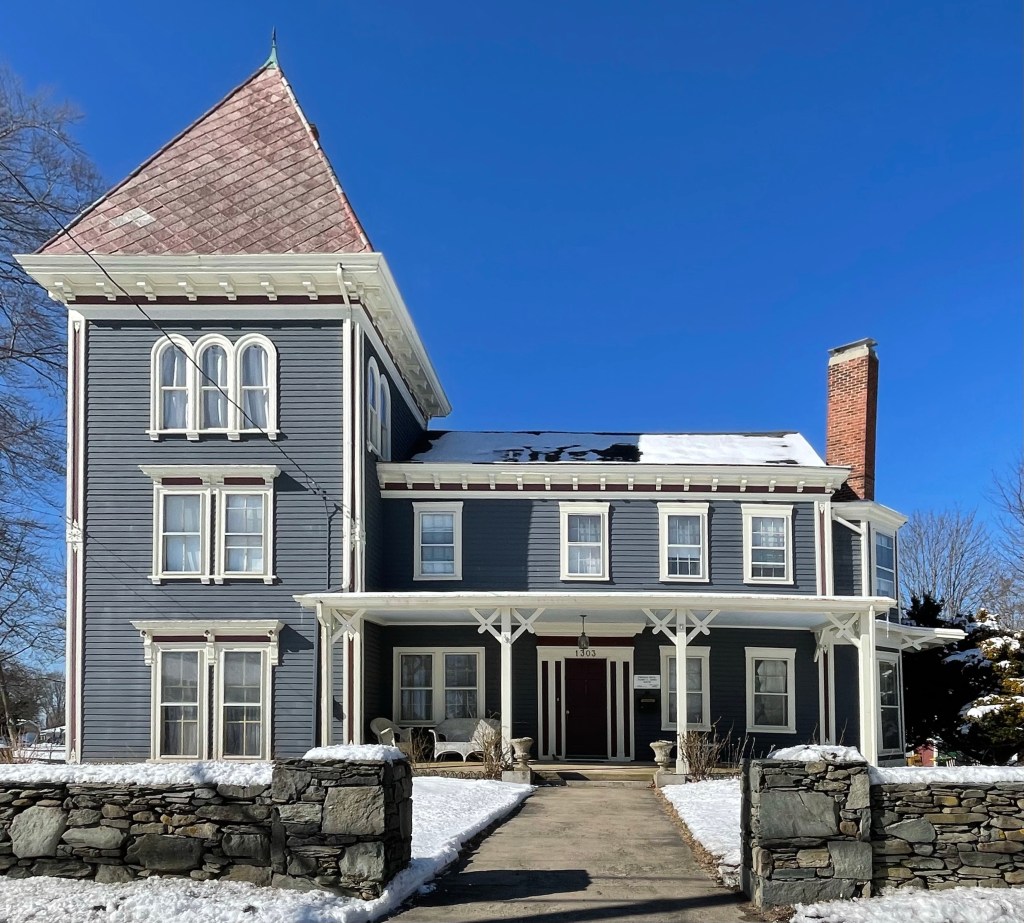
One of the most unique houses in Bristol (and the State of Rhode Island for that matter) is Ferncliffe, a colonial farmhouse that morphed into this beauty in the late 19th century. In 1749, the 200-acre farm of Benjamin Church, containing land where this home sits, was divided among his four daughters. Thomas Peck, a farmer, purchased one share in 1761; his deed refers to a house already on the property. The home was likely a five-bay Georgian home with little details. However, in 1882, James L. Tobin an undertaker, bought the property which then extended west to Narragansett Bay. He “modernized” the home with brackets, front porch, oh and a massive three-story tower with pyramidal roof! Tobin’s daughter Mary named the house for the fern plants lining the waterside cliffs at the far extent of the property, giving it the name “Ferncliffe”. Since then, the farmland was subdivided and sold off and now contains many house lots, with many of the streets laid out named after his children and wife. After Tobin’s death in 1925, he willed the home to his two living daughters, Helen and Annie.
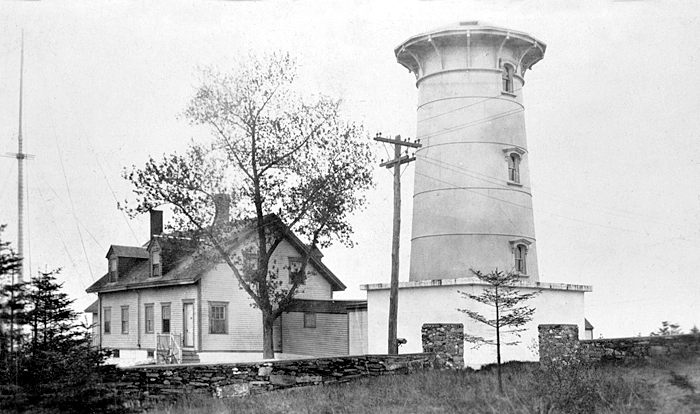
At the southern tip of Cape Elizabeth, Maine, two lighthouses have long provided a beacon to ships that sailed the rocky coast where the town protrudes into the ocean. The story of Cape Elizabeth’s Two Lights begins in 1614, when Captain John Smith, who sailed along New England’s shores, gave the appellation to the cape in honor of Princess Elizabeth, King Charles’ sister. After the American Revolution, Portland Harbor became an important trading port, and ships from all over the world would dock there. In 1827, the decision was made to use two lights at this location, a fixed light in the east tower and a revolving light in the west one, so the station would not be confused with the lights at nearby Portland Head Light or Wood Island Light in nearby Biddeford. After land was purchased for a mere $50, the towers were built, spaced by 895 feet and topped by octagonal wrought-iron lanterns housing lamps and reflectors, first shone their lights in October 1828. The stone towers were poorly constructed and keepers would consistently complain about poor working and living conditions. A $30,000 appropriation was made in 1873 to fund the erection of two matching sixty-seven-foot, brick-lined, cast-iron towers set 923 feet apart and featuring elegant Italianate details. In 1878, a new wood-frame, one-and-a-half-story dwelling was built for the principal keeper near the east tower, designed in the Gothic Revival style. During World War II, the west tower became an observation tower after a cylindrical turret was installed atop, which had had its lantern room removed after being discontinued. It was auctioned to the highest bidder in 1959. In 1971, actor Gary Merrill, ex-husband of Bette Davis, purchased the west tower for $28,000. Merrill sold it in 1983, and a new house was built next to it. The keeper’s cottage at the east tower is also privately owned, but the tower is retained by the Coast Guard, and is automated today.
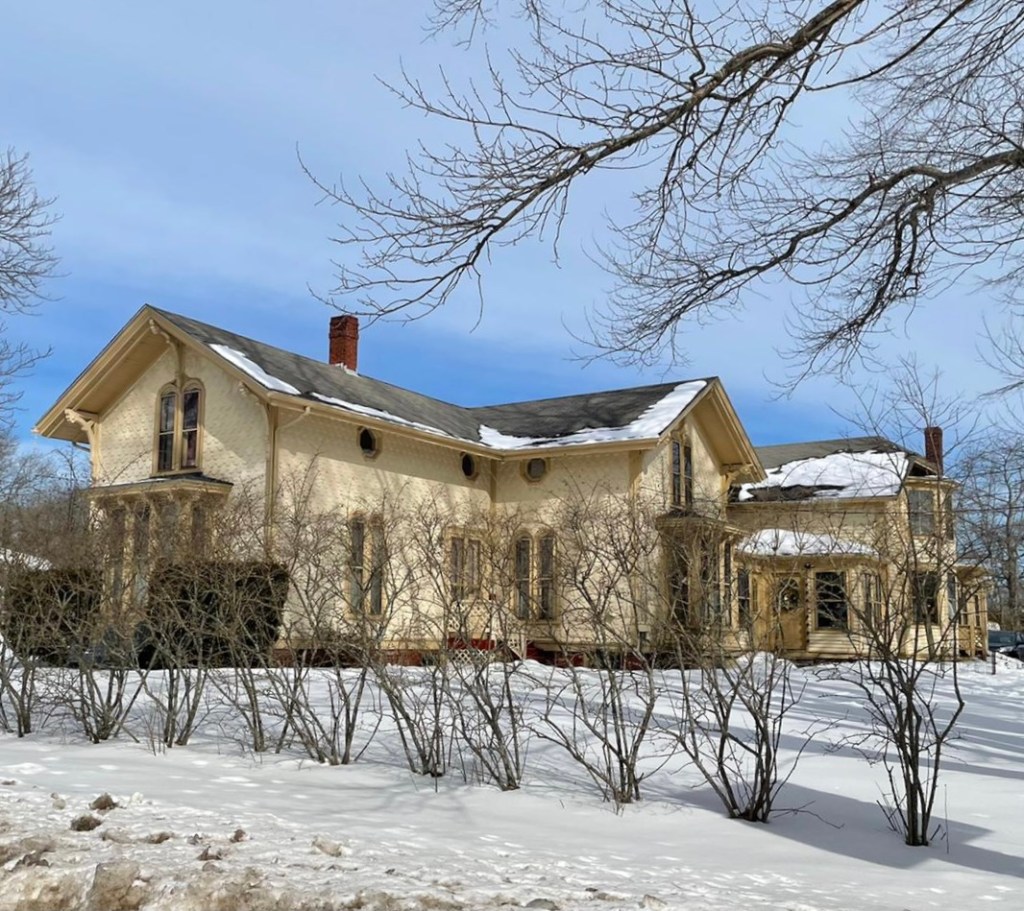
This charming home in Cape Elizabeth, Maine looks to have been built after the American Civil War, as an interesting Italianate cottage. The home is clad with scalloped shingle siding which works well with the paired round headed windows facing the street. The deep overhanging eaves are supported by brackets. Running under the eaves on the sides are octagonal windows, a very unique detail. The home is located at the center of town, away from the summer cottages which sprouted up along the rocky coastline in town starting around this time. It was converted into condominium units sometime in the late 20th century.
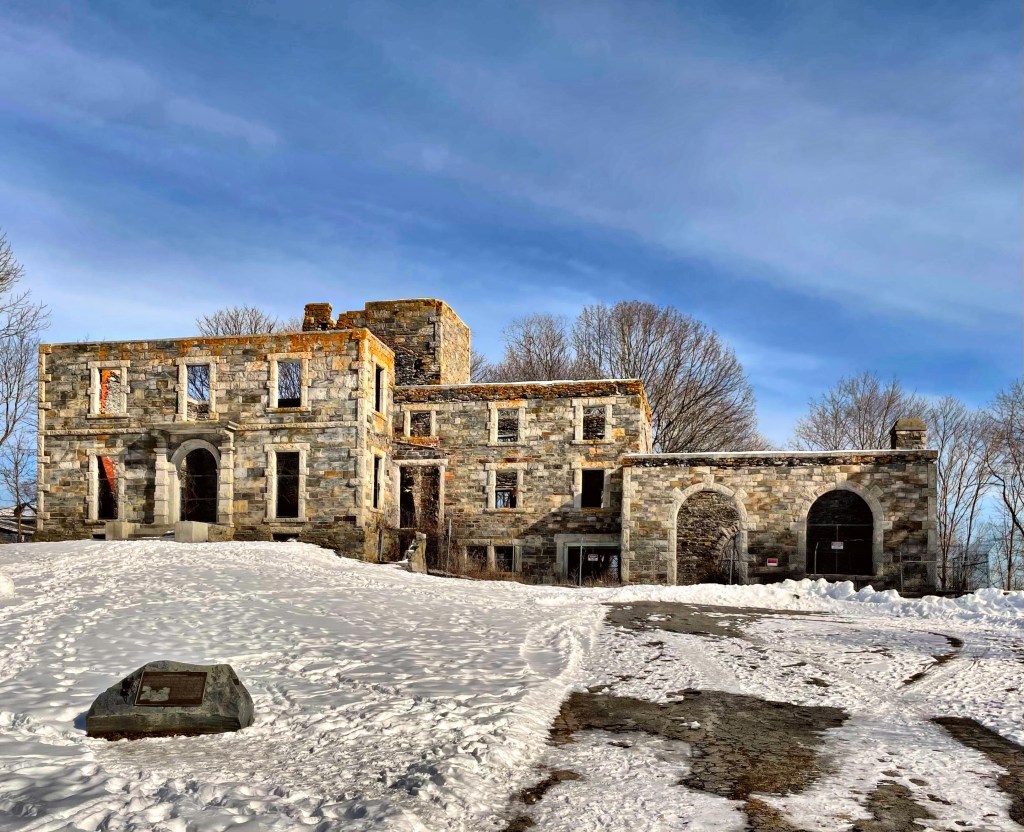
This shell of a former mansion was built in 1859 for Colonel John Goddard (1811-1870), a Civil War Union Army Officer. Goddard was a “lumberman” who amassed substantial wealth before the outbreak of the Civil War, and he hired architect Charles A. Alexander, to design an estate house for him and his family. The home appears to have been constructed of local stone with white granite trim and featured a prominent tower, emulating an Italian Villa. The home was purchased in 1898 by Judge Joseph W. Symonds, who presided over the Maine Supreme Judicial Court. Just two years later in 1900, during the expansion of Fort Williams, the estate was acquired by the Federal government. The home was used for housing married enlisted men and their families while stationed at Fort Williams. The basement was converted into the fort’s Non-Commissioned Officers’ Club. At the time of the town’s purchase of the Fort in 1964, the mansion was already in serious disrepair and its future was uncertain. People routinely broke in and damaged the interior, which suffered numerous small fires over the years, until the town decided in 1981 to hold a controlled burn of the home, leaving the shell. The shell remains a significant architectural landmark and a massive opportunity for the town.
152 Beacon (center) and 150 Beacon (right) demolished. Courtesy of Boston Athenaeum.
In 1860, David Stewart, a merchant from New York, built a townhouse on Beacon Street in Boston’s Back Bay neighborhood as a wedding present for his twenty year old daughter, Isabella Stewart, and her new husband, John (Jack) Lowell Gardner. The house was originally numbered 126 Beacon, but re-numbered as 152 Beacon ca. 1862 when homes were built on the south side of the street. The home was the city dwelling of the young couple, who also owned “Green Hill” in Brookline, and an estate on the North Shore. Isabella Stewart Gardner began amassing a large collection of art and their Back Bay home was insufficient to display it all. In 1880, John purchased the neighboring home at 150 Beacon from Andrew Robeson, a wealthy merchant from Fall River, whose main home is now the headquarters of the Fall River Historical Society. Soon thereafter they combined the two houses, with the address of 152 Beacon, to provide greater space for the display of the growing art collection being assembled by Isabella. After her husband’s death in late 1898, Isabella Gardner pursued plans for a new home that would provide a suitable setting for her art collection. She purchased land in the Fenway and began construction on her mansion, Fenway Court, now the Isabella Stewart Gardner Museum. One year after completion of Fenway Court, the two townhomes were purchased by Eben Draper, who razed them for his mansion in 1904 (see last post).
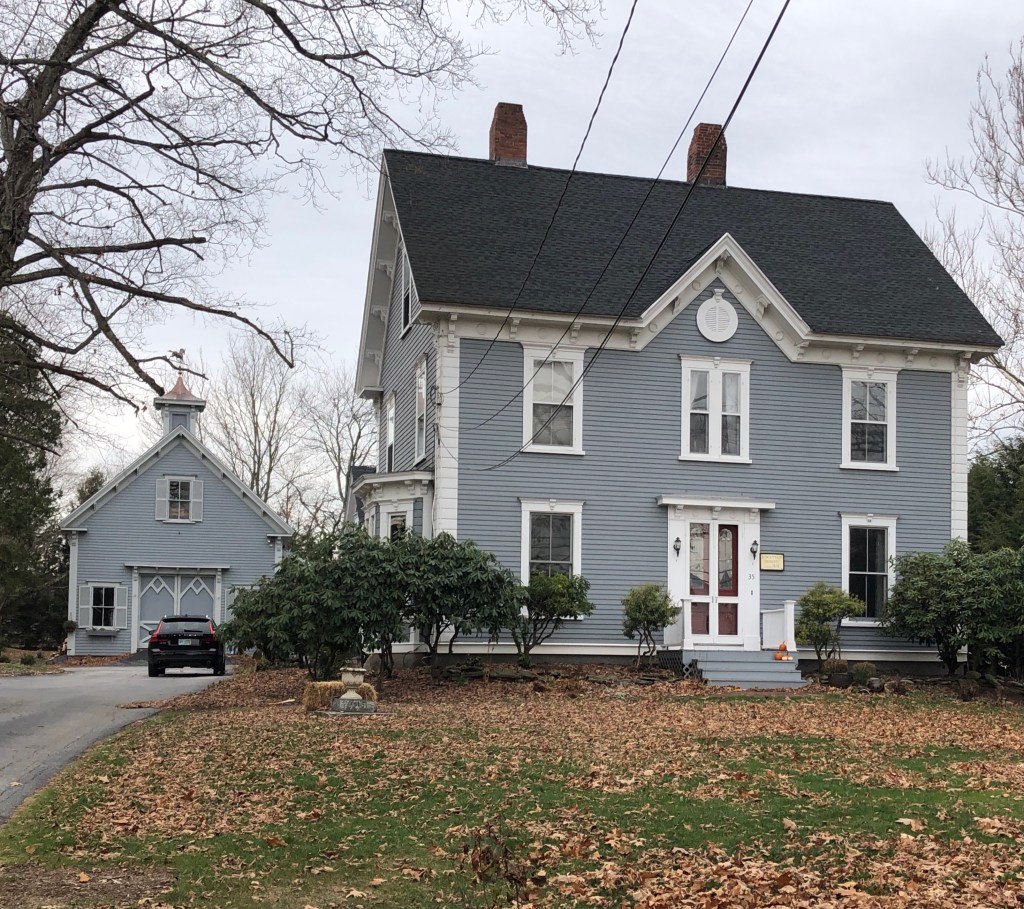
This Italianate home with attached barn was built in 1877 for William and Almira Clapp. William worked as a schoolteacher and shopkeeper in Boston before meeting Almira, marrying her, and moving to her home town of Hollis, New Hampshire, a big change of pace from Boston. The couple eventually built this home, behind an older home and lived here until their deaths. A subsequent owner demolished the older colonial in front to establish this farmhouse’s presence on the main road. The home was eventually purchased by Charles Stratton, and the Stratton family lived here for decades. The home and barn are well preserved examples of Victorian era agricultural and residential architecture in southern NH.
In the early 19th century, firefighting in New York was done by an assortment of volunteer groups with no centralized director. This hall was built as a headquarters for two of these groups—a move toward cooperation amongst competitors. Each company split the ground floor, divided into three rooms. The front room for the apparatus, the centre room for their meetings and the room in the rear for sitting and reading. The upper stories held meeting rooms and a library. The building was occupied as a fire headquarters until it relocated in 1887. The City of New York closed the station in the 1970s and it was rented as a mosque and theater company, losing much of its architectural detailing over the years. The Italianate style building, faced with Connecticut brownstone was restored close to the original design based on historic photos and converted to retail use, now housing Dolce & Gabbana.
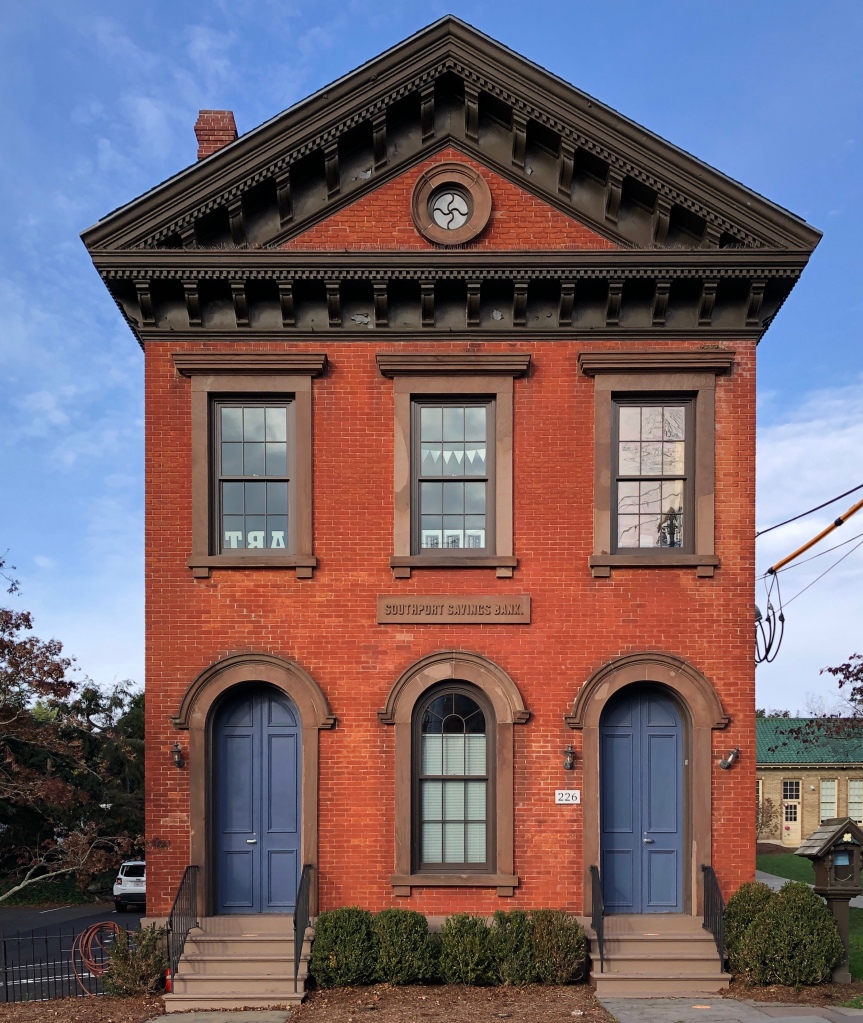
The Southport Savings Bank obtained a charter from the Connecticut General Assembly in May 1854, and was organized on September 25 of that year. Original incorporators included Paschal Sheffield, Austin Perry, Wakeman B. Meeker, Charles Perry, Prancis D. Perry, E.D. Sherwood, John Meeker, Frederick Marquand, and Andrew Bulkley. A new building, located at the foot of Main Street, was constructed to be accessible to shipowners, shop keepers, the farmer patronage, and commercial traders. This bank building was occupied in 1865, eventually merging with Bridgeport People’s Savings Bank on July 1, 1955, becoming the Southport Branch of the People’s Savings Bank – Bridgeport. It ceased to be a bank in the 2010s and is now occupied by the Southport School.
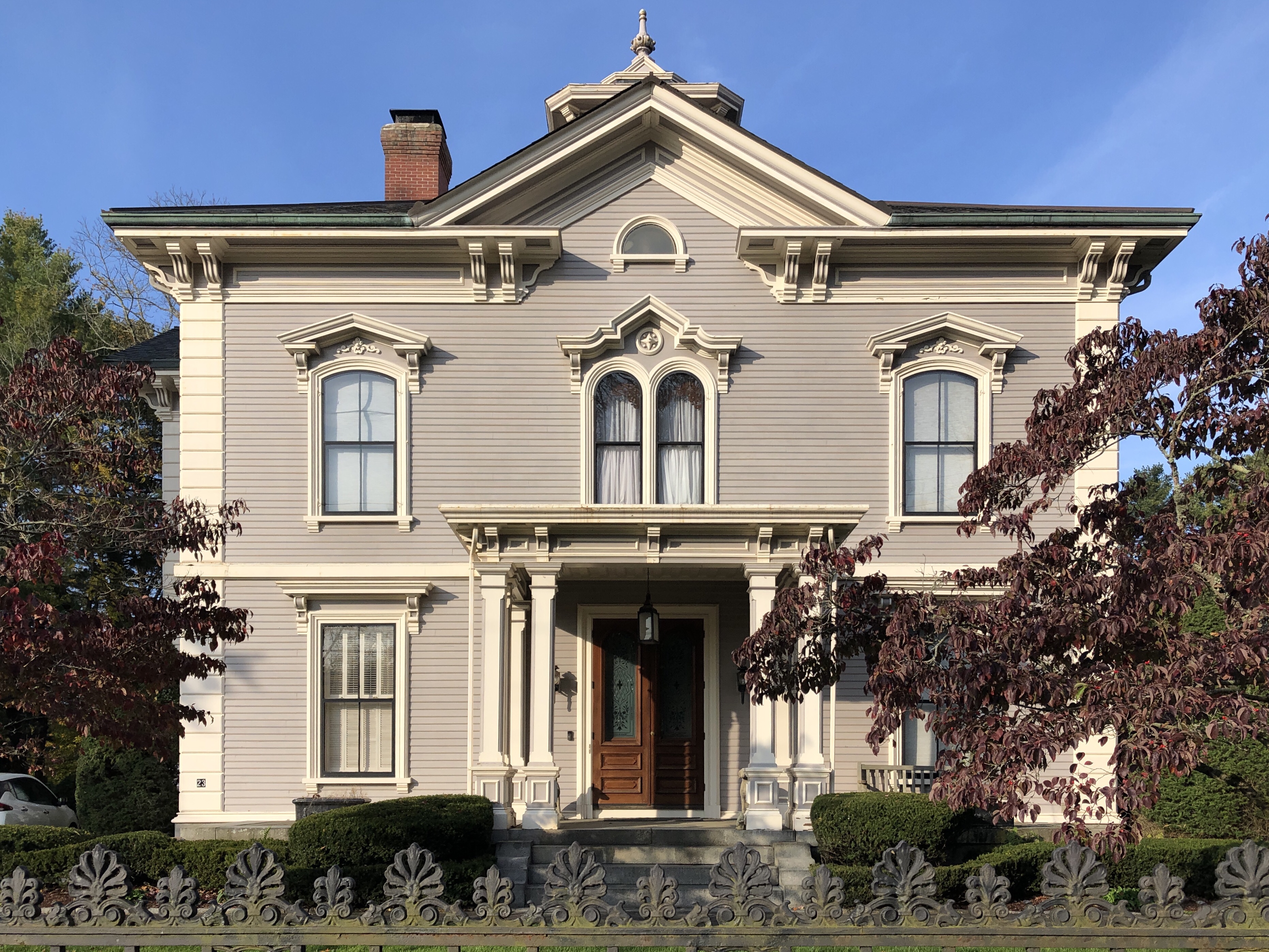
Located on Main Street in Easton, the Oliver Ames Jr. House exemplifies the romanticism of the Italianate style in the mid 19th century. Built in 1864, the home, known as “Unity Close”, was designed by George Snell, a Boston-based architect. Oliver Ames Jr. was a son of Oliver Ames Sr., who along with his brother, Oakes Ames, joined the family business at the Ames Shovel Works in town. The home has a massive garden at the side yard, originally designed by the Olmsted Brothers, John and Frederick, the sons of the great Frederick Law Olmsted.




 Buildings of New England