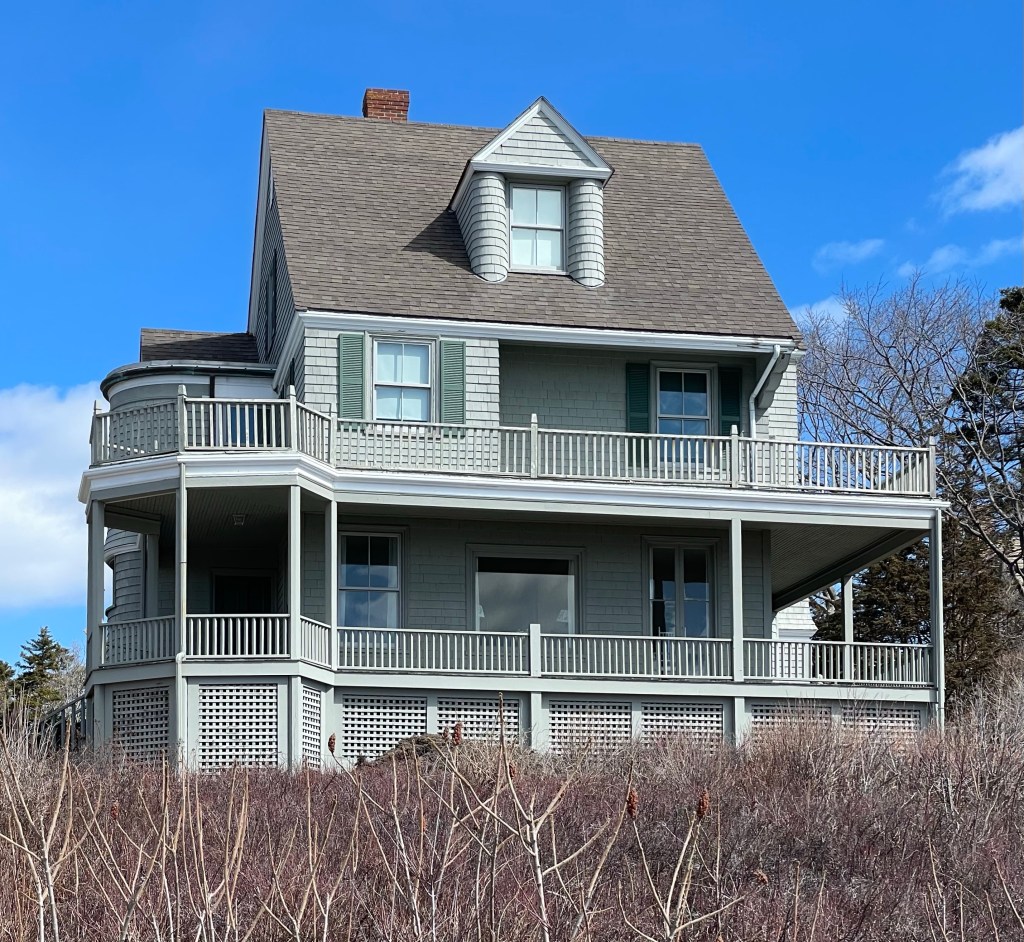
Juniper Ledge Cottage // 1889

Ellen Kemble (Bartol) Brazier was born in New York City in 1844, the eldest of four children of Barnabas and Emma Bartol. Her father had many business interests in sugar refining and the family was able to travel the world from his wealth and success. The family spent most of their time in Philadelphia, but like many of the city’s wealthy residents, they often summered elsewhere. Ellen Bartol married Joseph Harrison Brazier in 1866 and they had two children. When her father Barnabas died, Ellen inherited some of his remaining fortune and as a part of high society, she had a summer cottage in Kennebunkport built. Working with Maine architect John Calvin Stevens, she oversaw the designs of Juniper Ledge, this gorgeous, eclectic shingled residence in the Cape Arundel summer colony. Ellen would summer at the cottage until her death in 1925, but before she died, she joined her daughter in the 1910s and 1920s at Women’s Suffrage events and fundraisers, helping to pass the 19th Amendment, allowing women the right to vote in the United States. Ellen is buried in the West Laurel Hill Cemetery in Philadelphia next to her husband, not far from her parents.

Grayling Cottage // c.1900

John Bach McMaster (1852 –1932) was born in Brooklyn, New York to a rich plantation owning father and mother who ran operations in New Orleans until the outbreak of the Civil War. After this, John graduated from the College of the City of New York in 1872, worked as a civil engineer in 1873–1877. Falling in love with the field of American History, he switched careers and in 1883, became professor of American history in the University of Pennsylvania. McMaster is best known for his History of the People of the United States from the Revolution to the Civil War (1883), a valuable supplement to the more purely political writings of earlier years. The book was a huge success and John was able to purchase house lots in the newly established Cape Arundel Summer Colony in Kennebunkport, Maine, a colony populated by many wealthy Philadelphians for summer homes. He first appears to have built “The Kedge”, a chunky, but beautiful cottage on a cliff. McMaster would also have this larger cottage built by the turn of the 20th century, which in design, appears to be a more eclectic Shingle style dwelling. Just a stone’s throw from the Atlantic, the house features continuous cedar shingle siding, sweeping porches to provide views of the ocean, a prominent chimney, and Colonial-inspired fanlight motifs.

Spouting Rock Cottage // 1887

Another of the earlier summer cottages built in Kennebunkport’s Cape Arundel summer colony is this charming dwelling perched on a stone outcropping overlooking the rocky coast of Maine. Spouting Rock Cottage was built in 1887 as a transitional Shingle style and Queen Anne summer home for author John Townsend Trowbridge of Arlington, Massachusetts. Trowbridge spent many summers in Kennebunkport and was engaged in local cultural affairs, he even named Spouting Rock and Blowing Cave, natural features in the town. For his summer cottage, Trowbridge hired Arlington-based architect J. Merrill Brown, who provided a rustic, timeless design without all the unnecessary frills and details for the rugged coastline. That is to say that the cottage is anything but boring, with its sweeping porches, complex form with rounded stair-tower, and dormer with curved shingle returns. Perfection.

Gable and Tower Cottages // 1889

These two similar houses in the Cape Arundel Summer Colony in Kennebunkport, Maine, were built in 1889 for Prosper Louis Senat (1852–1925) and his wife Clementine. Prosper was a well-known artist from Philadelphia, who would summer in Kennebunkport and traveled the world with Clementine, painting landscapes and seascapes. Senat and his wife lived in one cottage and likely rented the other to family and friends when visiting town. His studio was built on a nearby street and is extant. Tower cottage (greenish-grey) was renamed Shady Oak Cottage in the 20th century. Both cottages were built by George Gooch, a local contractor from plans by an unknown architect and feature bay windows, short towers, smaller windows, and continuous shingle siding.

“The Dory” Cottage // 1888

Before Miss Gerrard purchased the Glen Cottage (last post) in 1900 in Kennebunkport, Maine, she had already summered in her own summer cottage nextdoor for over a decade. In 1888, she hired an architect from New Jersey to furnish plans for this charming shingle and stone cottage as her summer retreat. The cottage features a prominent brick and rubble stone chimney facing the street with a gambrel roof. The entrance is tucked away under a recessed porch and looks to be the original dutch-door. I can’t imagine how amazing summers in this house would be!

Henry Thatcher Fowler House // 1903

Henry Thatcher Fowler (1867-1948) was born in Fishkill, New York, on March 4, 1867. He graduated from Yale in 1890 and received his Ph.D., also at Yale, in 1896. After stints teaching at Yale, Norwich Academy, and Knox College, Professor Fowler came to Brown and was hired as Professor of Biblical Literature and History; he was chairman of that department until 1932. Soon after arriving to Providence to accept his professorship at Brown, Henry and wife, Harriett, hired the local architectural firm of Martin & Hall to design a new home for them a few blocks away from his work. The house blends Tudor and Shingle styles with the ogee entrance at the porch, flared shingled overhangs on each floor, and a prominent gable facing the street.

Peleg Eddy House // c.1895

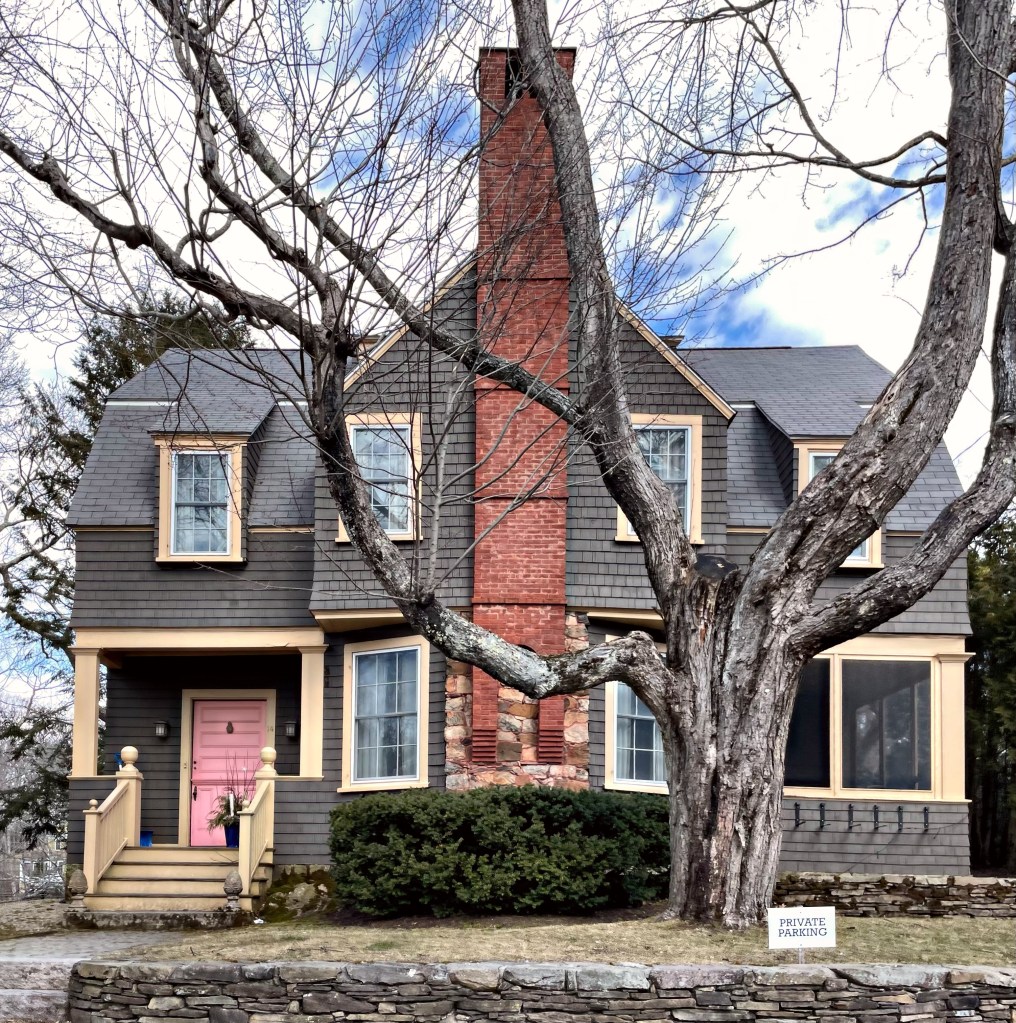
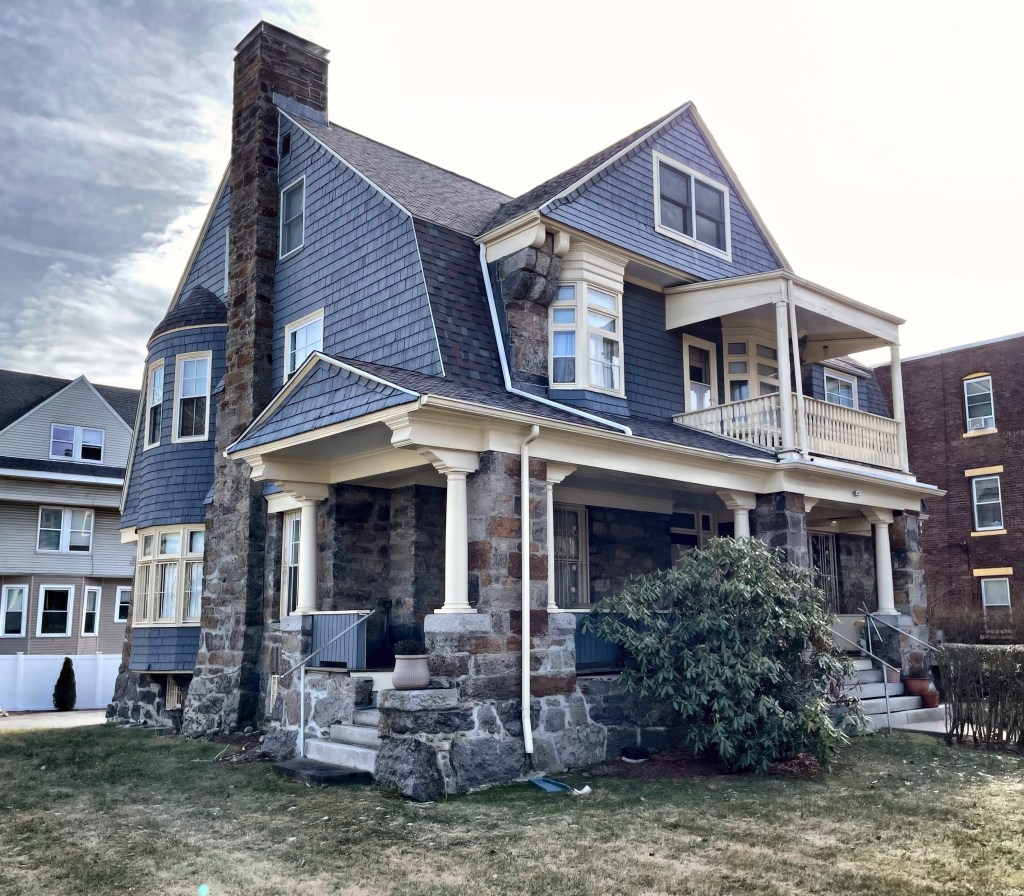
Roxbury is not well-known for its Shingle style architecture, but this example might change that! This dwelling was built around 1895 by the heirs of Horatio Harris on family land that was subdivided for house lots at the end of the 19th century. The expansive Harris estate was developed, largely on speculation and included some amazing single family homes, rowhouses and multi-family dwellings. This Shingle style home appears to have also been built on speculation and was owned by the Harris heirs for some time. The property was occupied for some time by Peleg E. Eddy and his wife Caroline in the earliest years of the house’s existence. I could not locate the architect, but it could be estimated as a design by J. Williams Beal, a local architect who was commissioned to design the nearby Harriswood Crescent development for the Harris family. The design features a Roxbury puddingstone first floor and chimney which contrast elegantly with the shingle siding.

Samuel P. Tilton Cottage // 1880

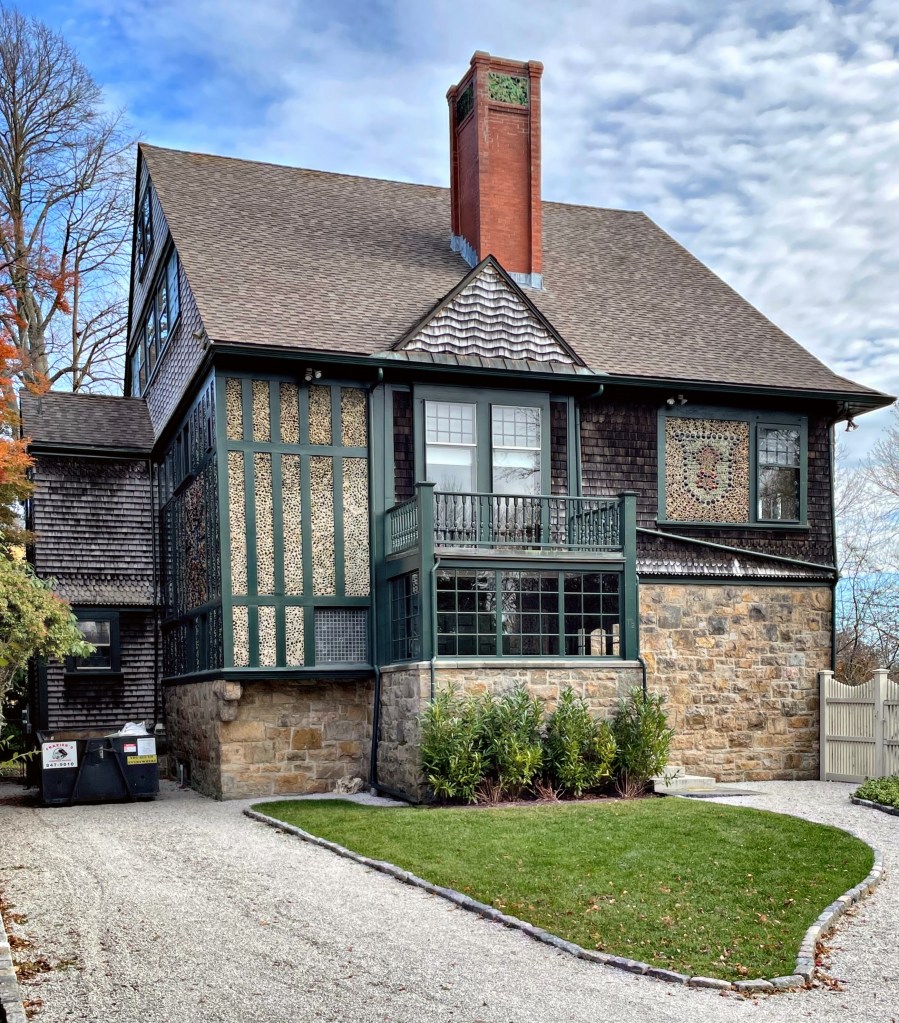
One of the most well-designed and least-pretentious summer cottages in Newport is this charming dwelling on a dead end street. The Samuel P. Tilton Cottage was designed in 1880 by the prestigious firm of McKim, Mead & White as an idiosyncratic blending of Queen Anne and Shingle architectural styles. Mr. Tilton was a milliner (maker and seller of women’s hats) with stores in Boston and Paris, France. He had this cottage built to summer close to the nation’s wealthiest, likely marketing some hats at elaborate Gilded Age events. The facade is assertively Queen Anne with its massing and decorative panels, with shingled side elevation seemingly sprouting from the earth. The architectural terminology for these unique decorative panels is “sgraffito” where here, cement or plaster siding is set and adorned with shells, pebbles, colored glass, and pieces of coal into a cartouche design. The house is one of the finest in Newport, and shows that bigger isn’t always better!

Berkeley House // 1885

In 1885, a 28-year-old Leroy King (1857-1895) and his wife Ethel Rhinelander King (1857-1925) hired one of the country’s most prominent architects, Stanford White, to design a Newport home for their family. Leroy was the son of Edward King, a prominent local merchant, and upon his fathers death in 1875, inherited some of the $100+million dollar fortune he had amassed in today’s dollars. The corner lot at Bellevue and Berkeley avenues was purchased and work was underway on the new mansion. The house is a really interesting take on the Shingle style, but instead of cedar shingle siding, employs fireproof construction. A central hall, large gabled masses, picturesque window arrangements, and a spectrum of surface textures (here conveyed largely in natural stone and brick with flourishes of shingle and pebble dash work), align this house with McKim, Mead & White’s earlier efforts in this style. The interior has been meticulously preserved and maintained by the owners.

Dr. Grouard Cottage // c.1897

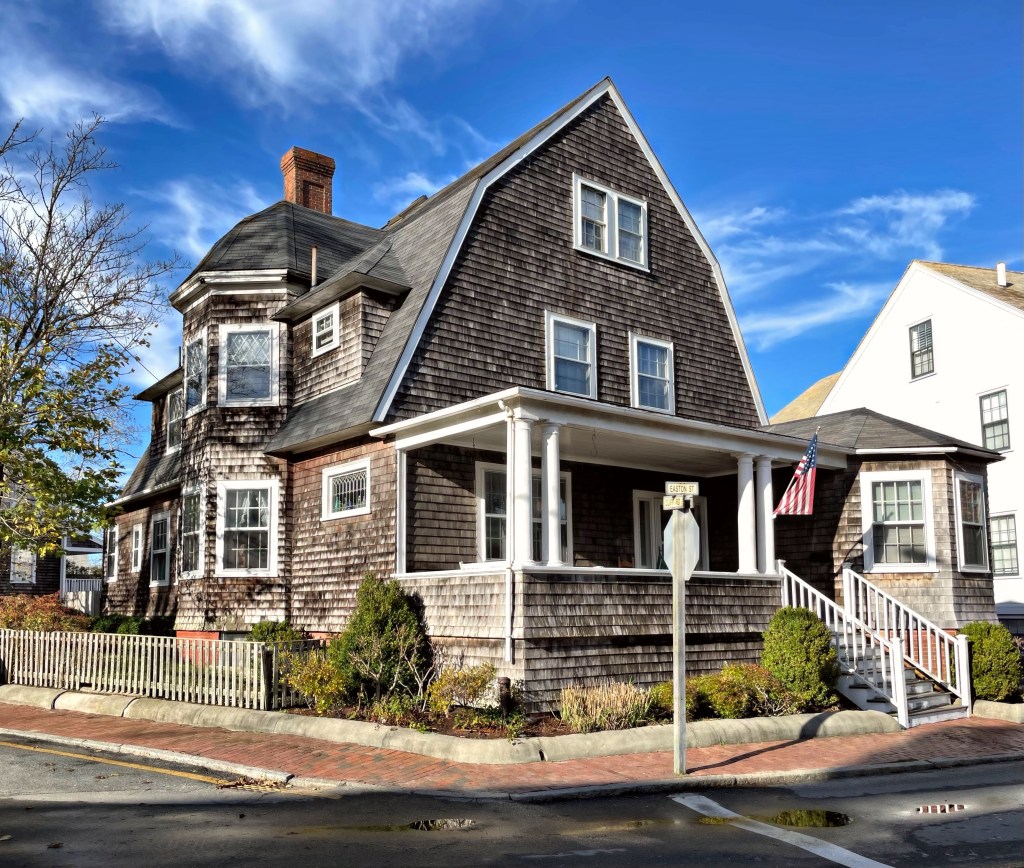
Dr. John Shackford Grouard (1867-1927) was a physician and surgeon born in Allegheny County, Penn. He attended Phillips Exeter Academy, and earned an M.D. from Harvard Medical School in 1889. In 1891, he moved to Nantucket, Massachusetts, where he established his own general medicine and surgical practice. Years after establishing his practice, he built this beautiful Shingle/Queen Anne style cottage that is dominated by a massive gambrel roof and is located adjacent to the Nantucket Hotel. He served as the Town Physician and medical examiner, on the Nantucket School Board, and as president of both the Nantucket Civic League and Citizen’s Gas, Electric, and Power Company. Dr. Grouard also co-founded the Nantucket Cottage Hospital in 1911, but more on that later. Dr. John Shackford Grouard died in Boston in 1927, one week after surgery for a gallbladder inflammation.