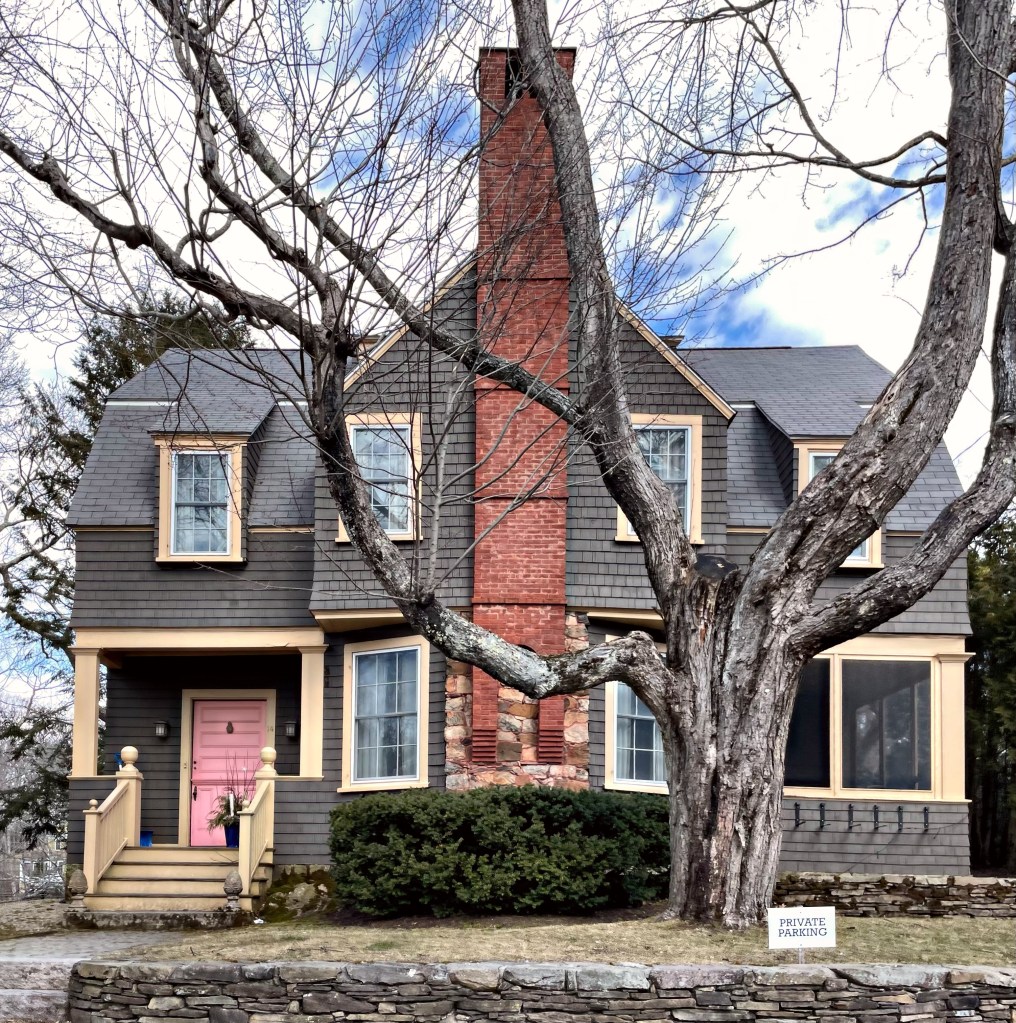
Before Miss Gerrard purchased the Glen Cottage (last post) in 1900 in Kennebunkport, Maine, she had already summered in her own summer cottage nextdoor for over a decade. In 1888, she hired an architect from New Jersey to furnish plans for this charming shingle and stone cottage as her summer retreat. The cottage features a prominent brick and rubble stone chimney facing the street with a gambrel roof. The entrance is tucked away under a recessed porch and looks to be the original dutch-door. I can’t imagine how amazing summers in this house would be!
Henry Thatcher Fowler (1867-1948) was born in Fishkill, New York, on March 4, 1867. He graduated from Yale in 1890 and received his Ph.D., also at Yale, in 1896. After stints teaching at Yale, Norwich Academy, and Knox College, Professor Fowler came to Brown and was hired as Professor of Biblical Literature and History; he was chairman of that department until 1932. Soon after arriving to Providence to accept his professorship at Brown, Henry and wife, Harriett, hired the local architectural firm of Martin & Hall to design a new home for them a few blocks away from his work. The house blends Tudor and Shingle styles with the ogee entrance at the porch, flared shingled overhangs on each floor, and a prominent gable facing the street.
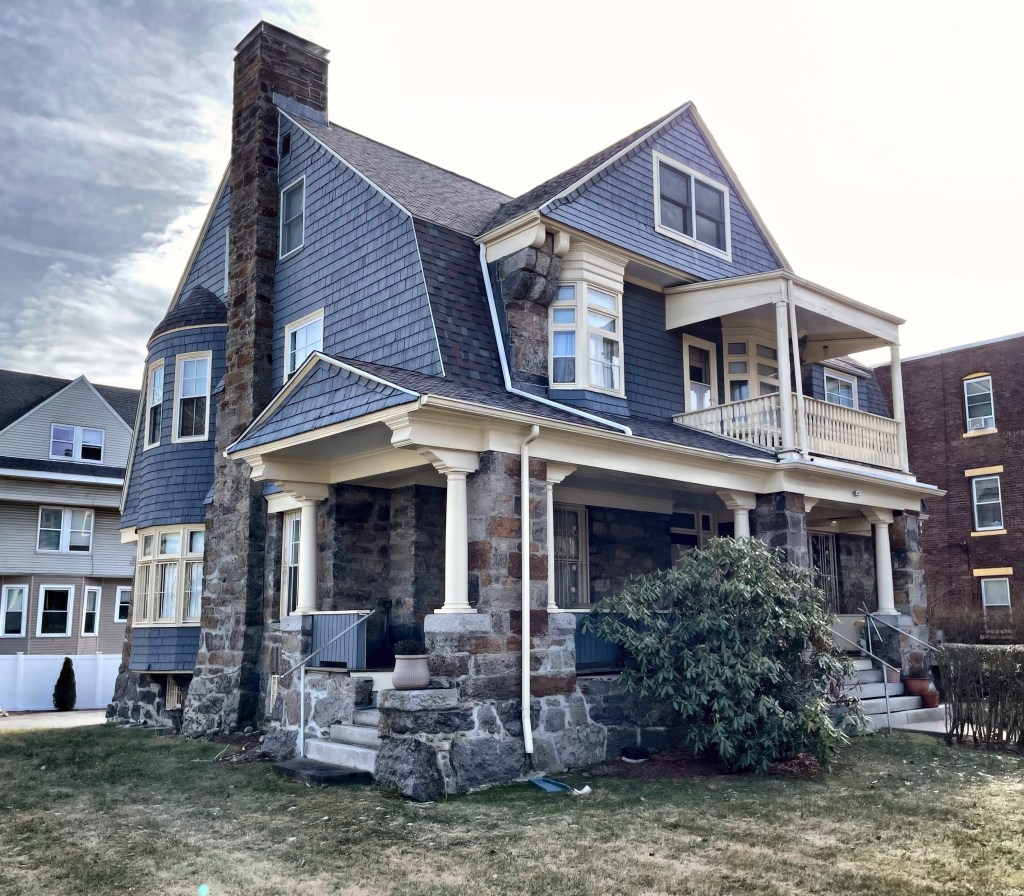
Roxbury is not well-known for its Shingle style architecture, but this example might change that! This dwelling was built around 1895 by the heirs of Horatio Harris on family land that was subdivided for house lots at the end of the 19th century. The expansive Harris estate was developed, largely on speculation and included some amazing single family homes, rowhouses and multi-family dwellings. This Shingle style home appears to have also been built on speculation and was owned by the Harris heirs for some time. The property was occupied for some time by Peleg E. Eddy and his wife Caroline in the earliest years of the house’s existence. I could not locate the architect, but it could be estimated as a design by J. Williams Beal, a local architect who was commissioned to design the nearby Harriswood Crescent development for the Harris family. The design features a Roxbury puddingstone first floor and chimney which contrast elegantly with the shingle siding.
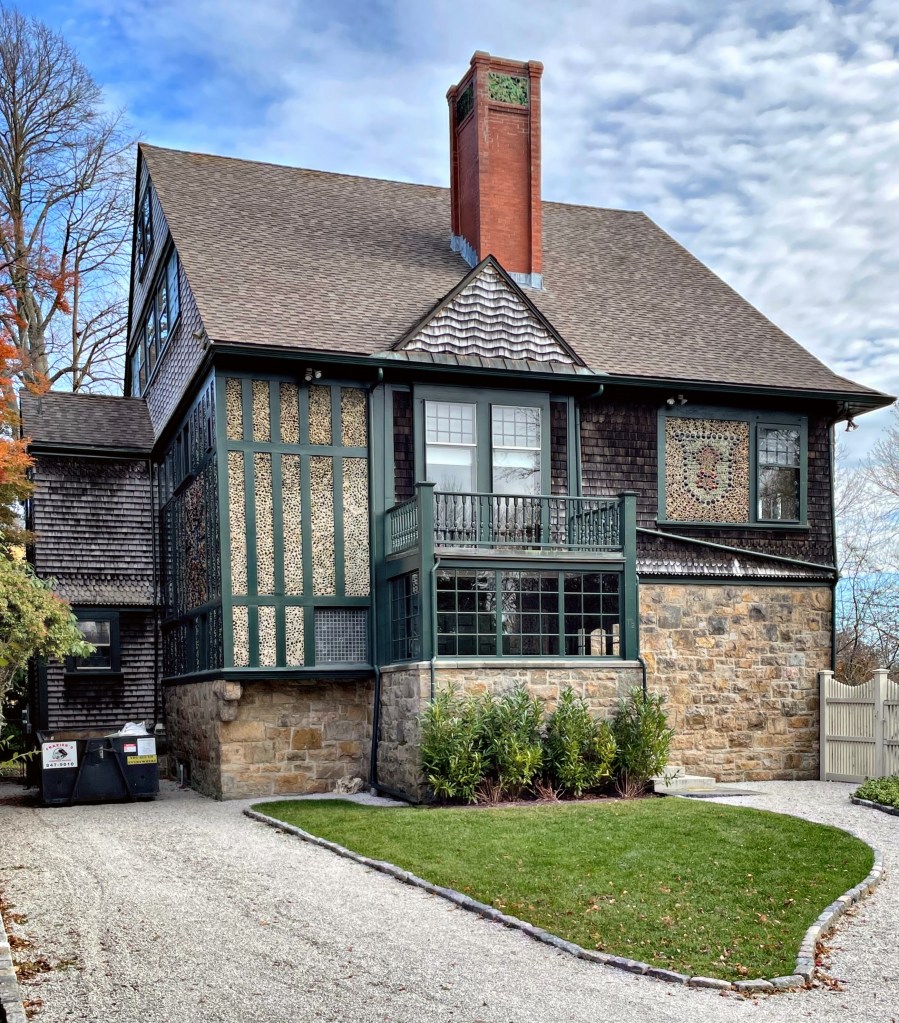
One of the most well-designed and least-pretentious summer cottages in Newport is this charming dwelling on a dead end street. The Samuel P. Tilton Cottage was designed in 1880 by the prestigious firm of McKim, Mead & White as an idiosyncratic blending of Queen Anne and Shingle architectural styles. Mr. Tilton was a milliner (maker and seller of women’s hats) with stores in Boston and Paris, France. He had this cottage built to summer close to the nation’s wealthiest, likely marketing some hats at elaborate Gilded Age events. The facade is assertively Queen Anne with its massing and decorative panels, with shingled side elevation seemingly sprouting from the earth. The architectural terminology for these unique decorative panels is “sgraffito” where here, cement or plaster siding is set and adorned with shells, pebbles, colored glass, and pieces of coal into a cartouche design. The house is one of the finest in Newport, and shows that bigger isn’t always better!
In 1885, a 28-year-old Leroy King (1857-1895) and his wife Ethel Rhinelander King (1857-1925) hired one of the country’s most prominent architects, Stanford White, to design a Newport home for their family. Leroy was the son of Edward King, a prominent local merchant, and upon his fathers death in 1875, inherited some of the $100+million dollar fortune he had amassed in today’s dollars. The corner lot at Bellevue and Berkeley avenues was purchased and work was underway on the new mansion. The house is a really interesting take on the Shingle style, but instead of cedar shingle siding, employs fireproof construction. A central hall, large gabled masses, picturesque window arrangements, and a spectrum of surface textures (here conveyed largely in natural stone and brick with flourishes of shingle and pebble dash work), align this house with McKim, Mead & White’s earlier efforts in this style. The interior has been meticulously preserved and maintained by the owners.
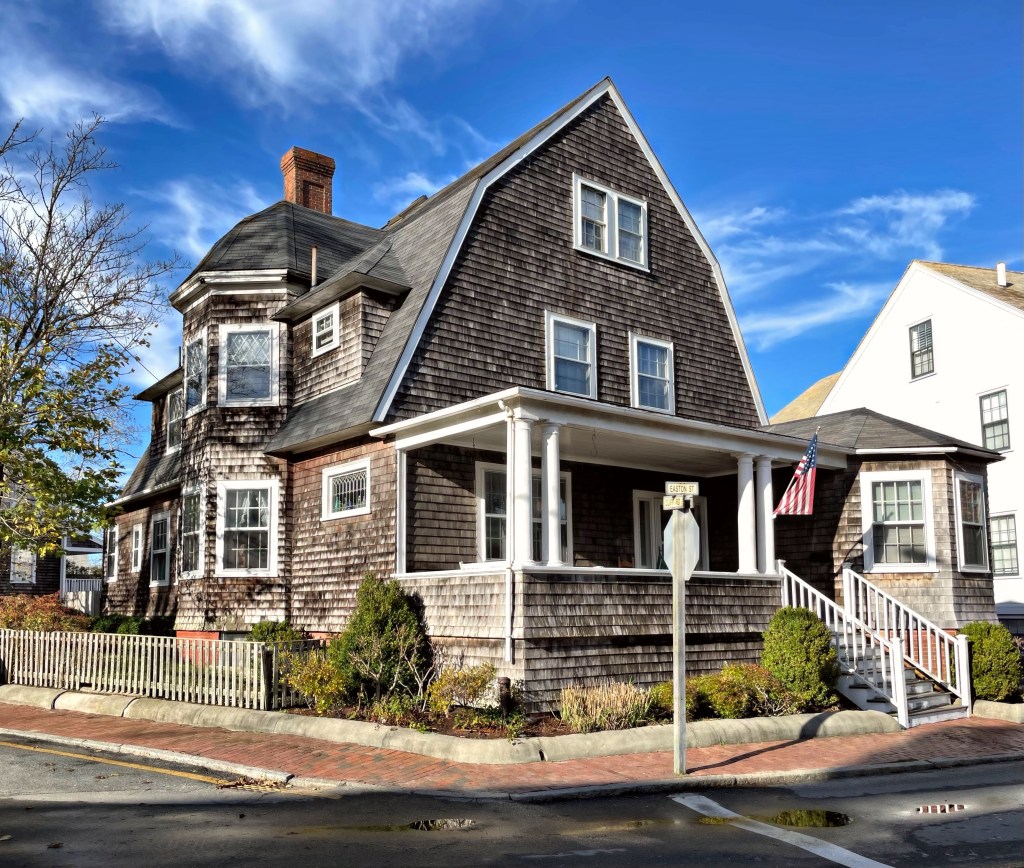
Dr. John Shackford Grouard (1867-1927) was a physician and surgeon born in Allegheny County, Penn. He attended Phillips Exeter Academy, and earned an M.D. from Harvard Medical School in 1889. In 1891, he moved to Nantucket, Massachusetts, where he established his own general medicine and surgical practice. Years after establishing his practice, he built this beautiful Shingle/Queen Anne style cottage that is dominated by a massive gambrel roof and is located adjacent to the Nantucket Hotel. He served as the Town Physician and medical examiner, on the Nantucket School Board, and as president of both the Nantucket Civic League and Citizen’s Gas, Electric, and Power Company. Dr. Grouard also co-founded the Nantucket Cottage Hospital in 1911, but more on that later. Dr. John Shackford Grouard died in Boston in 1927, one week after surgery for a gallbladder inflammation.
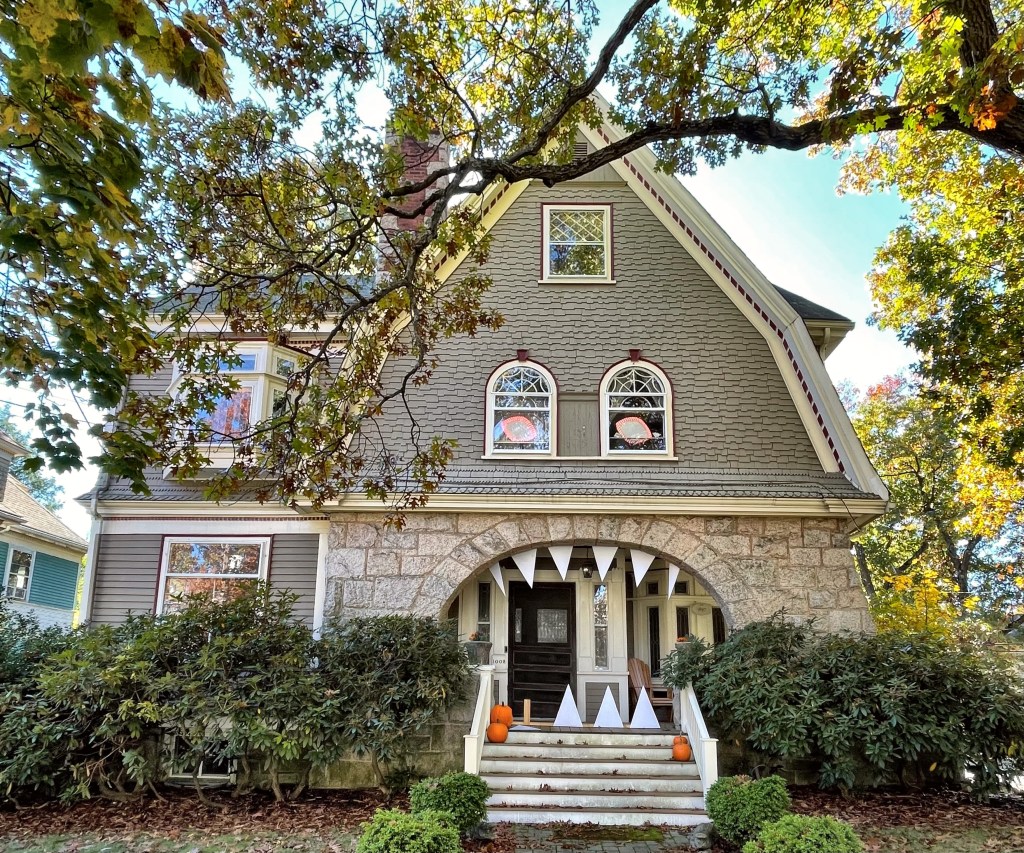
Happy Halloween! To celebrate I wanted to feature one of the more creatively decorated houses in the Boston area, which blends spookiness with architecture! This is the Barrows-Goddard House, so named after its first two owners. The house is located in Newton and was built in 1898 as an eclectic Queen Anne/Shingle style home. The original owner was Joseph Barrows, who developed the property and sold it within a year, relocating to a new home on a less busy street. The property was owned next by Christopher Goddard, an insurance agent with offices in Boston. Architecturally, the gable roof of the main block is intersected by an over-scaled gambrel cross-gable clad in patterned cut wood shingles. The focal point of the design is the Syrian-arched entrance porch of coursed, dressed fieldstone which this time of year, eats trick-o-treaters!
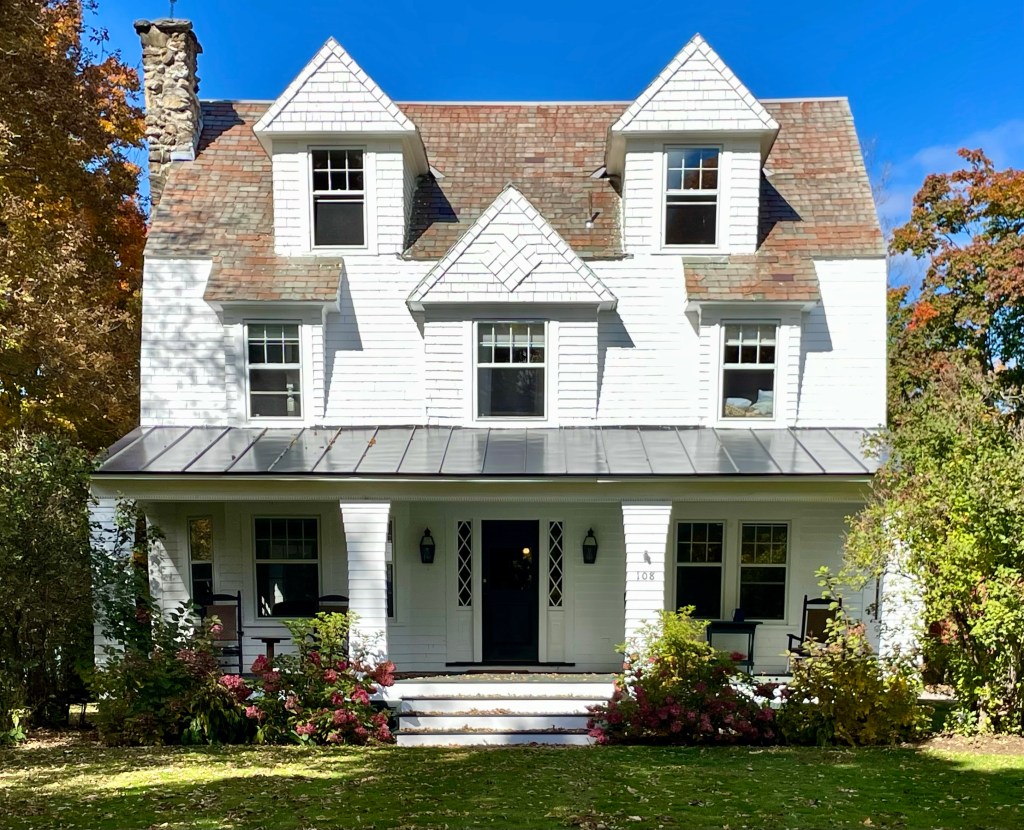
The former Dorset Methodist Church sat on this property from about 1840 to 1900 until they merged with the United Church of Dorset. A Philadelphia physician, Dr. John Herr Musser (1856-1912), built this vacation home in 1906, and passed away just six years later. His widow Agnes Harper Musser (1856-1941) and their children continued to vacation here until after WWII. The home is a rare example of the Shingle style in Dorset and was painted the bright white to fit in with the more traditional New England village vibe, but it would be better-suited with a period- and style-appropriate paint scheme. The home is now offered for short-term/vacation rentals.
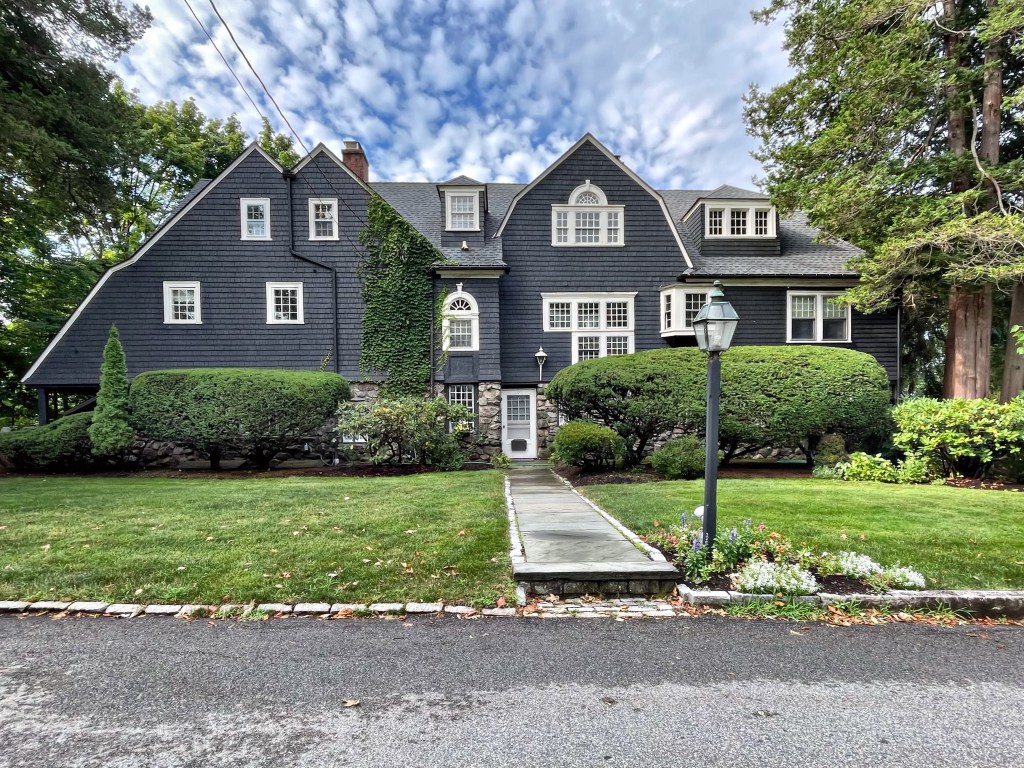
Located on a dead end street in Waban, you’ll find this stunning Shingle style property, which rambles on forever! The house was built in the first decade of the 20th century and blends the Shingle style with the ever-popular Colonial Revival style. I could surprisingly not locate the architect for the house, but I’d guess that it was designed by the architectural firm of Longfellow, Alden, & Harlow, the last of which, Alfred Branch Harlow, shared a last name with the original owner of the home, Arthur Brooks Harlow. (And the same last name as Louis K. Harlow, an artist who lived one street away in a similar style home). I am not sure if these two were related, but thats my hunch. If anyone wants to do more digging on this and share the story with me, I’d be so grateful!
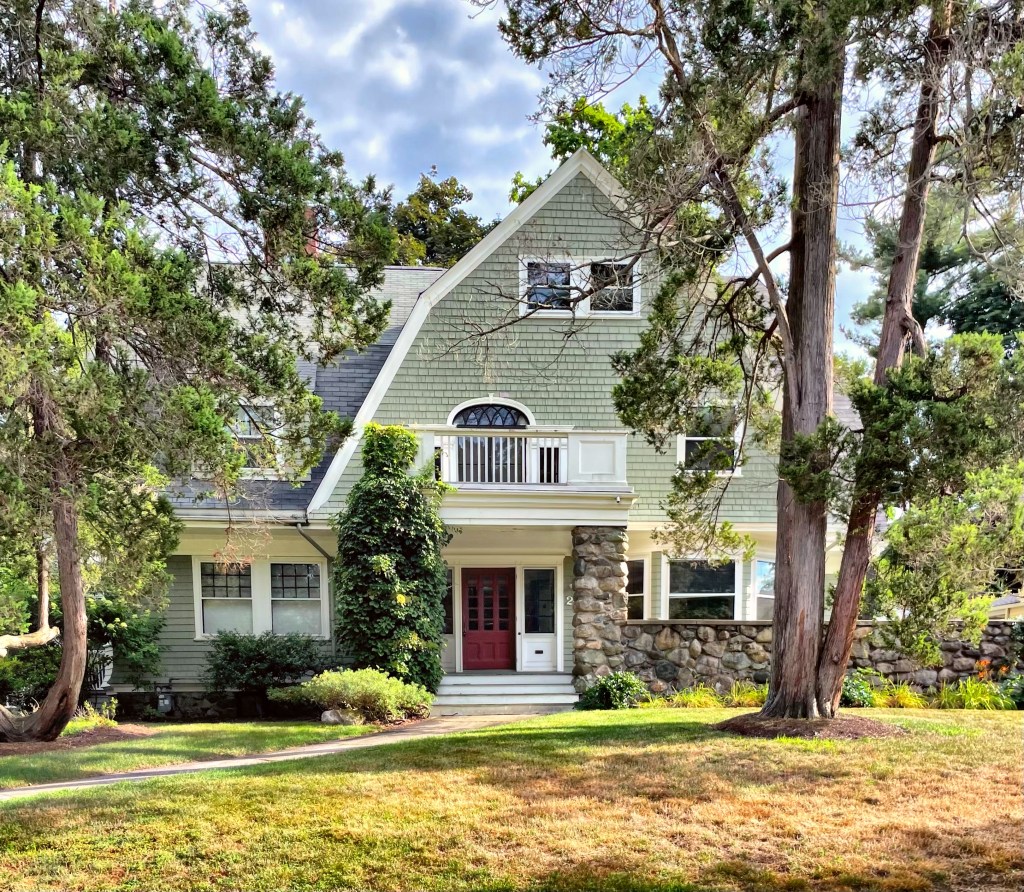
When the Waban section of Newton got a rail line connecting it to Boston, development boomed! Architects who lived in other parts of the Boston area saw an immense opportunity, not only for work, but for a bucolic setting where they could also reside. One of these architects that lived and worked in Waban was Thomas Marriott James, who in the early 20th century, designed and moved into this house on Pine Ridge Road. James was also born in Cambridge but received no academic architectural training. By 1893, Boston directories record that he was a draftsman at the office of Eugene L. Clark, a prolific designer of suburban homes. His residence in Waban blends the Shingle and Colonial Revival styles under a broad gambrel roof. The verandah is inset and has segmental bays with shingle posts as supports. The kneewall is also shingled, adding to the composition.
Benjamin H. Davidson, a wool merchant had this stunning property built in Waban for his family in 1897. Benjamin and his architect envisioned a large, Shingle style mansion, set back off the street. The house obviously exhibits shingle cladding along all surfaces including stone piers coming up from the ground at the porch, giving the house an organic feeling. The design also includes a large stairhall Palladian window, which is obscured from the street by a balustrade.
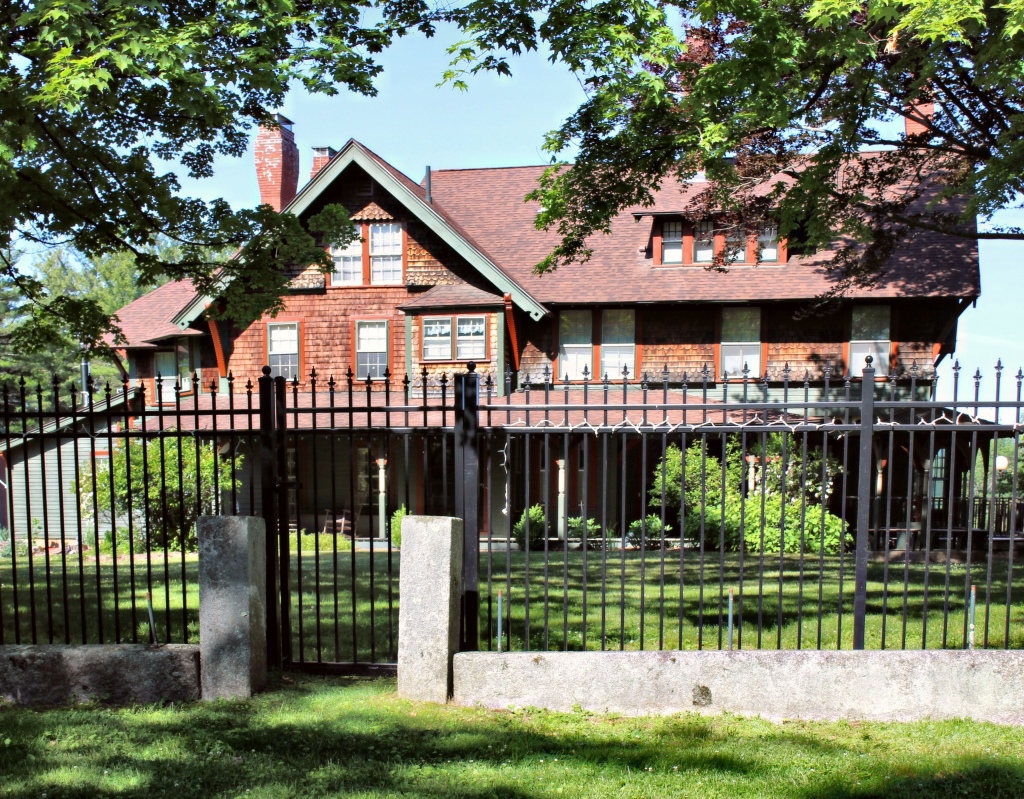
The earliest of Wilton New Hampshire’s summer “cottages” is Moors Manor Cottage, a turn-of-the-century mansion set on former farmland with views of the mountains in the distance! While Wilton never compared to Newport or Bar Harbor as the major summer resort towns for the wealthy, the upper-middle class would sometimes build summer homes in their familial towns where they would escape the hustle-and-bustle of city life. Luckily, this home has been very well-preserved inside and out (but I wish that big fence was gone it really obscures the beauty of the house).
Located at the Naulakha Estate in Dummerston, Vermont, the Kipling Carriage House has long served as a companion to the larger Shingled home. This charming building originally stored author Rudyard Kipling’s carriage and an apartment space for his coachman. The quaint structure sits atop a high stone foundation and retains much of its original detailing, and inside, the structure oozes charm! After Rudyard Kipling sold the estate, the next family converted the structure to a servant’s quarters. In 1992, the British-based Landmark Trust acquired Naulakha as its first American building, later creating the Landmark Trust USA who maintain the property to this day. Like Naulakha, the Kipling Carriage House is available for short-term rentals, which helps the Landmark Trust USA maintain and restore these historic buildings.
I was fortunate enough to be able to spend a couple nights at the Kipling Carriage House and the experience is something I will hold with me for the rest of my life. The wood-lined walls, historic windows, cozy furniture, and fireplace, make you feel so at home, and sweeping views of the Connecticut River Valley add to the splendor. There is something so great about “unplugging” from screens and reading one of Kipling’s books by the fireplace in one of his properties!
Located on a hillside in rural Dummerston, Vermont, you will find Naulakha, one of the most significant properties in the region. Naulakha (pronounced now-LAH-kuh) was built in 1893 for Rudyard Kipling an english journalist and author born in British India, an upbringing which inspired much of his professional work. In 1892, Kipling married Caroline Balestier, who was born into a prominent New England family. The couple honeymooned in Vermont near Carrie’s family home. The couple would settle in Vermont in a cottage which was soon outgrown, leading the couple to buy 10 acres of land from Carrie’s brother Beatty Balestier and built their own house. The new Shingle-style home they had built was named Naulakha after a book written by Rudyard and Caroline’s late-brother Wolcott. Kipling wanted a home that merged the distinctive qualities of the Indian bungalow with those of the American Shingle Style and he worked closely with his architect, Henry Rutgers Marshall of New York City, a Balestier family friend to achieve this.
The rectangular mass of the home parallels the contours the hill upon which its sited, and sits atop a raised fieldstone basement salvaged from stone walls on the property. From the home, Kipling wrote some of his most influential work, including the Jungle Books (1894, 1895), Captains Courageous (1896,The Seven Seas (1896), and The Day’s Work (1898). Sadly, the Kipling’s moved out of Naulakha after just a few years, largely from familial disputes with Caroline’s brother, Beatty. The family removed to England where they settled, though Rudyard always mentioned how much he missed his secluded life in Vermont. The property was then purchased by the Holbrook family, who made slight modifications to the property, but all maintaining the original design and feeling. In 1992, the British-based Landmark Trust acquired Naulakha as its first American building, later creating the Landmark Trust USA to maintain the property and more. The Landmark Trust USA rents out Naulakha and the adjacent carriage house for short-term rentals to provide revenue for maintaining these properties.
For more on my stay at the absolutely stunning Kipling Carriage House, check out my later blog post here.
Located just a block of Main Street in Ridgefield, Connecticut, St. Mary’s Catholic Church stands out as a rare example of Victorian Gothic architecture in a village full of Colonial (and Revival) and mid-19th century buildings. The first known Catholic to arrive in town was James Brophy, who’s family settled in Ridgefield in 1848. While growth of a local Catholic church in Ridgefield was slowly being established, the character of the town was changing by the second half of the 19th century, with wealthy New Yorkers building homes for vacationing in the summers. From this, many Irish Catholic immigrants were hired to work on the new estates. The first permanent Catholic church in town was built in 1867 as a modest wood frame church. As the congregation grew, a new church edifice was needed, and after a capital campaign, funds were gathered to erect a new church. Connecticut architect Joseph A. Jackson (who specialized in ecclesiastical design), was hired to furnish plans for the new church. The building exhibits eclectic architectural styles. Gothic design is seen in the pointed or lancet windows, arches and cast iron finials. The Queen Anne style is reflected in the use of textured and varied building materials, such as brick, brownstone, and shingles. And St. Mary’s most unique feature, its unusual steeple with its four turreted abutments and conical roof worked in shingles, is representative of the Shingle style.