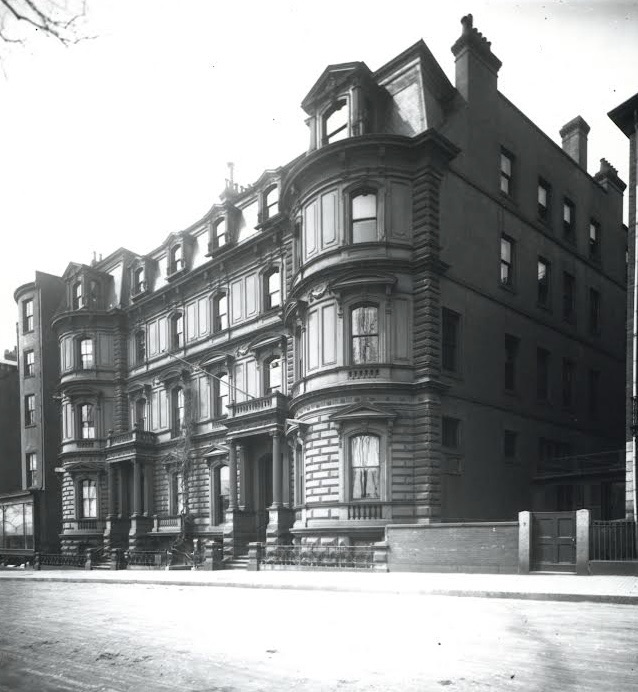
Hutchings-Pfaff Mansion // c.1865

In the mid-19th century, Roxbury was seen as a country retreat for wealthy Bostonians. Many purchased large estates of land and built mansions where they would find peace and solitude from the polluted Downtown areas. As the need increased for more workers, old farms and estates were subdivided, and single family homes, row houses, and multi-family homes sprang up to accommodate the growing population with the advent of trolley service in 1887. This is one of those estates that were demolished. This house was seemingly built for Colonel William Vinson Hutchings after the conclusion of the American Civil War. The stone mansion featured ample porches and a large stone stable amongst winding dirt paths and mature trees. The property was eventually purchased by Henry and Agnes Pfaff, of the Pfaff Brewing Company nearby. The lot was subdivided by 1895 with houselots carved out of the larger estate. By the 1930s, the stone mansion and stable were demolished, leaving just the stone gatehouse (next post) as the last survivor of this once great Roxbury estate.

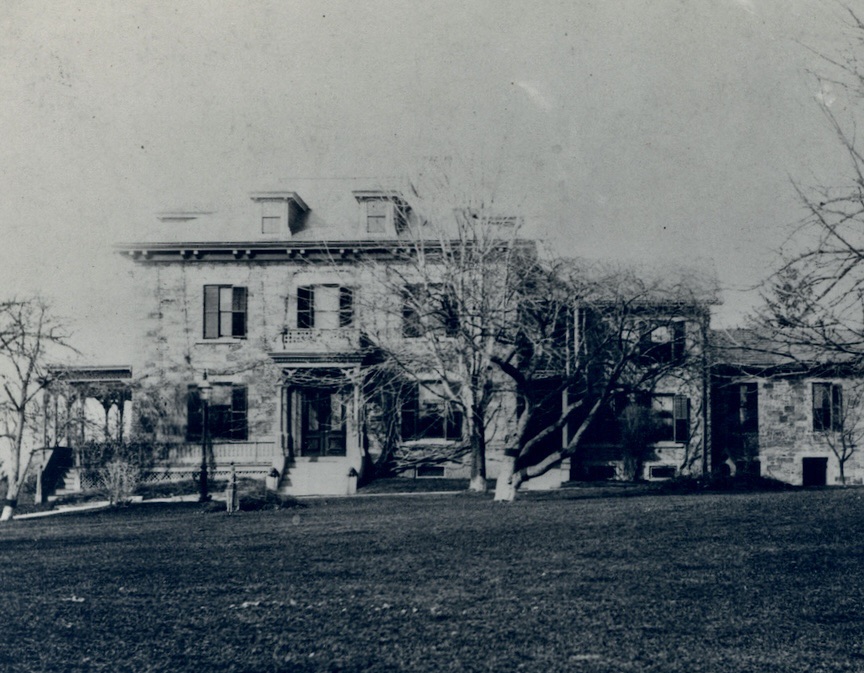
Town-Sheffield Mansion // c.1836-1957

One of the biggest architectural losses in New Haven was the 1957 demolition of the Town-Sheffield Mansion, formerly on Hillhouse Avenue. The mansion was built around 1836 by esteemed American architect and civil engineer Ithiel Town (1784-1844) as his own home on Hillhouse Avenue in the Greek Revival style; here he kept what was then an extraordinary architectural library, which was said to have been larger than any other personal collection anywhere at the time, including that of Sir John Soane in London. After Town’s death, the house was bought by Joseph Earl Sheffield in 1859, benefactor of the Sheffield Scientific School at Yale, and modified by local architect, Henry Austin in the Italianate Villa style. Alterations included two large asymmetrical towers, a new porch, and symmetrical side wings with large bay windows. After Sheffield’s death in 1889, the building was used for laboratory space for the school. Although the house was one of Austin’s most important works, it was demolished in 1957 by Yale to make way for Dunham Laboratory.

The Colony // 1898-1969

In 1898, before the Berzelius Society at Yale built their present “tomb” in New Haven, the organization funded one of the finest residence halls in town at the time. The building was known as “The Colony” and would house Seniors who were members of the secret society. Located on Hillhouse Avenue, the stately Colonial Revival/Neoclassical building was designed by architects Henry Bacon and James Brite. Bacon is best known for having designed the Lincoln Memorial on the National Mall. Yale purchased the Colony dormitory in 1933 for student housing, later using it for faculty offices before demolishing it in 1969 to facilitate construction of the Yale Health Services Center, one of the least inspiring buildings on the campus.

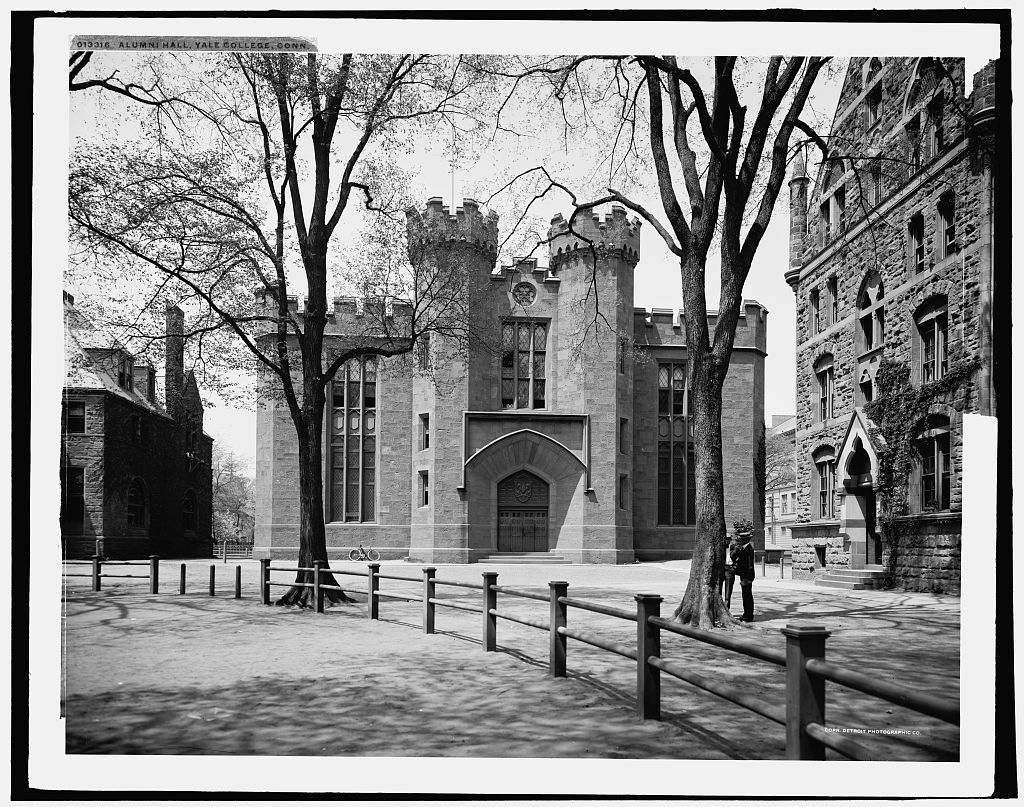
Yale University – Alumni Hall // 1851-1911

Detroit Publishing Company image

Alumni Hall at Yale was designed and built between 1851-1853, at the northwest corner of Yale’s Old Campus. Its was designed by Gothic specialist architect Alexander Jackson Davis, who completed Dwight Hall (the Old Library) a some years prior. The building had a large, open floorplan on the first floor for large gatherings as well as the entrance examinations, along with the biennial examinations that every student had to take at the end of his sophomore and senior years. As the building turned 50 years old, the campus around it was already looking very different. Shifting priorities for dormitory space in the yard necessitated its demolition for Wright Hall (next post). Alumni Hall was razed in 1911, but its two crenelated towers were salvaged when the building was demolished. They were incorporated into Weir Hall which has been incorporated into Jonathan Edwards College, one of Yale’s residential colleges.

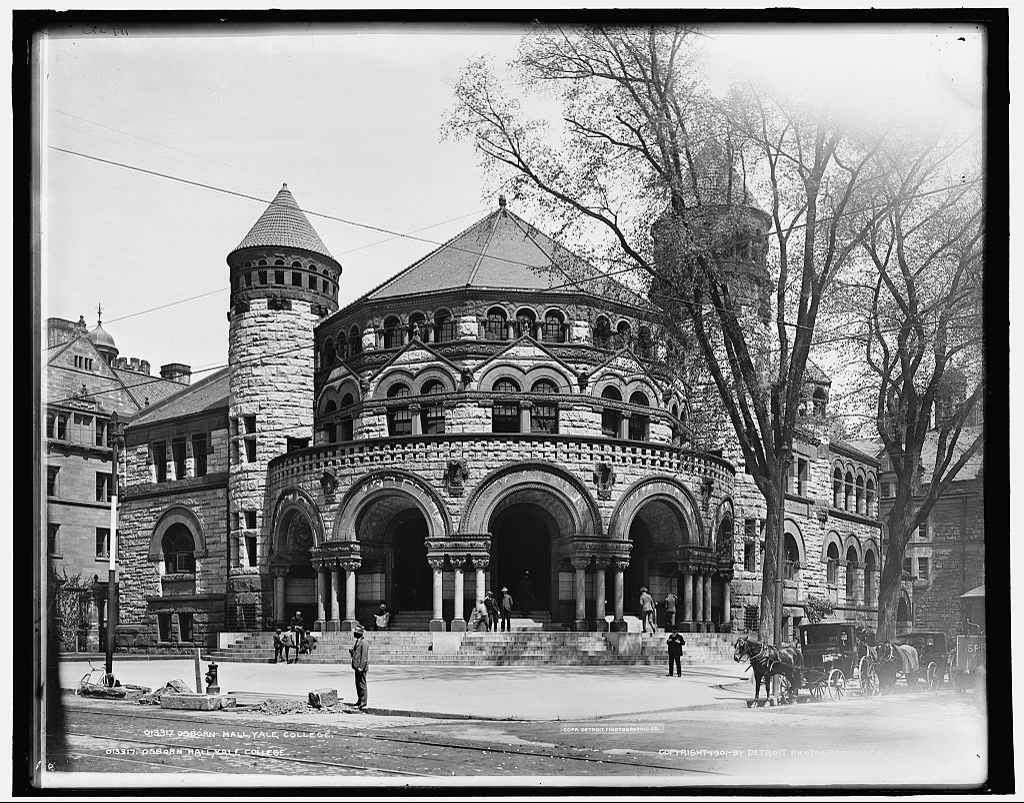
Yale University – Osborn Hall // 1888-1926

One of the biggest architectural losses at Yale was the demolition of the grandiose Osborn Hall in 1926, after standing less than 38 years! The building was constructed in 1888 at the southeast corner of the Old Yard at Yale, at the corner of College and Chapel streets, and was a landmark example of the Richardsonian Romanesque style of architecture. Designed by architect Bruce Price, the building was designed to face outward and was said to resemble a “squating toad with an open lip”. While architecturally stunning, the building was immediately met with criticism. Its construction necessitated the removal of the cherished Yale fence and the outward-facing design made it hard for students to focus on lectures while the sounds of horses and carriages on the cobblestone streets just outside. The short-lived Osborn Hall was razed in 1926 for Bingham Hall (next post), a prominently designed, but inward-facing building.

Powell Building // 1921-1990

Even skyscrapers face the wrecking-ball…The Powell Building was among New Haven’s first building recognized as a “skyscraper.” Built in 1921, the commercial building is Neo-Gothic Revival in style with the two bottom stories and the two top stories are detailed in Gothic motifs, with eight more plain floors between. The resulting shaft-like appearance distinguishes the Powell Building from other contemporary commercial structures in the city, which are essentially heightened versions of various historical styles. The architect, Roy W. Foote, was among New Haven’s leading architects in the first half of the 20th century, largely due to his local efforts in high-rise construction. The Powell Building was erected as a speculative venture by Albert H. Powell, whose primary business was a wholesale coal dealership. Early occupants were professional offices and a bank at the first floor. The building historically was located at the New Haven Green, between the Victorian Gothic City Hall and Classical Federal Courthouse. The building was sadly razed by 1990 by the New Haven Redevelopment Authority, who were VERY active in town knocking down neighborhoods in the second half of the 20th century. It was replaced by the Connecticut Financial Center skyscraper, currently New Haven’s tallest building.

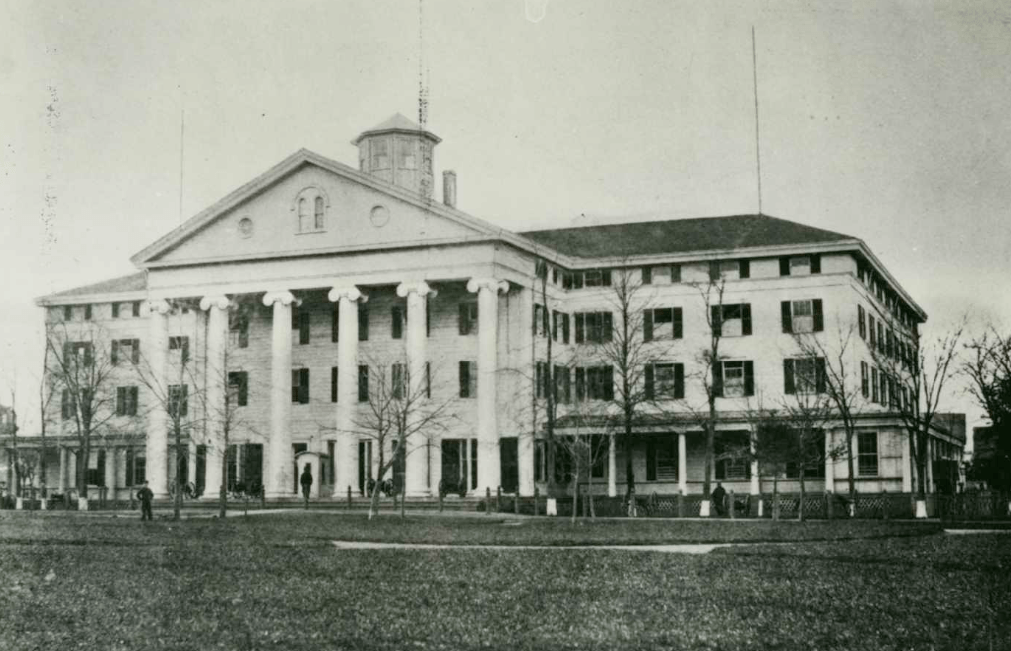
Tontine Hotel // 1824-1913

Historically, inns and taverns offered short-term stays for visitors to New Haven, Connecticut. As the town developed and Yale College grew, land-owners began to realize the potential for larger, centrally located hotels. Established in 1824 and fronting the Town Green, the Tontine Hotel stood for less than 100 years, but was a prominent establishment in the city. The hotel was designed by architect David Hoadley and it hosted many well-known individuals including Native American chief and orator Red Jacket, who gave a speech here in 1829, and Daniel Webster, who came here in 1832. When more modern hotels were built in the early 20th century, the Tontine saw declining and less fancy clientele. The site was slated for redevelopment and the block was demolished in 1913 for the new Federal Courthouse and Post Office (last post).

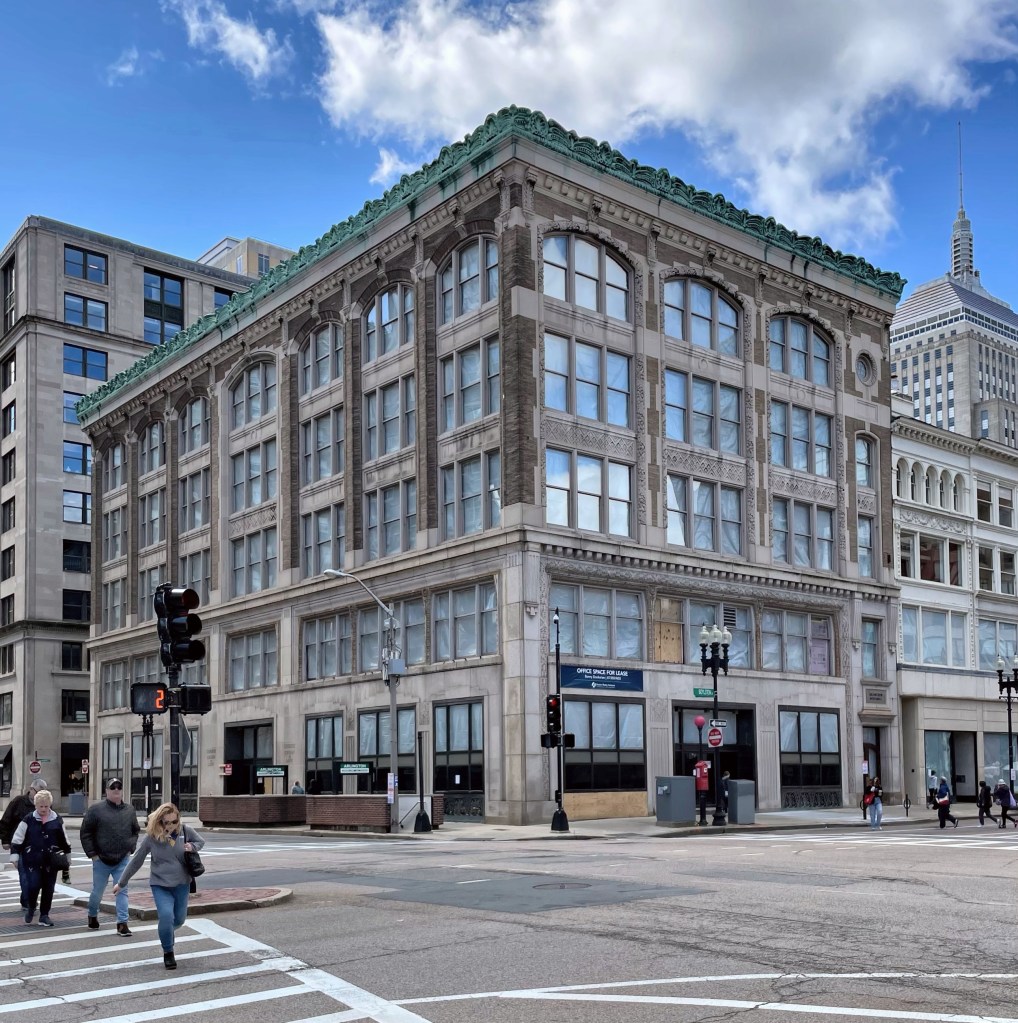
Arlington Building // 1904-2022

This one took me a while to write about because it still pains me to see it was demolished… The Arlington Building was constructed in 1904 as a mid-block building on Boylston Street, across from the Public Garden for the Bryant and Stratton Commercial School. It was designed by architect William Gibbons Rantoul of the firm Andrews, Jacques & Rantoul in the Beaux Arts style. The school building was significantly altered when Arlington Street was extended southward through Boylston Street, making this building suddenly a corner landmark. The new Arlington Street elevation was modeled after the Boylston Street facade. By 1929, Shreve, Crump & Low, established in 1796, the oldest purveyor of luxury goods in North America, moved into the building. The next year, they hired architect William T. Aldrich to add Art Deco embellishments and storefront designs, along with interior renovations to modernize the structure. The luxury company had downsized and moved out of the building, and its prominent site was threatened when owner/developer Druker Co. submitted for a demolition permit to raze the building (and others on the block) to erect a modern office/commercial building. After years of fighting between local preservationists and business interests and developers, the latter won and the building was demolished by late 2022. The new building, 350 Boylston Street, is presently undergoing construction, and in my opinion, is a poor attempt to fit into the surrounding context and is neither as unique or inspiring as the former building.

Almeron Goodell Farmhouse // 1863

The Little River area of Waterbury, Vermont, was a very sparsely developed area of farms located on the slope of Ricker Mountain, which was difficult to traverse and farm. Almeron Goodell (1834-1910) and his wife Luthera bought farmland here in 1863 and built this farmhouse that year from rough-hewn timbers on the land. In 1870, the couple and their seven-year-old son, Bert, had four cows, one horse, and a flock of chickens on their property – enough to supply the family’s needs. Life on Ricker Mountain was hard. By the late 1800s, the loss of soil fertility on the land prompted some farmers to abandon the hillsides for more fertile land in the valleys nearby or the free land offered in the American West. Additionally, the Green Mountain Power Company began purchasing farmland to erect a hydroelectric dam and reservoir in 1920, effectively abandoning the area. The Little River area was left behind, with abandoned farms, family cemeteries, and carriage roads, slowly returning back to the earth. Luckily for us, the area is preserved as part of the Little River State Park, where you can hike and explore the area, learning about the past inhabitants of the now ghost village. The Goodell Farmhouse is the only extant farmhouse left from this early settlement and a lasting reminder of how hard life was for many who settled in undeveloped land in New England. The farmhouse was used as a hunting lodge in the 1940s, likely the only reason it still stands to this day.

Horatio Harris Villa // 1857

Not much remains of one of Roxbury’s once grand rural estates, but as there is some left, I want to feature it before it’s all gone, possibly any day now! Horatio Harris was born in Dorchester (present-day South Boston) in 1821 and ran a prominent auction house in Boston. He built his country estate in Roxbury beginning in 1857 in the Gothic Revival style, adding on and updating numerous times. During the Civil War, the firm of Horatio Harris & Co. obtained the contract to sell at auction all goods which were confiscated by the United States’ land or naval forces and brought to Boston. He made a lot of money and added to his land holdings and estate house in Roxbury. The mansion’s construction was timely as Roxbury was transitioning from a rural town, with farms and country estates of wealthy Boston merchants, to a streetcar suburb, increasing the land value of his holdings. The estate included nearly 30 acres of meandering paths, a lake with an island, outbuildings, and an observation tower – one of which remain today besides the ruin of the former mansion. Horatio died in 1876, in the decades following his death, his heirs began subdividing the estate, developing some and selling other plots off for houselots. By the early 1900s, Jewish people began moving into Roxbury, mixing with the predominantly Yankee population. By 1915, the Harris manor house was owned by the Hebrew Alliance of Roxbury, Inc. By the 1920s, they expanded facilities, adding a school building to the front of the former Harris Mansion, completely obscuring the facade of the old estate. In the 1940s, the upper stories were removed. Seemingly the death knell of the old Harris Villa was a fire in 2019, which gutted much of the remaining original fabric of the estate. All that remains is a bay window, some window trim details and a Gothic porte-cochere at the rear of the estate. See it before it’s too late!