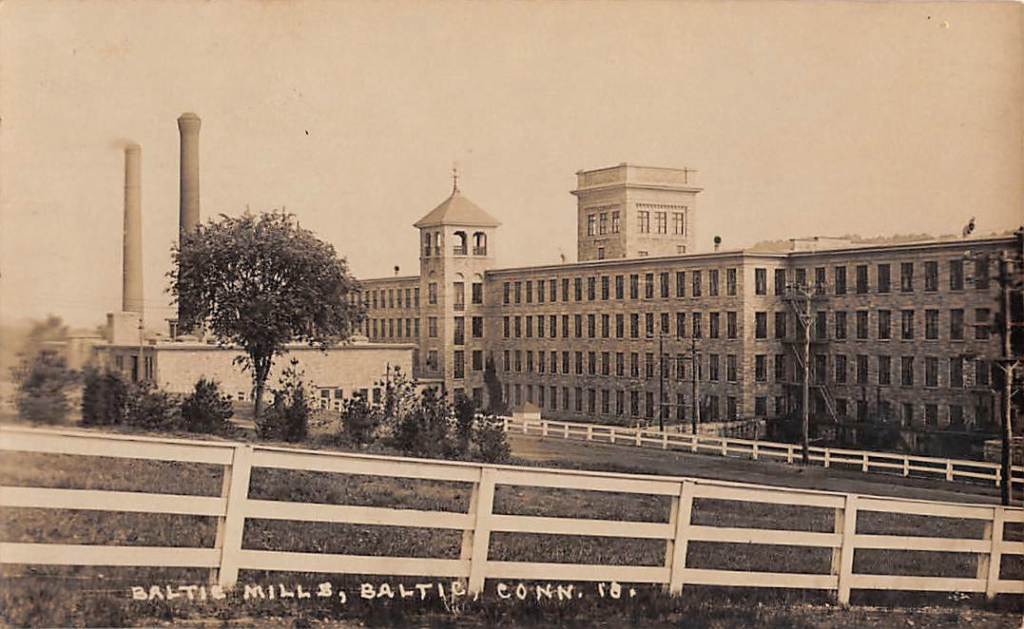
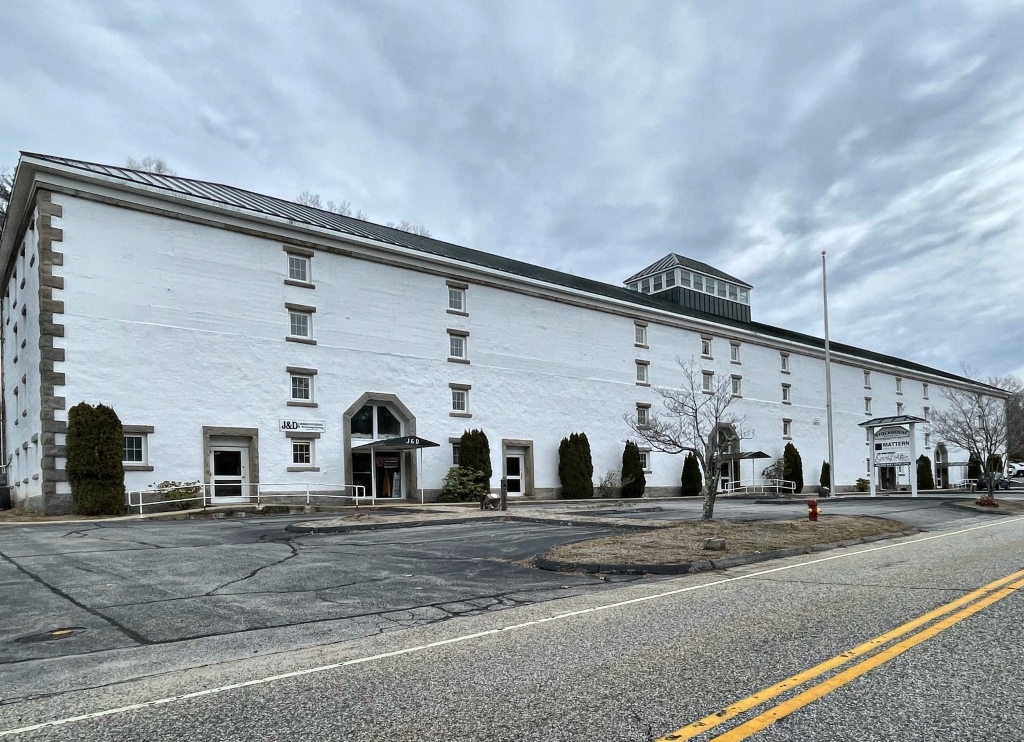
Baltic Mill Warehouse // c.1890

Situated along the Shetucket River in Sprague, Connecticut, lies the remains of what was once the nation’s largest textile mill. At its peak, over 1,000 employees operated 1,750 looms and 70,000 spindles to produce some of the country’s finest cotton. The Baltic Mill (as it became known) not only helped reshape Connecticut’s economic and cultural landscape, but its geographic one as well, giving rise to the founding of an entirely new village. The Baltic Mill did very well until the economic Panic of 1873 set in, decimating the company’s finances. The mill was forced to scale back their operations. Then, in 1877, a fire destroyed the interior of the mill, bringing an end to the complex for decades. At the turn of the 20th century, a businessman from Pawtucket, Rhode Island, named Frederick Sayles purchased the property with an eye toward revitalizing the local textile industry. He founded the Baltic Mills Company and set about making extensive repairs and upgrades to the property, including this c.1890 storage building for materials and finished textiles. Unfortunately for Sayles, the New England textile industry had already begun to decline and it wasn’t long before the company’s depleted finances forced Sayles to sell off much of its assets. The company did survive long enough to produce uniforms, parachutes, and life rafts for soldiers in World War II, but the mill’s operations ultimately came to a halt in 1966. The large 19th century mill would eventually be demolished, but this old Warehouse (a fraction of the size of the mill) is one of the last industrial pieces of the former sprawling complex and is now occupied by local businesses.

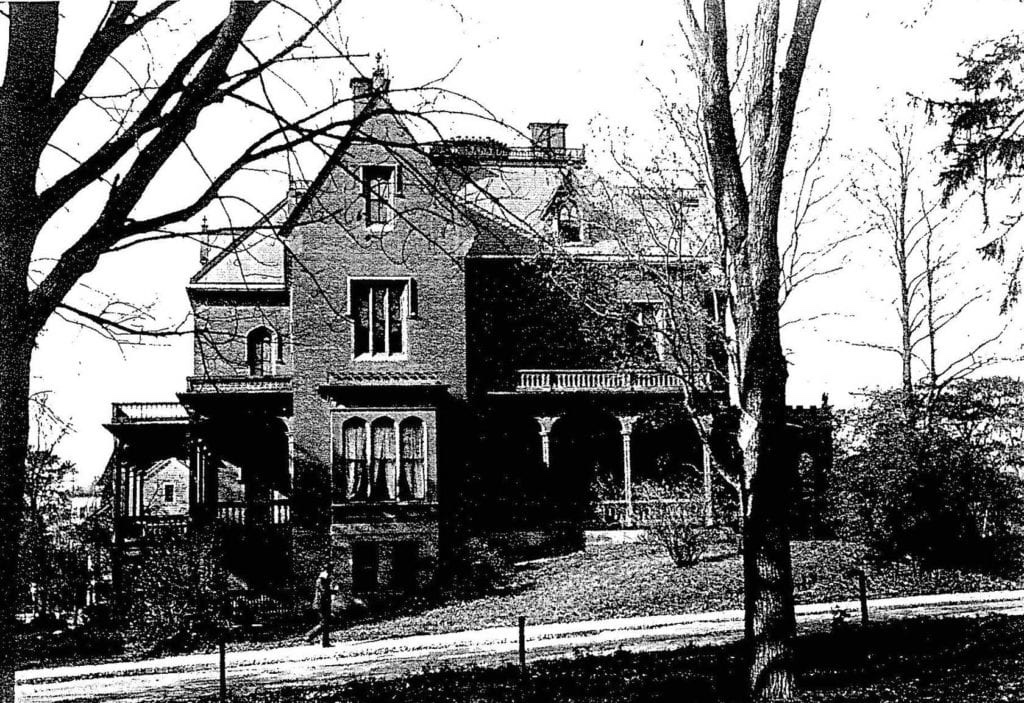
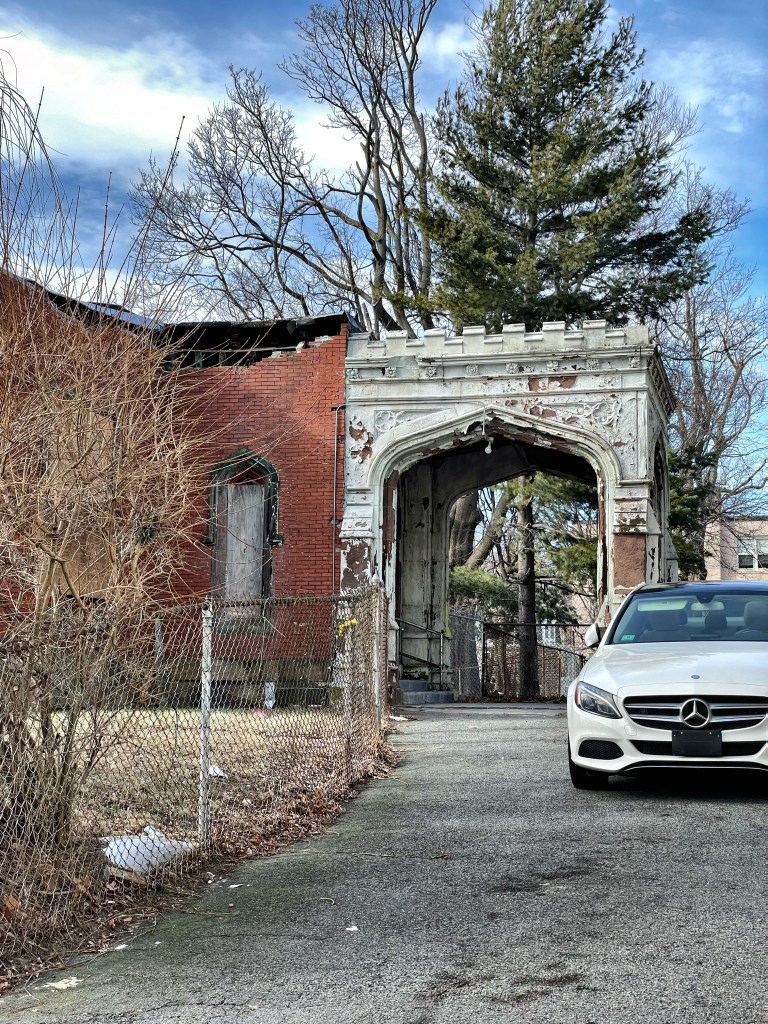
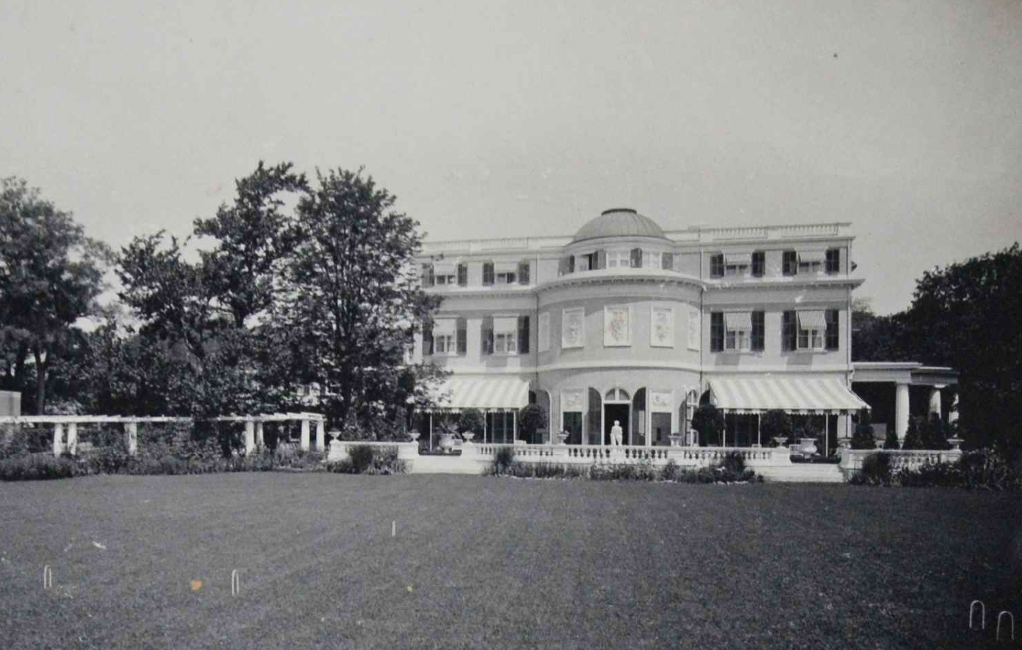
Villa Rosa // 1900-1962

Built as the summer residence of Mr. Eben Rollins Morse and Mrs. Marion Steedman Morse of Boston and New York, Villa Rosa was one of the finest summer cottages in Newport. The property was purchased by Mr. and Mrs. Morse, which originally included three, large estates two of which were featured previously. Mr. Morse was a stockbroker and investment banker, and the couple lived on Commonwealth Avenue in Boston, maintaining a summer home in Beverly, Massachusetts. In 1900, the couple hired Ogden Codman, Jr., a society architect and historian from Boston, to design a townhome in New York (their new permanent home) and Newport, where they could summer with other wealthy New Yorkers. Their cottage, Villa Rosa, was a huge statement, likely to insert themselves into the high-society of Newport summers. Oriented to the south, rather than to Bellevue Avenue, the house took maximum advantage of its long narrow setting. The exterior of the house was covered in pastel pink stucco offset with white bas-relief panels and was crowned by a copper dome. The heart of the house was the green trellised circular Music Room or Ballroom, the first room in the United States to incorporate lattice design as a decorative scheme. The property was eventually sold for $21,500 to E.A. McNulty, a Rhode Island contractor. Ogden Codman’s masterpiece was demolished in December of 1962 and an apartment complex built on the site in 1965. Townhouse condominiums replaced the gardens in the 1970s and the gateposts, a final vestige, were cleared in 2004.

Image courtesy of Newport Historical Society.

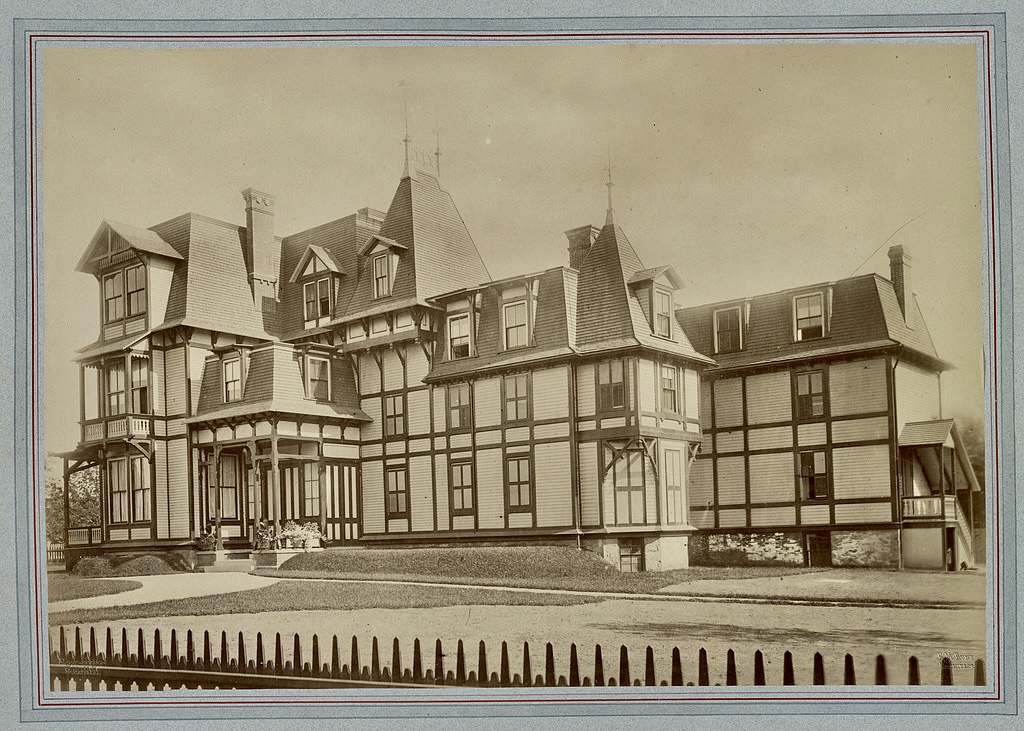
“The Lodge” // 1870-1899

Believe it or not, but Newport, Rhode Island was once a “tear-down town”. Despite having arguably the largest extant collection of Gilded Age mansions, many older, properties were razed and redeveloped as tastes changed between the mid-19th century and the turn of the 20th century. And then there was the 1960s… But that’s for another time. This stunning mansion formerly on Bellevue Avenue was built in 1870 for Elizabeth Underhill Coles (1813-1891), the widow of William F. Coles of New York City by the high-society architect Richard Morris Hunt. The “cottage” was their summer residence and one of the finest Stick style residences built in the seaside town. The irregular layout, half-timbering and complex roof forms show the influence on the emerging Queen Anne style. The mansion was sold out of the Coles Family after Elizabeth’s death and was razed by 1900 for the second mansion on the site (next post).

Overlook Mountain House Ruins // 1923-

One of the most intriguing and historical hikes around is at Overlook Mountain in Woodstock, there is just something so mesmerising and enchanting about abandoned places. Overlook Mountain has long been a significant location in New York. In the boom years of New York City after the Civil War, more than 90 quarries in the Town of Woodstock (many around Mount Overlook) produced bluestone for sidewalks in Manhattan. By the end of the 19th century, the mountain and surrounding area became a tourist location for New Yorkers escaping the woes of city living, looking to breathe in the fresh mountain air up the Hudson. The current ruins Overlook Mountain House was actually the third hotel on the site. The first Overlook Mountain House was built in 1871 and accommodated 300 guests, before it was destroyed by fire in 1875. It was rebuilt in 1878 by the Kiersted Brothers of Saugerties. Overlook was used irregularly between 1887 and 1917, when Morris Newgold of Manhattan purchased the hotel. In 1921, it was the site of a secret organizational meeting of what was to become the Communist Labor Party of America. The second incarnation of the Overlook Mountain House was destroyed by fire in 1923. And Morris Newgold sought to rebuild with fireproof construction.

His architect used concrete to rebuild the hotel, which likely would have been covered with stucco. They also broke ground for a chapel, stables, and a standalone lodge for private housing for his family. Newgold’s shaky finances paired with the Great Depression made for slow progress, and portions of the resort were still “under construction” as late as 1939 (and the main hotel never being finished from what I could find). Morris Newgold died in 1940 and the property was either sold by his son or acquired via eminent domain by the New York State Conservation Department and made part of the Catskill Forest Preserve. You can now explore the old ruins of the Overlook Mountain House between views of the Catskill Mountains.

1928 House

Pagoda Building // c.1850-1917

For the last on this series of Lost Boston buildings, I present this little-known landmark which was once neighbors to the Old State House. The Pagoda Building as it was named, was located on the corner of Washington and State Streets and was one of the tallest buildings on the street upon completion. The seven-story building of Quincy granite exhibited round arched windows and an interpretation of a belvedere at the roof which served as a penthouse. The building’s upper six stories were residential, including the spectacular Oriental penthouse at the top, with retail space at the ground floor. The architect was a recent immigrant from Britain named George Snell, who clearly made a name for himself, later entering a partnership with James R. Gregerson. The Pagoda Building, which was originally an early “skyscraper” in Boston was quickly surpassed in height and floor plate size and was deemed inadequate for such a prominent location. It was demolished by 1917.

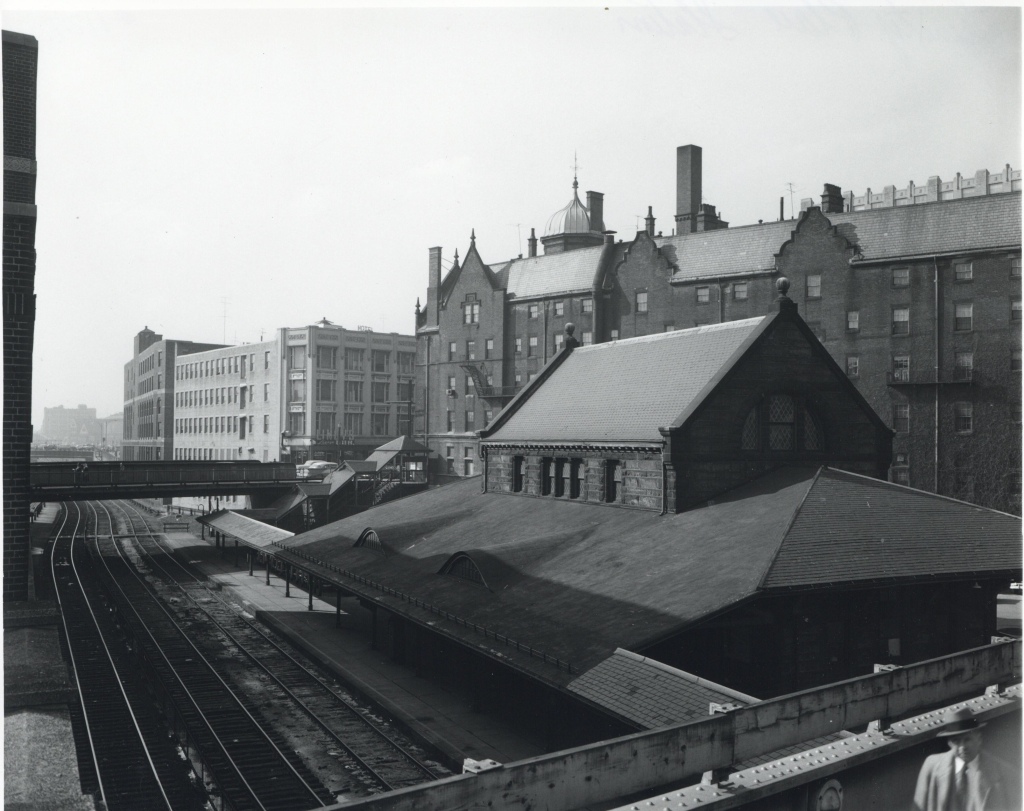
Trinity Place Station // 1900-1964

Trinity Place Station was the Boston & Albany Railroad’s second depot for trains running outbound from its newly completed South Station. The depot was designed by Alexander Wadsworth “Waddy” Longfellow, Jr., who from Harvard University in 1876, later studying architecture at the Massachusetts Institute of Technology and the École des Beaux-Arts in Paris, and then worked as senior draftsman in Henry Hobson Richardson‘s office upon his return to the United States. A. W. Longfellow was also the nephew of poet Henry Wadsworth Longfellow. He designed the station of pink granite with a covered platform 375 feet in length. The building long served train commuters leaving the ever-changing Back Bay neighborhood. Consolidated lines led to the station being deemed obsolete, and it was scheduled for demolition. Much of the old line route would be cleared for the right-of-way for the Mass Pike Expansion into Boston. The demolition on Trinity Place was postponed until early 1964 to allow for scenes of the movie, “The Cardinal” to be filmed there.

Frank Howard Tattoo Shop // c.1870-1960s

Ever so often, I stumble across a historic photo and I end up spending way too much time falling down rabbit-holes uncovering a cool history. This is one of those times.

Frank Howard Packer (1857-1925) was born in Providence, Rhode Island and worked at his father’s jewelry store there, later moving to Chicago. Out west, Frank was first tattooed by a friend, and he was hooked. Frank started using his body as a canvas, and when he ran out of space, his wife Annie was covered with tattoos. The couple were discovered by Barnum & Bailey’s Greatest Show on Earth and were hired to tour the country alongside other acts. Frank was the “Original Tattooed Man” and Annie was the first tattooed woman to tour with Barnum & Bailey. At these shows, Frank and Annie would show off their tattoos and then tattoo spectators for money. Eventually, they had enough money to open a tattoo parlor in a Civil War-era building on Court Street in Boston. The space was originally shared with a barbershop, but it later expanded to the entire floor of the building. Annie died in 1911 and Frank remarried a few years later and seemingly began to wind down his tattooing career. He died in 1925. The old shop building was demolished in the 1960s as part of Boston’s Urban Renewal period.

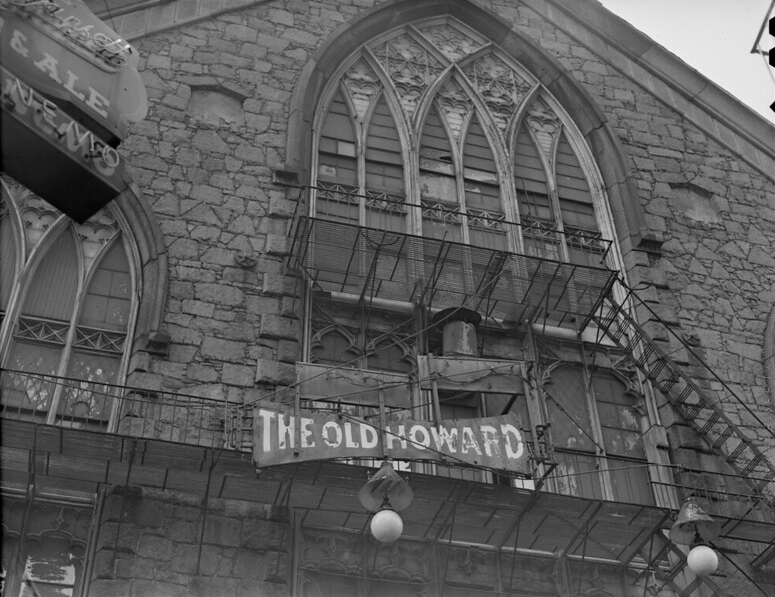
Howard Athenaeum // 1846-1962

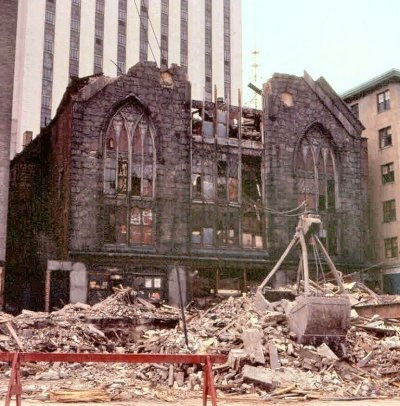
One of the more iconic theater buildings to ever stand in Boston was the Howard Athenaeum, later the Old Howard, which stood on the former Howard Street in Downtown Boston. The origins of the building begin in 1843, when a flimsy, tent was built to serve as a church for the small Millerite sect. The small but loyal congregation eventually abandoned the site following disappointment with the minister’s promise that the world would end in 1844. After Armageddon failed to materialize, the founder of the sect, William Miller, an ex-Deputy Sheriff from Poultney, Vermont, was discredited and the Millerites moved on. After running their former minister out of town, several church members (who had given up all their worldly possessions in preparation for their trip to heaven,) decided to recoup some of their losses by selling the property to Messers Boyd and Beard, who opened a theater here in 1845. A fire destroyed the structure, and it was replaced by a larger, fireproof building that same year. The new building was constructed in 1845 and was designed by architect Isaiah Rogers in the Gothic Revival style with massive granite blocks from Quincy.

The Howard Athenaeum saw many iconic performers and historical events in its 100 years. A young John Wilkes Booth, played Hamlet at the Howard before becoming famous for a more nefarious deed in Washington in 1865. Also, Sarah Parker Remond, a Black anti-slavery activist and lecturer with the American Anti-Slavery Society (and later a medical doctor), had bought a ticket through the mail for the Donizetti opera, Don Pasquale, but, upon arriving, refused to sit in a segregated section for the show. She was forcibly removed and pushed down a flight of stairs. She eventually won a desegregation lawsuit against the managers of the Howard Athenaeum and received $500 in a settlement.

The theater was quickly deemed obsolete and second-tier compared to more modern theatres built nearby. By the mid-20th century, the Old Howard was largely featuring burlesque shows. To keep bringing in audiences, the burlesque performances got more risqué with each year. As a result, the Boston vice squad made the Old Howard the object of their attention. The Boston Vice squad made a 16 mm film during one of their raids in 1953 and captured on film the performance by “Irma the Body”. This film footage resulted in an indecency hearing which eventually led to the closing of the Old Howard in 1953. A fire a few years later along with Urban Renewal led to the demolition of the Old Howard by 1962. Like the former Suffolk Savings Bank (featured previously), the present Center Plaza Building is on the site.

Kate and Charles Page House // 1888-2001

C.1888 photo courtesy of BPL collections

In 1888, Kate and Charles Page purchased a house lot in the sparsely developed Fenway section of Boston. The corner lot at Westland and Parker (renamed Hemenway) provided views to natural scenery and access to many Boston amenities. The couple worked with architect Herbert Langford Warren, who had previously apprenticed under the great H. H. Richardson. Warren took many of the common motifs seen in Richardson’s own style, but he was also a fan of the Arts and Crafts Movement, with its love of fine handicraft. You can see that in the elaborate diaper-patterned brick and in the stepped gables. The gables were a revival of a motif from old Flemish, Dutch, and Scottish architecture, sometimes called corbie-step gables, because corbies (crows) liked to stand on the steps. The interior was just as stunning, with massive brick arches, fanciful woodwork, and a prominent stairhall at the entrance. The couple was likely inspired to hire Warren by their son, Walter Gilman Page, a young artist who maintained a studio space in the home for some time. The home was sold out of the family by 1912. In 1917, the whole house was lifted up one story and a strip of retail stores was inserted beneath it. The original arched entryway then became a second-floor window. It was replaced with a taller building by 2003. Interestingly, upon the opening, the Commissioner of the Boston Parks and Recreation Department and long-time Boston Preservation Alliance Executive Director stated that the 1888 house “looked like a missing front tooth” and was happy to see it demolished.

United States Hotel, Boston // 1839-1930

On August 18, 1929, the United States Hotel in Downtown Boston closed its doors for good. Once housing and feeding over 700 guests per night, the hotel saw severely declining numbers by the time of the Great Depression. Construction on the hotel commenced in 1837, and it was completed two years later in 1839. The hotel was operated by the Messrs. Holman and Clark, who saw an immediate success due to the hotel’s location central to Boston’s major train stations. The hotel (which first contained 300 rooms) did so well that the building was expanded numerous times with undulating additions to maximize light and air into the many rooms. At the hotel, over 150 employees served the guests at their rooms, the dining halls, bathing facilities or the stables which had drivers ready at a moments notice. The United States Hotel was one of the finest establishments in Boston and was thought to be the largest in the country by the middle of the 19th century. The size and amenities however was the downfall of the iconic hotel as Boston’s train stations saw fewer passengers in the early decades of the 20th century. Owners of the hotel sought to squeeze out every last dollar from the complex before they locked her up for good, hosting an auction on everything from beds to a chair said to have been sat on by Charles Dickens during his stay. The hotel was razed in 1930.