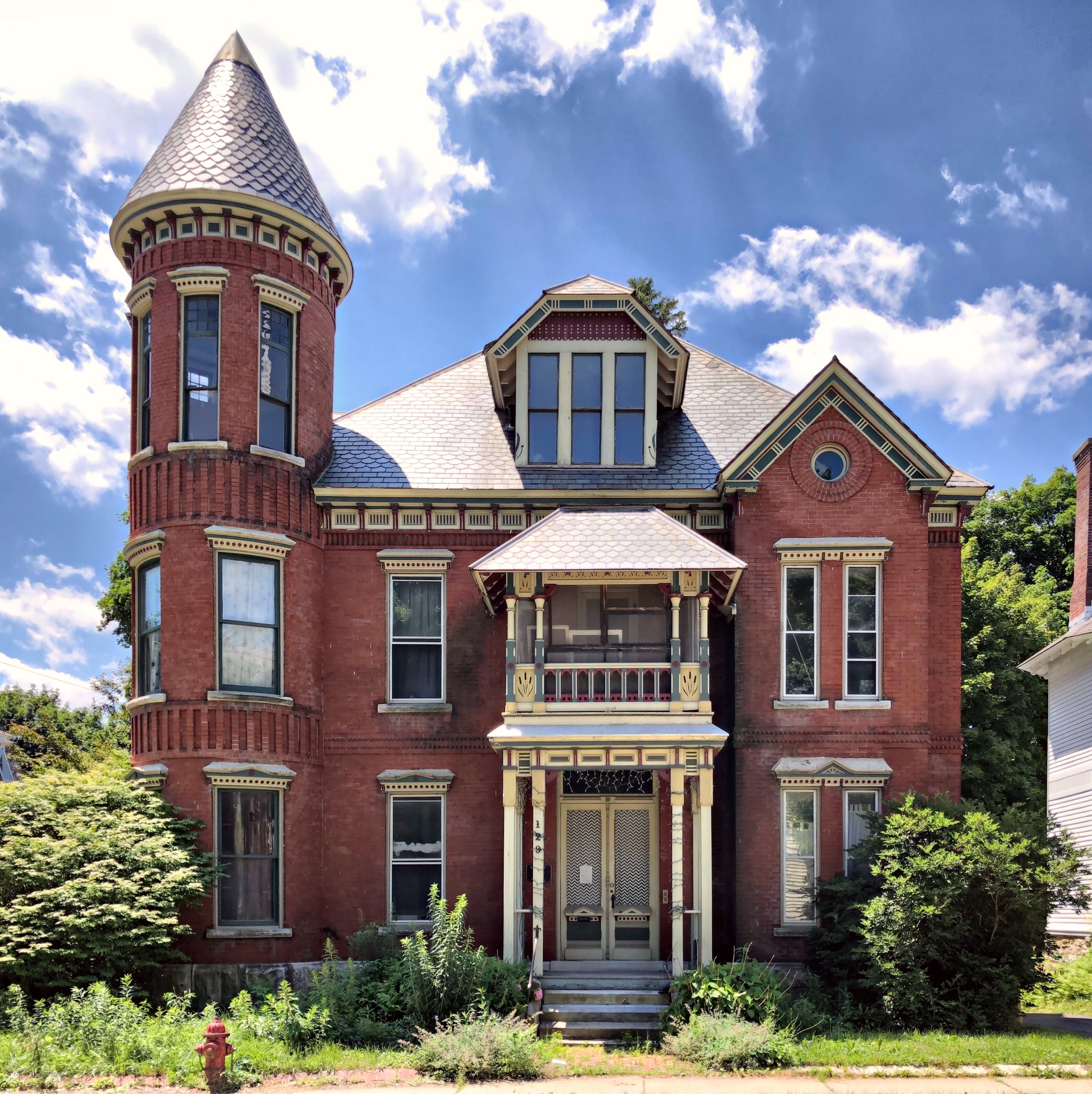
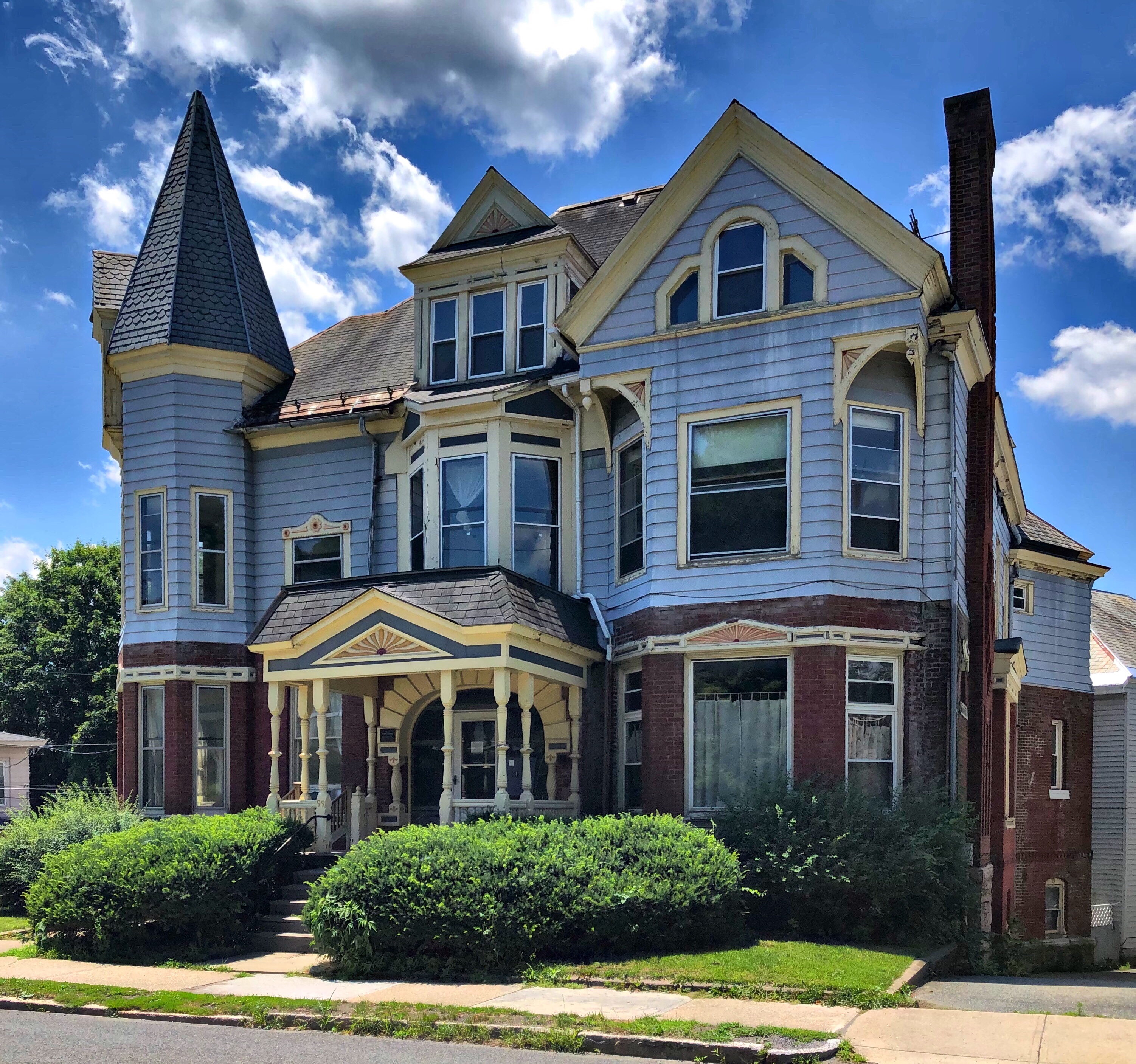
Built in 1881 for William Henry Whitman, this stunning Victorian house remains one of the better-preserved in the town of North Adams. William Whitman was a successful shoe manufacturer in town that lived modestly until his late 40s when he had this home built. The brick home is trimmed with freestone and features a very prominent three-story corner tower with conical roof. The house is a blending of the Stick and Queen Anne styles, under the umbrella of the ‘Victorian’ classification.
The Blackinton area of North Adams had no organized church congregation in the mid-nineteenth century; instead, the community met in the public hall and attended sermons given by a professor at nearby Williams College. By 1871, the hall could no longer accommodate the attendance. In that year, Sanford Blackinton of the S. Blackinton Woolen Mill Company, (who built his new mansion away from the mill)spent $10,000 to build this church, which could seat 300 people. The church was not associated with any specific denomination, and in fact, services were given by a rotating group of preachers from the Baptist, Methodist, and Congregational churches from North Adams. The Victorian Gothic church originally featured a tall steeple, which sadly burned in the 1940s when struck by lightning. The stunted tower was reconfigured at that time. The gorgeous church remains a landmark in the Blackinton area of North Adams.
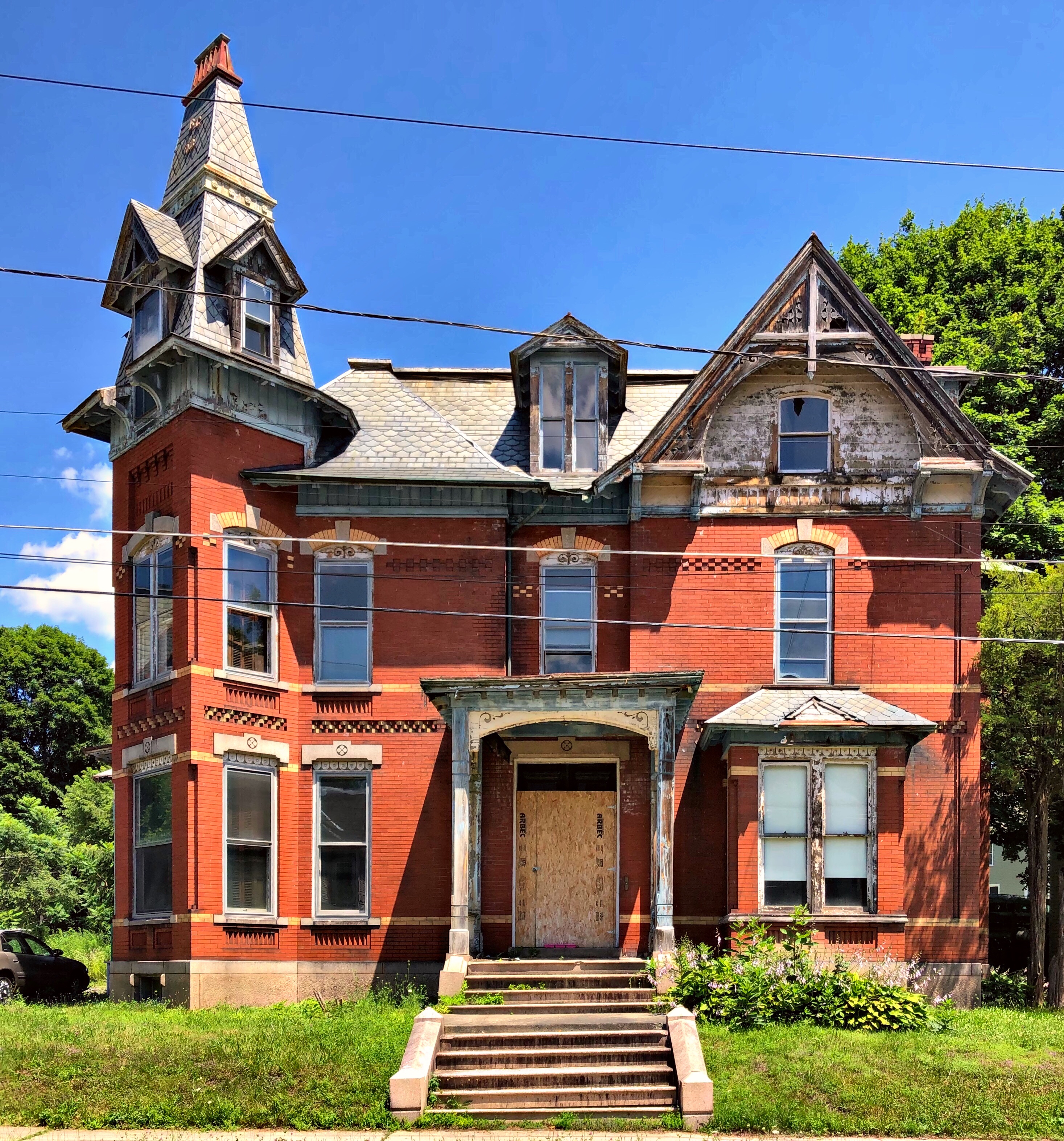
This house was built in 1882 for Frank Walker, a merchant who owned a feed and grain store in Downtown North Adams, Massachusetts. The Stick and Queen Anne style home was designed by architect Marcus F. Cummings, who also designed the Blackinton Mansion. The brick and freestone home was converted to multi-family sometime in the mid-20th-century due to the changing demographics of the town. Since then, the home has seen weathering and deferred maintenance, but retains much of its original detailing and character.
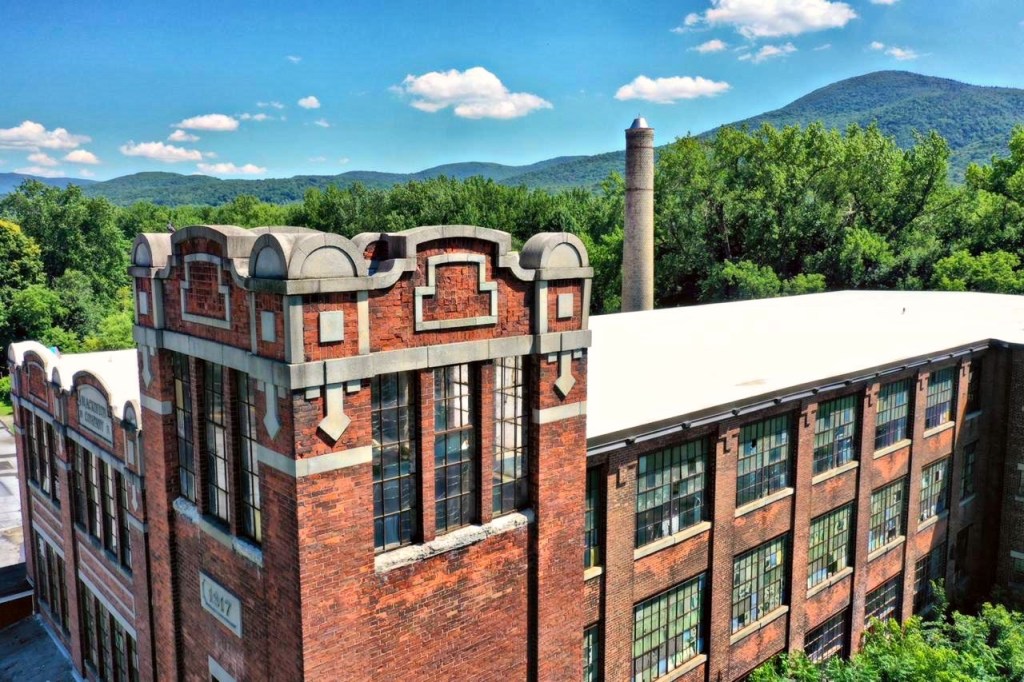
On the outskirts of North Adams, in the village of Blackinton, you will find this massive decaying mill complex slowly being overtaken by Mother Nature and time. The complex is the Blackinton Woolen Mill, which was founded by Sanford Blackinton, who started his woolen mill on the banks of the Hoosic River in 1821 (later building his mansion closer to town). The mill increased production yearly and produced cloth during the Civil War for the Union cause. After, the mill increased production and ran 24 hours a day with the only time the mill would close down would be for mill fires, machinery repairs, or low water supply. In 1869, 162 men, 105 women, and 35 children worked in the mill with the length of the working day being eleven hours! After Blackinton’s death, the mill was succeeded by William Pomeroy, his son-in-law, who had marketed the Blackinton product through his own woolen goods store in New York. In 1917, the present main mill building was built; it is three stories high, with large windows in recessed bays between vertical brick members, resembling pilasters, which rise from the ground to the flat roof. The tower and parapet on the end facing the street are decorated with ornate castellation giving the complex a high-style design. The mill was constructed behind the weave shed (1908) which is a long one-story structure fronting the main street, decreasing the mill’s presence. As is the history of industry in New England, the mill struggled after WWII with a national shift to a service economy away from production. The building has been vacant since the late 1980s and has been eyed for redevelopment into loft and artist studios since.
This mansion in North Adams, MA was built in 1865 for Sanford Blackinton. Blackinton was said to be the first millionaire in North Adams, and his mansion was the most elaborate home ever built in the city. His mill produced woolen goods during the Civil War including cloth for the Union forces. After the Civil War, many factory owners no longer lived amongst their workers, as they formerly had done, but instead built luxurious mansions in other neighborhoods, away from their factories. These large residences were designed in extravagant modern styles to impress the public and reflect the stature of their owners. European materials were even imported to grace these homes, such as the Italian marble fireplaces in the Blackinton Mansion.
Sanford Blackinton built his mansion in the hopes that it would become the ancestral home for his descendants. However, after the death of his widow (their four children died by the 1870s), the mansion was put up for sale in 1896, and was bought by North Adams’s first mayor, A.C. Houghton. He in turn donated the mansion, along with $10,000 for renovations, to the city, to be used as a public library and as a meeting place for the local historical society. He requested that the building be known as the Andrew Jackson Houghton Memorial after his late brother. The home, designed by architect Marcus Fayette Cummings, is a high-style Second Empire mansion with a prominent tower, constructed of red brick with brownstone trim.
The St. John’s Episcopal Church in North Adams, MA was established in 1855 by Rev. William Tatlock and Stephen Higginson Tyng Jr. while both were studying at nearby Williams College. A church was built in 1858, but deteriorated quickly, and the congregation gathered funding to erect this large edifice. Architect Stephen C. Earle, a leading architect in Central and Western Massachusetts, designed the Gothic church constructed out of large stone blocks quarried nearby. The church continued to grow over the next decades, and it was added onto as the immigrant community boomed in town following North Adams’ industrial growth. In 1893, the adjoining Parish House was constructed of the same stone as the main church, also designed by Earle. In the 20th century, membership shrunk due to decreasing population, and in 2011, the parishes of St. John’s Episcopal Church in North Adams and St. Mark’s Episcopal Church in Adams merged to form the All Saints’ Episcopal Church.
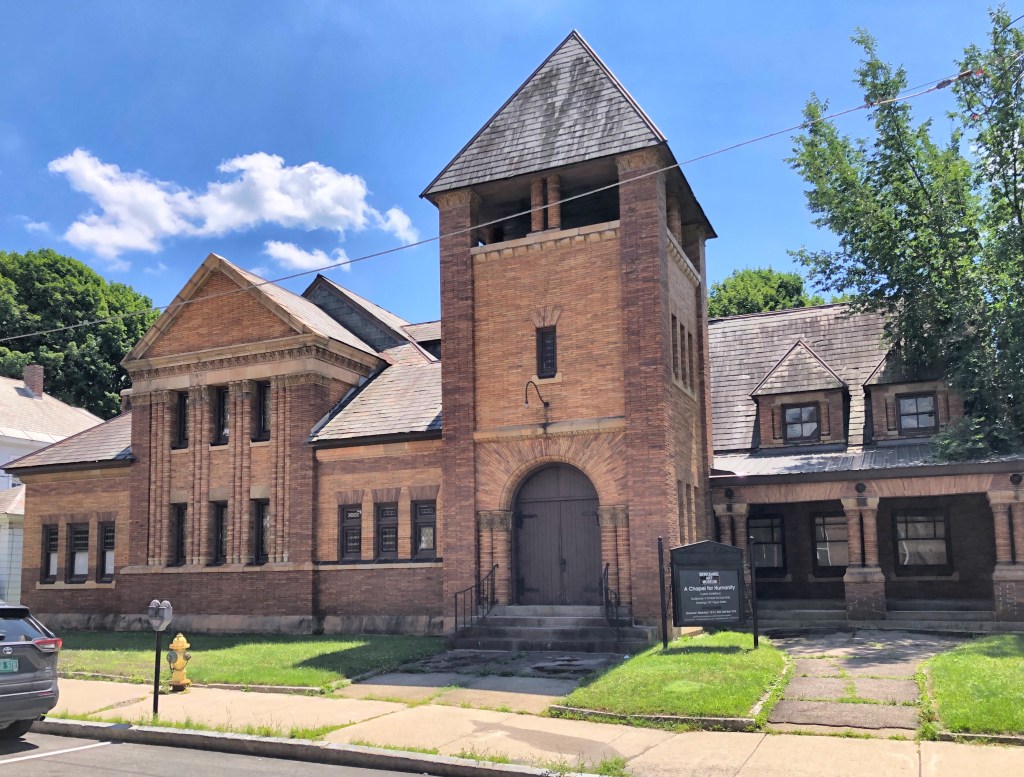
Tucked away off Main Street in North Adams you’ll find this charming little church. The Universalists were organized in North Adams in 1842, restoring an existing church near the Hoosic River. The congregation chose a site for a new church in 1852, and erected a white wooden chapel. It is unclear if the church was outgrown or a fire destroyed it, but the Unitarian society voted to build this church for a cost of approximately $25,000 in 1892. Architect Henry Neill Wilson of Pittsfield drew the plans, and the firm of Porter and Harnam of North Adams constructed the church. Due to the declining population in town in the mid-20th century, the church struggled and was sold to a private owner. The building began to decay by the 1970s and was later sold in 1996 to Barbara and Eric Rudd to house artist Eric Rudd’s installation entitled “A Chapel for Humanity”. The building is currently used as the Berkshire Art Museum Annex.
Located on Main Street in North Adams, you’ll find this monstrous commercial block looking like it belongs in New York, not in Western MA. North Adams in the early 20th century was booming as an industrial center with a rapidly growing population. Due to this, business owners had the capital and clientele needed to erect large commercial buildings. A man named Jencks Kimbell owned a couple large parcels of land on Main Street and ran a livery stable there until his death in 1858. The business was ran by his sons until their death and the property was willed to their widows Clara and Lydia who saw the potential for the site to make them money. In 1902, the two widows erected this magnificent block on Main Street, with a stone facade. Built on top of a quicksand pit, it was the first building in North Adams to be built on steel pilings. I could find no information on the architect, but it is Eclectic to say the least! It has Romaneque arches, monumental pilasters with Corinthian capitals, and a Swan’s neck broken pediment at the parapet.
At the end of the 19th century, many homes built were a hybrid of architectural styles. The Wilkinson House on Church Street in North Adams, MA is one of these examples. The term Eclectic can often be used to describe the phenomena when many architects of the 19th and early 20th centuries designed buildings in a variety of styles according to the wishes of their clients, or their own, blending features and styles which in the past may have been reserved for a single style. This home exhibits features of the Queen Anne and Colonial Revival styles.
Edmund Burke Penniman (1841-1929) was born in North Adams, a son of Mr. and Mrs. Edmund B. Penniman. His father an established lawyer, and mother died, leaving the young boy with a sizable estate. Just before the Civil War broke out, he developed a mill, which had to shut down when the war began. After the war, the company had no orders to fill and they sold the property. Penniman became treasurer for the North Adams Manufacturing Company, and later served as President of the Hoosac Savings Bank. He and his family resided in this Stick style home until his wife’s death in 1909. The home features a brick ground floor and clapboards (now aluminum) above. The Victorian home has a rusticated arched entryway protected by a projecting porch with stickwork. A large corner tower gives the house a large street presence.






 Buildings of New England