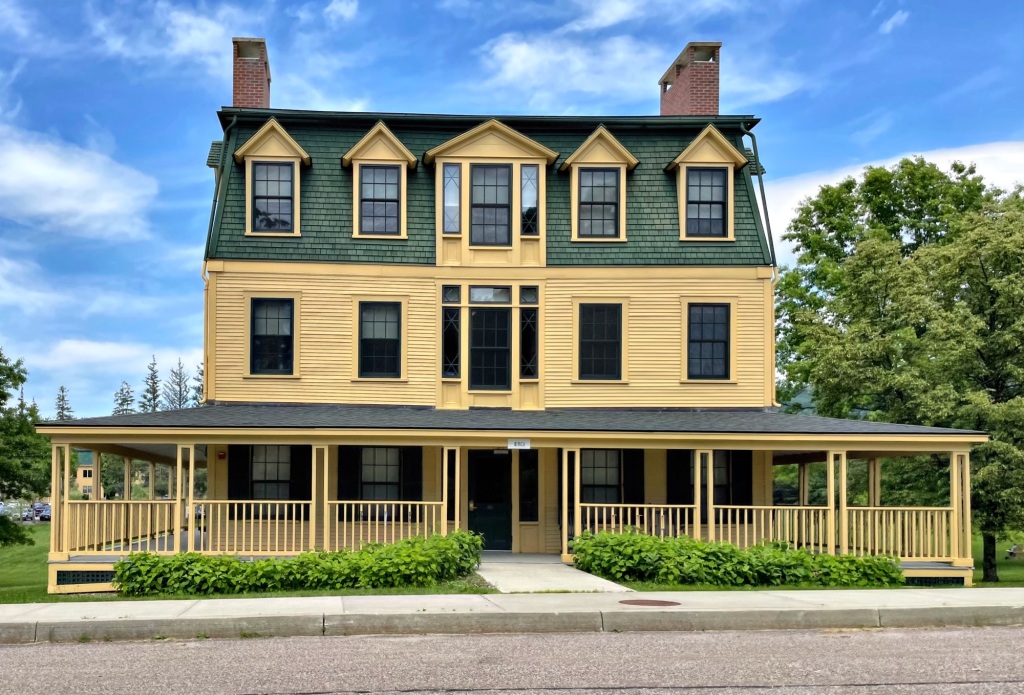
Welcome back to the Bread Loaf Campus! For more early history and context of the complex, check out the post on the Bread Loaf Inn. By 1900, owner Joseph Battell’s enterprise exceeded the capacity of the original inn, and cottages were added to accommodate more guests visiting his new permanent home in the mountains of Ripton, Vermont. An early cottage built by Battell is this late-Mansard structure, named Birch Cottage. The structure clearly took cues from the Bread Loaf Inn, built over a decade earlier, and originally had two floors of porches wrapping around the entire structure.
The Breadloaf Inn is a rare intact example of Vermont’s Victorian resort architecture that also has important associations with the environmental movement and for American literature. Located in the quiet town of Ripton, Vermont, this impressive structure was built in 1882 by eccentric philanthropist Joseph Battell. Mr. Battell attended Middlebury College in the early 1860s but he was forced to abandon his studies due to ill health. On the advice of his doctor, Battell spent a weekend at a farmhouse in nearby Ripton where the clear mountain air would help cure his ailing lungs. He so loved the beauty of the surrounding hills that he decided to buy the old farmhouse, which became known as the Bread Loaf Inn, named for Bread Loaf Mountain not far away. Over the years, numerous new buildings, porches, and barns were added in order to accommodate Battell’s many friends and guests. The Inn, which was remodelled from the farmhouse in 1882, and the surrounding mountains served as Battell’s home and sanctuary for the rest of his long life. He amassed land holdings of over 30,000 acres of forest, preserving it in perpetuity until his death in 1915, becoming the state’s largest landowner when he died. Battell’s vast mountain estate was left to Middlebury College, who brought the seasonal inn back to life as the summer Breadloaf School of English. In 1926 the college added the Breadloaf Writers’ Conference, drawing such luminaries as poet Robert Frost, who spent summers at a cabin nearby. The complex is maintained by Middlebury College to this day, who do a great job at preserving the original buildings.
Robert Frost, the famed American poet is best known for his realistic depictions of rural life in New England. Frequently honored during his lifetime, Frost is the only poet to receive four Pulitzer Prizes for Poetry, and in 1961, he was named poet laureate of Vermont, one of his favorite places to write. Though his writing is often beautiful, Robert Frost did suffer tragedies. His beloved wife, Elinor, died in 1938, causing him to resign from a teaching position at Amherst College. In the fall of 1940, the Frost family experienced another tragedy when Robert’s only son Carol committed suicide at 38 years of age. Robert Frost, who suffered from depression himself, would buy this farm in rural Ripton, Vermont, that year. The farm was a respite to escape to nature and be free from painful memories of the past. Frost chose the site eight miles from Middlebury College, and two miles from the Broad Loaf Inn, where each summer the college sponsored the Bread Loaf Writers’ Conference, the oldest and most prestigious writers conference in the country. The farm he purchased was established by and known as the Homer Noble Farm. The farmhouse seemingly dates to the early 19th century, and the property was added to by a cabin built for Mr. Frost to write and occupy when spending summers on the farm. The property would serve as his country retreat for summers away from his main residence in Cambridge, Massachusetts, until his death in 1963. The property is now owned by Middlebury College. The grounds are open to the public during daylight hours.
Located a stone’s throw from the Ripton Community House in Ripton, Vermont, this church building helps contribute to the village center’s distinguished architectural presence for such a small community. The vernacular church building was constructed in 1864, the same time that the Congregational Church (now the Community House) was built. The Methodist Episcopal parishioners in town met in local homes and schools even before formally organizing their society in 1829, but it wasn’t until the onset of the Civil War that they started construction of a church building. During its full life as a methodist church, the building has also housed members of all faiths, and has been the place of worship for poets, authors and lecturers including Robert Frost, who was a summer resident. The building is well-preserved 160 years later!
The Ripton Community Housestands at the center of the rural village center of Ripton, Vermont, a town in the midst of the Green Mountains. The community house was built in 1864 and is an excellent late-example of the Greek Revival style in this part of the state. The building was constructed on land that was deeded by Sylvester Fisher in 1864 to the local Congregational Society with the proviso that a house of worship costing not less than $2000 must be erected within two years. The church was built and maintained by the Congregational Society until 1920 when it was deeded to the Methodist Episcopal Church to be used for religious, social and educational purposes. This restriction was removed in 1928 and it was deeded to the Ripton Community Club which made renovations and used the facilities for club meetings, social events, community dinners, square dancing and more. The club dissolved in 1964 and the building began to deterioriate for years until the town banded together to protect and applied for grants to restore the building to its former glory, what we can all appreciate today when driving through the quaint town.
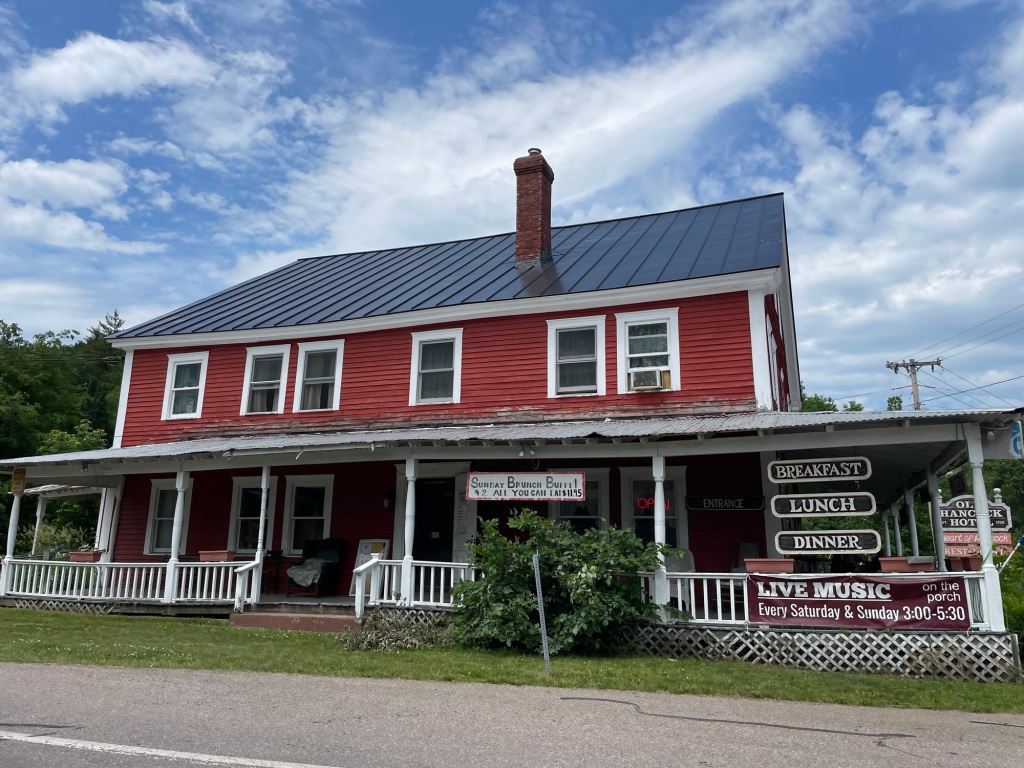
Before the Centre Turnpike was laid out in 1808, better-connecting Middlebury, Vermont to towns east of the Green Mountains, visitors would have to travel hours longer to divert around the mountains. This new route cut right through the small village of Hancock, Vermont and the town prospered as a result. Along the route, this vernacular, Federal period tavern was built shortly after the turnpike aimed to take advantage of the new visitors driving through the town. This tavern/inn was operated for a time by a J. E. Wright as a hotel and the building has a perfect wrap-around porch.
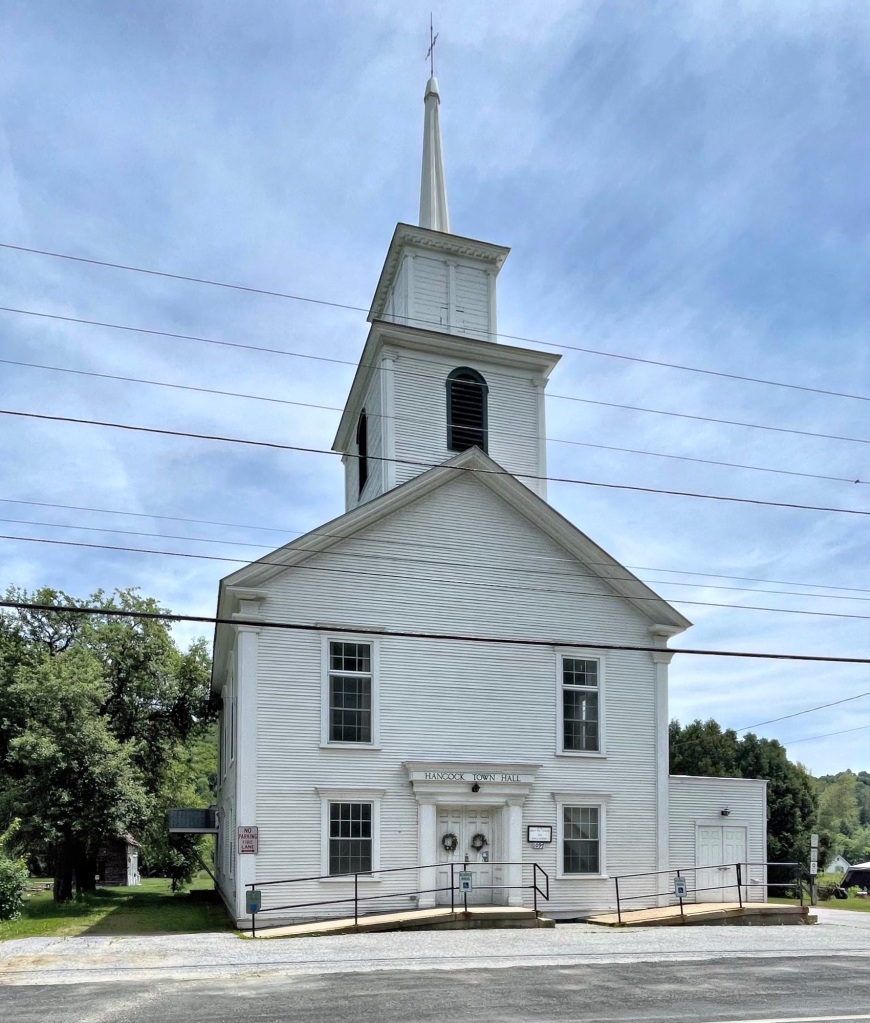
Hancock, Vermont is located in Addison County, and sits on the east side of the Green Mountains. The land here was granted November 7, 1780 and chartered July 31, 1781 by Governor Chittenden, to Samuel Wilcox and 129 associates. Hancock grew as pioneers sought new land and opportunity after the Revolutionary War with some taking up farming and others engaging in the lumber trade. The population in the rural town reached its peak of 472 residents in 1830, a number it has never seen again – the current population is 359. As the town saw its largest growth in the early decades of the 19th century, the town officials decided to erect a joint Town House and Union Church to serve multiple uses. This structure, built in the Greek Revival style by around 1850, has two stories, with the ground floor historically housing town offices, and the second floor formerly housing a meeting space and church hall. The classically designed building has a box cornice, frieze, and molded corner pilasters. The double entrance doors have pilaster and entablature surround and the three-stage steeple has a clapboarded base with corner pilasters. The structure has survived generations and natural disasters and is a testament to this small, but proud town in rural Vermont.
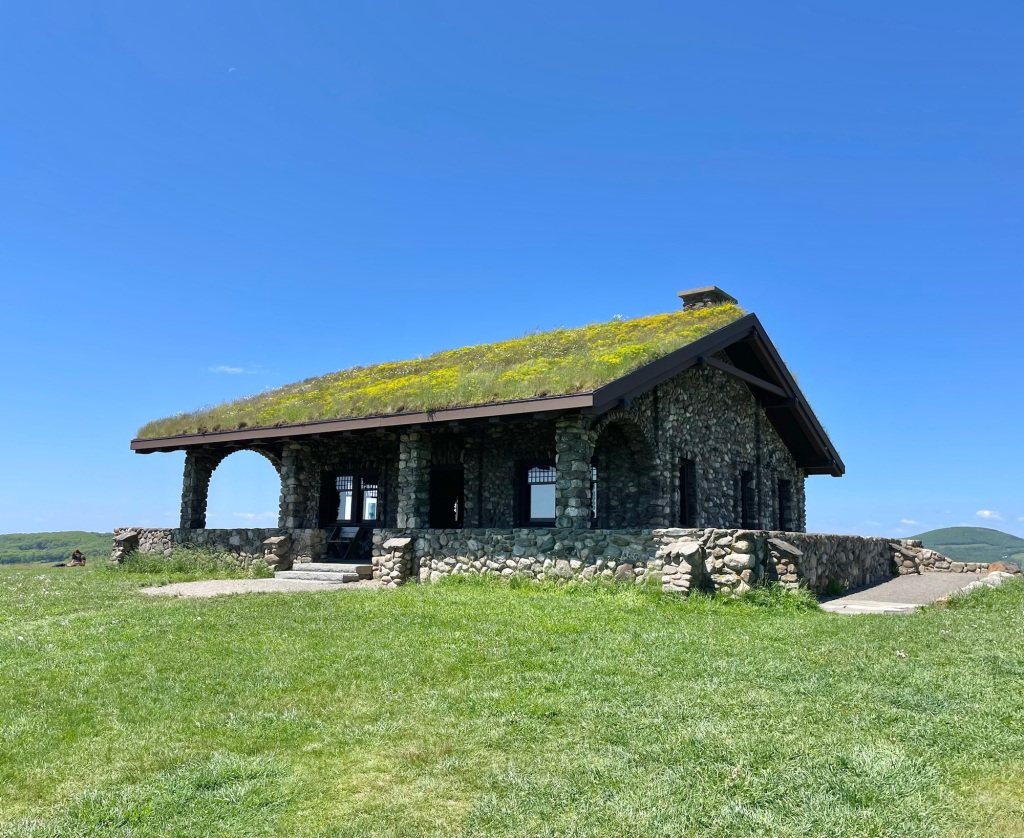
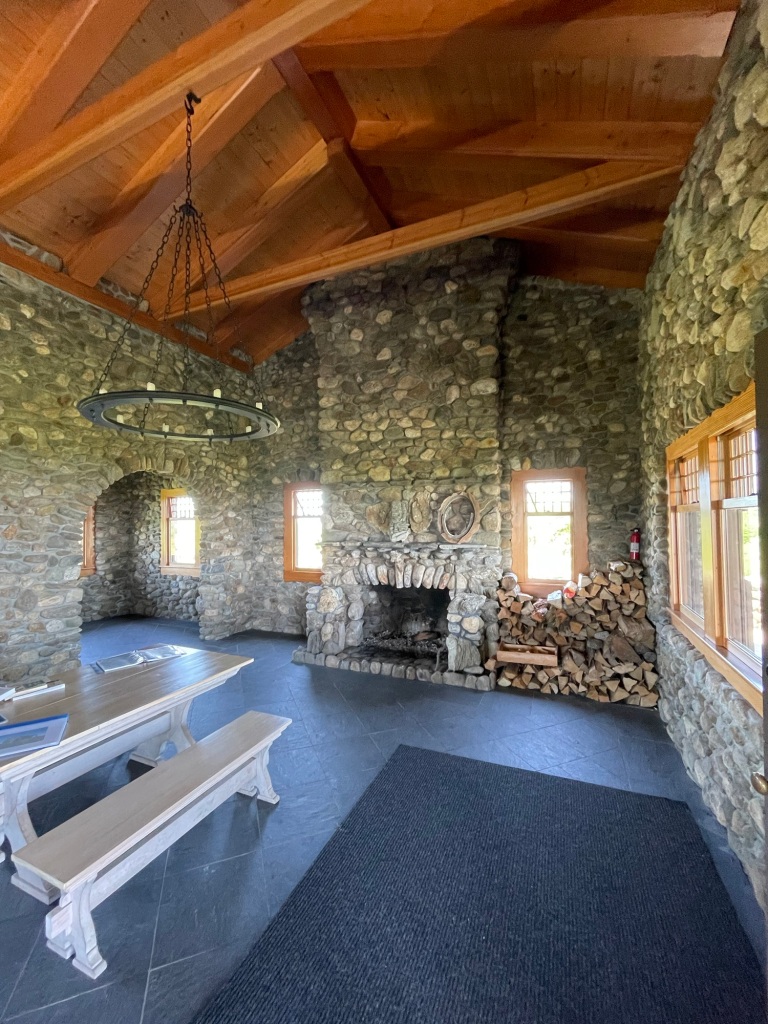
“Beech Nut” is a stone cottage built at the top of Beech Hill in Rockport in one of the best hiking areas of Mid-Coast Maine. The hut was built in 1913 for owner John Gribbel (1858-1936), a Philadelphia-based industrialist, who had a summer estate, “Weatherend” in Rockport. He hired a Norwegian immigrant named Hans Heisted, an employee of the Olmsted Brothers, to improve the grounds at Weatherend, which included meandering paths, stone walls, and stone structures. Meanwhile, the Gribbels had started acquiring land on Beech Hill in 1909, and eventually accumulated holdings of more than 300 acres. To keep the masons and landscapers busy during the winter, Gribbel and Heisted thought to build a small hut a few miles away on Beech Hill, which would serve as the family picnic and tea shelter. The stone building features a unique sod roof which was typical of Scandinavian houses up until the late 1800s. Once complete, family and friends would visit Beech Nut to enjoy the fresh air and views of the Atlantic from atop the hill for the day. After successive owners, the property began to deteriorate until the 1980s, when developers began to swarm the open space for redevelopment. In 1986, the land around Beech Nut was put under conservation easement and was acquired in 2003 by the Maine Coast Heritage Trust, which then transferred it in 2006 to the Coastal Mountains Land Trust. In 2007, the hut was completely restored and serves as a respite after the uphill climb for visitors.
As coastal communities in Maine’s mid-coast began to see more wealthy summer residents, these enclaves of cottages needed clubhouses and spaces to spend their summer days. In 1899, Philadelphian (and Rockport summer resident) Charles Wolcott Henry converted a section of his oceanfront summer estate at Rockport’s Beauchamp Point to a newly established golf club which quickly outcompeted all others nearby. Within a few years, Boston architect Charles H. Brigham, was hired to design this Craftsman style clubhouse that sits on an elevated site with an expansive wraparound veranda providing views of the new course and the Penobscot Bay. The rubble-stone foundation and walls clad in brown-stained shingles are well suited to the rugged coastal Maine site. The golf course, also designed in 1901, was planned by groundskeeper Thomas Grant as a 9-hole course. The recreational complex has been meticulously preserved and is a great example of a turn-of-the-century clubhouse in coastal Maine. The 1901 clubhouse is also said to be the oldest golf building in Maine!
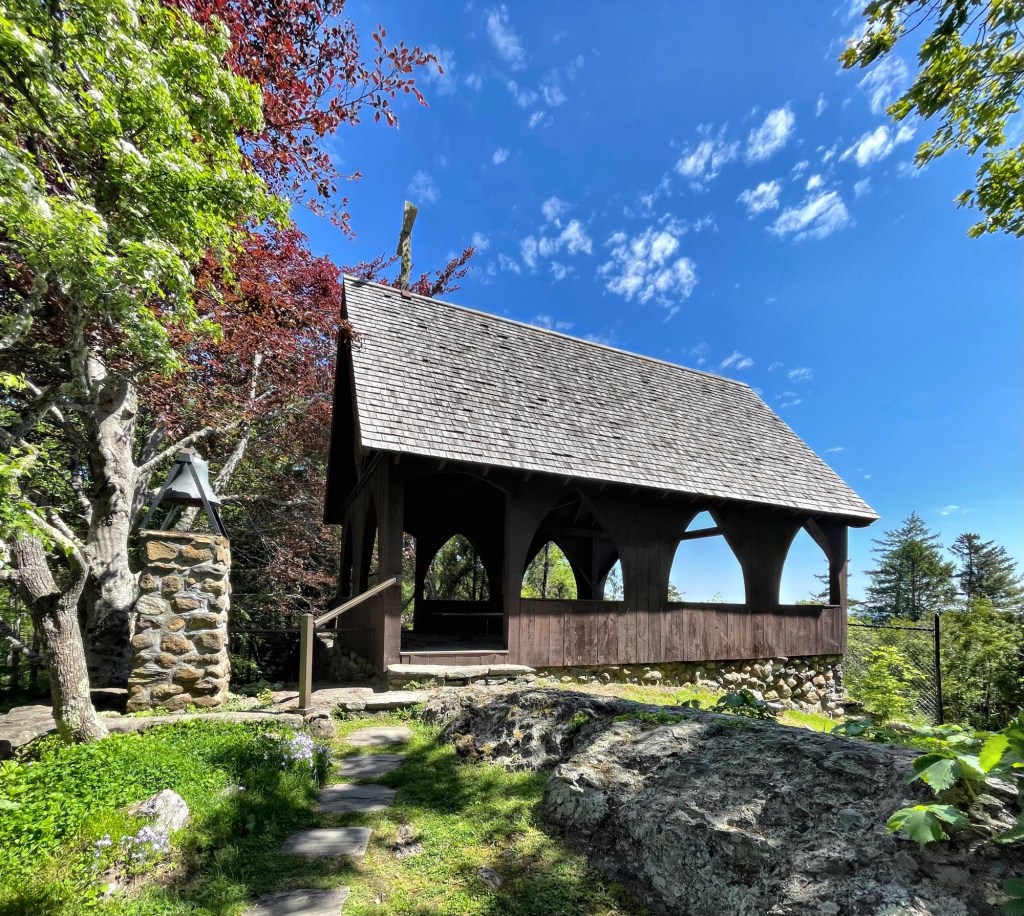
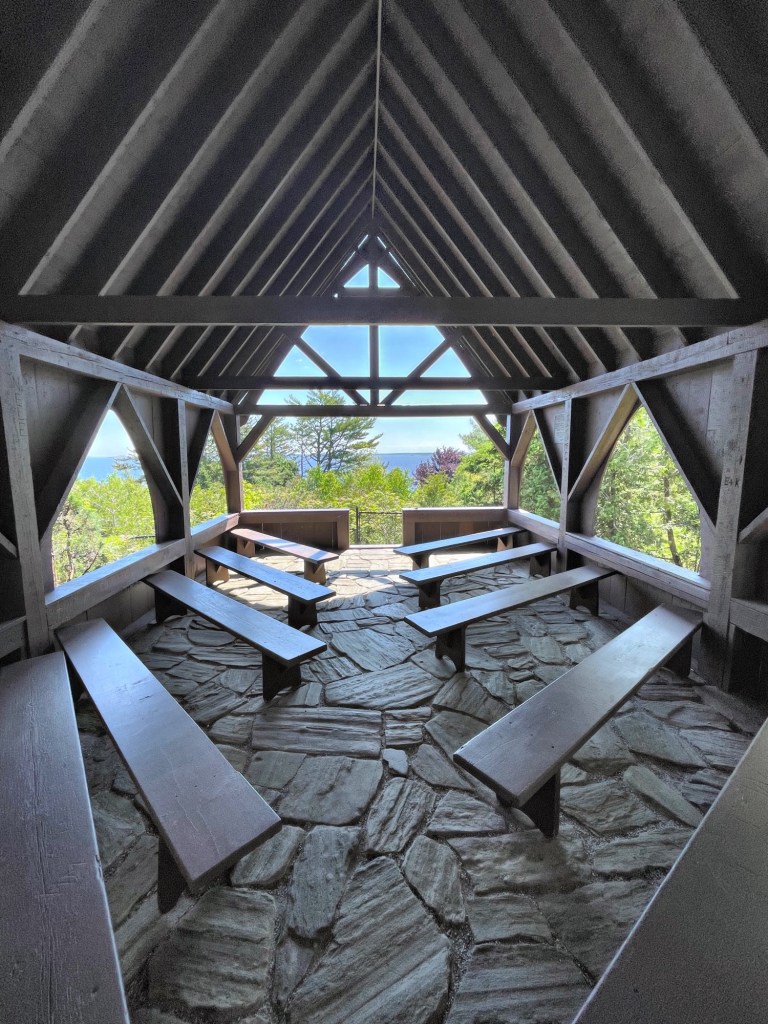
After the Tamarack Lodge hotel of Rockport, Maine, burned down in 1954, nearby resident Helene Bok began to envision what would be the best use of the charred landscape. Her project became the Vesper Hill Children’s Chapel, an absolutely stunning outdoor chapel that is open to the public. Her dream was to build a refuge that would be open for all people and “speak in and of itself of the beauty, goodness and truth of nature, life and God.” It is not clear to me who the designers were, but the structure and grounds are elegantly sited on the hill, overlooking the harbor in the distance. Helene planned the chapel to partially sit atop the rustic stone foundation of the former hotel on the site, with an open post-and-beam wooden structure above. After Helene’s death, Elmer Crockett, a designer for years on the Olmsted staff in Maine, oversaw the grounds and maintained a biblical herb garden. The chapel is today approached by a roofed stairway and surrounded by mature trees and locally harvested stones. It is truly a hidden gem in Mid-Coast Maine.



 Buildings of New England