Old Killingly High School // 1908

The Old Killingly High School is located in a densely built residential neighborhood east of downtown Danielson, a village of Killingly, Connecticut. The building has served the community for well over 100 years, but through various uses. The school was built in 1908 and enlarged with side wings in 1927. It was considered state of the art for its time, with fireproof construction, wide hallways, and large bands of windows to maximize lighting of the classrooms. Clearly showcasing the village’s wealth and hope for future prosperity. The school was even designed by Hartwell, Richardson & Driver, a leading architectural firm based in Boston, Massachusetts. The building served as the community’s high school until 1965, and as its junior high school 1966–90 until it was converted to a community center and police station for the town. The Renaissance Revival style building is a gem and while tucked away off the main street, it shines through some great maintenance and restoration from the town.

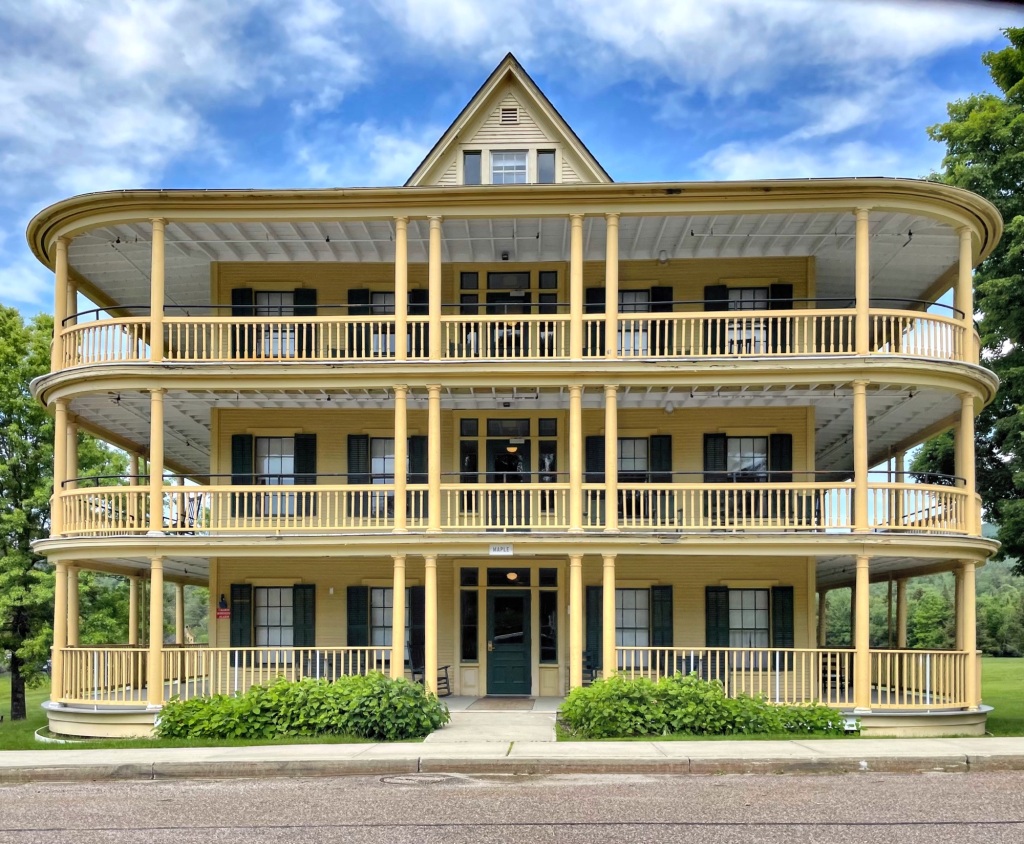
Bread Loaf Campus – Maple Cottage // c.1900

Welcome back to the Bread Loaf Campus! For more early history and context of the complex, check out the post on the Bread Loaf Inn. By 1900, owner Joseph Battell’s enterprise exceeded the capacity of the original inn, and cottages were added to accommodate more guests visiting his new permanent home in the mountains of Ripton, Vermont. Located adjacent to the Mansard-roofed Birch Cottage, one of the most visually striking buildings in the campus is Maple Cottage, which reads more porch than cottage, but it’s 100% perfect. It was the last cottage built by Battell for his family and friends to stay at when visiting. They must have loved evenings on the three-floors of porches looking out over the Green Mountains.

Warren Industrial Trust Building // 1906

This monumental Georgian Revival bank building sits on Main Street in Warren, Rhode Island, and is one of the finest buildings of the style in the entire state. The Warren Industrial Trust in 1906 hired Edmund R. Willson of the Providence architectural firm of Stone, Carpenter & Willson to design the bank for the town after it had absorbed the town’s multiple banks, under one roof. Four Corinthian columns support a robust pediment over the entrance with the red brick elevations enlivened with arched windows, oversized keystones, and pilasters with contrasting capitals and bases. The building shows that Colonial Revival architecture, while often seen as a refined, classical style, can be festive and ornate.

Robert Palmer Jr. House // 1907

Robert Palmer Jr. (1856-1914) was born in Groton, Connecticut as the son of Robert Sr., a prominent businessman and Deacon in Noank’s seaside village (his house was featured previously). Robert Sr. established the Palmer shipyard, which became the largest business enterprise in Noank. Jr. would later join his father’s business and did well for himself financially, eventually marrying and building this Neo-Classical mansion on Church Street in town. The company, under Sr. and Jr.’s leadership, built many seafaring vessels that were internationally renowned until the company closed in 1914 after the death of Robert Jr. This house is unique in town for the monumental two-story portico, Palladian windows at the first floor, and a projecting entry vestibule.

First Church of Christ Scientist, Providence // 1906

One of the most stunning and monumental buildings in Providence is this building, a church which pretty closely resembles the Rhode Island State House! Christian Scientists in Providence began to hold informal services in 1889 and received a charter from the state legislature in 1895. Construction started on this church, the First Church of Christ, Scientist in 1906 from plans by local architect Howard Hoppin who roughly modeled the building after the congregation’s Mother Church in Boston. The Classical Revival building is capped by a copper hemispherical dome supported by a colonnade of Corinthian columns. The main block of the structure at the street is fairly modest, possibly due to the residential character of its surroundings.