Osborne Memorial Hall // 1920

Weare is the largest town in Hillsborough County, New Hampshire by land area. As a result, the town’s villages historically were fairly isolated (especially before the arrival of the automobile). Social halls were important gathering places for some of these rural communities, allowing for events and celebrations to be held in a designated location. Before 1920, South Weare only had a Union Church which could meet this demand. In her will, Nellie Osborne donated funds in the memory of her husband Wellman Osborne, who grew up in Weare, to erect a social hall there. South Weare residents established the South Weare Improvement Society to make use of the money and oversee construction of the Memorial Hall. The Arts and Crafts style community building with its pyramidally roof opened in 1921. After numerous decades of deferred maintenance and dwindling use of the facilities, Osborne Hall was in decline and danger of demolition. Luckily, new members banded together and funded a restoration and modernization of the building. Here’s to another 100 years!
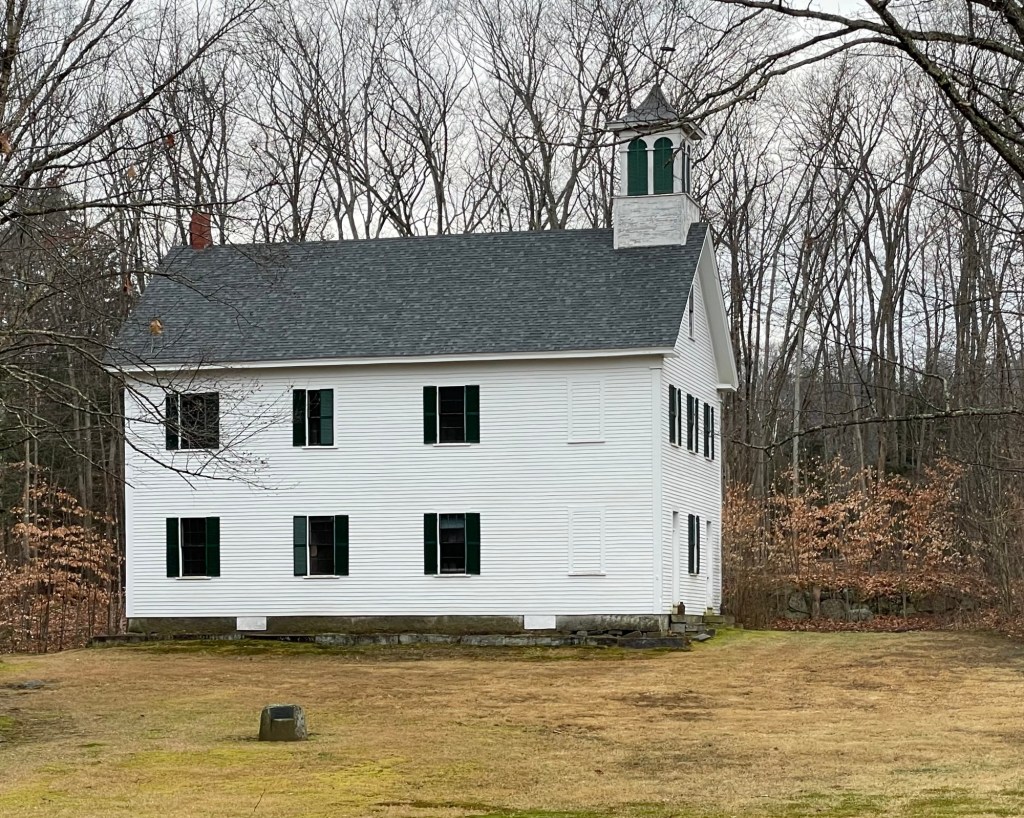
Clinton Grove Academy // 1874

Clinton Grove Academy of Weare, New Hampshire was the first Quaker seminary in the state when it was founded in 1834 by Moses Cartland (1805–1863). Moses Cartland was a Quaker abolitionist who served as the first Principal of the school and for fourteen years after. He later would move to Lee, NH, and aided those who escaped slavery in the south, sheltering them and assisting them on their way north to Canada. The original Academy here served as a private high school and included a classroom building, boarding house, barn and sheds. Students came from as far away as Ontario, Nova Scotia, Minnesota and Texas to study here under Mr. Cartland. In 1872, the Academy complex burned. It was quickly rebuilt as one structure here, in 1874. This building served as a district school until the 1930s. Today, it looks like the building is largely vacant, anyone know what its purpose is?

Weare Town House // 1837

Weare, New Hampshire has a pretty cool history. Located at the northern edge of Hillsborough County, the land presently known as Weare was granted to veterans of the Canadian wars in 1735 by Governor Jonathan Belcher, who named it “Beverly-Canada” after many of the veteran’s hometown, Beverly, Massachusetts. After various disputes over the settlement and naming of the town, it became known as “Weare’s Town” before being incorporated by Governor Benning Wentworth in 1764 as Weare, after Meshech Weare, who served as the town’s first clerk and later went on to become New Hampshire’s first Governor. The town grew slowly during the 18th and 19th centuries around five major villages, with farmland and forests connecting them. Near the geographic center of town, this Town House was built in 1837 to be a government and religious center of the town. Originally, town meetings were held on the first floor and the Universalist Church met on the second floor and the local high school was installed on the second floor in 1919. The building remains the town offices with event space for rent inside today. The building is a great example of a vernacular Greek/Gothic Revival town house of the period with a two-stage tower with pinnacles at the corners of each stage and a louvered belfry at the bell.

Yale University Art Gallery // 1953

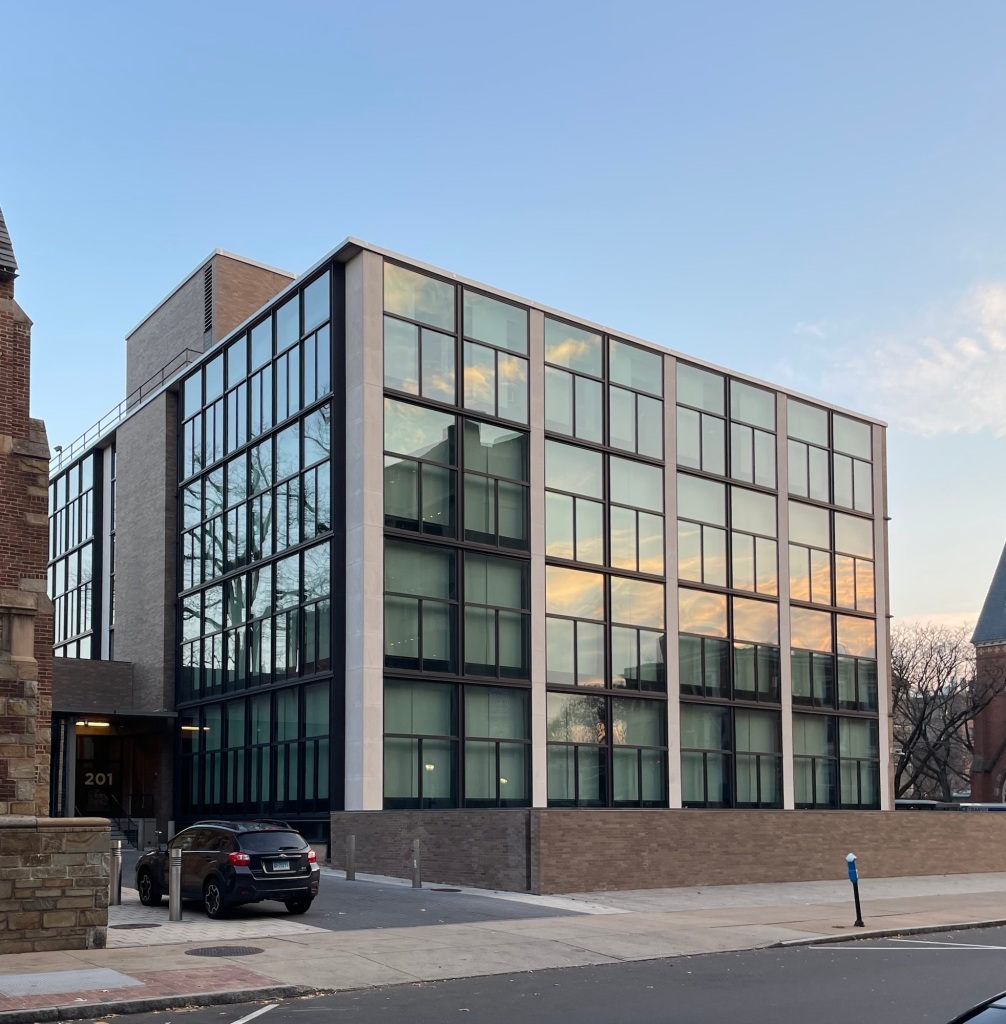
Yale University’s School of Architecture was in the midst transition when Louis Kahn joined the faculty in 1947. The post-war years at Yale trended away from the school’s Beaux-Arts lineage towards the avant-garde, and Modernist principles brought over from European architects. When the University called for a new wing for its existing Venetian Gothic style Art Gallery Building (1928), they obviously had no choice but to make a statement for the future of the school. Architecture professor Louis Kahn worked with Anne Tyng, who was both a professional partner and his “muse”, who heavily influenced his works, including here where she designed the concrete tetrahedral slab ceiling at the interior galleries. As a professor and practicing architect, Kahn hoped for students and visitors would engage with the building, even interior spaces often overlooked design-wise, such as the stairwells. While the facades are fairly minimal in design details, because the attention was paid to the interiors, which provide protection from natural light while also allowing for large floor plates for customizable exhibitions. The structure is Yale’s first true Modernist building on a campus which soon after was dominated by some of the country’s most iconic examples of the style.

Yale University – Trumbull Gallery // 1832-1901

Pre-1869 image of Trumbull Gallery, Yale Archives

Before there was Street Hall or the Old Yale Art Gallery Building, there was the Trumbull Gallery, the first college-connected art museum in the United States. This building was erected in 1832 by artist and collector, John Trumbull (1756-1843), who specialized in Revolutionary-era works, and was known as the “Painter of the Revolution”. In his later years, Trumbull sold 28 paintings and 60 miniature portraits to the Yale College, and helped establish the college-affiliated art museum. He is said to have designed this Classical style building, to house his collections, all with minimal windows to protect his collection from direct sunlight. The gallery also housed a crypt for Trumbull and his wife, hence its tomb-like appearance. When Street Hall was built, the collection and tombs were relocated there, and again in the late 1920s when the Art Gallery was constructed. In 1869, Yale College added windows to the building and operated the school treasury from here until it was demolished in 1901. The Trumbull Gallery stood just in front of the Old Library.

Yale University – Yale Art Gallery Building // 1928

One of the most visually stunning and unique buildings in New England is the 1928 Yale Art Gallery building, which is connected to Street Hall (last post) via a skybridge over High Street. Completed in 1928, the Yale Art Gallery was designed by relatively little-known, but significant 20th century architect, Egerton Swartwout. Swartwout graduated from Yale College in 1891 with a B.A. degree and with no formal architecture training, was hired as a draftsman at the illustrious firm of McKim, Mead & White in New York before running his own office, Tracy and Swartwout. Built in a Gothic Renaissance style inspired by Italian buildings such as the Bargello in Florence, the sandstone masonry structure commands the prominent site with a corner tower and facade fronted by five gothic arched windows. Inside, visitors are transported to a historic Italian art museum within the Gallery Wing, with the full-height Gothic windows with walls, floors and ceilings restored and lined in stone.

Yale University – Street Hall // 1866

Closing out this series on Yale’s Old Campus, I present one of the finest Victorian Gothic collegiate buildings in the United States, Street Hall. Street Hall was designed by Peter B. Wight (who had just completed the Venetian Gothic style National Academy of Design in New York City) and opened in 1866. The building opened as the Yale School of the Fine Arts, which was the first art school on an American college campus. The building was named after Augustus Russell Street (1791–1866), a Yale graduate and New Haven businessman who donated the funds for the building’s construction on the condition that all residents of the city could enroll in the school, wanting a bridge between citizens of New Haven (“Town”) and the college “Gown”). Augustus Street and his wife, Caroline Leffingwell had seven daughters together, all of whom predeceased them. It was likely the fact he was around so many women in his life that he also required the Yale School of the Fine Arts to admit both male and female students (Yale would become co-educational and admit women to all programs in 1969.) Street Hall is a landmark example of the Victorian/Venetian Gothic style with lancet arches, polychromatic stone, and trefoil and quatrefoil stone medallions. Street Hall is now connected to, and is a part of the Yale University Art Gallery.

Yale University – Lanman-Wright Hall // 1912

Located at the northwest corner of the the Old Yard at Yale, Lanman-Wright Hall is one of the more recent buildings constructed that enclose the space. Long an advocate for adding new dormitory facilities at Yale, Henry Parks Wright, a Latin professor and later Dean of Yale College (1884-1909), was able in retirement, to see Wright Hall erected in his honor. From 1884 to 1894, the college enrollment had doubled to 1,150, forcing the freshmen to room off campus. This had led to the opening of privately owned residence halls around the campus, some of which were very luxurious. Over time, the students became widely separated by income and social standing and Wright felt that if the spirit of true democracy at Yale were to be perpetuated, it was essential that freshmen should be better integrated. Wright Hall was designed by architect William Adams Delano of Delano and Aldrich, Class of 1895, and was built in the place of Alumni Hall (last post). Accommodating 150, it was the largest dormitory on the Old Campus and designed in a Neo-Gothic style, blending it in with some of the Victorian-era Gothic residence halls nearby. The building went through a renovation in 1993, funded by benefactor William Kelsey Lanman, and renamed Lanman-Wright Hall upon completion.

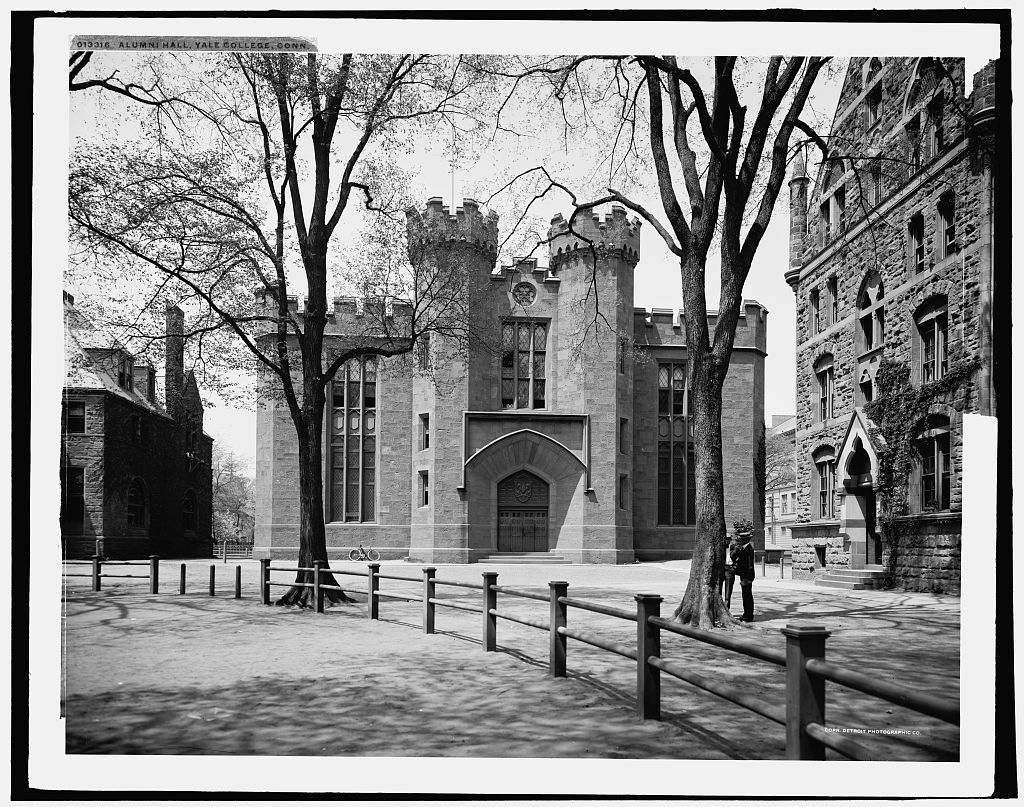
Yale University – Alumni Hall // 1851-1911

Detroit Publishing Company image

Alumni Hall at Yale was designed and built between 1851-1853, at the northwest corner of Yale’s Old Campus. Its was designed by Gothic specialist architect Alexander Jackson Davis, who completed Dwight Hall (the Old Library) a some years prior. The building had a large, open floorplan on the first floor for large gatherings as well as the entrance examinations, along with the biennial examinations that every student had to take at the end of his sophomore and senior years. As the building turned 50 years old, the campus around it was already looking very different. Shifting priorities for dormitory space in the yard necessitated its demolition for Wright Hall (next post). Alumni Hall was razed in 1911, but its two crenelated towers were salvaged when the building was demolished. They were incorporated into Weir Hall which has been incorporated into Jonathan Edwards College, one of Yale’s residential colleges.

Yale University – Phelps Hall and Gate // 1896

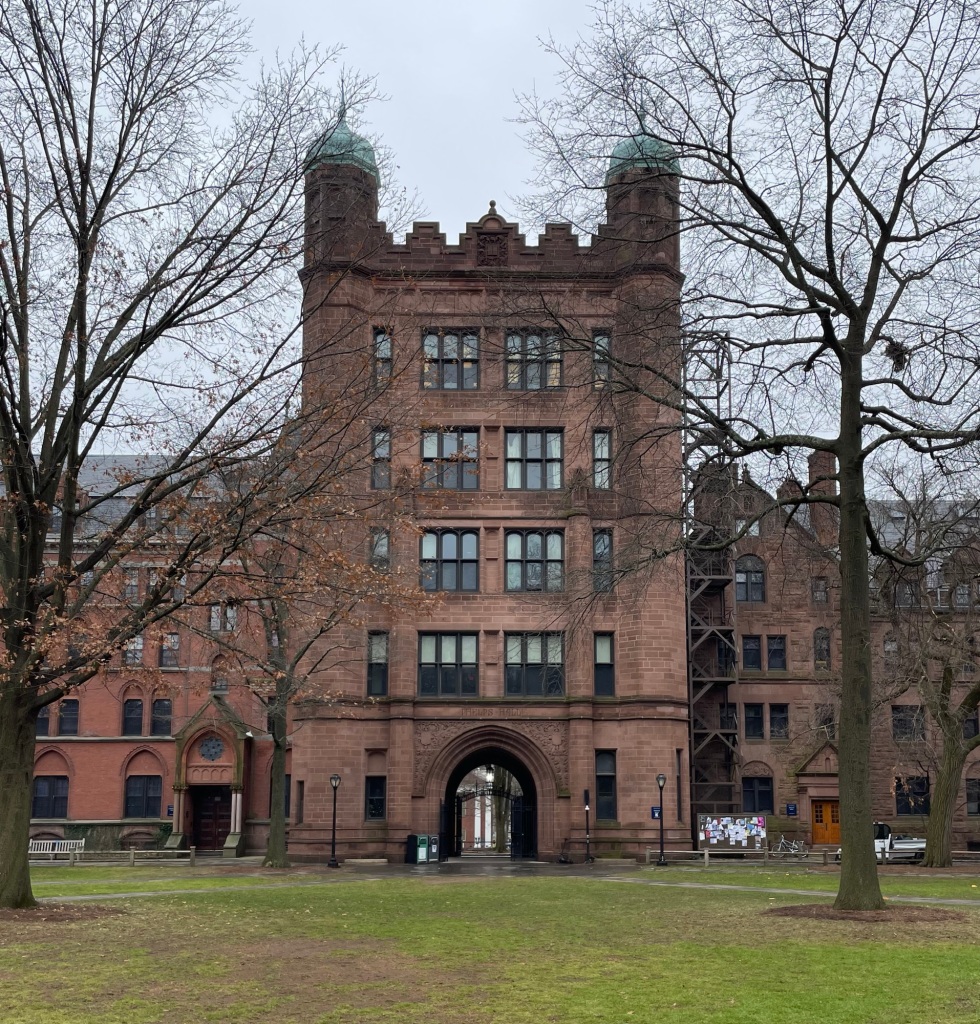
After Lawrance and Welch halls (previous two posts) were built on the eastern edge of Yale’s Old Campus, there was a small space between the two that needed to be enclosed to provide a true cloister for students, shielding them from the noise and ever-developing Downtown of New Haven. Architect Charles C. Haight designed the new hall to resemble a medieval gatehouse. The simple, tall rectangular mass has octagonal towers at each corner with copper domes on top and a crenelated parapet resembling an old English castle spanning between them. On the ground floor is the Phelps Gate, the main entrance to the Old Campus from the east. Its namesake was the late William Walter Phelps, an 1860 Yale graduate who served as a Congressman and as ambassador to Germany and Austria-Hungary. The building holds an important role in the annual commencement ceremonies, which begin in the New Haven Green and pass through to the Old Campus through this gateway.