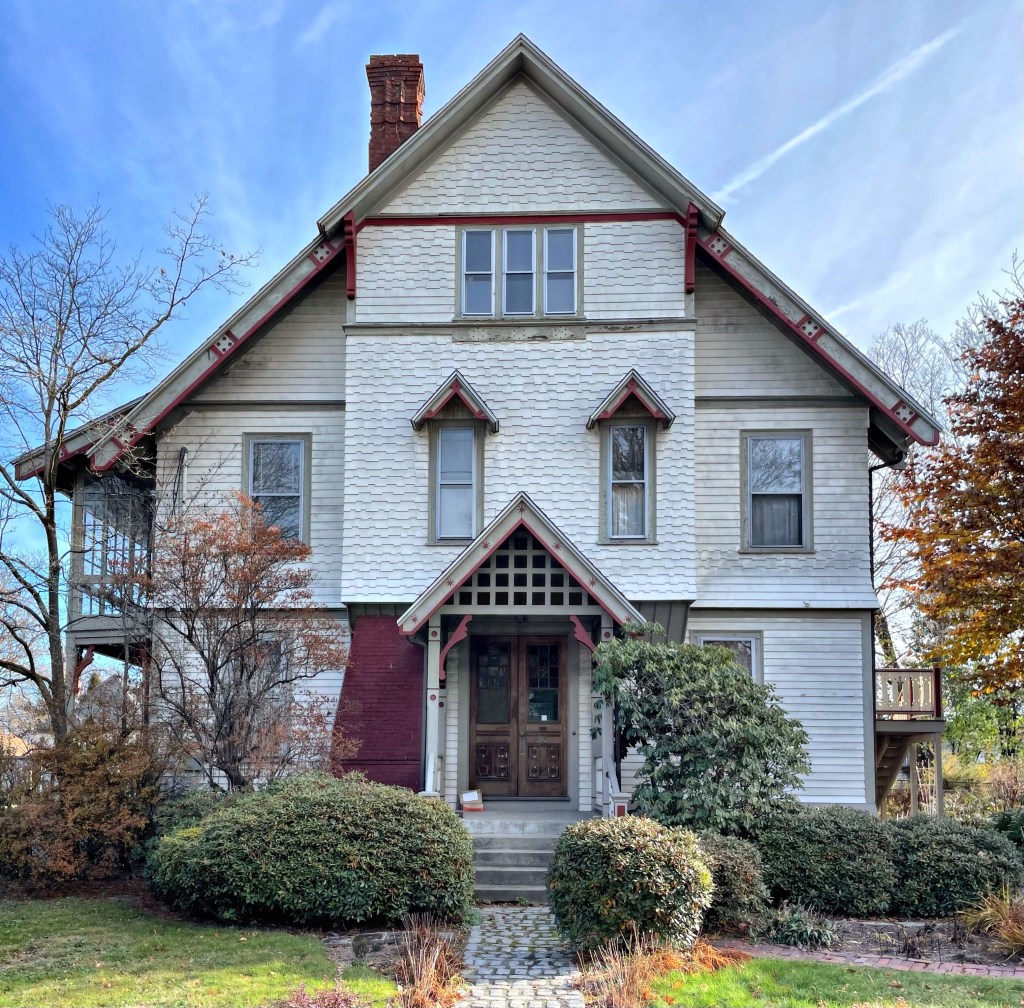
Built in 1883 for a member of the Thomas Wales family, this house in Clam Point, Dorchester, possesses a compact essentially rectangular clapboard and wood shingle-clad form. The architect, John A. Fox, designed the main façade elegantly with an open Stick style porch projecting from the center of the first floor which is enclosed by a steeply-pitched roof. The pitch of the porch roof is echoed in the small and shallow gable-like lintels which are really unique to the area. The treatment makes the facade read somewhat like a face.
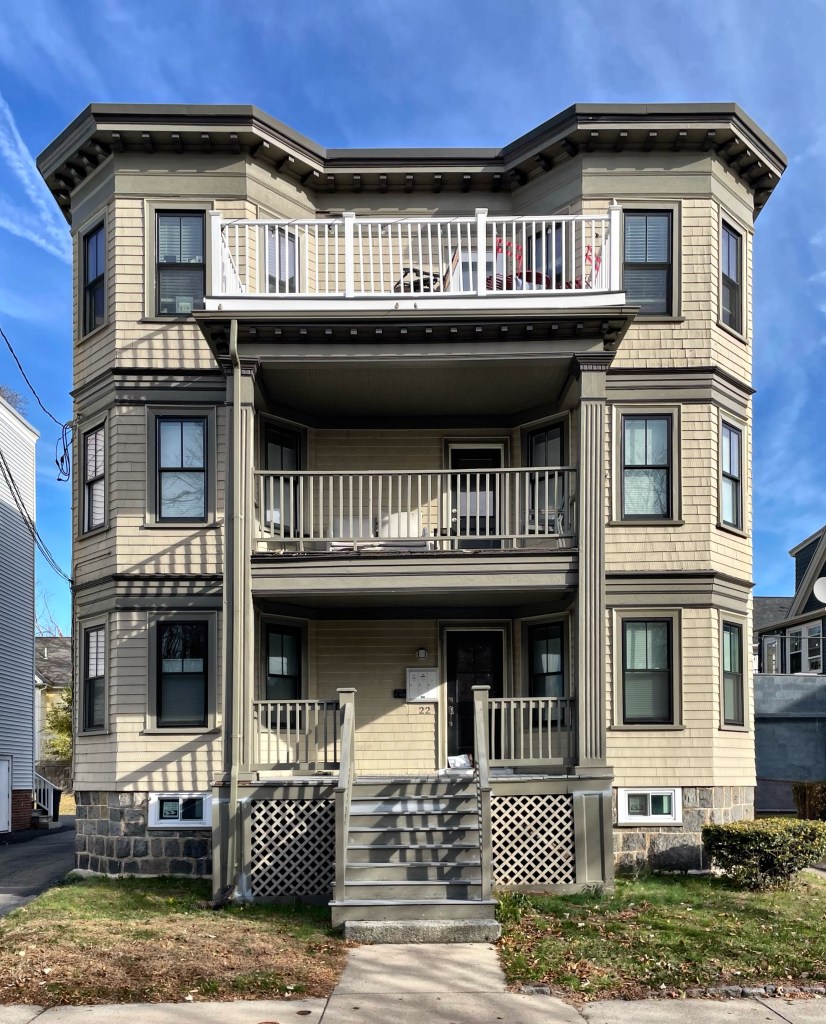
One of the features that sets the Clam Point neighborhood apart from other Dorchester neighborhoods is that the majority of its houses are still surrounded by ample yards. In most Dorchester neighborhoods, the electric streetcar triggered explosive growth in the form of three-deckers, which have arguably become the symbol of the neighborhood’s housing. Three-deckers (also called triple-deckers) are housing types that surged in popularity in the late 19th and early 20th centuries as they provided housing where each floor usually consists of a single apartment. Frequently, extended families lived in two, or all three floors, providing access and generational wealth to immigrant families who otherwise may not be able to afford land and building a single-family home. This example was built in 1911 by Italian-born contractor Ambrogio Piotti, who lived in a large mansion on Melville Avenue nearby. The three flats were rented out to families and the three-decker is clad in wood shingles, has polygonal bays with three-leveled porches with monumental Classical Revival columns.
Elisha T. Loring (1804-1889) was born on Cape Cod and began his career in the Chilean tin and copper trades, moving to Boston in 1839. His house at 21 Mill Street in Dorchester’s Harrison Square neighborhood was built in the early 1840s, showcasing his wealth and stature in the community. Based out of this house, Loring made a large fortune in the Lake Superior mines, also known as the Calumet and Hecla mines. By 1862 he was the treasurer to the Pewabic and Franklin Mining Companies, and a decade later is listed as “President, National Dock Company.” Loring’s Dorchester mansion is Greek Revival in style and consists of a three bay by three bay main block and a substantial rear ell. The house’s original clapboards were replaced by wood shingles sometime in the 20th century. The main elevation’s pedimented center pavilion exhibits a small front porch whose Ionic columns support a heavy, cornice-headed entablature. The porch’s roof is set off by an ornate cast iron railing. The side elevation is unusually wide and culminates in broad pedimented attics containing elliptical lunette windows.
Until recently, the Clam Point neighborhood of Dorchester was called Harrison Square. The name commemorated President William Henry Harrison’s visit to Dorchester during the presidential campaign of 1840 and honored his memory, as he died of pneumonia shortly after taking office. Development in the neighborhood was initiated following the arrival of the Old Colony Railroad depot (1844). When rail service to Harrison Square was discontinued in 1957, the Harrison name began to fade from the memories of area inhabitants. The name “Clam Point” is said to have been coined during the 1970s by realtors intent on touting the area as a desirable coastal community of antique homes, it stuck. Likely the oldest extant house in the neighborhood (built before the railroad depot) is this house on Mill Street, constructed as a double-house around 1830 for brothers Elisha and John Preston. The vernacular, late-Federal style house has later shed dormers and lancet windows in the side gables. The Preston’s land holdings and sale before the Civil War led to much of the later development in the neighborhood.
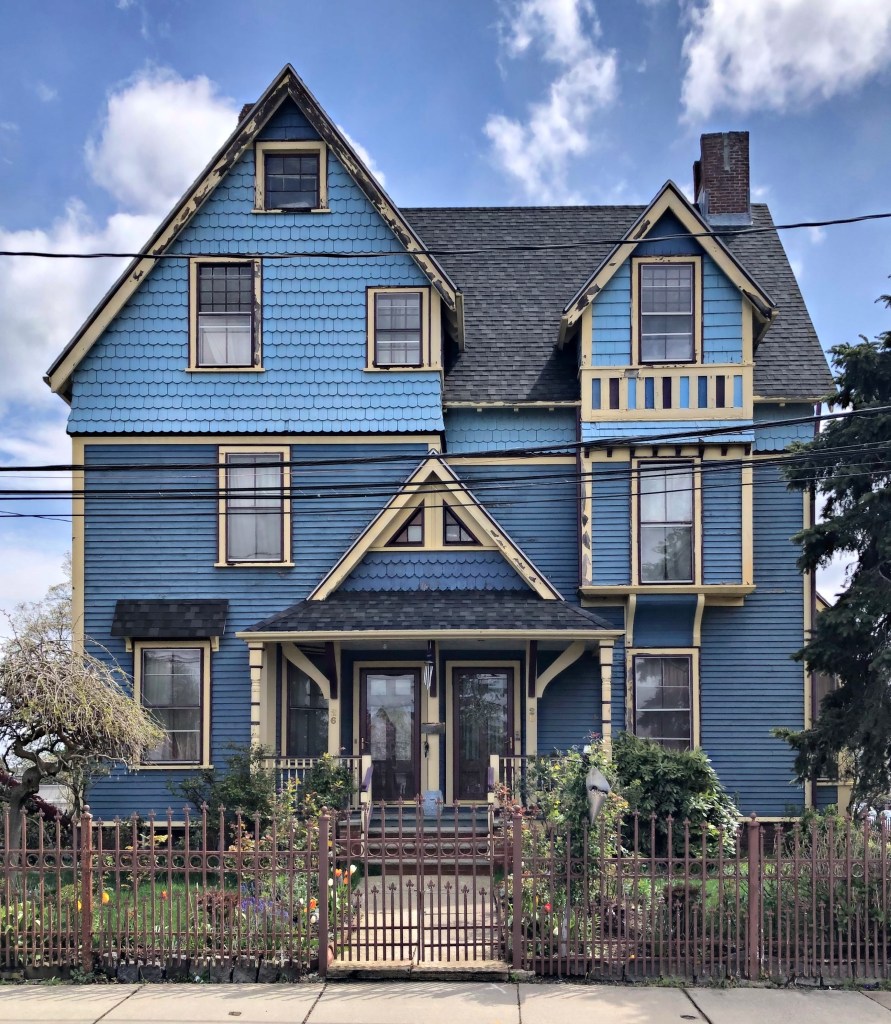
Nothing beats a good Victorian-era house! This example in the Clam Point neighborhood of Dorchester does not disappoint. The Stick-style double-house was built for miss Mary E. Noyes and Ms. Hersey replacing an older house on the lot. The women hired architect John A. Fox to design the house which possesses one of the most complex forms and roof configurations in the neighborhood. Clad with clapboards at the first and second stories, its six intersecting gables are sheathed with scalloped shingles. At the main entrance on the façade is an open porch with square posts and railings with turned balusters. The side façade is even more complex with two side gables and a two-tier porch enlivened by Chinese Chippendale and spool work railings. The Herseys, along with Mary E. Noyes, co-owned the house until 1884; thereafter it was owned by Mary E. Noyes until around World War I. The stick style home really pops with that blue color, what do you think?
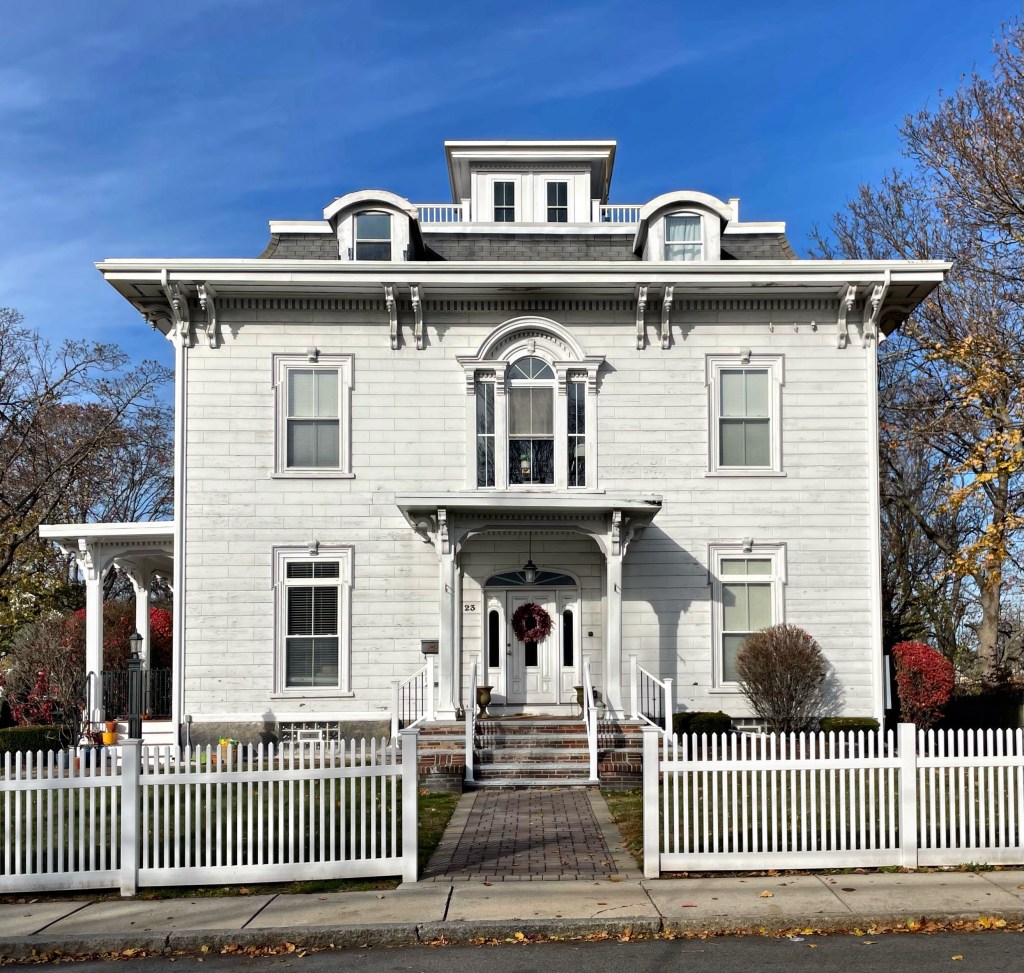
Originally built for Charles E. Jenkins, a partner in Bailey & Jenkins, suppliers of doors and blinds, this house in Dorchester’s Clam Point neighborhood stands out as one of the earliest and high-style mansions in the area. It appears to have been designed by local architect Luther Briggs, Jr. Shortly after its completion, the property was purchased by Theron and Rebecca Shaw. Theron was a partner at Lindsley, Shaw & Co., boot dealers in Downtown Boston. He died in 1870 and the house was sold to Dr. Luther Dimmick Shepard, a dentist. While the house (like many in Boston) is covered in later siding and has a plain white color scheme, the building retains its architectural integrity and would really shine when restored! What color would you love to see this Italianate/Second Empire style mansion be painted?
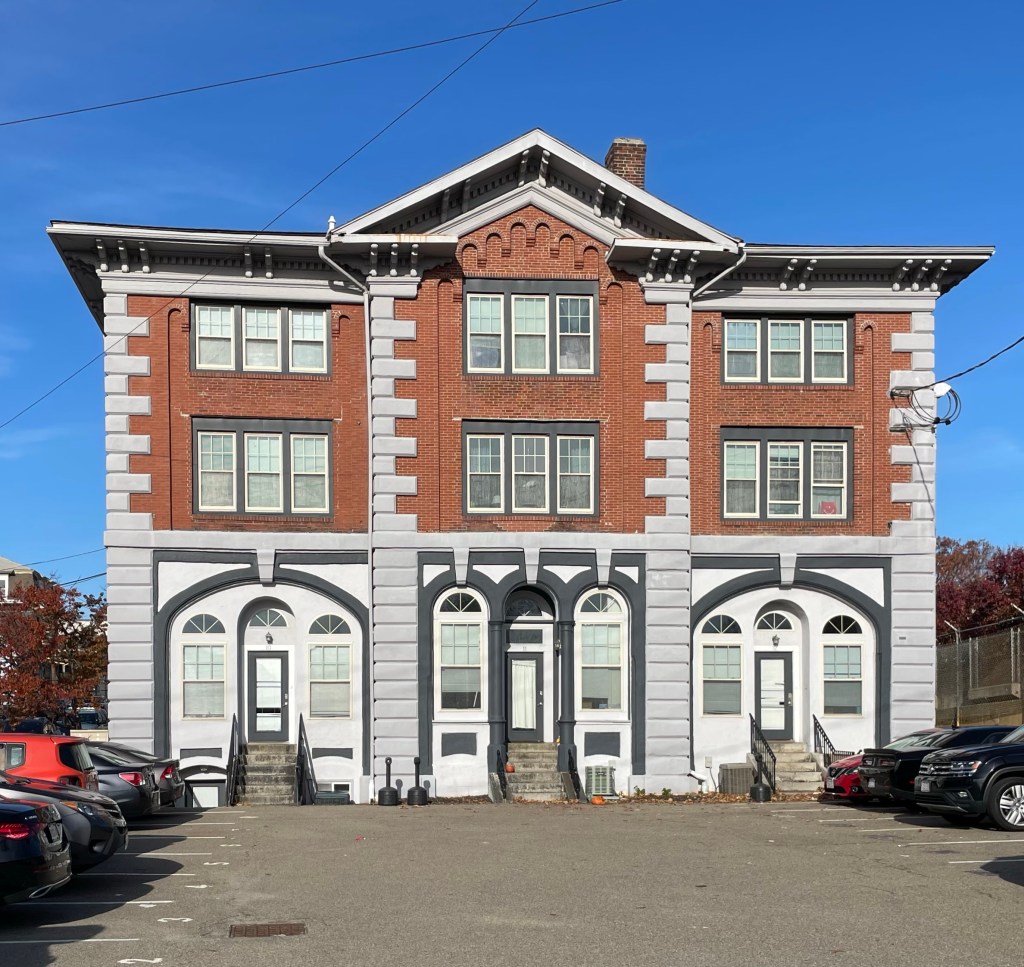
This is your sign to take a different route! When exploring a new town or neighborhood, I love to explore the obscure streets just as much as the iconic Main Streets as hidden treasures can always be found! This building in Dorchester’s Port Norfolk neighborhood was constructed in 1860 as the new home of the Dorchester Mutual Fire Insurance Company, which was incorporated in 1855. The company seemingly hired Dorchester-based architect Luther Briggs, who also laid out the streets for Port Norfolk and the Clam Point neighborhoods and designed many buildings in the area at the time. The high-style Italianate building features bold proportions, quoins, and cornice. While the former round-arched windows have since been enclosed and are traditional double-hung windows, they building still stands out! At the rear, Second Empire style rowhouses were built for private ownership. The building is now all condominiums following a renovation.
One of my favorites in Dorchester is this Second Empire manse, built c.1870 for cotton broker Freeman S. Packer. The house at 14 Everett Street in the Clam Point/Harrison Square neighborhood is a handsome, formal example of a Luther Briggs-designed Italianate Mansard residence. Although today sheathed in vinyl siding, much of the original siding and trim detail are likely still under there, preserved. Set back from the street facing an ample hedge-enclosed front yard, the three bay main façade exhibits a center pavilion and full-length front porch which undoubtedly appealed to summer guests who vacationed here when this house was known at the Russell House, an apartment hotel during the 1890s and early 1900s.
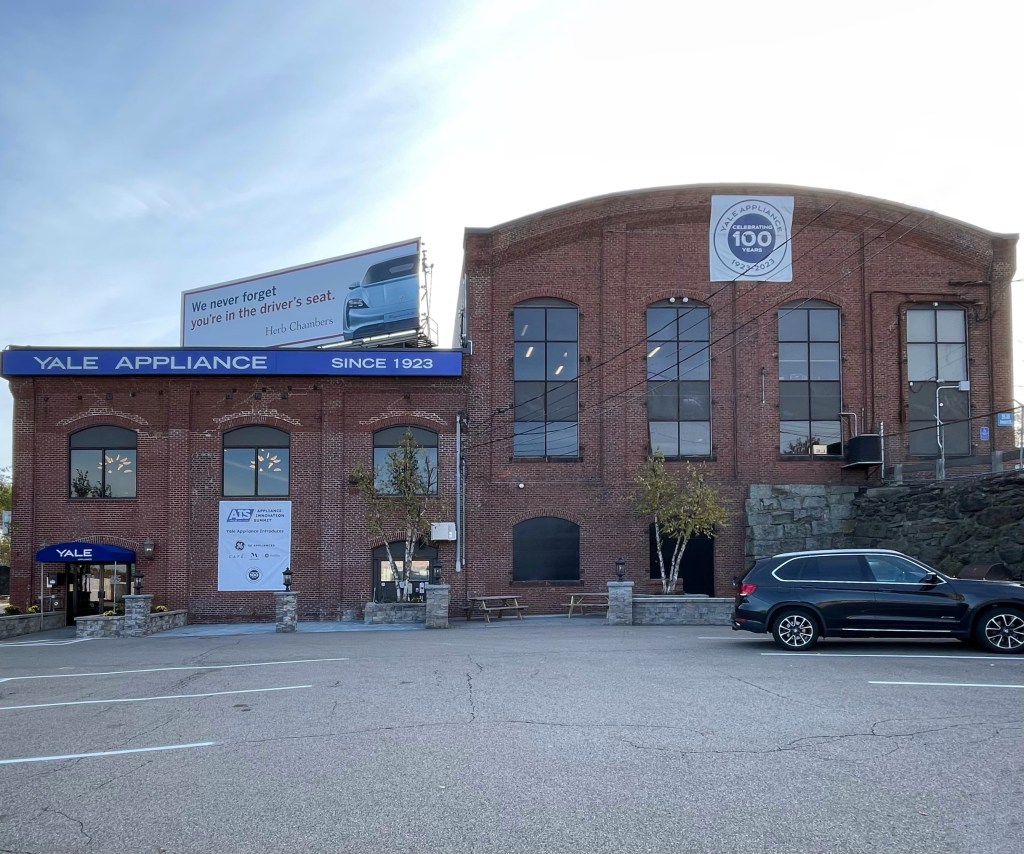
The West End Street Railway was established in 1887 originally as an offshoot of a land development venture, but it rose to prominence when it merged several independent streetcar companies into a single organization. Over the next decade, it became the primary operator of public street transit within the Boston area! During this time, the company maintained one of the largest street railway systems in the world, the first unified streetcar system in the United States, and first electrified system in a major US city. Now, it’s the infamous MBTA. How far they fall… Power plants were needed all over the city to provide electrical power for the company’s street cars, this was the fourth (and final) power station built, and it powered the Dorchester, Neponset, Ashmont and Milton lines. The station was constructed in 1896 on the shores of Dorchester Bay, which allowed for coal to be delivered in barges to the plant. Old stone walls formerly lining the shore can be seen to this day. Landfilling in the second half of the 20th century and the construction of I-93 have since cut off the building from the shore. Eventually the building was sold off and today is home to Yale Appliance, good thing none of their products are coal powered!
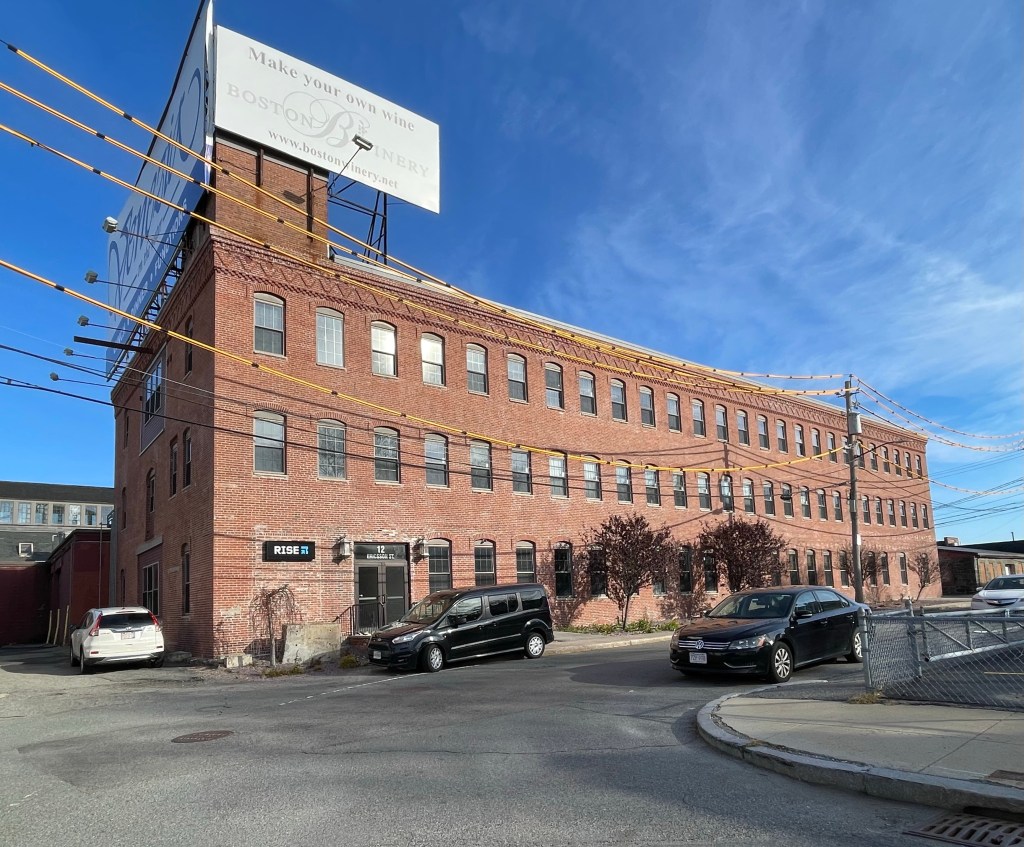
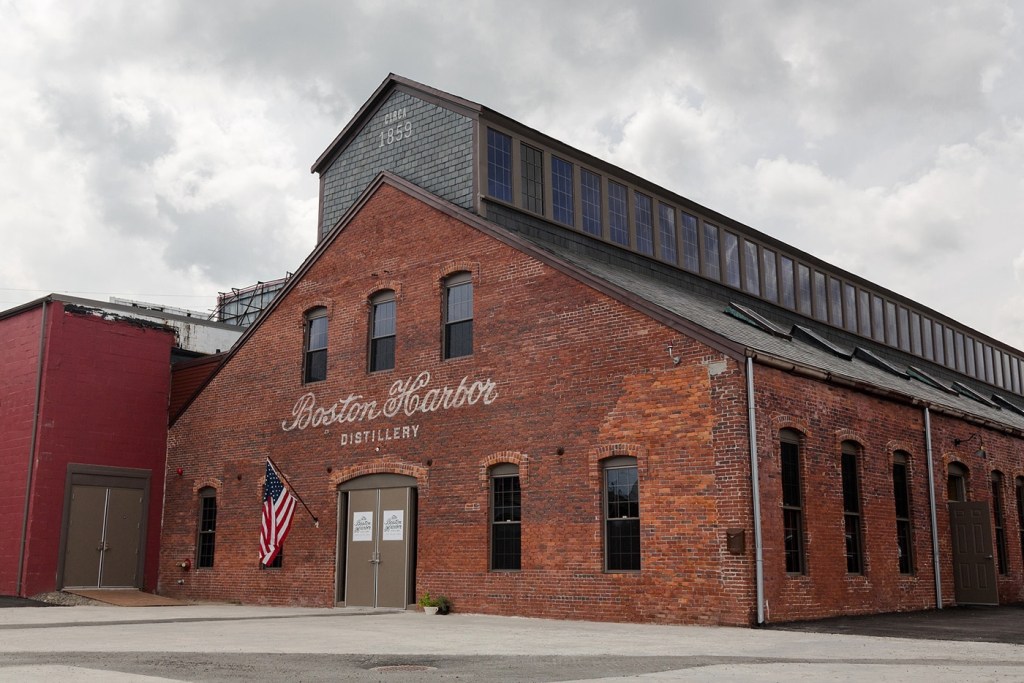
The Putnam Nail Company was founded in 1860 and located at the northern tip of the Port Norfolk neighborhood of Dorchester, Boston, Massachusetts. The company was founded by Silas Safford Putnam (1822-1895), who was the seventh of nine children by Israel Smith Putnam and Charlotte Safford of Hartford, NY. He moved to Boston and found work as Boston’s industrial growth took-off. He owned a curtain factory before patenting a process to manufacture wrought nails in the 1850s. After some time in Abington and Roxbury, he moved to Dorchester, purchasing large pieces of land and began building a manufacturing complex for his new Putnam Nail Company. The company made world-class horseshoe nails until it closed in the early 1900s. The property here was acquired by the George Lawley & Son Shipyard, who moved from their cramped City Point, South Boston shipyard to this newer yard. Already an established and respected New England manufacturer, the Lawley company had been building wooden ships in Massachusetts since 1866. The site was later the home to Seymour’s Ice Cream and was abandoned in the late 20th century. The large 1890s brick factory is now occupied by RISE, a development/construction management firm, with other buildings occupied by the Boston Winery and Boston Harbor Distillery.



 Buildings of New England