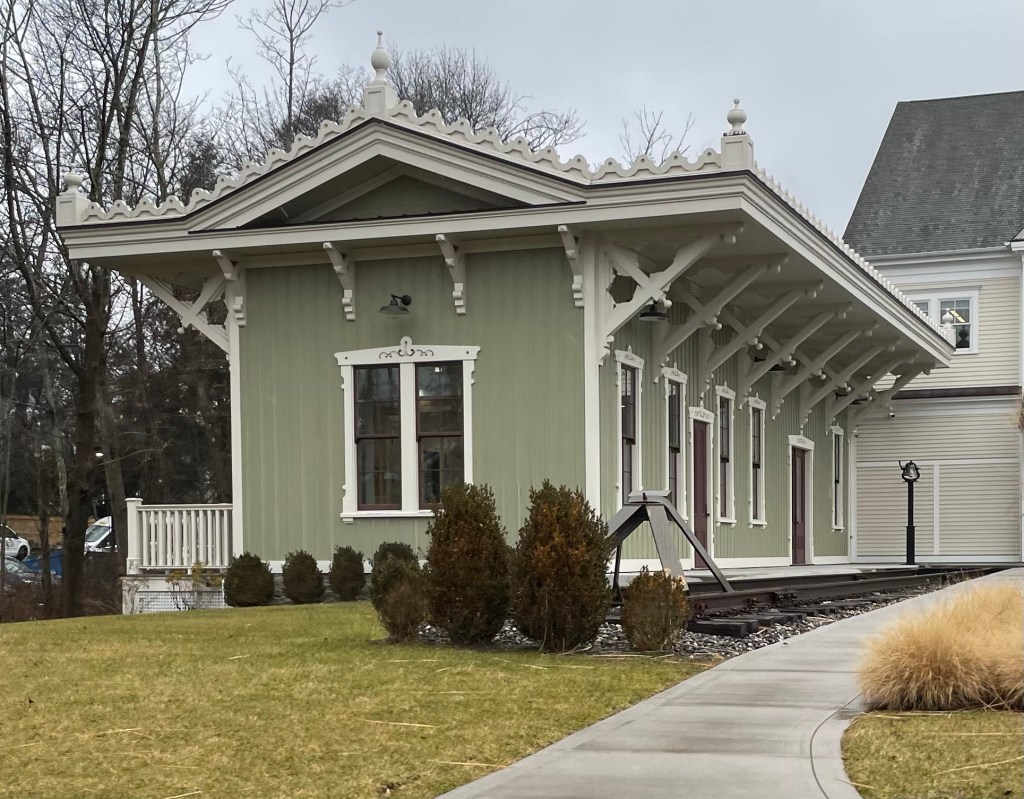
Ridgefield Train Depot // 1870

In 1870, the Ridgefield Branch branch line of the Danbury and Norwalk Railroad and later the New York, New Haven and Hartford Railroad was built connecting the sleepy village of Ridgefield to Branchville train station via the main line. The line was an early risk, built to offer service to the wealthy New Yorkers who began arriving to spend their summers in Ridgefield. Many of these “summer people” had their own private railroad cars, with chauffeurs meeting them as they arrived, driving horse and buggies to bring them and their luggage to their estates located throughout the town. As travel shifted to personal automobile, ridership dropped in the early 20th century, and the branch was replaced by bus service in 1925. Freight service was scarce, and lasted longer, to 1964. The depot was sold to the Ridgefield Supply Company, who used the 1870 building as storage for decades until it was disassembled, moved and rebuilt by the Ridgefield Supply Company in 2015, as part of their expansion. The historic station today provides an important link to Ridgefield’s past.
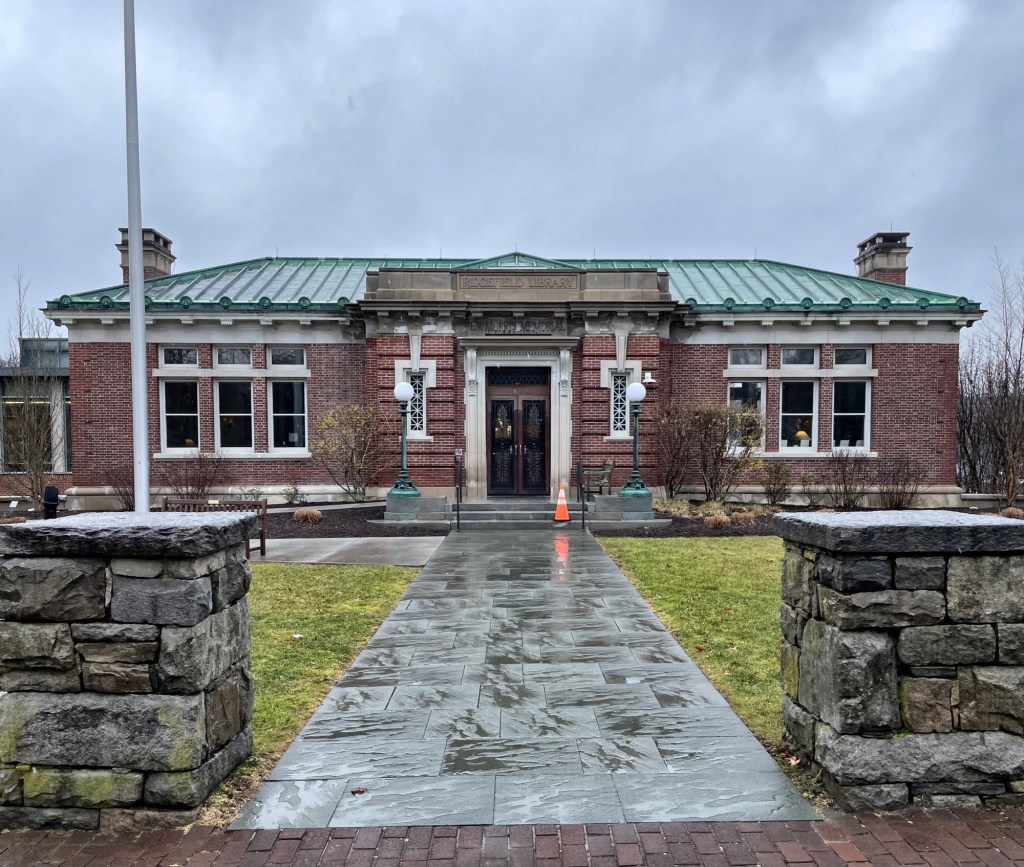
Ridgefield Public Library // 1901

The Ridgefield Public Library is an intriguing Beaux Arts style building from the turn of the 20th century. Built in 1901, the brick structure replaced the Smith Tavern, a 1798 frame structure built by Amos Smith right on Main Street. In 1900 the Smith Family sold the property to James N. Morris who had this library built in memory of his wife, Elizabeth, donating it to the town. Architect Raleigh G. Gildersleeve is credited with the design which is comprised of a one-story building constructed of brick with cast stone trim details and ironwork at the door. The library was given later additions, which are recessive in location and detailing to let the original building shine, as it should!

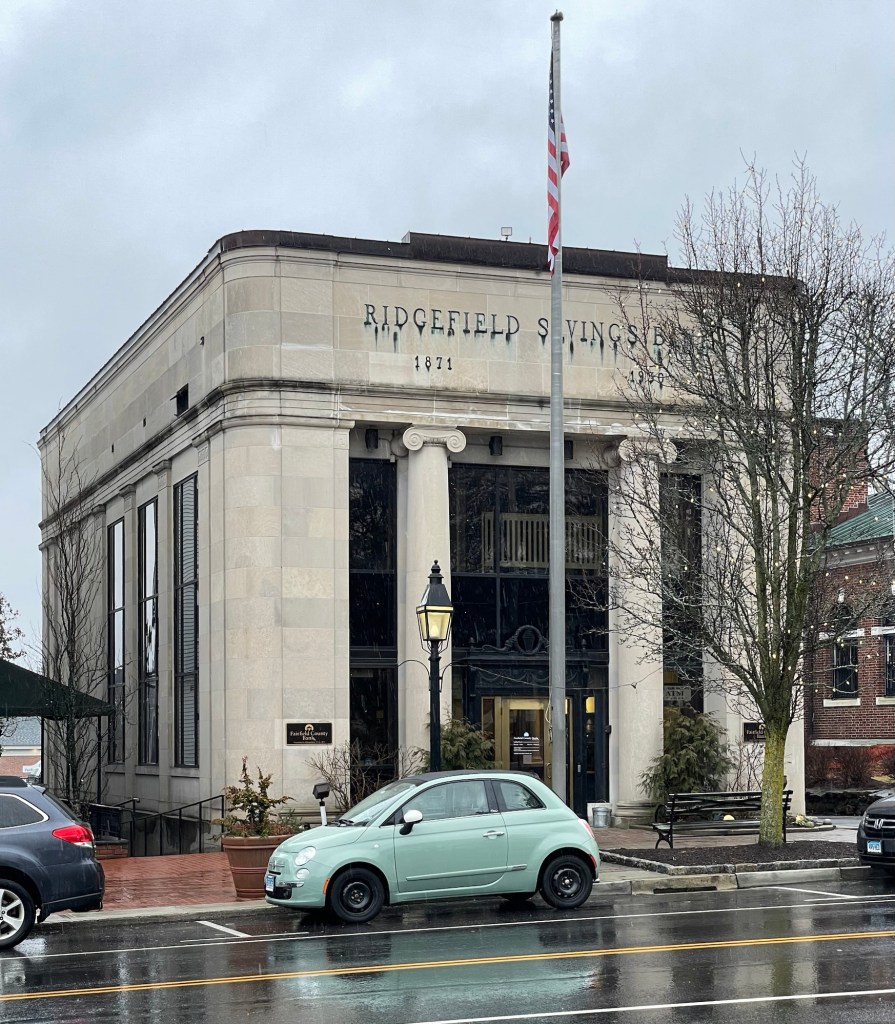
Former Ridgefield Savings Bank Building // 1930

Historically, bank buildings were built with architecture at the forefront to show members and prospective investors that their company instilled prosperity and longevity. Today, many new bank buildings are cookie-cutter designs and lack ornamentation or intrigue… The interwar Ridgefield Savings Bank on Main Street in Ridgefield, Connecticut, was built in 1930 from plans by architects Ralph Hawes and Ernest Strassie in the Neo-Classical style with Art Deco rounded corners and undecorated planes. Dominated by its Classical Ionic portico the bank building is a lasting commercial landmark on the town’s charming Main Street. It is now occupied by the Fairfield County Bank.

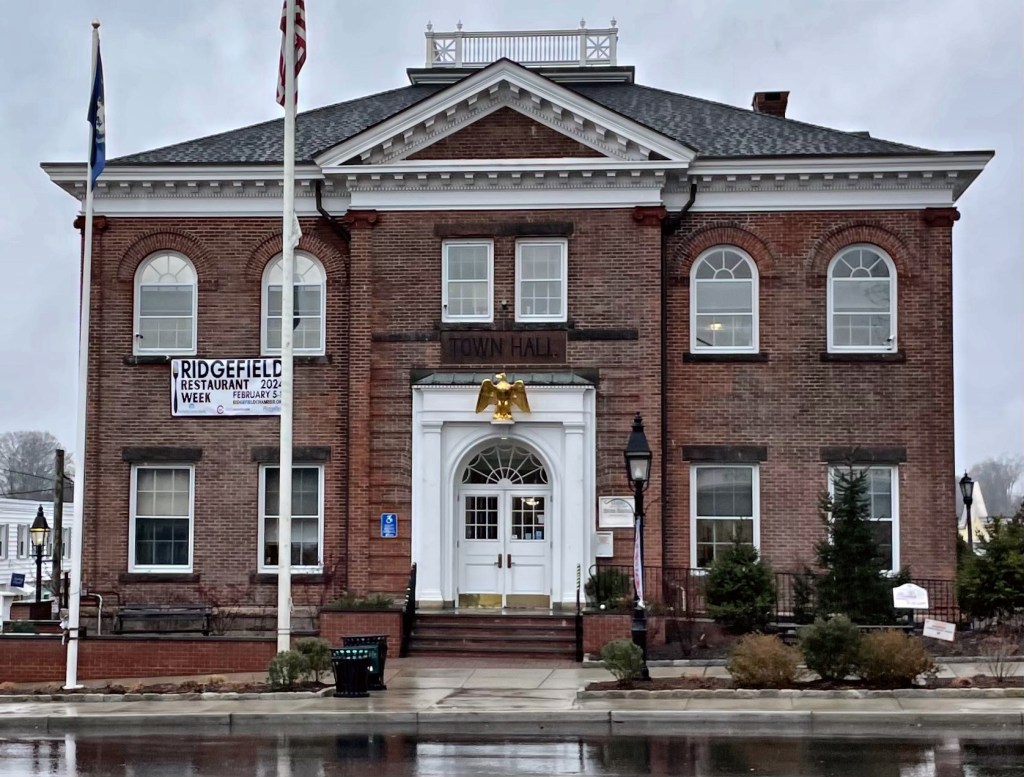
Ridgefield Town Hall // 1896

Ridgefield, Connecticut was settled in 1708 when 24 families from Long Island purchased land from Chief Catoonah of the Ramapo tribe. The Fundamental Orders adopted by Connecticut in 1639 directed would-be settlers, able to support a minister, to establish a settlement, build a Congregational church and farm the land. This is exactly what was done in Ridgefield, beginning in 1708. The original 24 proprietors received 7½-acre home lots drawn by lottery, with a 25th reserved for the minister. The lots were located up and down Main Street from a Common where a Meeting House was built. The town grew and for much of its three centuries, was primarily comprised of old farms. By the late 19th century, spurred by the connection of the railroad, Ridgefield was “discovered” by wealthy New York residents, who assembled large estates in town, a trend that has only picked up in the 21st century! Population growth and a large fire on the town’s Main Street in 1895 necessitated a new Town Hall building. The present Town Hall building was constructed in 1896 from plans by architect Philip Sunderland. Colonial Revival and Romanesque in style, the two-story brick building features a pedimented central bay also containing the entrance with fan light transom, round arched windows, brownstone trim, and narrow pilasters of brick. The building houses town offices today.

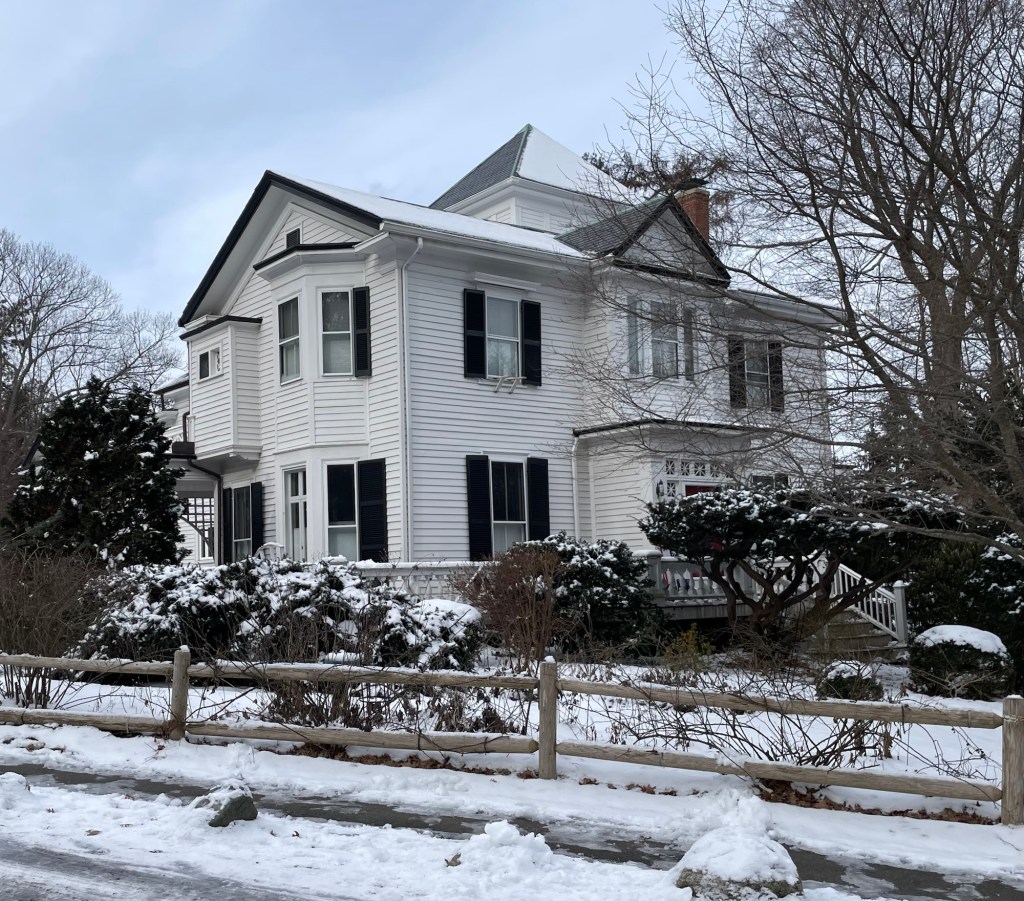
George Cobb House // c.1865

While most of the early homes in Newton Centre were built by a few landowners and rented to tenants, this charming Mansard cottage was owner-occupied from the start. Tucked away on the quiet (and appropriately named) Pleasant Street, the George Cobb House is one of the most beautiful old Victorians in the neighborhood. An early resident was George Washington Cobb (1840-1925) was a druggist who ran an apothecary in East Boston, and he made the long commute there every day from this house. The property has a mansard roof with pedimented dormer and three-story tower capped by a bell-cast mansard roof. Paneled pilasters and brackets add a lot of detail to the primary facade.

First Baptist Church in Newton // 1888

The Boston area has an embarrassment of riches when it comes to Richardsonian Romanesque style buildings, due in part to its namesake, Henry Hobson Richardson lived and worked locally. One of my all-time favorites is the First Baptist Church in Newton Centre. The church was designed by architect John Lyman Faxon, who was clearly influenced by Richardson. The First Baptist Church in Newton is among the oldest Baptist congregations in the state. Baptists were recorded as living in Newton as early as the 1720’s, but growth was slow and marked by persecution. In 1780, a congregation was assembled and the next year a rough, unplastered barn like meeting house was begun alongside Baptist Pond (now Crystal Lake). Fifteen years later, the congregation was finally able to afford a stove; twenty one years later, in 1802, the structure was enlarged. In 1836, the congregation constructed a larger meeting house in a more convenient location, the corner of Beacon and Center Streets. The second building was remodelled in 1856 and 1869 and finally was moved from the site to make way for the present church, the third meeting house, dedicated in November 1888. The First Baptist Church is undergoing some work at the exterior at the time of the photo, but the amazing brownstone trim and the winged creatures on four sides of the octagonal tower still shine!

Sudbury Aqueduct Waste Weir Control House // 1878

The Sudbury Aqueduct was constructed between 1875 and 1878 and runs for 16 miles from Framingham, Massachusetts to the Chestnut Hill Reservoir in Boston, and was in use for almost 100 years. It was designed to carry water from the watershed of the Sudbury River to Boston and its surrounding communities, supplying the ever growing metro area with fresh drinking water. Along the route, meter and control houses were built along with the Echo Bridge, to guide the running water to Boston for distribution all over the city. City architect of Boston, George A. Clough designed many of the structures along the route including this waste weir structure in Newton Centre. The weir was known as “Clarks Waste Weir” as it was built on the edge of land owned by Charles P. Clark. The aqueduct was taken out of regular service in 1978 but remains an emergency backup. Much of the aqueduct’s route is open to the public as an unimproved walking trail.

Charles H. Bennett Cottage // c.1868

Another of the charming gingerbread cottages in Newton Centre built on Charles Davis’ “Mount Pleasant” estate is this charmer. Like the Charles Davis rental cottage on Pleasant Street nearby, this home was rented by Mr. Davis to tenants briefly before it was purchased by George A. Rollins who later sold the property to its longest owner, Charles H. Bennett, a Boston stockbroker. The house is one of four near-identical gingerbread cottages developed by Davis, all retain their decorative bargeboard trim and porch detailing. This one may be my favorite!

Charles S. Davis Cottage // c.1868

When wealthy Boston manufacturer Charles S. Davis began subdividing his suburban Newton Centre estate, “Mount Pleasant”(last post) in the 1860s he was extremely particular on the dwellings and residents that would be his new neighbors. He sold off some parcels to friends and affluent members of the community and he also built some small gingerbread cottages – like the house seen here – for rent. This Victorian Gothic gingerbread house was rented to provide Mr. Davis with some additional income. It was eventually sold off to a private owner and has been meticulously preserved ever since.

Mount Pleasant Estate // c.1856

One of the surviving old estates in Newton is Mount Pleasant, one of the oldest in Newton Centre. The home was originally built in the 1850s by Roswell Willard Turner, who acquired large land holdings in Newton Centre. The large property was eventually purchased by Charles S. Davis, an associate of the Boston piano manufacturing firm of Hallett & Davis. As Newton Centre developed, he enlarged his own home in the 1860s, and sold off his holdings, developing the surrounding area with charming Gothic Revival cottages on Mount Pleasant, the hill upon which his property gained its name. His own home was enlarged and includes elongated additions, a tower with hipped roof, and arched windows.