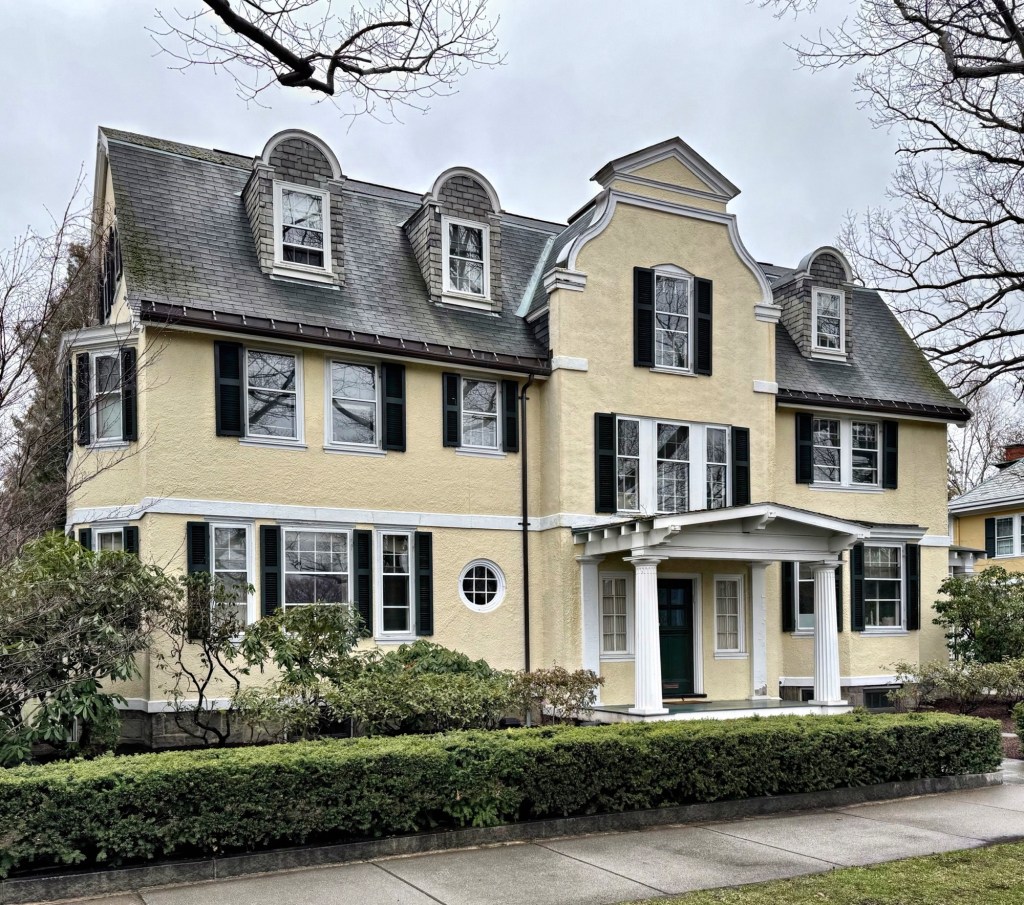
Harry W. Cotton House // 1905

In 1905, George H. Cotton and his wife, Cora S. Cotton, purchased a house lot on Amory Street in Brookline and hired famed architect, William Gibbons Rantoul, to design this home for their son and daughter-in-law. George Cotton was a manufacturer of brass tubing and also the founder of the Belmont Springs Water Company and maintained homes in the Back Bay of Boston and in Belmont. His son, Harry W. Cotton, also worked for the American Tube Works and lived in this home with his family. The Cotton House is an architectural blending of Dutch Renaissance Revival and Arts & Crafts styles. The stucco siding and entry portico are in the Craftsman style, while the prominent Flemish gable on the central pavilion and round arched pediments for the dormers are in the Flemish mode.

Dutch House // 1893

Located on the appropriately named Netherlands Road in Brookline, MA, this house was actually designed as a temporary structure as part of the 1893 World’s Fair, also known as the World’s Columbian Exposition or the White City, depicted in the great book, Devil in the White City. The Dutch House was constructed in 1893 by the Van Houten Cocoa Company of the Netherlands, as a display pavilion and cocoa house. It was located at one end of the Manufactures and Liberal Arts Building (the largest building ever constructed at the time). The Dutch House as we know of it today, was greatly inspired in design by the Franeker City Hall (c. 1591) in the Netherlands. While attending the World’s Fair, Captain Charles Brooks Appleton of Brookline be.came so captivated with the structure that after the Fair, he purchased the building and had it dismantled and transported to Brookline. By the early 2000s, much of the amazing carvings on the building had fallen off, until a new homeowner had them all restored from drawings and images of the building, to the iconic landmark we see today.