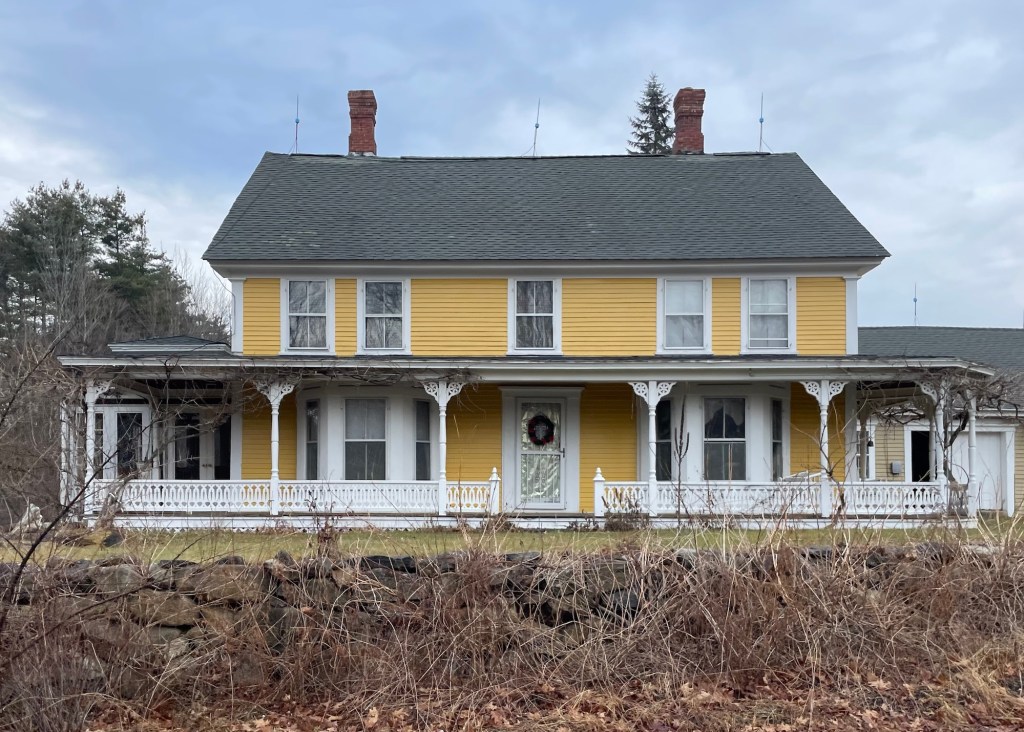
The backroads of New England always lead you to great discoveries! This time, driving around Weare, New Hampshire, I stumbled upon this large farmhouse on the side of the road. The home was owned by Cyrus Hazen by 1858 and due to its style, I would date it to be built in the 1850s. Cyrus Hazen married Louisa Bartlett (as her second marriage) in 1847 and they appear to have had this home built a few years later. The Hazen’s ran a farm from this home for decades. Sometime after the Civil War, the home would have gotten the full-length verandah (front porch) and a side tower, both Victorian-era additions. The home is now attached to the historic barn by an ell.
The Reuben Curtiss House is a classic example of a Greek Revival farmhouse from the mid-19th century, located in Southbury, Connecticut. Local history states that a house built here by Israel Curtiss (1716-1795) who farmed the land with his large family. In 1798, Israel’s large estate was distributed among three of his sons, Joseph, Benjamin, and Reuben. This was complicated by the fact that in the same year, both Joseph and Benjamin died, leaving the entire estate to Reuben. From about 1840 and possibly until he sold the property in 1866, Reuben B. Curtiss ran an academy here, known as “Buck Hill Seminary for Boys.” It was a large operation, as suggested by the size of the addition and confirmed by the 1850 federal census. At that time there were 23 students in residence, ranging in age from 8 to 12, along with four adult supervisors. It was likely that the former farmhouse was expanded and the present 1840s Greek Revival block was added which now is the main facade.
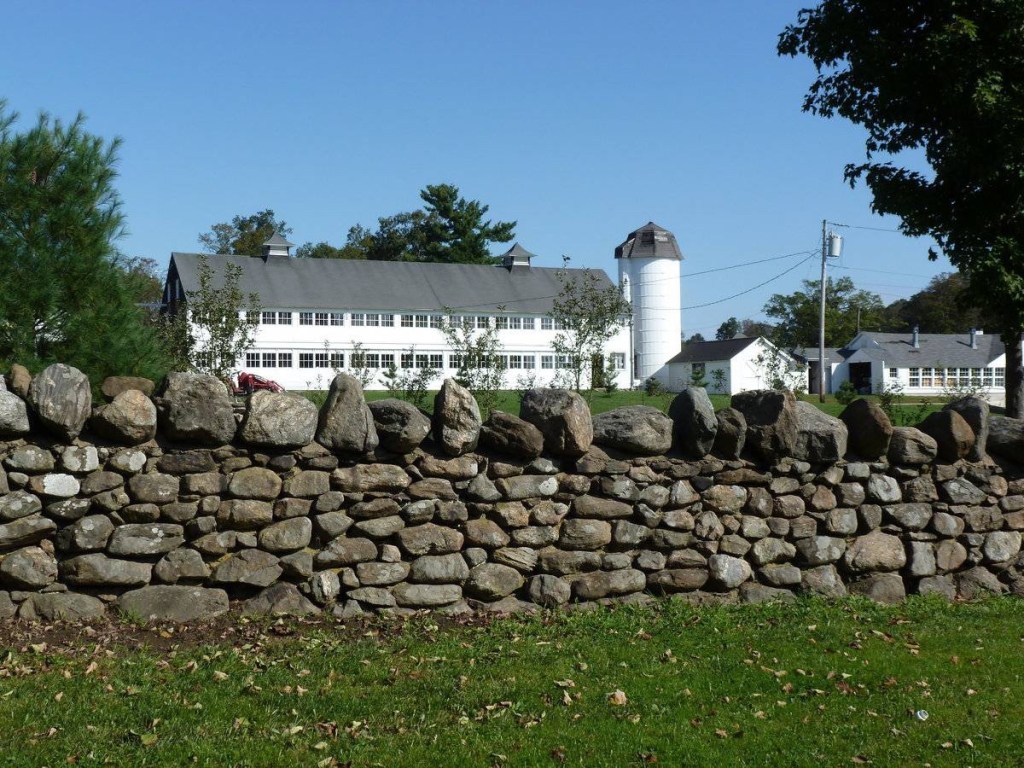
Tranquillity Farm, spanning the rolling hills around Lake Quassapaug in Middlebury Connecticut, was originally a 303-acre model/gentleman’s farm developed by John Howard Whittemore, a successful industrial-era businessman in Naugatuck, and his wife Julia Spencer Whittemore. Whittemore was a major figure in Naugatuck, sponsoring a series of commissions of McKim, Mead & White for buildings in the city center. For his country farm estate, he again commissioned McKim, Mead & White to design a new country house, a farm superintendent’s house, boat house on the lake, and other outbuildings for a working farm. An older farm was purchased, which included a modest Greek Revival style farmhouse dating to the early-mid 19th century (seen here) and a large wooden barn. Both of these were kept and incorporated into the estate near the southern entrance to the property, possibly to harken visitors back to the charm of rural living. The sweeping landscape, featuring miles of distinctive stone walls lining the roads and crisscrossing the fields, was designed by Charles Eliot and completed by Warren H. Manning – both protégée of Olmsted.
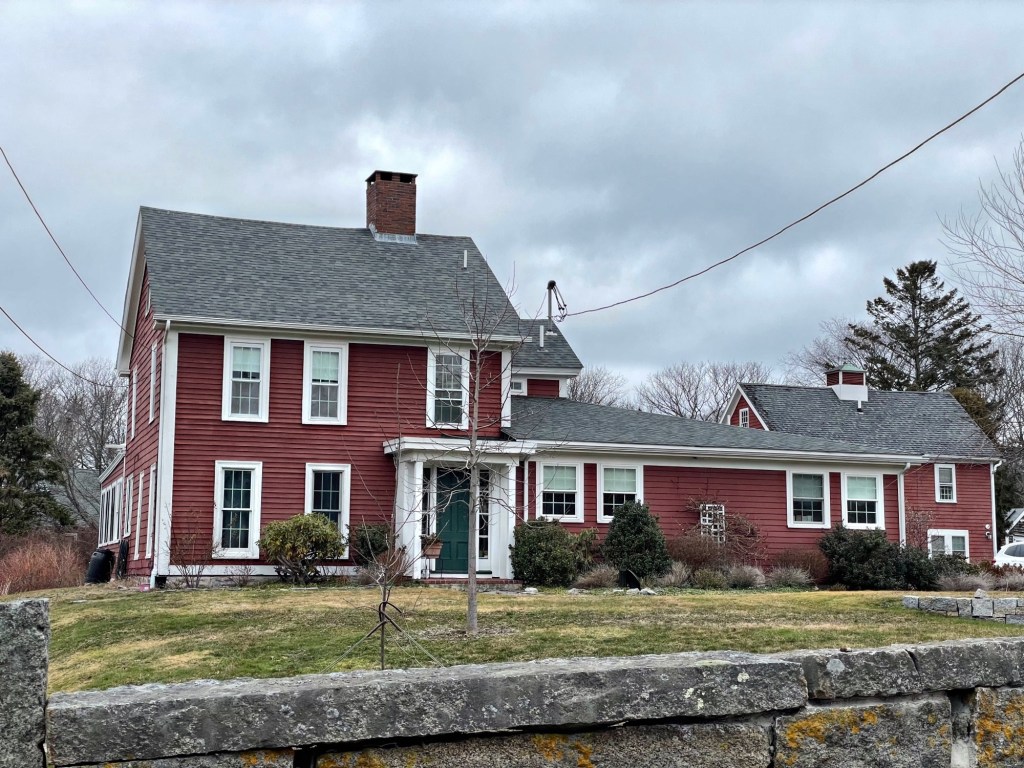
Can I get an “Amen”?! Amen Farm was built in the mid-19th century on 47 acres in Brooklin, Maine, overlooking the Blue Hill Bay and Acadia National Park in the distance. The Cape house, like many on Blue Hill peninsula, is modest and was enlarged by telescoping ells as space was needed. The house was long owned by the Bowden Family who farmed the land, later adding a small gas station to the side of the road (since removed). Later owner, Joseph “Roy” Barrette (1896-1995) likely helped give the home its name. Barrette got his first look at Maine in 1919 from a ship, when he was a deck-hand on an 800-ton coal barge, hauling West Virginia coal from Norfolk to Portland. He had bought this farm in 1958 and was looking forward to his retiring years, which he intended to spend in a library of some 3,000 volumes and indulging his hobbies as a gardener, a gourmet, and a connoisseur of fine wines. John Wiggins, associate editor of The Ellsworth American newspaper, impressed by Barrette’s garden, his literary tastes, and his writing style, persuaded him to write a column, which he called “The Retired Gardener.” He wrote many essays and three books from this home in Brooklin where he never fully retired. Roy died in 1995 and the property was eventually listed for sale in 2019. The house is undergoing some work and landscaping upon the time of the photos.
The Little River area of Waterbury, Vermont, was a very sparsely developed area of farms located on the slope of Ricker Mountain, which was difficult to traverse and farm. Almeron Goodell (1834-1910) and his wife Luthera bought farmland here in 1863 and built this farmhouse that year from rough-hewn timbers on the land. In 1870, the couple and their seven-year-old son, Bert, had four cows, one horse, and a flock of chickens on their property – enough to supply the family’s needs. Life on Ricker Mountain was hard. By the late 1800s, the loss of soil fertility on the land prompted some farmers to abandon the hillsides for more fertile land in the valleys nearby or the free land offered in the American West. Additionally, the Green Mountain Power Company began purchasing farmland to erect a hydroelectric dam and reservoir in 1920, effectively abandoning the area. The Little River area was left behind, with abandoned farms, family cemeteries, and carriage roads, slowly returning back to the earth. Luckily for us, the area is preserved as part of the Little River State Park, where you can hike and explore the area, learning about the past inhabitants of the now ghost village. The Goodell Farmhouse is the only extant farmhouse left from this early settlement and a lasting reminder of how hard life was for many who settled in undeveloped land in New England. The farmhouse was used as a hunting lodge in the 1940s, likely the only reason it still stands to this day.
In the early years of the establishment of the settlement of Landgrove Vermont, Joshua Dale 1765-1845) moved to the newly incorporated town and built this large farmhouse on the south-facing slope of a mountain. With strong ties to nearby Weston, he tried to make a life in the new town of Landgrove, serving as a selectman, but he and his family moved back just four years later. The property was purchased by Obadiah Pease (1766-1830) who lived here with his wife Achsah and their seven children. The farm was eventually willed to their son Elihu, who did very well farming the property during his ownership (1830-1857). In 1842, he was the third-richest man in town at just 39 years old. From 1855 to 1857 he farmed only half the farm and a Shrewsbury man, Dexter R. Way, farmed the rest. At age 54, Elihu sold his farm to Dexter Way and left Landgrove to Wisconsin. After successive ownership, the farm was bought in 1933 by Nelson and Elizabeth Bigelow, for $1,500! The property included 200 acres of land, a dilapidated farmhouse and two decrepit barns. For the following seven years the land was gradually brought under control and the house restored, but the barns were unsalvageable. This homestead is a lasting example as to what a little faith and hard-work can accomplish, bringing what is seen as a tear-down up to one of the nicest homes in the area!
I stumbled upon this Greek Revival farmhouse located on one of many dirt roads in Landgrove, Vermont and had to snap a few photos! I couldn’t find much on the history of the house besides the fact it was listed on an 1869 atlas as the property of an “I. Cory”. The five-bay farmhouse has an elaborate door treatment and bold corner pilasters all perched behind a historic stone wall. The house telescoped outward with additions, eventually connecting it to what is now a garage. This farmhouse purchased in the 20th century by John A. Brown, who worked as Dean of Students at Princeton University.
This beautiful farmhouse in Cavendish, Vermont is located along a winding dirt road and has ties to one of the town’s original family’s. A home was built here in 1785 and changed hands numerously over the first few decades of its existence. The farmhouse that was built also served as a tavern for travellers along the newly laid out Wethersfield Turnpike. It is possible that the cheap land and rural character of the new town was appealing to some, but reality away from true commerce may have made many sell the farm after a few years, which could explain why the property was bought and sold so often early on. The property was purchased by Jonathan Atherton, a Revolutionary War veteran, farmer, surveyor and lawyer, who acquired large landholdings in Cavendish. In 1821, Jonathan Atherton was sued in court by his neighbor, Jedediah Tuttle for beating Tuttle’s wife Lydia. In order to finance the bonds, Atherton mortgaged all his real estate in Cavendish to his brother Joseph, and Elihu Ives, Jonathan Atherton Jr.’s father-in-law. Atherton St. lost the case and had to pay a fine. The property was eventually inherited by Stedman Atherton, the youngest son of Jonathan, who seems to have demolished the old homestead and constructed the present home on the site. The original dwelling was also the childhood home of Henry B. Atherton, a staunch abolitionist and soldier in the American Civil War, who later served as a lawyer and state legislator for New Hampshire, and his sister Eliza (Atherton) Aiken, a Civil War nurse who has been referred to as America’s own “Florence Nightingale”. The old Atherton farmstead was recently renovated.
This house in Cavendish was constructed in 1850 by Joshua Parker and is an outstanding example of a gothicized snecked ashlar house. The house is in the Cape form and largely exhibits a more traditional cottage layout, but with the steep gable dormer, giving the home a distinctive Gothic feeling. The 1850 home replaced a late 18th century farmhouse, but in the iconic snecked ashlar construction. The farm grew over the subsequent decades, including a c.1900 snecked ashlar barn (not pictured), which is probably the last building of “Snecked Ashlar” construction erected in the State of Vermont.
Scott Farm, established as a working farm in the late 18th century and as a commercial apple orchard in 1911, is an excellent example of the vernacular architecture that Vermont is known for. The sprawling 571-acre farm was established in Dummerston in 1791 and purchased by Rufus Scott in the mid-1800s. In the 1840s, he built this farmhouse and many of the barn buildings soon after. The five bay Greek Revival house is in a Cape form and retains its historic slate roof and detailing. The property has been owned since 1995 by The Landmark Trust USA, a non-profit organization whose mission is to preserve historic properties through creative sustainable uses for public enjoyment and education. The farm sits a short drive to Naulakha and the Dutton Farmhouse (both featured previously) which are also managed by the Landmark Trust USA.