Holy Family Parish Church // 1882

In 1872, due to industrialization and increased numbers of immigrants settling in the area for work, it was decided that a new Catholic parish should be established in East Abington. Two years later, the village of East Abington incorporated as Rockland. It would be a decade later, in 1882, until the Holy Family Parish would be established, beginning planning of a true house of worship for the growing number of Catholics here. When the Holy Family Church was constructed in 1882, only a quarter of the Rockland’s approximately 4000 residents were Catholic at that time. Most of the original congregation consisted of Irish immigrants who worked in the town’s boot and shoe manufacturing industry. As the industry continued to flourish in the 1890s and 1900s, new shoe factories were built, bringing more workers to Rockland, including: Canadians, Italians, and British to the area. The town’s Catholic community grew as a result. The Victorian Gothic style Catholic church was built in 1882, with no known architect at this time. A complex of other buildings, including a school, rectory, and community center.

St. George’s Episcopal Church, Central Falls // 1922

Tucked away in the middle of a residential neighborhood in the dense city of Central Falls, Rhode Island, this Neo-Gothic style church more closely resembles an English country church than one typically found in a dense, industrial city. This is the St. George’s Episcopal Church, located at the corner of Central and Clinton streets, and built for the local Episcopal congregation there in 1922. The church was designed by the Rhode Island architectural firm of Clarke & Howe and is built of rough-faced stone with limestone trim. The highlight of the design is the large central tower with lancet, stained glass window, and belfry. 

East Church of Salem – Salem Witch Museum // 1844

One of the most recognizable buildings in Salem is the former East Church, now occupied by the Salem Witch Museum. The East Church was constructed between 1844 and 1846 for the oldest branch of the First Church of Salem, which originally organized in 1718. The stunning Gothic Revival church has been credited to architect Minard Lafever (1798-1854), a prominent New York architect known for his Gothic, Greek and other Exotic Revival style buildings. Constructed of brownstone, a material Lafever utilized for his New York City churches built at the same time, the East Church exhibited pointed arch stained glass windows, crenellation resembling battlements, and once featured two, four-stage octagonal towers, which were cut down in the 1920s to their current height. The church suffered from a massive fire in the early 20th century and the church eventually moved out in the 1950s. The building was occupied by the Salem Auto Museum until another fire in 1969. In 1972, the Salem Witch Museum moved in and completely updated the interior.

St. Peter’s Episcopal Church // 1833

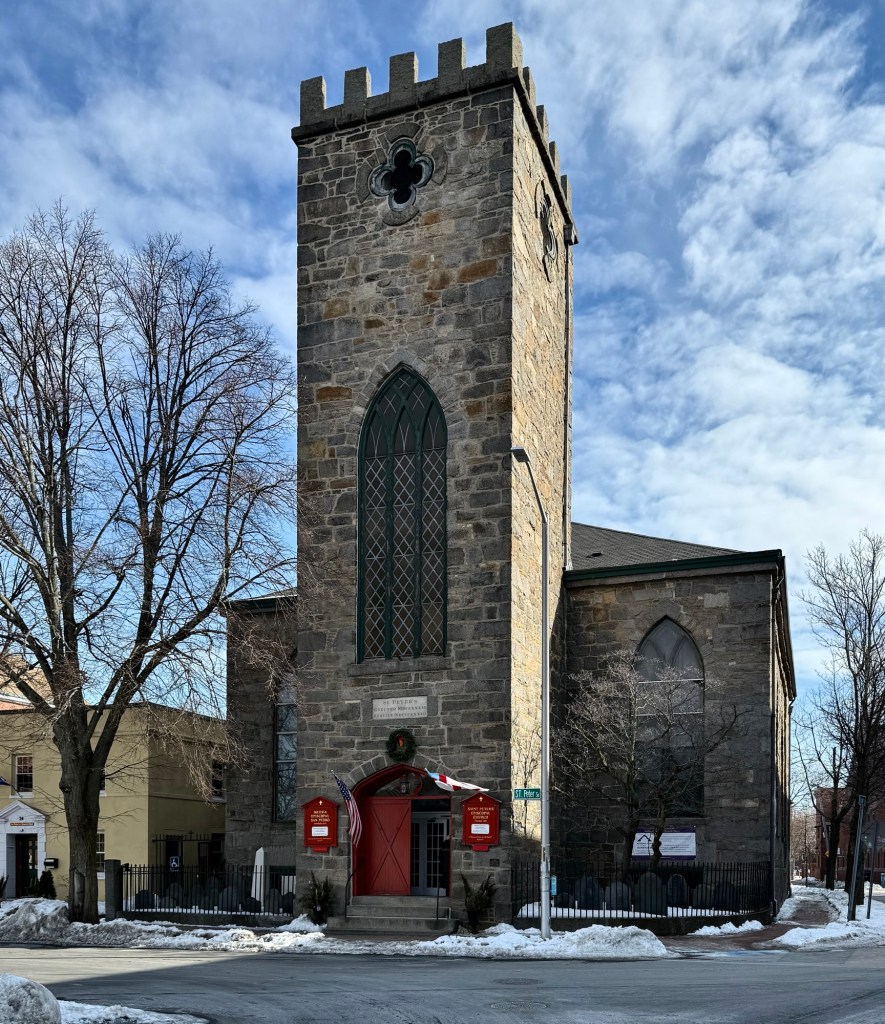
The St. Peter’s Episcopal Church of Salem, is a landmark example of a granite, Gothic Revival church of the 19th century. The present church, which is constructed of Cape Ann granite, was the second church on the site built for local Episcopalians, replacing a wood-frame building constructed there 100 years prior. Designed by architect Isaiah Rogers, the Gothic church features a prominent entry tower with a quatrefoil window in each elevation, large lancet-arched windows in the tower and lining the sanctuary, and a crenelated parapet. When completed, St. Peter’s had Salem’s first church bell, an 1740 English bell that supposedly still graces the tower today and is said to be the oldest church bell in the United States! In 1871, the rear chapel was added to the building, from plans by George E. Harney. The chapel was built directly over the old parish cemetery, requiring some of the tombstones to be placed inside the chapel walls, while others were moved to the front of the church, creating a really unique “garden cemetery” in front of the church.

St. Paul’s Episcopal Church, Brookline // 1852

The St. Paul’s Episcopal Church of Brookline, Massachusetts is an architecturally and historically significant landmark to the area. The congregation was established in 1849, and within months, in May 1850, the corporation, which was made up of wealthy Boston-area residents, accepted an offer from Augustus Aspinwall of a building lot to erect a church. Esteemed ecclesiastical architect, Richard Upjohn, the architect of Trinity Church in New York, was hired to design the church in Brookline of the same, Gothic style. The wealth of the congregation was evident by the consistent expansions of the complex, to include a chapel, rectory, parish house, and other expansions to those buildings. St. Paul’s Church is the oldest religious structure in Brookline, and almost was lost when the sanctuary was devastated by fire in 1976, leaving only its exterior walls and two stained glass windows. The congregation rebuilt the interiors and the building remains well-preserved at its exterior, built of Roxbury Puddingstone.

Trinity Parish Chapel, Southport // 1872

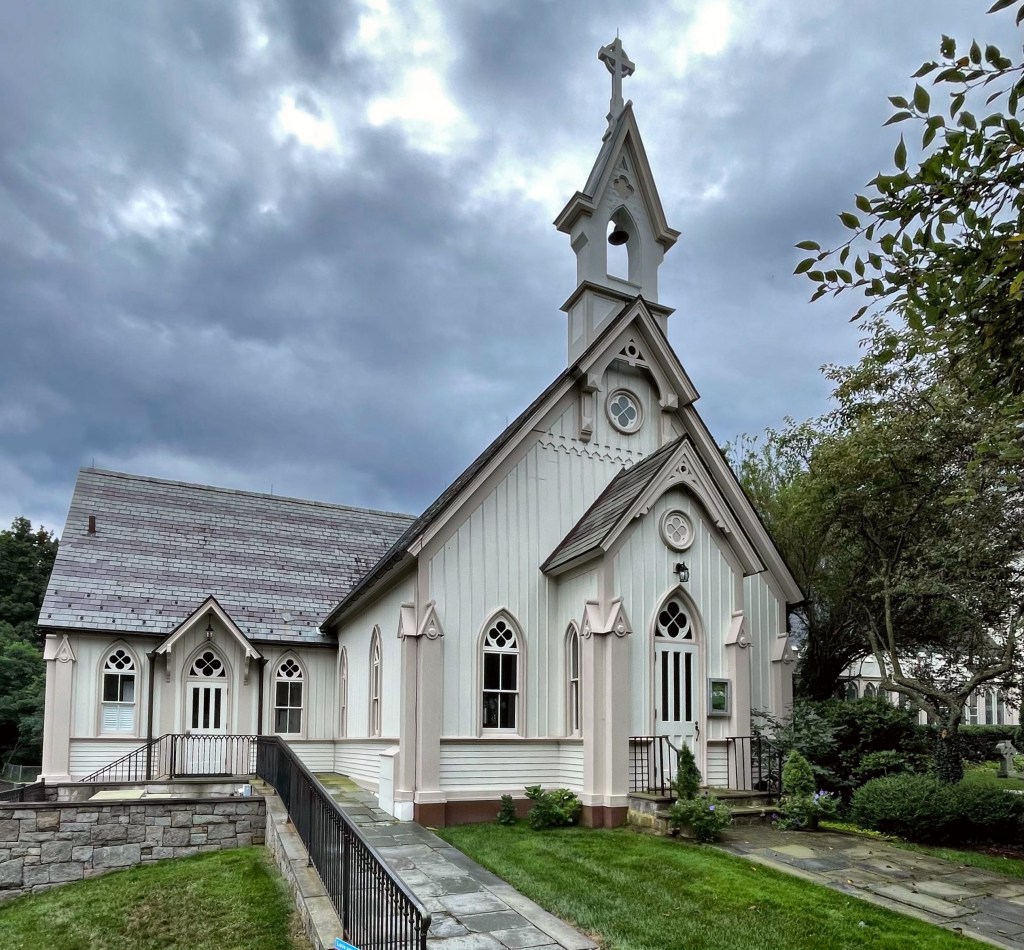
The Trinity Episcopal Church in the Southport section of Fairfield, Connecticut was established in 1725. As the parish and town grew, a large and architecturally stunning church was erected in 1862, and housed services for some of the wealthiest and well-connected residents of Connecticut. During Rev. Edward Wells’ rectorship, it was decided that a parish school was needed, and as an ardent believer in religious training, he started planning for a new chapel for use as a school. The Trinity Parish Chapel was designed by Southport architects Disbrow & Taylor and erected 1871-72. This Gothic Revival building is an excellent example of the rural church architecture which enjoyed widespread popularity throughout the country during the mid 19th century. Designed on a simple rectangular and decorative wooden bell cote, the small chapel’s board-and-batten siding and modest though strong Gothic details create a composition which compliments the more grand church just steps away. The chapel was originally built as a free-standing building, but was connected by a large, brick addition in the 20th century.