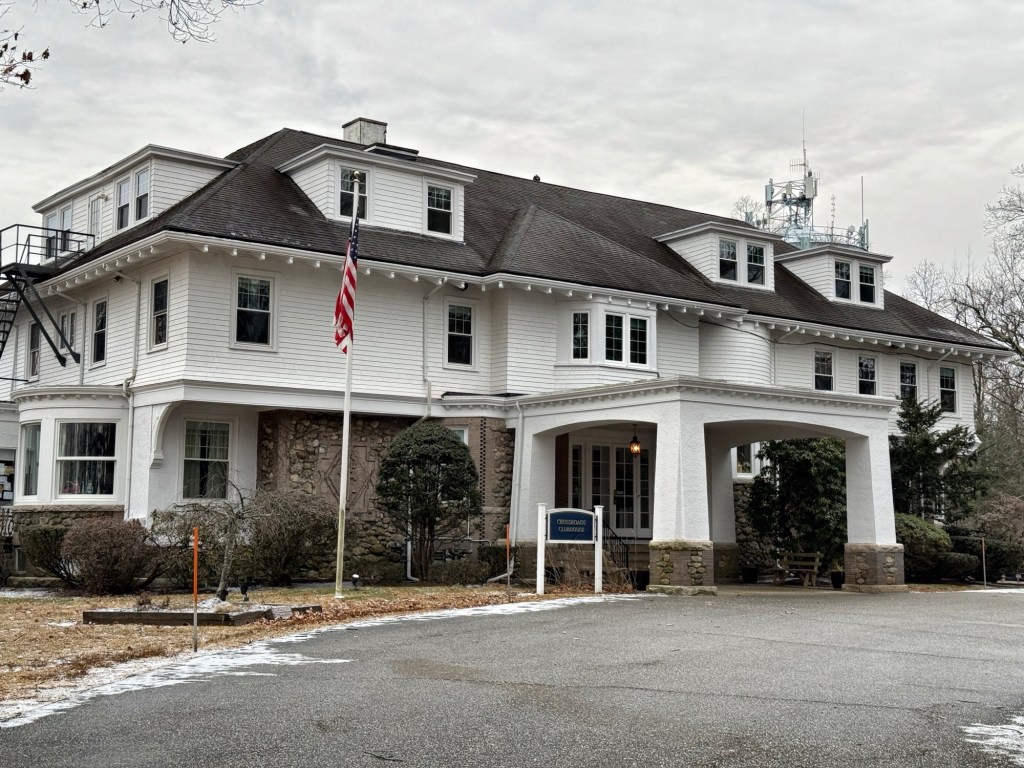
The Larches // 1910

George Otis Draper (1867-1923) was born in Hopedale and attended MIT to prepare to help run the extremely successful family business, the Draper Corporation in town, which was experiencing a period of rapid growth and expansion of factories. With his position at the company, his wealth afforded him the ability to build a massive country estate known as The Larches. The shingled Colonial Revival style home featured a massive crenelated tower and appeared like a castle in the countryside. George O. Draper sold this home to his aunt Hannah Thwing Draper Osgood in 1909, and within a month, the home burned to the ground. She began construction on the “new Larches“, a shingled mansion with a stunning blending of Colonial Revival and Craftsman styles. The home was likely designed by Robert Allen Cook, who was based out of nearby Milford, MA. The property today is run by Crossroads Clubhouse, an employment and recovery center that offers people with mental health conditions opportunities to achieve their full potential.
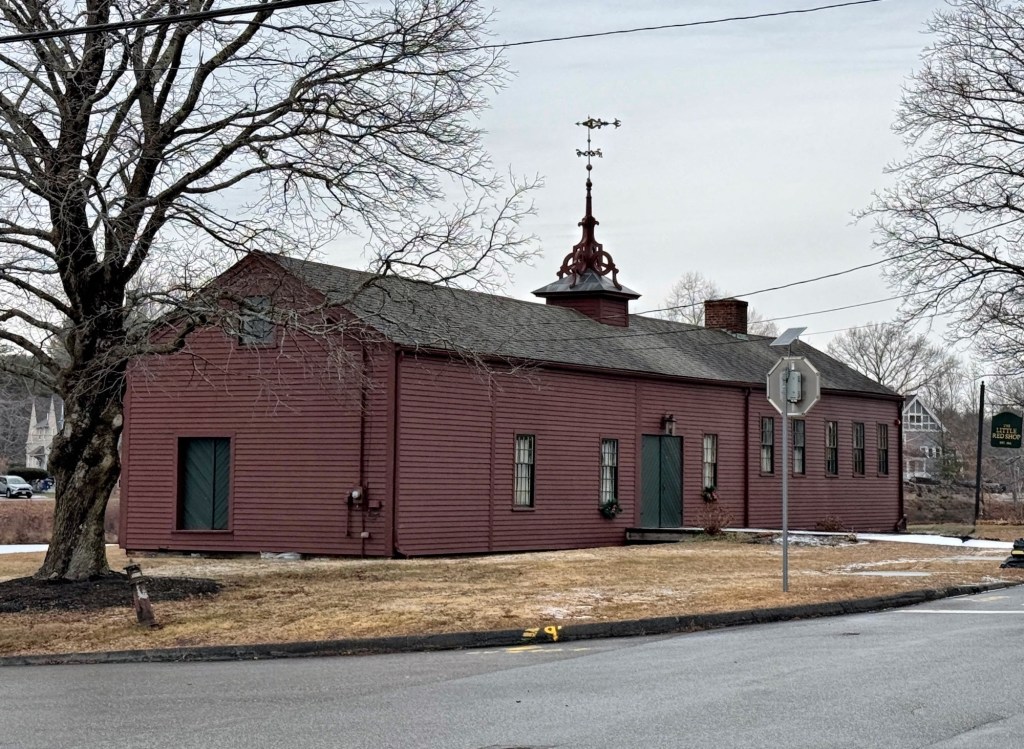
Little Red Shop // c. 1843

The area that is now the town of Hopedale, Massachusetts, was originally known simply as the “Dale,” a small, secluded agricultural area between Mendon and Milford, that beginning in 1842, was home to a communal Christian society called “Hopedale Community.” The communal agricultural and manufacturing society that eventually acquired over 600 acres  and numbered more than 300 members at its peak before ultimately failing in 1856 due to socioeconomic inequalities and bankruptcy resulting from conflicts between its ideology and business organization.  In that same year, the assets of Hopedale Community were purchased by the E.D. and G. Draper Company, led by Ebenezer and George Draper, who were the operators of Hopedale Community’s most successful manufacturing enterprise, textile machinery manufacturing. The Drapers had previously shared space in this old machine shop, which dates to around 1843, alongside fellow community workers who made hat and shoe boxes, sawed lumber, and ran an iron forge. As the Drapers founded the Draper Corporation, which became the largest maker of power looms for the textile industry in the United States, they never lost sight of their beginnings and preserved this building, which became known as the Little Red Shop. To preserve the building, it was moved four times in its life, to allow for the growth of the company factories, eventually being placed in its current location on town parkland, where it now houses a collection of Draper textile machinery as the Little Red Shop Museum. The Little Red Stop is just one story with nine bays and is vernacular in style, with its notable decorative feature being the metal weathervane mounted at the roof over an elaborate saw-cut wooden base. 

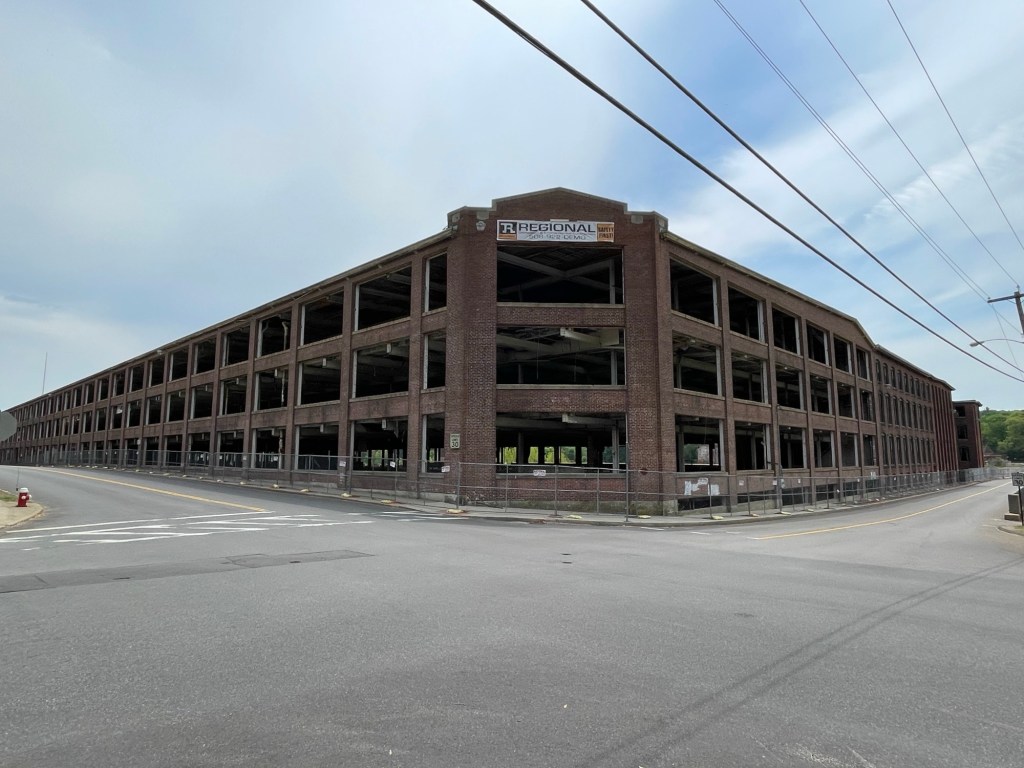
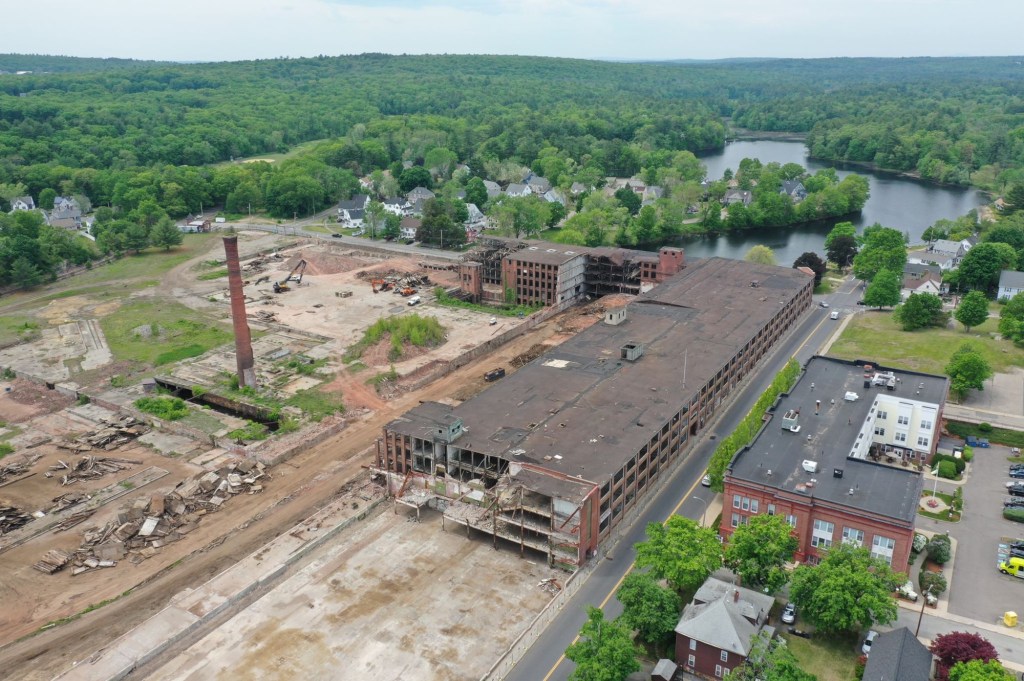
Draper Corporation Factory Complex // 1892-2021

2021 aerial photo

Hopedale, Massachusetts separated from Milford and incorporated in 1886. The “downtown” of the community encompasses industrial, institutional, and residential buildings in Hopedale Village, also known as Draper Village after the long-driver of the local economy, Draper Corporation. Hopedale was largely developed as a planned company town, and its architectural significance and ultimate preservation was largely due to the success of the Draper Corporation as majority owner until the 1950s. The Draper Corporation was originally a small operation in Hopedale in 1841 managed by George Draper (1817-1887), but grew exponentially thanks to his son, George Albert Draper (1855-1926), who had a passion for finding innovative technology to make the production of cloth more efficient. He led the company’s charge to become the nation’s leading producer of machines for the cloth-making industry. In the ensuing decades the factory village of Hopedale became a “model” company town under his leadership, with the business controlling every aspect of the town and worker life in a paternalistic program that extended beyond social structure to include architecture and urban planning of the village. The company developed hundreds of homes for workers, a town hall, library, churches, schools, a fire station, and recreational facilities, along with its factory complex at the center. In1892, with the advent of the Northrop Loom, Draper became the largest producer of textile machinery in the country. Due to their success at the end of the 19th century, much of the complex was built and rebuilt in fire-proof brick factory buildings with large windows to allow light and air into the facilities. Draper’s dominant position within the textile machine manufacturing industry began to erode shortly after World War II, and the company began to sell its company houses to their occupants as private homes in 1956. During the 1960s American textile machinery makers such as Draper lost their technological leadership to foreign manufacturers due to cheap labor, and the general American textile industry collapsed. The plant eventually closed in 1980, and sat vacant until it was decided by the local officials to raze the once great complex, as adaptive reuse was not feasible in the market for such large structures. The mill was demolished in the summer of 2021 and the lot at the center of town remains a brownfield site.