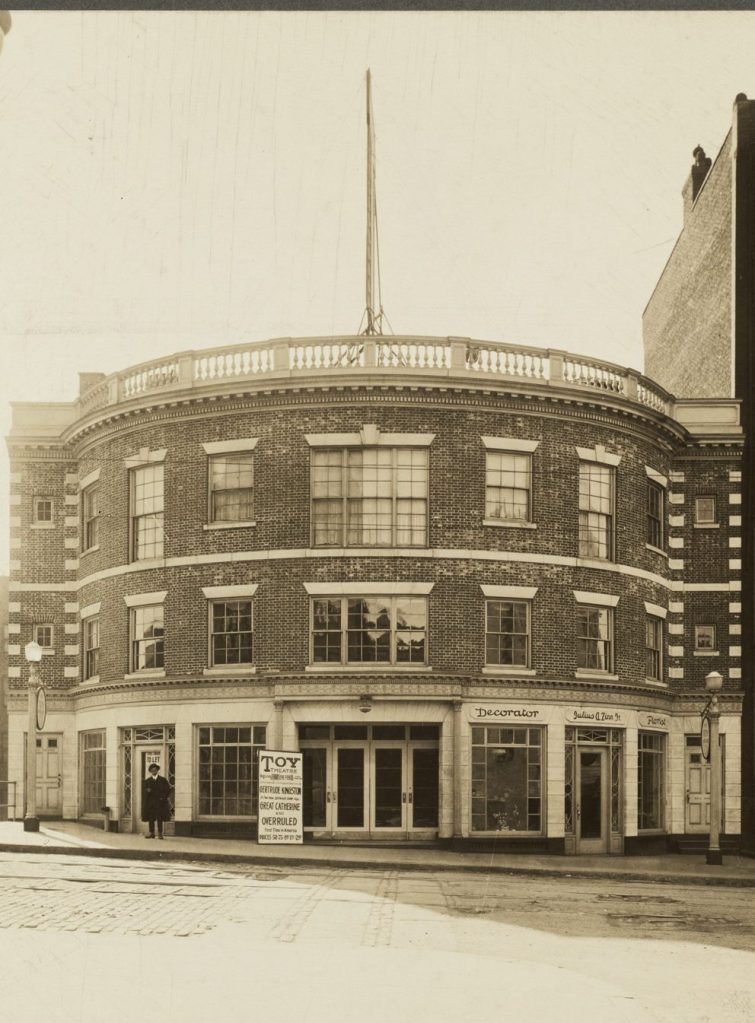
When the Toy Theatre on Lime Street in Beacon Hill (last post) was formed in the early 20th century, the members of the small (but growing) theatre group of well-connected artists and actors had their sights on something with permanence. By 1914, the group had funding and acquired land on Dartmouth street, a block away from Copley Square, and ground was broken to build a large new theatre. The fashionable Colonial Revival style building featured a large rounded bay and was constructed of brick and limestone. The theatre group could not support the building, and it was rebranded as the Copley Theatre within a couple years. Continuing the bad luck, the City of Boston decided to extend Stuart Street by 1921, and this building was along the proposed route. The street was extended and a new “Copley Theatre” was built on Stuart Street, a stone’s throw from this building. And so goes the short-lived history of the Toy Theatre.
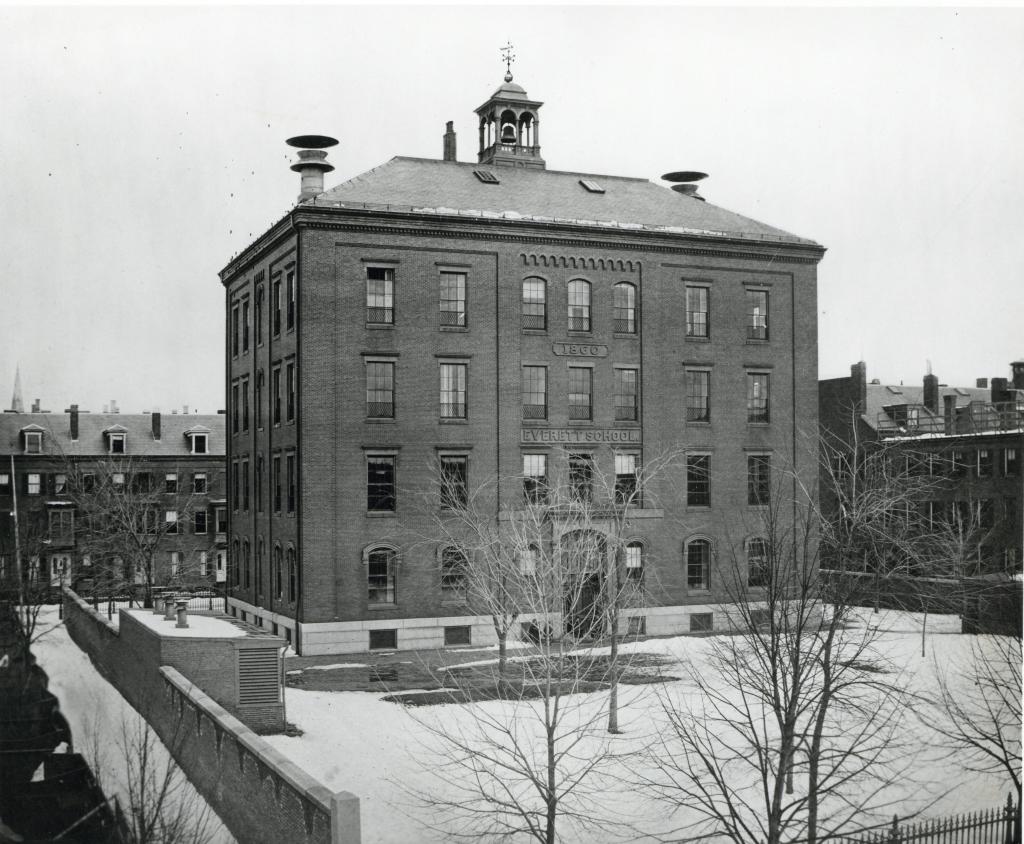
The Everett Schoolhouse opened in 1860 as Boston’s most modern school at the time, serving students in the South End and Roxbury. The school was located on Northampton Street, just off Tremont Street, and stood four stories with lawns surrounding it. The building was architecturally beautiful, with brick walls and stone trim and basement, large double-hung windows, and a slate roof capped by a bell tower. The building was so special, the opening ceremonies were documented in the New York Times in 1860. The school was named after Edward Everett (1794-1865), a Boston-native who served as a U.S. Senator, the 15th Governor of Massachusetts, Minister to Great Britain, and United States Secretary of State. He also taught at Harvard University and served as its president. My favorite tidbit of history on Edward Everett is that he was a great orator, and was the featured speaker at the dedication ceremony of the Gettysburg National Cemetery in 1863, where he spoke for over two hours—immediately before President Abraham Lincoln delivered his famous two-minute Gettysburg Address! The Everett Schoolhouse in Boston saw thousands of children graduate before a fire on the top floor of the building in 1965 and subsequent water damage from fire hoses necessitated its demolition.
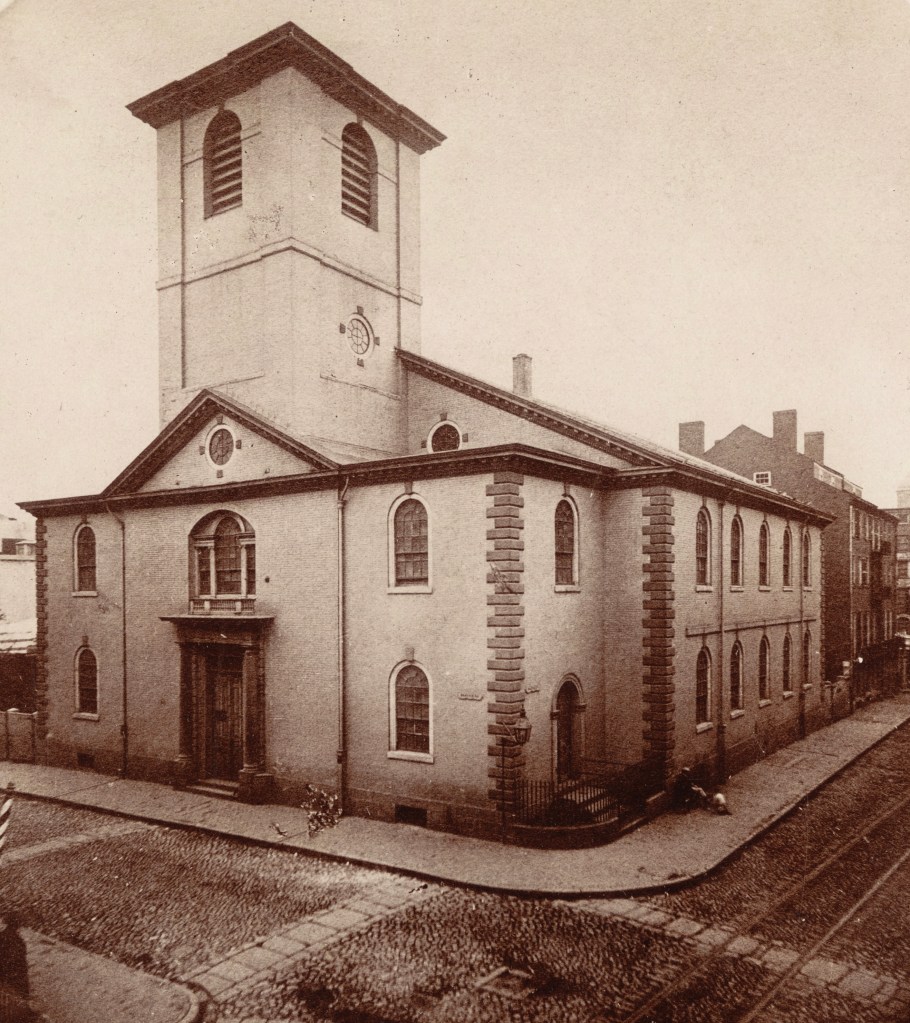
Boston’s constant churning of development has given us amazing architectural landmarks, and incredibly unfathomable architectural loss. One of such cases of loss is the former Brattle Street Church which was located on Brattle Street, roughly where the main entrance to Boston City Hall is located today. Demolition of significant architecture in Boston began way before the period of Urban Renewal in the mid-20th century, and the loss of the Brattle Street Church in Downtown Boston showcases this. The Brattle Street Church had been founded in the 1690s by a group of merchants seeking an alternative to the authority exercised by Increase and Cotton Mather in Boston’s existing congregations. Despite these beginnings, the church remained Congregational through the 18th century. At the time of the Revolution, Brattle Street counted such figures as John Hancock, Samuel Adams, Joseph Warren, and John and Abigail Adams among its parishioners. The original wooden church was replaced in 1772 by this stunning brick building, designed by Thomas Dawes. Just years after the doors opened, the American Revolution upended life in Boston. This building was a survivor, and was apparently hit by cannon-fire by the American batteries at the siege of Boston. A cannonball can be seen lodged into the building at the second floor, to the right of the Palladian window. After the American Civil War, development of the Back Bay led to a shifting population away from the downtown core, and a new church was erected for the congregation, the Brattle Square Church, designed by Henry Hobson Richardson. This church was demolished in 1872, just 100 years after it opened its doors and took a cannon for America.
All Aboard!! The Kneeland Street Station was built at the southern edge of Downtown Boston in 1847 for the newly established Old Colony Railroad Company. By the early 1840s, the city of Boston had six major rail lines connecting it with other places including Lowell, Maine, Fitchburg, and Salem to the north, Worcester to the west and Providence to the southwest. The southeastern part of Massachusetts had yet to be served by a rail link to Boston. On March 16, 1844 the Old Colony Railroad Corporation was formed to provide a rail connection between Boston and Plymouth. Construction of the line began in South Boston in 1844 and the line opened to Plymouth in 1845. The company needed a more accessible station to the residents and businessmen of Downtown Boston, so they acquired a large parcel of land on Kneeland Street to extend the line. The corporation hired architect Gridley James Fox Bryant, who designed this stunning railroad station constructed of brick with strong stone trimmings. As was common, a large clock was affixed to the building to allow waiting passengers to know how long they would be waiting. From 1845 to 1893, the Old Colony railroad network grew extensively through a series of mergers and acquisitions with other established railroads, serving lines to Providence, Newport, Fall River, New Bedford and down the Cape. The railroad was acquired in 1893 by the New York, New Haven and Hartford Railroad, and sought to consolidate the many local stations into a larger building. They soon after began construction on Boston’s South Station, re-routing lines to that new building. They sold off the excess stations, including this one on Kneeland Street, and it was eventually demolished in 1918.
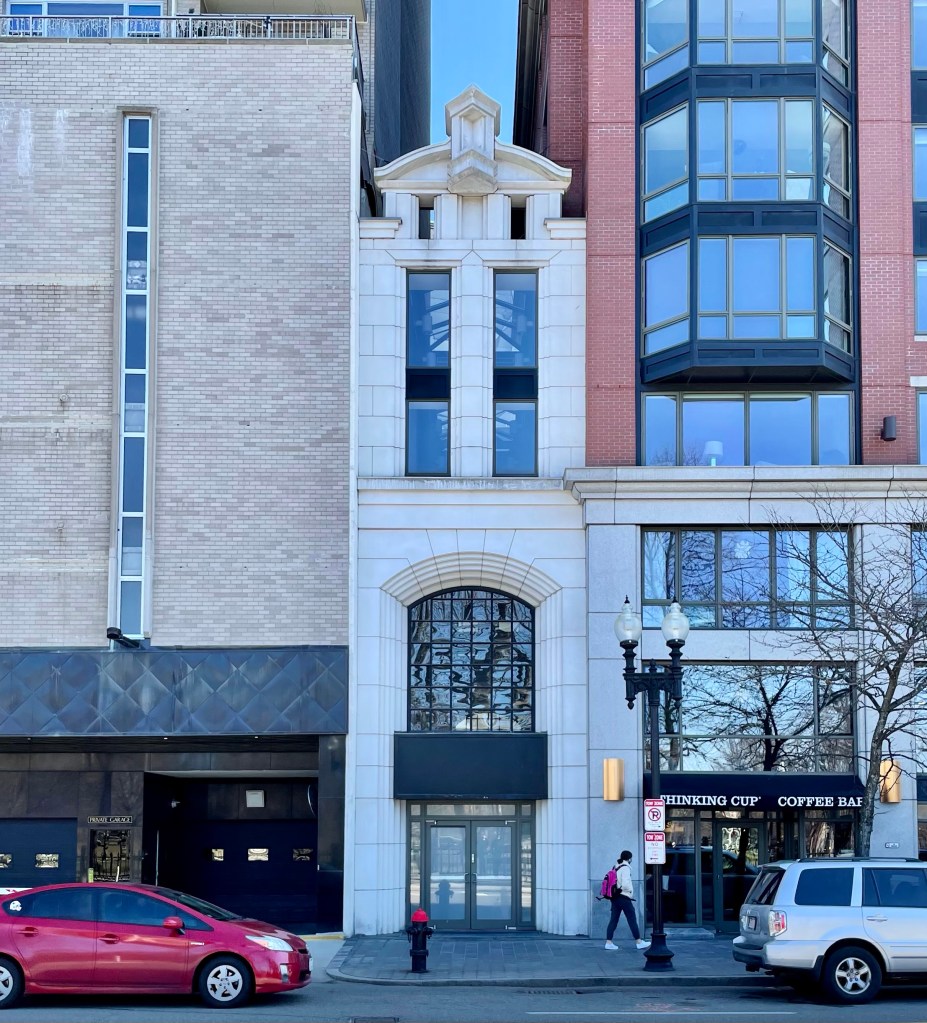
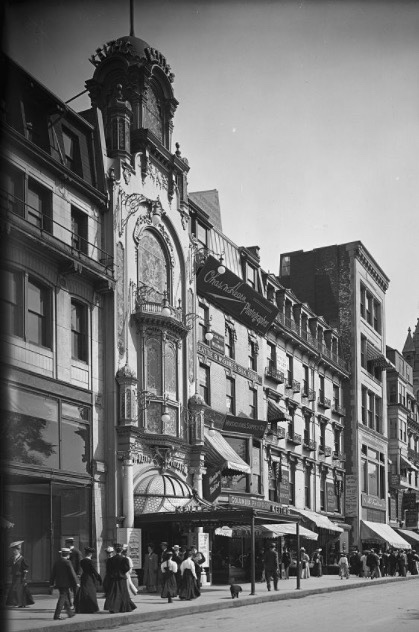
The other day, I was walking in Boston Common along Tremont Street, when I noticed this oddly ornate building wedged between larger, modern buildings. I HAD to investigate! The building was actually constructed as an arcade/covered walkway which ran to Mason Street behind, with a tunnel running under that street into the B.F. Keith’s Theatre. In 1892, Benjamin F. Keith and his business partner E.F. Albee purchased land off Mason Street, a scarcely trafficked street between the busy Tremont and Washington Streets in Boston’s Theater District, with the goal of creating the city’s finest vaudville theatre. The duo hired J. B. McElfatrick & Son, architects who specialized in theatres, to design the new B.F. Keith’s. Due to the site being wedged between two main streets, entrances were built off both Tremont and Washington with flashing lights and marquees, guiding patrons inward. The Tremont facade was especially grand so that B. F. Keith’s New Theatre could be advertised on, and approached directly from, Boston Common, with lights flooding the park. The theater opened in 1894 and was over-the-top with intricate details and sculpture all over, appealing to the city’s wealthy as a place to see the arts. Although it was primarily a vaudeville house during Keith-Albee’s ownership, famed inventor Thomas Edison demonstrated his new Vitascope movie projector here on May 18, 1896. This was the first projection of a movie anywhere in Boston. As live shows made way for motion pictures, the theater adapted, but suffered around the Great Depression when would-be patrons decided to save their limited money. In 1939, the theater was converted to a movie theater named the Normandie. The theater was demolished in 1952 for a surface parking lot to provide better service to the Opera House (originally B.F. Keith’s Memorial Theatre, confusing I know) and Paramount Theater. Today, all we have left of the once beloved B.F. Keith’s Theater is the small annex, which is virtually unrecognizable from historic images as most of its decoration and the top two stories were removed.
Ca. 1910 image courtesy of Boston Public Archives.
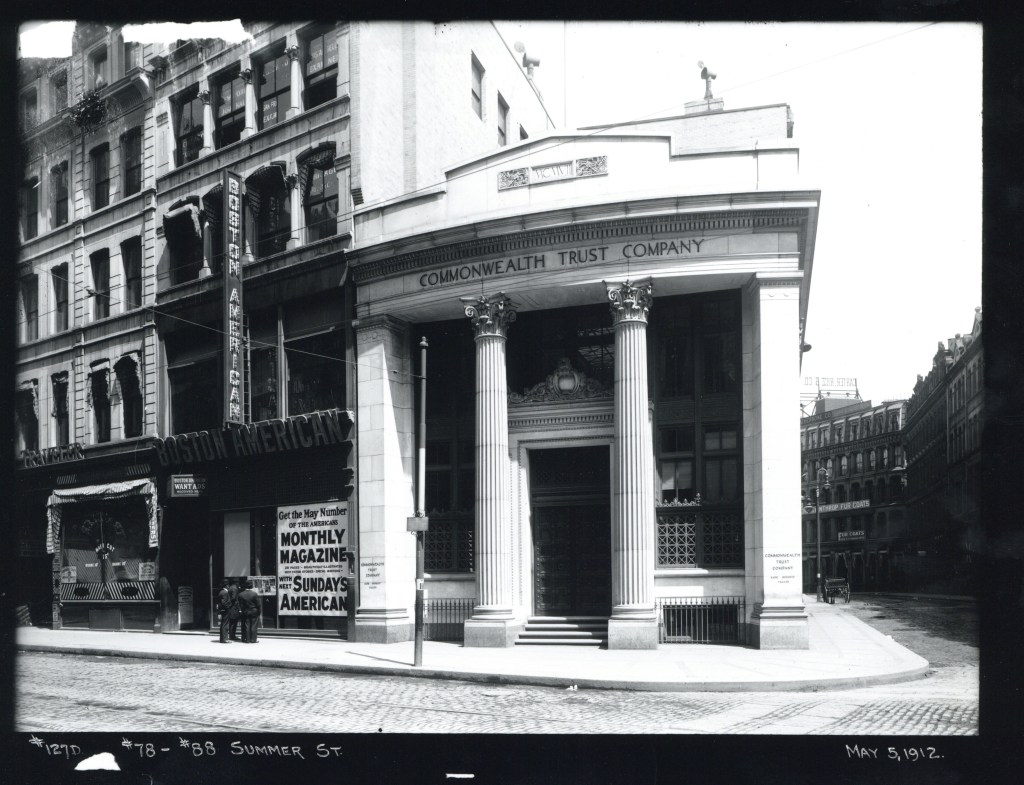
Located at the corner of Summer and Devonshire Streets in Downtown Boston, the Commonwealth Trust Company’s two-story marble banking house commanded the corner, despite its short stature. The building, completed in 1908, was constructed with Lee marble and decorated with ornate wrought and cast-iron grilles over windows. The building was designed by the architectural firm of Parker, Thomas & Rice in the Classical mode with large, fluted Corinthian columns and boxed corner pilasters framing the recessed center entrance, Corinthian pilasters ran along the side facade. At the inside, the building was coated with Cararra and Blanco marble with paneled oak offices. At the ground floor, offices and banking stations framed the outer walls, with the safety deposit boxes located on the second floor. The building was demolished by the 1970s and replaced with a one-story minimalist Modern building (I could not figure out why the former building was razed). The new building was demolished after a few decades with a larger building, better fitting the commercial district.

 Buildings of New England
